Doorbell Not Working: Bell Push, Ding Dong and Wiring Checks

A doorbell not working nearly always comes down to one of three parts: the supply, the bell push at the door, or the bell unit inside. Below we take a ding dong bell not ringing, a bell push problem, a musical bell that cuts off, a bell that rings by itself and a wireless bell that has gone silent, in the order an electrician would check them, with safe first steps and the MRPs of the bells and pushes we make in Mumbai.
Key takeaways
- Check order — MCB or switch, then the push, then the cable, then the bell unit.
- Bell push — loose, sticky, rusty or wet pushes are the most common fault; replace like a switch, MCB off.
- Hums, no chime — a ding dong plunger is stuck; the push and cable are fine.
- Rings by itself — stuck or wet push, or a cable fault; switch off at the MCB.
- Our MRPs — bell pushes from ₹30, ding dong bells from ₹195, musical bells ₹235 to ₹310.
Doorbell not working: the short answer
A wired doorbell is a small circuit with three parts: a supply from the house wiring, a bell push at the door that closes the circuit while it is pressed, and the bell unit inside the home that rings or plays a tune. When the bell goes quiet, one of those three has stopped doing its job, or the cable between them has.
The good news is that the order of checks is short, and the first ones need no tools. Is anything else on that circuit dead? Does the push feel normal, or loose, sticky or wet? Does the bell make any sound at all, a hum, a click, half a tune? Each answer points to a different part.
This guide takes a doorbell not working through those checks in order, then covers the special cases: a ding dong bell that hums but will not ring, a musical bell that plays wrong, a bell that rings by itself, and a wireless bell that stopped. Anything past the visible checks is work for a licensed electrician. For choosing a new bell and where to fit it, see our door bell for home guide.
Why is my doorbell not ringing?
A doorbell usually stops ringing because the circuit’s MCB has tripped or been switched off, a wire at the bell push has worked loose, the push itself is worn, stuck or wet, the cable between push and bell is damaged, or the bell unit has failed; checking them in that order finds most faults fastest.
From easiest to hardest:
1. MCB or switch off 2. Push loose or worn 3. Push wet or rusty 4. Cable damaged 5. Bell unit failed
Start at the board. A bell often shares a lighting circuit, so if the lights in the passage are dead too, the MCB has tripped; our guide to an MCB tripping again and again covers why. If everything else works, move to the push.
A doorbell runs on mains voltage in most Indian homes. Do not open the push or the bell with the supply on. Switch off its MCB and let an electrician prove it dead.
| What happens | Likely cause | First step |
|---|---|---|
| Total silence, lights also dead | MCB tripped | Check the board |
| Silence, push feels loose | Loose wire or worn push | MCB off, replace push |
| Hum but no chime | Stuck plunger in bell | Clean or replace bell |
| Half a tune or crackle | Electronics or speaker | Replace musical bell |
| Rings by itself | Stuck or wet push, cable fault | MCB off, call electrician |
| Wireless bell silent | Battery, pairing or range | New battery, re-pair |
How to tell if the bell push is the problem?
The bell push is likely the problem if it feels loose, wobbly or sticky, gives no click or spring when pressed, shows rust or water marks, or makes the bell work only when pressed hard or at an angle; a push that fails these checks is replaced like a switch, with the MCB off.
Signs from the outside:
No spring back Wobbles in the plate Works if pressed hard Rust or green marks Rings when touched lightly
Door pushes live a harder life than any indoor switch: hands, rain, dust and sun. A rain-exposed push is the most common failure point in an otherwise healthy bell circuit.
A bell push is a momentary switch: it closes only while held. Never swap it for an ordinary on/off switch, or the bell will ring until it burns out. Our door bell guide explains why a bell push is not a light switch.
If the push is outdoors, fit a cover or move it under the door canopy when you replace it. It is the cheapest way to stop the same fault next monsoon.
Supply, push and bell; one of them has stopped working.
An outdoor push is the most common failure point.
A humming bell has supply; the fault is inside it.
Most doorbells run on mains; switch off before any work.
Ding dong bell not ringing but humming: why?
A ding dong bell that hums or buzzes but does not chime usually has a plunger stuck in its coil from dust, rust or a bent striker, so the coil is powered but the striker cannot move; a weak or slurred chime points the same way, and the bell unit needs cleaning by a technician or replacing.
A ding dong bell works with an electromagnet: pressing the push energises a coil that throws a plunger against one tone bar, and releasing it lets the plunger spring back to strike the other. What you hear tells you where it sticks:
Hum, no chime plunger stuck.
Ding but no dong return spring weak or striker bent.
Dull clunk tone bar loose or touching the cover.
Hot or burning smell coil overheating.
A humming coil is getting supply, which tells you the push and the cable are fine. The fault is inside the bell. Bells fitted near a kitchen or a dusty road clog faster.
A bell unit that feels hot, smells of burning or hums continuously with no one pressing the push must be switched off at the MCB and checked.
Musical doorbell playing wrong or cutting off: what is the cause?
A musical doorbell that plays half a tune, plays slowly, sounds distorted or cuts off usually has a failing electronic board or speaker inside, often from heat, moisture or a voltage surge, though a push that bounces open and closed can also restart the tune; a technician can tell which in a few minutes.
Common patterns:
Tune restarts push contacts bouncing.
Low or crackly sound speaker or board failing.
Plays on its own damp push or cable fault.
Silent after a storm surge damage to the board.
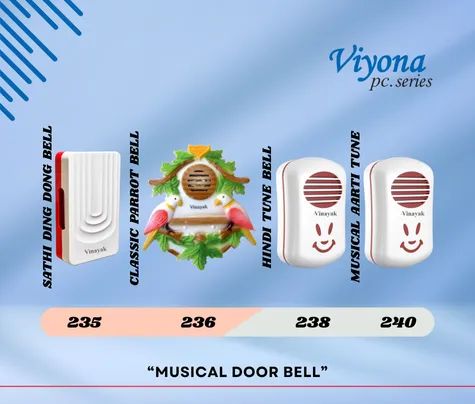
A musical bell has no plunger to free up. When its electronics fail, replacement is usually cheaper than repair. Our musical bells play parrot, English, Hindi and aarti tunes, from ₹235 MRP for the Classic parrot bell to ₹310 for the musical aarti tune smiley bell; see the VIYONA musical door bell page.
Doorbell ringing by itself: what does it mean?
A doorbell that rings by itself, or keeps ringing after the push is released, usually means the push is stuck closed, water has got into the push or the cable joint and is bridging the contacts, or the two cable conductors are touching somewhere along the run; switch it off at the MCB until an electrician finds the cause.
Likely causes:
Stuck push pressed in and not springing back.
Water in the push especially after rain.
Damaged cable pinched by a door frame or nailed through.
Wrong switch fitted an ordinary switch in place of a push.
A bell that rings non-stop also overheats its coil or its electronics, so leaving it running “until it stops” can finish off a healthy bell. If you cannot reach the MCB quickly, switch off at the main.
Water in a mains bell push means the push is live and wet at the door. Keep people from pressing it and switch the circuit off until it is fixed.
Wireless doorbell not working: what to check?
A wireless doorbell that stops working usually has a flat battery in the transmitter at the door, a receiver that has been unplugged, lost its pairing or moved out of range, or a signal blocked by a new steel door, grille or wall; changing the battery and re-pairing as its instructions describe fixes most of them.
The quick list:
Fresh battery Receiver plugged in Re-pair the two Steel door or grille Too far apart
Wireless bells trade a cable for a battery and a radio link. That is convenient in a finished home, but it means the bell can fail silently when the battery runs down. Our door bell guide compares wired and wireless in more detail.
The bells we make are ding dong and musical bells that work with a wired bell push. If a wireless bell keeps failing, a wired bell on a modular push, with the cable run in conduit, is the dependable upgrade.
How to replace a bell push safely?
To replace a bell push safely, switch off the MCB that feeds the bell, prove the push dead with a proper tester, note which wire goes where, remove the old push, connect the two wires to the new push’s terminals, tighten them, refit the plate and test; a licensed electrician should do it if you are unsure.
The steps:
MCB off Prove dead Photo the wiring Swap the push Refit and test
On a modular board, a bell push module is changed exactly like a switch module. Our guide on how to replace a switch in a switch board covers the plate and module steps. Buy a push of the same module size and range so it fits the plate.
A neon line tester that does not glow does not prove a circuit dead. Use a proper tester, or call an electrician.
Bell push problem: which push to buy?
Buy a bell push in the same style as the board it sits on, a modular push for a modular plate, a piano-type push for an older board or a surface push where there is no board, and choose one with an indicator if you want the push easy to find at night; prices start from ₹30 MRP.
MRP of bell pushes we make, by style
MRPs from our current catalogue, bars to scale with ₹135 as the full bar.
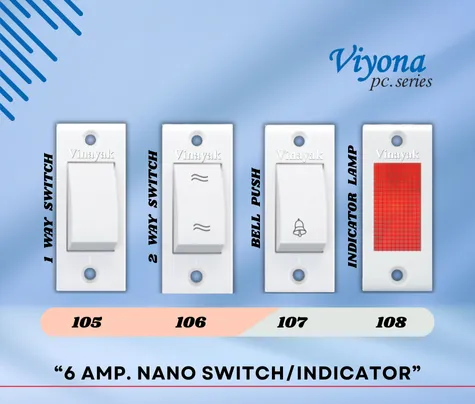
KEMPS K543 is a 10AX bell push in the Orchid modular range at ₹135 MRP. VIYONA 185 is a surface bell push at ₹36 for a push with no board behind it. The VIYONA Nano range includes a bell push and a matching indicator lamp.
When should the bell unit be replaced?
Replace the bell unit when the push and cable check out but the bell stays silent, hums without chiming after cleaning, overheats, smells of burning, or plays a distorted tune, because a new ding dong bell costs from ₹195 MRP, often less than a repair visit to rebuild an old one.
MRP of our ding dong and musical bells
MRPs from our current catalogue, bars to scale with ₹310 as the full bar.
VIYONA 234, the Boss ding dong bell, is our lowest-priced bell at ₹195 MRP. The Classic and Royal ding dong bell page has the full ding dong range. Fitting a new bell is electrician’s work: MCB off first.
How to stop the doorbell failing again?
A doorbell lasts longer when its push is protected from rain, its cable runs concealed or in conduit rather than clipped along a door frame, its bell unit sits away from kitchen grease and dust, and a push that starts to stick is replaced before it jams the circuit closed.
Small habits that help:
Push under cover Cable in conduit Bell in a dry spot Replace sticky pushes
If you need a louder or more insistent signal, for a large house or for an elderly family member, a buzzer may suit better; see our electric buzzer guide. For a patient who needs to call for help from bed, our hospital call bell system guide covers bell indicators. Our full bell range is on the VIYONA door bells page.
Renovating? Put the bell point and push in the wiring drawing with a conduit run to the door, instead of a cable clipped along the frame later.
FAQs
Why has my doorbell suddenly stopped working?
Why does my ding dong bell hum but not ring?
How do I know if my doorbell button is broken?
Why does my doorbell ring on its own?
Can I use a normal switch instead of a bell push?
What is the price of a new ding dong bell?
Why buyers choose Vinayak Electricals
- Ding dong and musical door bells made at our works in Marol, Andheri East, Mumbai.
- Bell pushes in VIYONA, KEMPS and VIZA, from piano-type to modular, from ₹30 MRP.
- Matching indicator lamps and bell indicators from the same catalogue.
- Manufacturing since 1995; ISO 9001:2015 certified.
- MRPs published openly.
- 500+ dealers with delivery across India.
A new bell or bell push
See our ding dong and musical door bells, with MRPs, and buy through a dealer near you.
View VIYONA door bells