MCB working principle: how an MCB trips, and fuse vs MCB
The MCB working principle rests on two effects of current, heat and magnetism. A bimetal strip bends when an overload heats it, and a magnetic coil snaps the contacts open in a short circuit. Below we draw an MCB from the inside, explain overload vs short circuit, trip curves, 10 kA and poles, then compare a kit kat fuse with an MCB using the MRPs of the ones we make in Mumbai.
Key takeaways
- Overload — the bimetal strip heats, bends and trips the latch: slow, seconds to minutes.
- Short circuit — the magnetic coil pulls its plunger and opens the contacts almost instantly.
- 10 kA — the largest fault current the MCB is rated to break; our VIYONA 401 to 433 range is 10 kA.
- Fuse vs MCB — a fuse melts and is rewired, an MCB trips and resets. Our 10 A kit kat fuse is ₹60 MRP, our 10 kA single pole MCB ₹145.
- ⚠ Not an RCCB — an MCB does not protect against shock from earth leakage. We do not make RCCBs.
MCB working principle: the short answer
An MCB (miniature circuit breaker) is an automatic switch that protects the wiring of one circuit. The MCB working principle uses two effects of electric current. The heating effect bends a bimetal strip when the circuit carries too much current for too long, which is an overload. The magnetic effect pulls a plunger into a coil when a very large current flows suddenly, which is a short circuit. Either one releases a spring-loaded latch, the contacts fly apart and the circuit is cut off.
We make MCBs, isolators and MCB boxes in our VIYONA range, and KEMPS TinyTrip modular MCBs for switch boards, at our works in Mumbai. Fitting or changing an MCB on a live installation is a job for a licensed electrician.
What is MCB and how does it work?
An MCB is a resettable switch fitted in the phase of each circuit in the distribution board, and it works by passing the circuit’s current through a coil, a pair of contacts and a bimetal strip in series, so that too much current either heats the strip or magnetises the coil enough to trip it open.
Follow the current through a working MCB:
- Line in The phase from the supply enters at the top terminal.
- Coil It flows through the turns of the magnetic coil.
- Contacts It crosses the closed fixed and moving contacts.
- Bimetal It flows through the bimetal strip.
- Load out It leaves from the bottom terminal to the circuit.
On a normal day the current stays within the rating printed on the face, such as 16 A, and nothing moves.
The toggle on the front is the handle you use to switch the MCB on and off by hand. When the MCB trips, the toggle drops to OFF by itself.
A single pole MCB belongs in the phase. One fitted in the neutral still trips, but it leaves the wiring and the appliance live while it is off. Our phase, neutral and earth guide shows how to tell them apart.
| Kit kat (rewireable) fuse | MCB | |
|---|---|---|
| What reacts to a fault | Fuse wire melts | Bimetal strip or magnetic coil trips a latch |
| After a fault | Rewire or replace the fuse | Fix the cause, push the toggle up |
| Overload and short circuit | Both, if the correct fuse wire is fitted | Both, by separate thermal and magnetic trips |
| Works as an on/off switch | No, the carrier is pulled out | Yes, by the toggle |
| Can be up-rated by mistake | Yes, with thicker wire | No, the trip level is set in the factory |
| Shows which circuit tripped | Only by pulling each carrier | Toggle drops to OFF |
| Our example (MRP) | VIYONA 131 10 A kit kat fuse, ₹60 | VIYONA 401 10 kA SP MCB, 6 to 32 A, ₹145 |
What are the parts of an MCB?
An MCB has six working parts: two terminals for line and load, a magnetic coil with a plunger for short circuits, a bimetal strip for overloads, a pair of contacts that open the circuit, an arc chute that puts out the spark, and a toggle with a latch that holds the contacts shut until a trip.
MCB working principle diagram: the parts inside
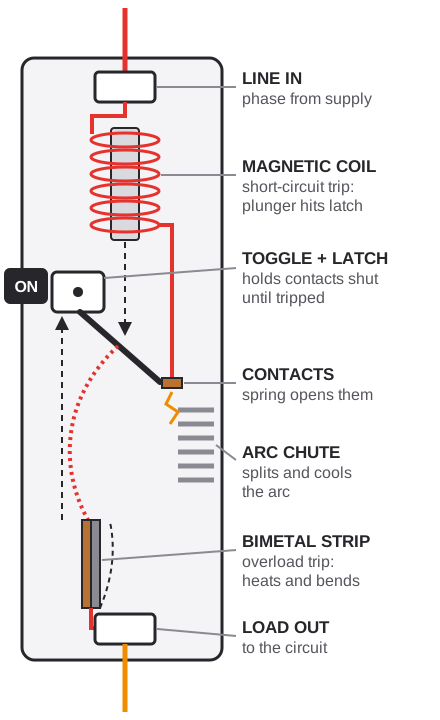
Drawn by us, simplified. Red is the current path; the dashed arrows show the plunger and the bimetal pushing the latch. Layouts differ between makers. Tap the diagram to open it full size.
Bimetal strip Two bonded metals that expand differently, so it bends when heated. Magnetic coil Turns of wire around an iron plunger: an electromagnet, or solenoid. Latch A catch holding the spring-loaded contacts shut. Arc chute Metal plates that split and cool the spark.
Never open an MCB. One that has been opened, dropped or scorched is replaced, not repaired.
Bends with heat and trips the MCB on overload.
Pulls its plunger and trips the MCB on a short circuit.
Splits and cools the spark as the contacts open.
Hold the contacts shut, drop to OFF on a trip, reset by hand.
How does an MCB work on overload?
On overload an MCB works by the heating effect of current: a current somewhat above the rating flows through the bimetal strip, the strip warms, one metal expands more than the other, the strip bends and pushes the trip bar, the latch lets go and the spring throws the contacts open.
An overload means a healthy circuit asked to carry more than it was designed for, such as a geyser, an iron and a heater on one 16 A socket circuit.
The bigger the overload, the faster the strip bends. This is an inverse-time trip: a small overload can take many minutes, a large one seconds. The test points commonly taught from IS/IEC 60898-1, the standard our 10 kA MCBs are made to, are that at 1.13 × rating the MCB must not trip within one hour, and at 1.45 × rating it must trip within one hour.
After a thermal trip the strip needs to cool before the toggle will stay up. Repeated trips after a few minutes mean overload; see our guide to an MCB tripping again and again.
Never fit a bigger MCB to stop overload trips. The cable behind it is the same size, and it overheats inside the wall before the larger breaker reacts.
How does an MCB work in short circuit?
In a short circuit an MCB works by the magnetic effect of current: the fault current, many times the rating, flows through the coil and turns it into a strong electromagnet that pulls the plunger in a fraction of a second, which knocks the latch free and forces the contacts apart.
A short circuit is a phase wire touching neutral or earth directly, with almost nothing in between to limit the current. Hundreds or thousands of amps try to flow.
This is the same magnetic effect of current you met in physics: current through a coil makes a magnetic field, and the field grows with the current. Above the trip level the plunger is pulled in at once.
As the contacts part, the current jumps the gap as an arc. The arc is driven into the arc chute, where the plates split it into several short arcs and cool it until it goes out.
An MCB that trips instantly and will not stay on is reporting a fault. Leave it off and call a licensed electrician; never hold the toggle up or tape it in place.
Short circuit and overloading: what is the difference?
The difference between short circuit and overloading is the size and the cause of the current: overloading is a healthy circuit carrying somewhat more than its rating because too much is plugged in, while a short circuit is a fault where phase meets neutral or earth and the current jumps to many times the rating.
Overload vs short circuit at a glance
Overload: A little above rating Too many appliances Bimetal: slow trip Fix: spread the load
Short circuit: Many times the rating Damaged insulation or a loose strand Coil: instant trip Fix: find the fault
General practice, not a test result.
“Short circuit and overload protection” is exactly what an MCB is for, and that is why its rating follows the cable, not the appliance; how a cable is laid changes its rating, as our types of wiring system guide shows. As common practice, lighting circuits take 6 A or 10 A and socket circuits 16 A; our which MCB for home guide goes circuit by circuit, and your electrician sets each one.
Earth leakage is a third kind of fault and neither of these. The small current that leaks through a person is far below any MCB rating, which is why a home also needs an RCCB.
What do B, C and D trip curves mean?
A trip curve, written as a letter before the rating such as B16 or C16, tells you at what multiple of its rating the MCB’s magnetic trip fires instantly: under IS/IEC 60898-1, a B curve between 3 and 5 times, a C curve between 5 and 10 times and a D curve between 10 and 20 times.
How an MCB trips: thermal zone, magnetic zone and the B, C, D bands
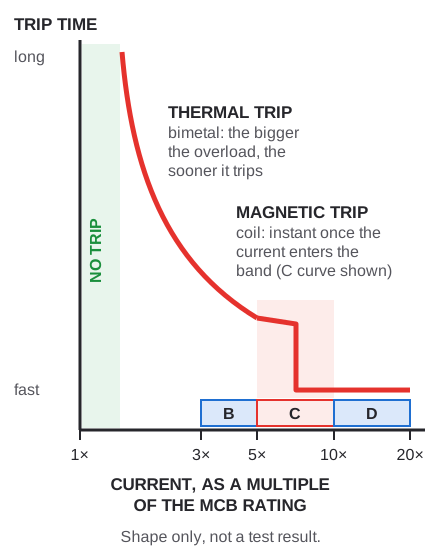
Drawn by us to show the shape only, with a C curve as the example; it is not a test result for any MCB. The bands are the IS/IEC 60898-1 multiples of rated current. Tap the diagram to open it full size.
The thermal part works the same way on all three. What moves is the magnetic band. A B curve trips on the smallest surge and commonly suits lighting and heaters. A C curve rides through the start-up surge of motors, pumps and compressors. A D curve is for heavy-inrush loads and is rare in homes.
For a 16 A rating, the B band is 48 to 80 A and the C band 80 to 160 A.
Our catalogue does not state a trip curve for our MCBs, so we do not claim one here. Check the marking on the device or ask your dealer, and match it to what your electrician specified.
What does 10 kA breaking capacity mean?
10 kA breaking capacity means the MCB is rated to safely interrupt a short-circuit current of up to 10,000 amps, which matters because a fault close to the supply can push thousands of amps for a moment, and a breaker that cannot clear it may weld its contacts shut or break apart.
Two numbers on the face do different jobs. The rating, such as 16 A, decides when it trips on overload. The breaking capacity decides the worst fault it can clear. Household MCBs are sold with breaking capacities such as 4.5 kA, 6 kA and 10 kA; your electrician checks the figure against the fault current possible at that board.
Every MCB in our VIYONA 10 kA range, codes 401 to 433, is made to IS/IEC 60898-1 under BIS licence CM/L-2544151, as printed in our catalogue. See the 10 kA breaking capacity MCB page and our MCB manufacturer in Mumbai page.
Check the kA figure printed on the device itself, not just on the box.
SP, DP, TP and FP: what do MCB poles mean?
MCB poles are the number of lines an MCB switches together: a single pole (SP) breaks only the phase, a double pole (DP) breaks phase and neutral, a three pole (TP) breaks the three phases of a 3 phase supply, and a four pole (FP) breaks the three phases and the neutral.
Each pole has its own trip parts, and the poles are tied by a common trip bar, so a fault on one pole opens them all. In a single phase home, circuits are commonly SP and the main switch DP, so the whole board can be cut on phase and neutral together. A three phase supply uses TP, or FP where the neutral is switched too.
MRP of our 63 A 10 kA MCB by number of poles
VIYONA MRPs from our current catalogue, bars to scale with ₹1,035 as the full bar.
Pole count follows the supply, not the size of the house. Our isolator vs MCB guide covers the main switch, and our 40 A and 63 A isolators start at ₹230 MRP for the 442.
Two single pole MCBs side by side are not a double pole MCB: without the common trip bar, one can trip alone.
Fuse and MCB difference: which is better?
The difference between a fuse and an MCB is what happens after a fault: a fuse protects by melting a thin wire that must then be rewired or replaced, while an MCB protects by tripping a mechanism that you reset with its toggle, and it also works as an on/off switch for the circuit.
A rewireable fuse, commonly called a kit kat fuse in India, holds a short length of fuse wire between two contacts in a removable carrier. Too much current heats the wire until it melts and breaks the circuit.
Fuse vs MCB: MRP of the ones we make
Catalogue MRPs, bars to scale against ₹350. 131, 132 and 133 are VIYONA; V1259 is a VIZA modular fuse; K225 is KEMPS (white).
The fuse is cheaper to buy. The MCB resets in seconds, shows which circuit tripped and cannot be up-rated with thicker wire. In new wiring the MCB is the standard choice.
Fuse wire and MCB: why are fuses being replaced?
Fuse wire is being replaced by MCBs mainly because a fuse is only as good as the wire someone last fitted: a blown fuse is often rewired with a thicker strand, or even a nail, which lifts its rating far above what the cable can carry, while an MCB’s trip level is fixed in the factory.
Other weak points of the rewireable fuse: a blown fuse cannot be seen without pulling each carrier, and a fuse placed in the neutral, a mistake found in some old boards, leaves the circuit live after it blows.
The fuse still has honest strengths: low cost and no moving parts. When an old fuse board is upgraded, the electrician typically fits a modular MCB in the switch board, such as our KEMPS TinyTrip modular MCB, or 10 kA MCBs in a box such as our SPN white line MCB box (₹380 MRP for 2 to 4 way).
Never repair a fuse with thicker wire, strands pulled from a cable or any metal that is not fuse wire of the correct rating. It turns the fuse into a plain link and leaves the cable with no protection.
Is an MCB the same as an RCCB?
No, an MCB is not the same as an RCCB: an MCB trips on overload and short circuit to protect the wiring, while an RCCB (residual current circuit breaker) trips when current leaks to earth, for example through a person, which is the protection against electric shock that an MCB cannot give.
An RCCB compares the current going out on the phase with the current coming back on the neutral. If some is missing, it is leaking to earth, and the RCCB trips at a leakage measured in milliamps; a 30 mA RCCB is common practice for protecting people. A 16 A MCB cannot see a leak of a few milliamps.
We do not make RCCBs. Fit one where your electrician advises. Before any work, the MCB goes off and the circuit is tested dead with a tester or multimeter. A line tester such as our VIYONA line tester (₹36 MRP for the 811) shows that phase is present, but no glow does not prove a circuit dead.
MCBs alone protect against overload and short circuit, not against shock.
MCB kaise kaam karta hai? The working principle in Hindi terms
In simple words, an MCB works in two ways: on overload (zyada load) the bimetal strip (bimetal patti) heats up and bends until it trips the latch, and on a short circuit the coil’s magnetic force (chumbakiya bal) pulls the plunger and opens the contacts at once (turant).
The words you will hear on site: MCB = Miniature Circuit Breaker trip = MCB gir gaya overload = zyada load short circuit = phase and neutral touching.
Looking for an MCB working principle animation? Read these five steps with the cut-away diagram above; it is the same sequence an animation shows.
- On: the toggle is up and the latch holds the contacts shut against a spring.
- Overload: the bimetal warms over seconds or minutes, bends and pushes the trip bar.
- Short circuit: the coil pulls its plunger in a fraction of a second and hits the latch.
- Arc: the contacts spring apart and the arc chute splits and cools the spark.
- Reset: with the fault fixed, push the toggle up to re-latch the contacts.
A breaker that trips again at once on reset has a fault on its circuit: stop and call a licensed electrician.
Exam tip: write “thermal for overload, magnetic for short circuit” and sketch the six parts.
FAQs
How does an MCB work?
MCB kaise kaam karta hai?
Fuse aur MCB mein kya antar hai?
What is the difference between short circuit and overloading?
Which trip curve are Vinayak MCBs?
Does an MCB protect against electric shock?
Why buyers choose Vinayak Electricals
- MCBs, isolators and MCB boxes made at our own works in Mumbai.
- VIYONA MCBs from 6 A to 63 A, single to four pole, with 10 kA breaking capacity (codes 401 to 433).
- Made to IS/IEC 60898-1 under BIS licence CM/L-2544151, as printed in our catalogue.
- Kit kat fuses (131, 132), the VIZA V1259 modular kit kat fuse and KEMPS TinyTrip modular MCBs for switch boards.
- 40 A and 63 A isolators, SPN boxes and double door distribution boards from the same catalogue.
- MRPs published openly; sold through dealers across India, in full boxes. Manufacturing in Mumbai since 1995.
MCBs, isolators and MCB boxes
See codes, poles and MRPs for our VIYONA 10 kA MCBs and isolators, then order through a dealer or call us.
View VIYONA MCBs