Single phase vs three phase: which connection does your home need?
Single phase vs three phase decides how much power your home can draw. Single phase brings one phase and a neutral at 230 V; three phase brings three phases and a neutral, 230 V to neutral and about 400 V between phases. Below we explain the single phase vs three phase difference, when a home needs a 3 phase connection, how loads are split in the board, what sanctioned load on your bill means, and kW vs kVA.
Key takeaways
- Single phase — one phase plus neutral at 230 V; enough for most flats and small homes.
- Three phase — R, Y, B plus neutral: 230 V phase to neutral, about 400 V between phases.
- When to switch — several ACs, an instant geyser, a three phase motor, or your supply company’s load limit.
- Sanctioned load — the kW or kVA your supply company agreed to supply; printed on your bill.
- kW vs kVA — kW = kVA × power factor; single phase kVA = V × A ÷ 1,000.
Single phase vs three phase: the short answer
Single phase vs three phase is about how many live wires bring power into your home: a single phase connection has one phase and a neutral at 230 V, while a three phase connection has three phases and a neutral, with about 400 V between any two phases, so it can carry roughly three times the power.
Most flats and small homes in India run happily on single phase. Three phase becomes worth it when the total load gets large: several air conditioners, an instant geyser, a lift or a pump with a three phase motor. In many states the supply company also asks for three phase once the load you apply for passes a limit in its supply code.
Below we explain the difference, when a home needs a 3 phase connection, how loads are split across phases in the distribution board, what sanctioned load means on your electricity bill, and kW vs kVA with the formula. We make the MCBs, isolators and distribution boards that sit at the heart of both kinds of connection, at our works in Mumbai; the meter, the service cable and the connection itself come from your supply company.
What is the difference between single phase and three phase electricity?
The difference between single phase and three phase electricity is the number of live conductors: single phase uses one phase and a neutral at 230 V, while three phase uses three phases, called R, Y and B, each 230 V to neutral and about 400 V to each other, peaking one after another a third of a cycle apart.
Single phase vs three phase supply into a home DB
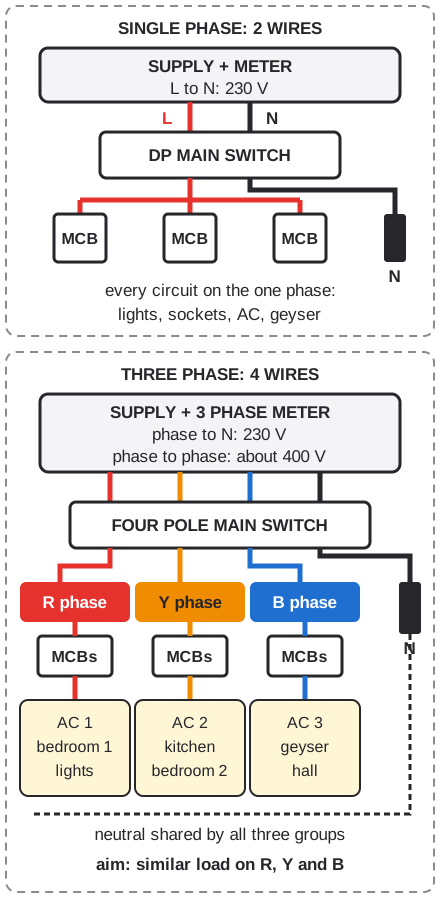
Drawn by us, simplified: earth wiring is not shown. Phase colours follow the older Indian red, yellow and blue code; newer wiring uses brown, black and grey. Tap the diagram to open it full size.
Because the three phases peak at different moments, the total power flows more smoothly, which is why three phase motors start and run without a capacitor. Each phase on its own is still an ordinary 230 V supply for lights, fans and sockets. Between two phases it is about 400 V; older books say 415 V.
A three phase home is not a 400 V home. Every single phase appliance is connected between one phase and neutral, exactly as in a single phase house. Our phase, neutral and earth guide explains the wires themselves.
| Point | Single phase | Three phase |
|---|---|---|
| Live wires | One phase plus neutral | Three phases (R, Y, B) plus neutral |
| Voltage | 230 V phase to neutral | 230 V phase to neutral, about 400 V phase to phase |
| Service cable | Two core | Four core |
| Main switch | Double pole (DP) | Four pole (FP) |
| Distribution board | SPN | TPN |
| Suits | Flats and smaller homes | Large homes, several ACs, three phase motors |
| Our example main (MRP) | VIYONA 442 DP isolator 40 A, ₹230 | VIYONA 461 FP isolator 40 A, ₹480 |
Single phase vs three phase connection: what changes at the meter and DB?
A three phase connection changes three things at your end: the service cable has four conductors instead of two, the meter is a three phase meter, and the distribution board becomes a TPN board with a four pole main switch and a separate row of MCBs for each phase, all sharing one neutral bar.
TPN stands for triple pole and neutral: three phase busbars plus a neutral bar. A single phase board is SPN, single pole and neutral. The main switch changes from a double pole (DP) isolator or MCB to a four pole (FP) one, so all three phases and the neutral switch off together.
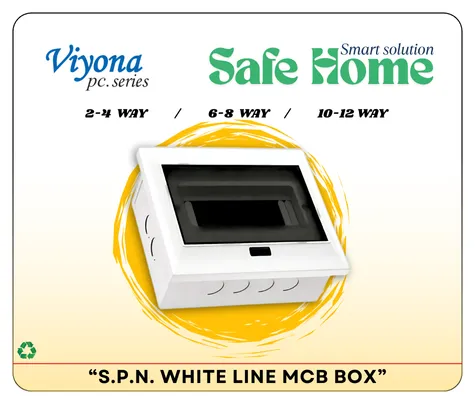
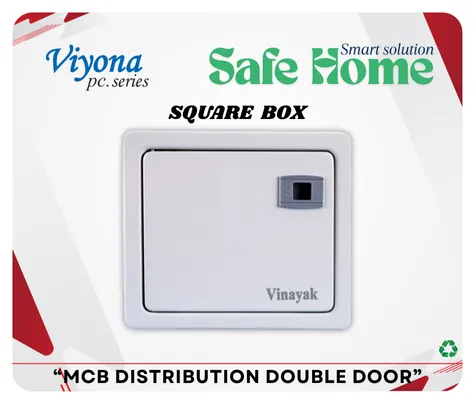
We make both. For single phase, our VIYONA SPN white line MCB box starts at ₹380 for the 2 to 4 way 371. For three phase, our double door distribution boards include the 387 4 way TPN at ₹2,620, the 388 6 way at ₹3,050 and the 389 8 way at ₹3,350 MRP. Our MCB box size list helps count the ways.
Only your supply company changes the connection, the service cable and the meter. Inside the house, the board work is for a licensed electrician, with the main off.
Two at the meter is single phase; four is three phase.
Spread ACs and heavy loads so R, Y and B carry similar current.
Sanctioned load and supply type are printed with your consumer details.
kVA is what the supply delivers; kW is what does the work.
When does a home need a 3 phase connection?
A home typically needs a 3 phase connection when its total load is too large for one phase to carry comfortably, such as a house with three or more air conditioners, an instant geyser and an induction cooktop, or when it has a three phase motor for a lift or pump, or when the supply company’s rules require it.
Typical running watts of common home loads
Typical ranges, not measurements of any one model; bars to scale against 3,000 W, rounded. The rating plate or BEE star label on your appliance is the real figure. The LED lamp is our 9 W 1065.
Add them up. An example home with three 1.5 ton ACs (about 4,500 W), a storage geyser, an induction cooktop, an iron, a fridge and about 500 W of lights and fans comes to roughly 10,200 W if everything ran at once. On single phase that is about 44 A (10,200 ÷ 230). Split evenly over three phases it is about 15 A per phase.
Nobody runs everything at once, so the real peak is lower. Your electrician and the supply company decide from the full list.
3 phase connection for home: how are loads split across phases?
In a three phase home the electrician spreads the circuits across the R, Y and B phases so that each carries a similar share of the load, usually by giving each phase its own group of single pole MCBs and putting the heaviest loads, such as each air conditioner, on different phases.
The aim is balance. If every AC sits on the R phase, that phase overloads while Y and B idle, and the shared neutral carries the difference. A common split is one AC per phase, the geyser and kitchen on different phases, and lights and sockets spread room by room.
Many electricians keep the points of one room on one phase, so that two sockets within reach of each other never have 400 V between them. A three phase motor, such as some lifts and larger pumps, needs all three phases through a triple pole MCB; our VIYONA 422 40 A triple pole MCB is ₹655 and the 423 63 A ₹815 MRP.
Phase failure is easy to spot in a balanced house: if one phase drops, only the rooms on that phase go dark. Do not move circuits between phases yourself to restore them; call your electrician.
Sanctioned load meaning: what is sanctioned load?
Sanctioned load is the maximum load, in kilowatts (kW) or kilovolt-amperes (kVA), that your supply company has agreed to supply to your connection, as recorded when the connection was given or last revised, while connected load is the total rating of all the appliances and points actually installed in your home.
Three terms get mixed up. Sanctioned load is what the supply company agreed to. Connected load is the sum of the ratings of everything wired in. Maximum demand is the highest load you actually draw over a short period, which some meters record.
In Hindi bills, sanctioned load usually appears as svikrit bhaar (स्वीकृत भार), literally “approved load”. Some bills use contract demand for the same idea, especially where it is expressed in kVA.
Connected load is often higher than the load you actually draw, because nobody runs every appliance at once. Whether your connected load may exceed the sanctioned figure depends on your state: some supply codes assess it from the appliances wired in, others from the maximum demand the meter records. If your load keeps going past what was sanctioned, supply companies ask customers to apply for an increase.
How sanctioned load is counted, and what happens when you exceed it, is set by each state’s regulator and supply company. Check your own supply company’s rules.
Sanctioned load in electricity bill: where is it and why does it matter?
Sanctioned load is printed on most electricity bills in the customer details near your consumer number, as a figure in kW or kVA, and it matters because in many tariffs the fixed or demand charge on each bill depends on it, and because a load well above it can lead to a penalty or a demand to apply for more.
Look for a line such as Sanctioned load, Connected load or Contract demand, with the supply type (single or three phase) beside it. The fixed charge is usually a separate line from the energy charge for units used.
To check whether yours fits, list your appliances with their rated watts, add them, and compare with what is sanctioned. A 1.5 ton AC alone typically draws about 1.5 kW at full cooling, so a home sanctioned for a small load that adds two ACs may need a revision.
Tariffs, fixed charges and the process differ by state and change from year to year, so we do not quote them. Use the slabs and charges printed on your own bill. Our electricity bill calculation guide shows how units become rupees.
Applying for a higher sanctioned load, or for three phase, goes through your supply company, usually with a load list and a test report from a licensed electrical contractor.
kW vs kVA: what is the difference?
kW, kilowatt, is real power, the part that actually does work such as heating, lighting or turning a motor, while kVA, kilovolt-ampere, is apparent power, simply volts times amps, and the two are linked by the power factor: kW equals kVA multiplied by the power factor, which is 1 or less.
Power factor (PF) tells you how much of the current flowing is doing useful work. A heater or a geyser element is close to PF 1, so its kW and kVA are about the same. Motors, compressors and some electronics draw current that is partly out of step with the voltage, so their PF is lower, such as 0.8, and they need more kVA for the same kW.
That is why cables, MCBs, transformers and inverters are rated by current or kVA, not kW: the wire heats with the total current, whether or not all of it is doing work.
In simple Hindi terms: kW = asli kaam ki power, kVA = kul power, and PF = kitna kaam mein laga. The same idea in English: kVA is what the supply delivers, kW is what you use.
Some bills charge on kVA or kVAh and some on kW or kWh, depending on the category. Read the unit printed on yours.
kW vs kVA formula, with worked examples
The kW vs kVA formula is kW = kVA × power factor; for single phase, kVA = volts × amps ÷ 1,000, and for three phase, kVA = 1.732 × line volts × amps ÷ 1,000, where 1.732 is the square root of 3 and line volts are the roughly 400 V measured between two phases.
Single phase: a 32 A circuit at 230 V carries 230 × 32 = 7,360 VA, which is 7.36 kVA. At a power factor of 0.8 that is 7.36 × 0.8 = 5.89 kW.
Three phase: 32 A on each phase at 400 V gives 1.732 × 400 × 32 = 22,170 VA, about 22.2 kVA. That is close to three single phases of 7.36 kVA each, as it should be.
Back to amps: a 4.4 kW three phase load at PF 0.8 draws about 4,400 ÷ (1.732 × 400 × 0.8) = 8 A per phase.
These are worked examples of the arithmetic. Cable sizes and MCB ratings come from your electrician, who also allows for how the cable is laid.
Which MCBs and isolators does a 3 phase home need?
A three phase home typically needs a four pole main switch, either an isolator or a four pole MCB, a TPN distribution board, and single pole MCBs for each circuit on each phase, plus a triple pole MCB for any three phase motor; a single phase home needs a double pole main and single pole circuit MCBs.
From our VIYONA range, as printed in our catalogue: four pole isolators 461 (40 A) at ₹480 and 462 (63 A) at ₹530; four pole 10 kA MCBs 432 (40 A) at ₹855 and 433 (63 A) at ₹1,035; and single pole 10 kA MCBs 401 (6 to 32 A) at ₹145, all in our 10 kA MCB range. For single phase, the 442 40 A double pole isolator is ₹230.
Count the ways How many single pole MCBs a TPN board holds on each phase depends on the board, so confirm the count with your dealer or electrician against your circuit list before buying.
An isolator switches but does not trip. See isolator vs MCB before choosing the main.
3 phase connection for home cost: what do you pay for?
The cost of a 3 phase connection for a home has two parts: the supply company’s charges for the connection, meter and any load increase, which differ by state and are not quoted here, and your own wiring side, which covers a TPN board, a four pole main, MCBs per phase and any rewiring to split circuits.
On your side, the board parts are the ones listed above: for example our 387 4 way TPN board at ₹2,620 MRP and a 461 four pole isolator at ₹480, where a single phase home uses an SPN box from ₹380 and a 442 double pole isolator at ₹230. The single pole MCBs are the same ₹145 each either way. Add the four core service cable from the meter, labour, and any rewiring needed to move circuits onto the new phases.
Ask your supply company for its current schedule of charges and the documents it needs, usually a load list and a test report from a licensed electrical contractor. Ask your electrician for a written quote for the board side.
Three phase does not lower your bill by itself. You pay for the units you use; the change gives headroom for a larger load, not cheaper electricity.
Is three phase more dangerous than single phase at home?
Three phase is not dangerous when it is installed and balanced correctly, but it carries two extra risks: about 400 V exists between any two phases, and a broken shared neutral can push some circuits well above 230 V and damage appliances, so a three phase board needs careful layout and tight neutral connections.
400 V between phases is a more severe shock than 230 V. Keeping each room on one phase keeps that voltage out of reach.
A loose or broken neutral in a three phase supply is worse than in single phase. With the neutral open and the phases unequally loaded, the voltage on the lightly loaded phase can rise towards 400 V. Signs include lamps that glow very bright in one part of the house while another dims.
Protect against both with tight neutral joints, a sound earth (see our types of earthing guide) and an RCCB where your electrician advises. We do not make RCCBs.
If lights in part of the house suddenly glow much brighter or appliances fail together, switch off the main at once and call a licensed electrician.
FAQs
What is the difference between single phase and three phase?
Ghar mein 3 phase connection kab lena chahiye?
Sanctioned load ka matlab kya hai?
kW aur kVA mein kya fark hai?
How do you convert kVA to kW?
Does a three phase connection reduce my electricity bill?
Why buyers choose Vinayak Electricals
- VIYONA 10 kA MCBs from single to four pole, codes 401 to 433, made to IS/IEC 60898-1 under BIS licence CM/L-2544151.
- Double, triple and four pole isolators, 40 A and 63 A, from ₹230 MRP.
- TPN double door distribution boards in 4, 6 and 8 way, and SPN boxes from 2 to 18 way.
- Made at our works in Mumbai since 1995; ISO 9001:2015 certified.
- MRPs published openly in our catalogue.
- All-India delivery through our dealers, in full boxes.
MCBs, isolators and TPN boards
See our VIYONA MCB range and distribution boards, then order through a dealer or call us.
View VIYONA MCBs