Single Pole or Double Pole MCB: Which Circuits Need a DP Breaker

Single pole vs double pole MCB is about how many wires the breaker cuts: a single pole (SP) MCB protects and switches the phase only, while a double pole (DP) MCB protects and switches phase and neutral together. Below we cover SP vs DP MCB differences, what an SPN MCB is, when to use a DP MCB, prices, board space and wiring, with the MRPs of the MCBs we make in Mumbai.
Key takeaways
- SP MCB — protects and cuts the phase only; standard for lights, fans and socket circuits under a DP main.
- DP MCB — protects and cuts phase and neutral together; used as the main switch and on ACs, pumps and sub-boards.
- SPN — one protected pole plus a switched neutral; isolates both wires but trips on the phase only.
- Never two SPs for a DP — without a common trip, one pole can open alone; never put an SP in the neutral.
- Our MRPs — VIYONA 10 kA single pole 6A to 32A ₹145; double pole 6A to 32A ₹350.
Single pole vs double pole MCB: the short answer
Single pole vs double pole MCB is a question of how many wires the breaker cuts. A single pole (SP) MCB protects and switches the phase only. A double pole (DP) MCB protects and switches the phase and the neutral together, so when it is off, or when it trips, nothing in the circuit is left connected to the supply.
In a typical single phase home both are used. The main switch is double pole, so the whole board can be cut on both wires. The individual circuits for lights, fans and sockets are usually single pole, because the DP main above them already gives a way to isolate the neutral. Heavy dedicated circuits, such as an AC, a pump or a supply to a sub-board, often get their own double pole MCB.
We make both, in our VIYONA 10 kA range for the distribution board and as modular Tiny Trip MCBs for a switch board, at our works in Marol, Andheri East, Mumbai. This guide covers the difference, SPN breakers, where DP is worth paying for, prices, and the wiring mistakes to avoid.
What is the difference between single pole and double pole MCB?
The difference between a single pole and a double pole MCB is that a single pole MCB has one protected pole and breaks only the phase wire, while a double pole MCB has two poles tied to a common trip and breaks both phase and neutral at once, giving full isolation of the circuit whenever it is off.
What each breaker cuts
SP MCB: Phase: protected, cut Neutral: stays connected 1 module
SPN MCB: Phase: protected, cut Neutral: cut, not protected Usually 2 modules
DP MCB: Phase: protected, cut Neutral: protected, cut 2 modules
A summary of general practice, not a test result. Module widths are the common sizes; check the breaker you buy.
Both trip on overload and short circuit in the same way; the number of poles does not change the rating or the breaking capacity. What it changes is how completely the circuit is dead when the breaker is off. Pole types up to four pole are introduced in our MCB working principle guide.
| Single pole (SP) | Double pole (DP) | |
|---|---|---|
| Wires it cuts | Phase only | Phase and neutral |
| Wires it protects | Phase | Phase and neutral |
| Ways in the box | 1 | 2 |
| Typical use at home | Lights, fans, sockets | Main switch, AC, pump, sub-board |
| Safe if polarity is reversed | No | Yes |
| Our 10 kA MRP, 6A to 32A | ₹145 (401) | ₹350 (411) |
| Our 63A MRP | ₹215 (403) | ₹530 (413) |
What is an SPN MCB?
An SPN MCB, also written 1P+N, is a single pole and neutral breaker: it has a protected pole that trips on overload and short circuit in the phase, plus a neutral pole that opens at the same moment but carries no trip of its own, so it isolates both wires like a DP while protecting only the phase.
In a home with the phase and neutral the right way round, an SPN and a DP give the same practical result: both wires open when the breaker is off or trips. The difference shows when something is wrong, such as a swapped phase and neutral, where only a DP has a trip on both wires.
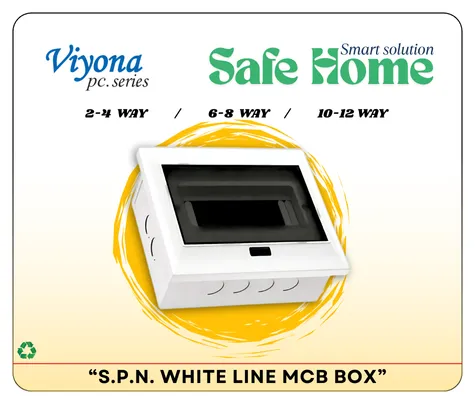
Do not confuse an SPN breaker with an SPN board. An SPN distribution board is a single phase board with a neutral bar, explained in our SPN vs TPN distribution board guide. Our SPN white line MCB box is that kind of board, from ₹380 MRP for 2 to 4 way.
Our catalogue lists single pole and double pole MCBs; it does not list a separate SPN breaker. Where a drawing calls for SPN, ask your electrician whether a DP will do the job.
Standard for light, fan and socket circuits under a DP main.
Cuts phase and neutral together for full isolation.
Two SP breakers side by side are not a DP breaker.
A single pole device goes in the phase, always.
When to use a double pole MCB?
Use a double pole MCB as the main switch of a single phase board, on heavy dedicated circuits such as an AC, pump or geyser where many electricians prefer full isolation, on any supply to a sub-board or outbuilding, and wherever the phase and neutral could be swapped, such as an inverter, a temporary supply or a changeover.
Main incomer AC circuit Water pump Sub-board feed Inverter output Outdoor and terrace EV charging point
The common thread is work at the far end. A technician servicing an AC outdoor unit, a plumber at a pump, or an electrician at a sub-board all want both wires dead with one switch. A single pole breaker leaves the neutral connected, and on a faulty or reversed installation that wire may not be at earth potential.
For the ratings these circuits take, see our MCB for 1, 1.5 and 2 ton AC and MCB for water pump guides; the inverter wiring is in our inverter for home guide.
A DP main switch does not replace the MCBs on each circuit. Every outgoing circuit still needs its own protection sized to its cable.
When is a single pole MCB enough?
A single pole MCB is enough for the ordinary outgoing circuits of a single phase home board, such as lights, fans and general sockets, as long as the board has a double pole main switch or isolator that can cut the neutral, and the phase is wired correctly into every single pole breaker.
This is the standard layout in most Indian flats: one DP incomer, then a row of SP MCBs, one per circuit, often with a DP for each AC. It keeps the board compact and the cost down.
The single pole breaker works because the danger in a home circuit sits on the phase. Cutting the phase makes the appliance and its wiring safe for normal use, and the DP main is there for anyone who needs the neutral off as well.
The single pole choice stops being enough when the neutral is shared or unreliable, when the circuit feeds another building, or when the supply polarity can change. Then a DP is worth the extra cost. How many circuits and ways a home needs is set out in our which MCB for home guide.
SP vs DP MCB price: how much more is double pole?
A double pole MCB costs a little over twice a single pole MCB of the same range, because it has two protected poles and a common trip: in our VIYONA 10 kA range a 6A to 32A single pole MCB is ₹145 MRP against ₹350 for the double pole, and at 63A the figures are ₹215 and ₹530.
MRP of single pole vs double pole MCBs we make
MRPs from our current catalogue, bars to scale with ₹625 as the full bar. 401 and 411 are our VIYONA 10 kA range; V401, V402, K225 and K226 are modular MCBs for a switch board.
VIYONA 411 is a double pole 10 kA MCB rated 6A to 32A with an MRP of ₹350.
On a whole board, choosing DP only where it counts keeps the cost sensible: a DP main and DPs for ACs, single poles for the rest.
Can two single pole MCBs replace a double pole MCB?
No, two single pole MCBs side by side are not a double pole MCB, because each one trips on its own, so one can trip and leave the other closed, while a true double pole MCB opens both poles together through a common trip.
The common trip bar is the whole point of a double pole breaker. It links the two poles inside the body so that a trip on either one opens both. A handle tie clipped across two single poles makes them switch together by hand, but it is not the same as an internal common trip unless the maker designs it for that.
The worst version of this is a single pole breaker in the neutral alone. If it trips, every appliance on the circuit stays connected to the live phase while looking switched off. That is a real shock risk.
Never fit a single pole MCB, a fuse or a single pole switch in the neutral only. Breakers and switches go in the phase, or in both wires through a proper double pole device.
Why must a single pole MCB go in the phase?
A single pole MCB must go in the phase wire because the phase is the wire at supply voltage, so cutting it makes the circuit safe, while a breaker in the neutral would leave every appliance, holder and socket on the circuit still connected to the live phase even after it trips or is switched off.
In a correctly wired board the phase comes from the main switch to the busbar that feeds each single pole breaker, and the neutral goes to a separate neutral bar. Each circuit takes its phase from its own breaker and its neutral from the bar.
Signs that polarity may be wrong somewhere include a tester glowing on neutral with a switch off, or a light that glows faintly when off. Our phase, neutral and earth guide explains the colour code and how the wires are identified, and our line tester guide shows the safe way to check.
A double pole breaker is more forgiving here, because it cuts both wires whichever way round they arrive. That is exactly why it is used where polarity may change, such as on an inverter or a temporary supply.
SP vs DP MCB: how much space in the board?
A single pole MCB takes one module, or one way, of an MCB box and a double pole MCB takes two, so a board with a double pole main and a double pole breaker for each AC fills up faster than its way count suggests, and the box should be chosen after the poles are counted, not before.
SP: 1 way DP: 2 ways TP: 3 ways FP: 4 ways
A worked count for a 2BHK: a DP main (2), two DP AC circuits (4), and six SP circuits for lights, sockets and geysers (6) fills 12 ways with none spare. A 12 way box would be full on day one; leaving two spare ways for later is common practice.
The modular breakers we make follow the same widths: VIZA V401 is a 1 module single pole Tiny Trip and V402 a 2 module double pole. Our MCB box size list gives way-counts and MRPs for every box we make, and our modular MCB box range shows the SPN and double door boards.
DP MCB vs DP switch vs isolator: what is the difference?
A DP MCB switches phase and neutral and also trips on overload and short circuit, while a DP switch and a DP isolator only switch both wires by hand and never trip, so a DP switch or isolator gives isolation without protection and must always have an MCB somewhere upstream on the same circuit.
DP MCB: switch + trip DP isolator: switch only DP switch: switch only
A 32A DP switch is common beside a geyser or an AC as a local cut-off you can reach. Our VIYONA 32A DP switch range includes the surface 175 at ₹195 MRP and the concealed 176 at ₹205. A surface double pole MCB, the VIYONA 177 (6A to 32A), is ₹350 and does the same job with a trip.
A DP isolator is the heavier main-switch version: our 442 is 40A at ₹230. Our isolator vs MCB guide covers when one can be the main.
Double pole devices we make: switch only vs switch and trip
VIYONA MRPs from our current catalogue, bars to scale with ₹350 as the full bar. Amber bars only switch; green bars also trip on overload and short circuit. 177 and 411 are rated 6A to 32A.
Wiring a double pole MCB: what to know
A double pole MCB is wired with the incoming phase and neutral on the supply side terminals, usually marked at the top, and the outgoing phase and neutral of the circuit on the load side, with each wire kept to its own pole as marked and every terminal tight, fitted by a licensed electrician with the supply off.
Supply side: in Load side: out N to the N pole Tight terminals
Many DP breakers mark the neutral pole with an N. Keep to that marking even though both poles trip. Mixed-up wires make the board confusing for the next person who works on it.
A loose terminal is a common cause of trouble in any breaker: it heats, discolours the body and can trip the breaker or melt the insulation. A breaker that feels warm at its terminals needs checking; our how to check MCB guide covers what to look for.
Switch off the main, test the circuit dead with a tester, and leave the fitting of any MCB to a licensed electrician. Never work in a live distribution board.
FAQs
What is the difference between SP and DP MCB?
Where is a double pole MCB used in a house?
Is a DP MCB better than an SP MCB?
What is the difference between SPN and DP MCB?
Can I use a single pole MCB for an AC?
What is the price of a double pole MCB?
Why buyers choose Vinayak Electricals
- Single and double pole MCBs made in-house at our works in Marol, Andheri East, Mumbai.
- VIYONA 10 kA range to IS/IEC 60898-1 under BIS licence CM/L-2544151, 6A to 63A.
- Modular Tiny Trip MCBs in KEMPS and VIZA for a local cut-off at the switch board.
- DP switches, isolators and SPN MCB boxes from the same catalogue.
- MRPs published openly; sold through 500+ dealers with delivery across India.
- Manufacturing in Mumbai since 1995; ISO 9001:2015 certified.
Single and double pole MCBs
See codes, ratings and MRPs for our VIYONA 10 kA MCBs, then order through a dealer or call us.
View 10 kA MCBs