Phase, Neutral and Earth: What Each Wire Does, Colours and Voltages
Phase, neutral and earth are the three wires behind every socket: the phase brings the supply, the neutral takes the current back, and the earth carries a fault safely to ground. Below we set out the difference between phase, neutral and earth, the voltages you should measure, why neutral is not safe, the wire colour codes used in India, how to identify each wire with a tester and a multimeter, and which terminal each one goes to.
Key takeaways
- Phase (L) — at about 230 V to earth; it gives the shock, so switches and single pole MCBs go in it.
- Neutral (N) — the return path, near 0 V to earth, carrying the same current as the phase.
- Earth (E) — no current in normal use; in a fault it carries current so the MCB or RCCB can trip.
- Colours — older red, black, green; newer brown, blue, green-yellow. Colour is a clue, never proof.
- ⚠ A neon tester finds the phase but never proves dead. MCB off, then confirm with a meter.
Phase, neutral and earth: the short answer
Phase, neutral and earth are the three wires of a home supply: the phase (L, live) carries the supply voltage to the load, the neutral (N) carries the current back to the source, and the earth (E) carries no current in normal use but gives a fault a safe path to ground, so the MCB trips instead of a person being shocked.
This guide is written for ITI electrician and diploma students and new electricians. It covers what each conductor does, the voltages you should measure between them, why the neutral is not safe to touch, the older and newer wire colour codes found in Indian homes, how to identify each wire with a line tester and a multimeter, and which terminal each one goes to on a switch, socket, plug and MCB.
We make switches, sockets, plug tops, MCBs and line testers at our works in Marol, Andheri East, Mumbai, and every MRP below is from our current catalogue. Testing a live installation is a job for a licensed electrician.
What is the difference between phase and neutral wire?
The phase wire is the one at supply voltage, about 230 V to earth in a single-phase home, and it is the wire that can give a shock; the neutral is the return path, connected to earth at the supply transformer, so it sits near 0 V to earth while carrying the same current back to the source.
Both are current-carrying conductors. In a single-phase circuit the phase and the neutral carry the same current: whatever goes out to a fan on the phase comes back on the neutral. That is why the neutral is sized like the phase, and why a loose neutral joint heats up just like a loose phase joint.
The difference is the voltage to earth. The supply transformer’s neutral point is connected to earth at the substation, so the neutral in your board is held close to earth potential. The phase is about 230 V above it. Your body touching the phase while standing on the floor completes a path to earth, which is the shock. That is why every switch and every single pole MCB goes in the phase.
Close to 0 V is not 0 V, and not always. A broken neutral can rise to full phase voltage; see why the neutral is not safe, below.
| Point | Phase (L) | Neutral (N) | Earth (E) |
|---|---|---|---|
| Job | Brings the supply to the load | Returns the current to the source | Carries fault current to ground |
| Current in normal use | Yes | Yes, the same as the phase | No |
| Voltage to earth | About 230 V | A few volts | 0 V |
| Switched? | Yes, every switch and SP MCB | Only by a DP MCB or isolator | Never |
| Older colour | Red | Black | Green |
| Newer colour | Brown | Blue | Green-yellow |
| Socket hole, facing it | Bottom right | Bottom left | Top, largest |
What does the earth wire do?
The earth wire is a protective conductor: it joins the metal body of an appliance and the earth pin of every socket to an earth electrode in the ground, carries no current in normal use, and in a fault carries the fault current so the MCB or an RCCB can cut the supply before the metal body can shock anyone.
Picture a geyser whose element touches its metal tank. With a sound earth, the phase current runs through the tank into the earth wire, a large fault current flows, and the MCB trips, provided the earth path is low enough in resistance; where it is not, an RCCB is what cuts the supply quickly. Without the earth, the tank sits live until a person touches it and becomes the path.
So the earth is never a return path for normal current, and never a substitute for the neutral. The earth electrode itself (pipe, plate or rod; see our types of earthing guide) is built by the electrician; we do not make earth electrodes, and we do not make RCCBs, the device that trips on a small leakage to earth. An MCB alone does not protect against shock; our which MCB for home guide explains why.
Whether a socket is actually earthed cannot be seen from the plate. An electrician tests the earth with an instrument; a working lamp proves nothing about it.
About 230 V to earth; every switch and SP MCB sits in the phase.
Carries the same current back; treat it as live until tested.
No current in normal use; lets the MCB or RCCB trip when a fault makes metal live.
MCB off, then prove dead with a meter; a neon tester alone is not enough.
Phase neutral earth voltage: what should you measure?
In an Indian single-phase home you should measure about 230 V between phase and neutral, about the same between phase and earth, and only a few volts between neutral and earth; between any two phases of a three-phase supply the figure is about 400 V.
Typical voltages between the conductors (nominal values)
Nominal Indian supply values, bars to scale with 400 V as the full bar. Older books quote 240 V and 415 V. A reading on site varies with the load and the supply; a meter, used by a trained person, decides.
Read the three numbers together. P–N and P–E both near 230 V with N–E small is a healthy point. P–E near 0 with P–N normal means the earth is missing. N–E high points to a loose neutral or a poor earth.
Neutral and earth voltage difference: why is it not zero?
Neutral and earth are joined only at the supply source, so the neutral current flowing back through the resistance of the neutral wire raises the neutral a few volts above earth at your socket; with no load it is close to zero, and a high reading means a loose neutral joint or a poor earth.
It is plain Ohm’s law: voltage = current × resistance. The bigger the load on the circuit and the longer or looser the neutral path, the higher the neutral–earth voltage. The earth wire carries no current, so it stays at earth potential.
The fix is never to join neutral to earth at a socket or a board to make the meter read zero. That puts normal current on the earth wire and on every metal body bonded to it, and hides the fault. Tighten the neutral joints and have the earth tested instead.
Never use the earth wire as a neutral, and never link N and E at a socket. Both put current where people touch.
Is the neutral wire safe to touch?
No, the neutral is not safe to touch: it carries the full load current, can sit several volts above earth, and becomes fully live if it breaks anywhere between your board and the supply, because the phase then reaches it through any load that is switched on; treat it as live until it is proved dead.
Three reasons. Broken neutral: with a fan on and the neutral open upstream, the neutral terminal shows full phase voltage through the fan winding. Reverse polarity: if phase and neutral were swapped at the board, the wire you think is neutral is the phase. Shared neutrals: a neutral can carry current from another circuit even when your MCB is off.
That is why the rule is MCB off, then test: every conductor, neutral included, is tested before it is touched. For a whole board, switching off a double pole MCB or isolator breaks phase and neutral together.
Phase neutral earth wire colours in India
Indian wiring uses two colour codes: the older one with red for phase, black for neutral and green for earth (red, yellow and blue for the three phases), and the newer IEC-style code with brown for phase, blue for neutral and green-yellow for earth (brown, black and grey for three phases).
Wire colour code chart: older Indian and newer IEC-style colours
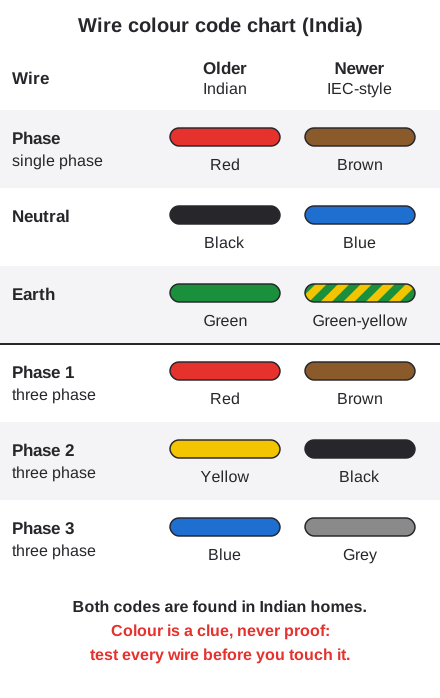
Drawn by us. Both codes are found in Indian homes, sometimes in the same house after a repair. Colour is a first clue only; a tester decides. Tap the diagram to open it full size.
Watch the trap in the chart: black is neutral in the older code but a phase in the newer three-phase code, and blue is a phase in the older code but neutral in the newer one. Appliance cords commonly follow the newer code: brown, blue and green-yellow.
Our VIYONA house wire is listed in five standard colours: black, red, blue, yellow and green, in 45 m and 90 m coils. A good electrician keeps one colour per job throughout a house and marks any exception at both ends.
How to identify phase, neutral and earth with a line tester
A line tester (neon tester) glows when its tip touches the phase and your finger touches the cap, so it finds the phase quickly; it does not glow on a healthy neutral or earth, but it cannot tell those two apart and it cannot prove that a circuit is dead.
Check the tester on a known live socket first, then test, then check it on the live socket again. We make the VIYONA line tester 811 (code 198) at ₹36 and 812 (code 199) at ₹42 MRP.
Its limits matter more than its glow. No glow is not proof of dead: the lamp can fail, the light may be too bright to see a faint glow, or you may be standing on an insulating floor. A glowing neutral means trouble, often a broken neutral, not a healthy circuit.
A neon tester shows that a phase is present. It never proves a circuit dead. Before touching any conductor, switch off the MCB and confirm dead with a voltage tester or multimeter.
How to identify phase, neutral and earth with a multimeter
Set a multimeter to an AC voltage range above 230 V and measure the three pairs: the wire that reads about 230 V to both others is the phase; of the remaining two, the pair reading a few volts is neutral and earth, and the earth is the wire with continuity to the earth bar when the supply is isolated.
- AC volts, range above 230 V, leads in the COM and V sockets, on a meter rated for mains (CAT III).
- Measure A–B, A–C and B–C. Two readings near 230 V share the phase.
- The small reading is neutral–earth.
- To tell N from E, isolate first: main double pole switch off and the circuit proved dead, then trace each wire to the board or check continuity to the earth bar; the earth wire reads close to 0 Ω. If both read low, stop and ask your instructor.
Hold the probes by their insulated grips and never switch ranges with the probes on a live point. Live measurement is for a trained person; as a student, do it on a training board under your instructor.
A meter set to current (A) or resistance and touched across a live supply can blow its fuse or flash. Check the dial before every reading.
Which wire goes to which terminal on a socket and plug?
On an Indian 3 pin socket, seen from the front, the large top hole is earth, the bottom right is phase and the bottom left is neutral; on the plug, seen from the pin side, everything is mirrored, so the phase pin is on the left, and the terminals are marked L, N and E.
Which hole is phase, neutral and earth on a 3 pin socket and plug
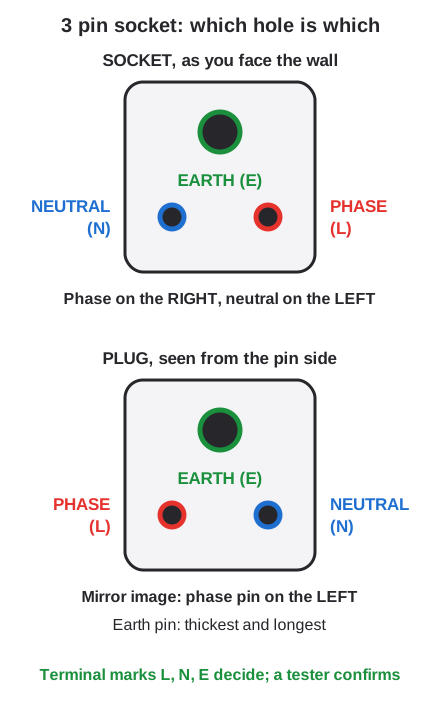
Drawn by us. Follow the L, N and E marks on the terminals of the actual socket or plug; a tester confirms the wiring. Tap the diagram to open it full size.
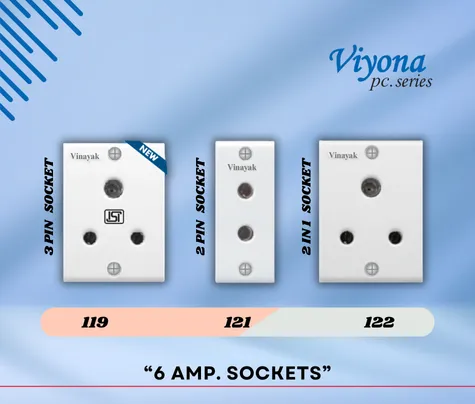
The earth pin is the thickest and longest, so it connects first and breaks last. Our VIYONA 119 3 pin socket is ₹40, and the KEMPS K192 6A 3 pin socket ₹110 MRP. In a plug top, brown or red goes to L, blue or black to N, green-yellow or green to E; our VIYONA 243 6A plug top is ₹68 and the 244 16A ₹110. See our 3 pin plug guide for wiring one step by step.
Which wire goes to the switch and the MCB?
The phase goes to the switch and to a single pole MCB, never the neutral; the neutral goes to the neutral link in the board and straight to the load, the earth goes to the earth bar and the earth terminal of each socket, and only a double pole MCB or isolator breaks phase and neutral together.
Switch: phase in, switched phase out to the light or fan. A switch in the neutral still turns the lamp off but leaves the holder live. Our switch board wiring diagram draws a full board.
Single pole MCB: in the phase of one circuit, such as our VIYONA 401, 6 to 32 A, ₹145. Double pole MCB: phase and neutral together, for a main incomer or a heavy circuit, such as our 411, 6 to 32 A, ₹350; both from our 10kA MCB range. Never put a single pole MCB in the neutral: it would trip and leave the circuit live. Our guide to how an MCB works explains the trip itself.
One phase in, one neutral back, one earth for protection. If a board shows anything else, stop and have it checked.
Common mistakes with phase, neutral and earth
Most faults with these three wires come from six mistakes, and every one can hide while the lights still work.
Switch in the neutral: holder live with the lamp off. N and E joined at a socket: current on the earth wire. Earth missing: the appliance works, but a fault leaves its body live. Phase and neutral swapped at the main switch: every switch and single pole MCB ends up in the neutral. Trusting colour: a past repair used whatever wire was at hand. Loose neutral: flicker, heat, and high neutral–earth voltage.
Before replacing anything, label each wire after testing it. Our guide to 6A vs 16A sockets covers the earth pin in more detail.
If a tester glows on a lamp holder with the switch off, or on a neutral, stop using the circuit and call a licensed electrician.
FAQs
Phase neutral earth kya hota hai?
Neutral aur earth mein kya difference hai?
What is the voltage between phase and neutral?
What are the wire colours for phase, neutral and earth in India?
Can a line tester tell neutral from earth?
Why does my neutral show voltage to earth?
Why buyers choose Vinayak Electricals
- VIYONA line testers 811 (₹36) and 812 (₹42) for finding the phase.
- 3 pin sockets from ₹40 (VIYONA 119) and plug tops from ₹68 (VIYONA 243), with the 16A 244 at ₹110.
- VIYONA 10kA MCBs: single pole 6 to 32 A at ₹145 and double pole at ₹350, made under licence CM/L-2544151.
- VIYONA house wire listed in black, red, blue, yellow and green, in 45 m and 90 m coils.
- Made at our works in Marol, Andheri East, Mumbai, since 1995; ISO 9001:2015 certified.
- MRPs published openly in our catalogue, with all-India delivery through our dealers.
Testers, sockets and MCBs for safe wiring
See our VIYONA MCB range, then order through a dealer or by phone.
View VIYONA MCBs