Voltage stabilizer for AC and fridge: voltage fluctuation at home, and how to choose one
Choosing a voltage stabilizer for AC and fridge starts with knowing how much your supply swings: a stabilizer protects the compressor from voltage fluctuation at home, the low evening voltage and high night voltage many Indian homes see. Below: what normal voltage is in India, the reasons for fluctuation (including a loose neutral, which is dangerous), what to do, how a stabilizer differs from a spike guard and an inverter, how to size one for a 1.5 ton or 2 ton AC and a double door fridge, and whether inverter models still need one.
Key takeaways
- Normal voltage — 230 V single phase, 50 Hz; the supply may vary within limits set by the regulations and your state’s supply code.
- Fluctuation causes — loaded transformer, motors starting, a loose neutral (dangerous) or thin, long, loosely jointed wiring.
- Stabilizer vs spike guard vs inverter — long low or high voltage, brief spikes, power cuts: three different jobs.
- AC sizing — rated amps × 230 V gives running VA; buy well above it, as the AC maker and the stabilizer maker’s chart advise.
- Inverter models — check the stated operating range against your readings. We do not make stabilizers.
Voltage stabilizer for AC and fridge: the short answer
A voltage stabilizer for an AC or fridge is a box between the wall socket and the appliance that raises low voltage and lowers high voltage so the compressor gets a steadier supply, and cuts the output off when the mains goes outside its working range. Whether you need one depends on how much your supply swings and on the range the appliance’s maker says it can take.
This guide covers what normal voltage is in India, why it fluctuates, the symptoms, what to do, how a stabilizer differs from a spike guard and an inverter, and how to size one for a 1.5 ton or 2 ton AC and a double door fridge.
We make MCBs, sockets and spike guards at our works in Mumbai. We do not make stabilizers, so we name no model and sell none; we explain how to choose one and what goes either side of it.
What is the normal voltage at home in India?
The normal voltage at home in India is 230 V single phase at 50 Hz between phase and neutral, and about 400 V between phases on three phase; the supply may vary within limits set by the regulations and your state’s supply code, so a reading a little above or below 230 V is normal.
230 V is the nominal figure printed on Indian appliances. 50 Hz is the frequency. Older meters and textbooks also say 220 V or 240 V; the declared figure today is 230 V.
How far is too far? Rule 54 of the old Indian Electricity Rules, 1956 allowed low-voltage supply at the point where it enters your premises to vary by no more than 6% either way from the declared voltage, which at 230 V is about 216–244 V. Those rules are no longer in force: the Central Electricity Authority’s regulations and your state commission’s supply code now set the limits, so check your supplier’s current figure before complaining with a number.
Readings well outside that, such as 180 V on a summer evening or 260 V at night, are what people mean by voltage fluctuation. For how single and three phase supplies differ, see single phase vs three phase.
| Device | Handles | Does not handle | Typical use at home |
|---|---|---|---|
| Voltage stabilizer | Long spells of low or high voltage; cuts off outside its range | Power cuts, short circuits | AC, fridge |
| Spike guard (with a surge part) | Brief spikes lasting a fraction of a second | Low or high voltage, power cuts, heavy loads | TV, router, computer |
| Inverter (home UPS) | Power cuts, from a battery | Correcting mains voltage for an AC | Fans, lights, router |
| MCB | Overload and short circuit | Voltage, spikes, shock | Every circuit in the board |
Reasons for voltage fluctuations at home
The usual reasons for voltage fluctuations at home are a heavily loaded local transformer or long supply line, heavy motors and compressors starting nearby, a loose or broken neutral at the meter, pole or board, and wiring inside the house that is too thin, too long or loosely jointed for the load it carries.
Grid and transformer On hot evenings every AC on the lane runs at once, and the voltage at the end of a long line sags. Late at night the load falls and it can rise. Heavy loads starting A lift, a pump or a fixed-speed AC compressor draws a brief large current at start, and lights dip for a moment.
Loose neutral The dangerous one. On a three-phase supply shared between homes, a broken neutral can push one home’s voltage far above 230 V, towards the 400 V between phases, and burn out appliances in seconds. Signs: lights that go very bright when a big load elsewhere switches off, bulbs failing, appliances shutting down. Switch off at the main and call your supply company and an electrician at once. Our guide to phase, neutral and earth explains the neutral’s role.
House wiring Covered in the next section.
Voltage that shoots up, with lights glaring and appliances failing, is a neutral fault until proved otherwise. A stabilizer is not the fix: switch off at the main.
Evening peak; compressors struggle and trip.
Late night; electronics fail early.
Glaring lights, burnt appliances: main off now.
Thin, long or loose runs drop volts under load.
Voltage drop at home: when your own wiring is the cause
Voltage drop at home is the voltage lost along the wires between your meter and an appliance; it grows with the current and the resistance of the path, so a long run of thin wire or a loose joint leaves a far socket below the board’s voltage whenever a heavy load runs.
It is Ohm’s law: volts lost = amps × ohms. Take an example run whose wire, out and back, adds 0.4 ohm. A 10 A load loses 4 V along it. Add a loose joint of 1 ohm and it loses 10 V more, and that joint turns 100 W into heat (10 × 10 × 1), which is how loose joints scorch.
Test If the voltage is fine at the board but low at one socket when the AC runs, the wiring is the cause, not the grid. Fix An electrician re-makes loose joints and, where needed, runs a heavier wire on its own circuit. Our house wire guide covers sizes; our VIYONA house wire is made by a partner, not by us.
The figures above are an example to show the arithmetic, not measurements of any house. Your electrician measures the real drop under load.
Voltage fluctuation at home: the symptoms
The symptoms of voltage fluctuation at home are lights that dim or brighten for no reason, fans that slow down in the evening, an AC or fridge that clicks off and restarts or will not start, appliances that shut down with an error, LED bulbs and chargers that fail early, and a stabilizer display that keeps changing.
Dimming lights Especially when a compressor starts. Slow fans In the evening peak. AC trips or will not start Low voltage makes a compressor struggle and draw more current. Burnt-out electronics After a night of high voltage. Flicker On one circuit only, it is a loose joint, not the grid.
A plug-in voltmeter, or the display on an existing stabilizer, shows the number. Note the time and the reading for a week; that record is what a supply company or electrician needs.
A plug-in voltmeter is a reading at one socket. It does not tell you whether the cause is the grid, the neutral or your wiring; an electrician compares readings at the meter and at the socket.
Voltage fluctuation at home: what to do
For voltage fluctuation at home, first find out whether neighbours have it too: if the whole building or lane does, complain to your electricity supply company with readings and times; if only your home does, have a licensed electrician check the neutral and the main connections; and protect compressors with a stabilizer while it is fixed.
Whole lane Supply company complaint, with your log of readings. Only your flat Electrician checks the meter-side and board neutral and the main joints. Glaring lights Main switch off now; suspect a broken neutral.
Meanwhile Avoid starting the AC, geyser and iron together. Unplug sensitive electronics during big swings. Give the AC and fridge a stabilizer sized for them. A home inverter covers power cuts, which is a different problem.
Each AC should also be on its own MCB in the board; our VIYONA 10 kA MCB 401 single pole is ₹145 MRP, and MCB for AC covers which rating.
Do not let anyone “fix” low voltage by joining neutral to earth or tapping another phase. Both are dangerous and against the rules.
What does a stabilizer do? Stabilizer vs spike guard vs inverter
A stabilizer corrects long spells of low or high mains voltage, a spike guard with a surge part only diverts brief spikes lasting a fraction of a second, and an inverter, a home UPS with a battery, keeps power on during a cut; they solve three different problems and do not replace each other.
Where a stabilizer sits, and where a spike guard sits
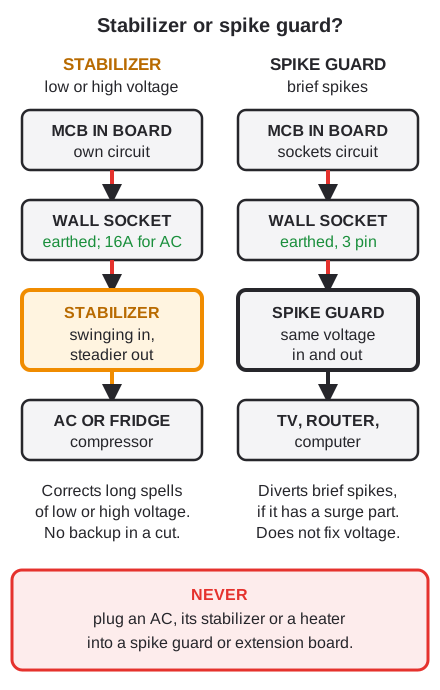
Drawn by us, simplified. Never plug an AC, its stabilizer or a heater into a spike guard or extension board. Tap the diagram to open it full size.
Stabilizer Uses a transformer, switched in steps by relays or adjusted by a motor in servo types, to boost low or cut high voltage for minutes or hours. Spike guard Brief spikes, and only if it has a surge component. Inverter Power cuts. MCB Overload and short circuit; it does nothing about voltage.
Our VIYONA spike guards suit the TV corner: the Classic 291 is ₹370 MRP and the 301 spike guard with two USB ports is ₹650. Our catalogue does not publish a surge rating for them; see our spike guard guide.
Stabilizer for AC: how to size one for 1.5 ton and 2 ton
To size a stabilizer for an AC, start from the AC’s rating plate, multiply the rated current by 230 V to get the running load in VA, then choose the model the stabilizer maker lists for that tonnage, which is rated well above the running load to carry the compressor’s start-up current and the low-voltage end of its range.
An example: a plate shows 7 A rated current. 7 × 230 = 1,610 VA, about 1.6 kVA while running. A fixed-speed compressor draws a brief current several times that at start, and at low voltage the stabilizer has to pull more current from the mains to boost it, so the box is sized well above the running figure.
The method Running VA from the plate, plus a margin for start-up and for boosting at low voltage. Who decides The AC maker’s recommendation in the manual, then the stabilizer maker’s chart for that tonnage and your lowest voltage. Trade rule of thumb Shops often suggest around 4 kVA for a 1.5 ton AC and 5 kVA for a 2 ton; treat that as a starting point to check against the manual, not a standard. One per AC The usual arrangement. Working range Pick one whose range covers your worst readings; see the next section.
How to read a stabilizer’s working range
A stabilizer’s working range is the band of mains input voltage, printed on its rating plate, over which it can hold the output near 230 V; below the low end or above the high end it cuts the output off to protect the appliance, so the range has to cover the lowest and highest voltages your home actually sees.
Stabilizer input range vs output: illustrative
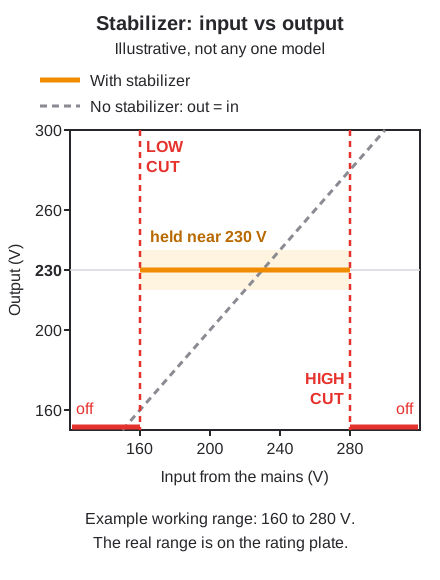
Illustrative only; 160 to 280 V is an example range, not a figure for any model. The rating plate gives the real range. Tap the diagram to open it full size.
Input range Printed as, for example, “160–280 V”; wider-range models go lower. Output Held in a band around 230 V, not exactly 230 V. Low cut Below the range, output off. High cut Above it, output off.
Time delay After a cut or a high-cut, a good AC or fridge stabilizer waits a few minutes before switching the compressor back on, so it does not restart against high pressure. Display A digital readout of input voltage doubles as your log.
Stabilizer for fridge, including a double door fridge
A stabilizer for a fridge is a smaller unit than an AC stabilizer, chosen from the maker’s chart by fridge type and size, with a start-up time delay so the compressor is not restarted the instant power returns; a double door frost-free fridge may need a larger one than a single door model.
Single door The smallest fridge stabilizers. Double door A frost-free model also runs a defrost heater, so it may need a larger one. Side-by-side Larger again. The fridge’s manual and the stabilizer maker’s chart decide; we give no wattage here because models differ widely.
Time delay The most useful feature on a fridge stabilizer. Wide range Many fridges with inverter compressors state a wide input range; read the next section before buying. Not on a spike guard A fridge, with or without a stabilizer, goes straight into an earthed wall socket.
A fridge that clicks off and on repeatedly during voltage swings is the case a stabilizer with a time delay is made for.
Does an inverter AC or fridge still need a stabilizer?
An inverter AC or fridge needs a stabilizer only if your mains voltage goes outside the operating range its manufacturer states, because many inverter models are built to run across a wide range of input voltage; check the range in the manual or on the rating plate, compare it with your logged readings, and decide from that.
Inside the stated range The maker may say no stabilizer is needed. Outside it Low or high readings beyond the range, or a known neutral problem in the building, still call for one. Warranty Read the warranty card for what it says about voltage damage.
An inverter AC also starts its compressor gradually, so it is gentler on the supply and less likely to dip your lights at start. How much power each draws is in our appliance power consumption guide.
“Inverter AC” means a variable-speed compressor, not a battery backup. A home inverter is a different machine.
Where to put a stabilizer, and why earthing matters
Put a stabilizer close to the appliance, on the wall or a dry shelf with space around it for air, plugged straight into an earthed 3 pin wall socket of the right rating on a circuit with its own MCB, never into an extension board, and with the appliance’s plug going into the stabilizer’s own output socket.
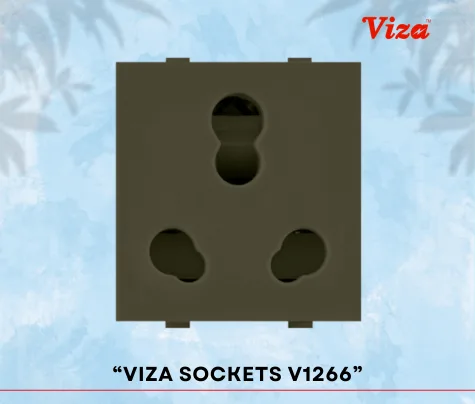
Earthed socket The stabilizer’s metal parts and the appliance body rely on the earth pin. 16A for an AC Our VIZA V1266 16 A socket is ₹179 MRP and the KEMPS K193 6A & 16AX universal socket ₹205. See 6A vs 16A socket.
Not on a spike guard Our Royal spike guard 311 (₹370 MRP) is a 6A strip: right for a TV, wrong for an AC or its stabilizer. Ventilation Stabilizers warm up; do not box them in. Dry Not on a wet balcony floor. Wiring a new AC point is for a licensed electrician, with the MCB off.
We do not make stabilizers. Buy one rated for your appliance from its maker’s chart, and have any new point wired by a licensed electrician.
FAQs
Stabilizer for AC 1.5 ton kitne kVA ka lena chahiye?
Fridge ke liye stabilizer zaruri hai kya?
What is the normal voltage at home in India?
Can a spike guard replace a stabilizer?
Does an inverter AC need a stabilizer?
What should I do about voltage fluctuation at home?
Why buyers choose Vinayak Electricals
- VIYONA 10 kA MCBs, made to IS/IEC 60898-1 under licence CM/L-2544151, for each AC circuit.
- 16 A sockets in KEMPS, VIZA and VIYONA for the AC and its stabilizer.
- VIYONA spike guards for the TV and computer, with MRPs from ₹370.
- We say plainly what we do not make: stabilizers, inverters and ACs.
- Every 3 pin socket we make carries the earth contact a stabilizer relies on.
- Manufacturing in Mumbai since 1995.
The point your stabilizer plugs into
See our 16 A sockets and VIYONA MCBs, with codes and MRPs.
Compare sockets