Inverter for home: sizing, battery backup and a safe connection
An inverter for home keeps your fans, lights and router running in a power cut. Choosing one means adding up the watts that must run, converting them to VA, and matching a battery to the hours you need. Below we show how to choose an inverter for home in India with worked numbers, how long a 150 Ah or 200 Ah battery lasts, sine wave vs square wave, and the safe inverter connection at home, with the MCBs, switches and sockets in it.
Key takeaways
- Size — add the watts that must run, then VA = W ÷ 0.8 (a common assumption); 400 W needs about 500 VA.
- Backup — hours ≈ Ah × V × 0.8 ÷ load W; a 150 Ah 12 V battery gives about 3.6 h at 400 W.
- Type — pure sine wave inverter; tubular battery for long, frequent cuts.
- Wiring — inverter feeds only chosen circuits through its own MCB, kept separate from mains circuits.
- ⚠ Never — geyser, iron, heater or AC on a home inverter, or its output plugged into a wall socket.
Inverter for home: the short answer
An inverter for home stores power in a battery while the mains is on and turns it back into 230 V AC during a power cut, so choosing one comes down to three numbers: the watts that must keep running, the inverter’s VA rating to carry them, and the battery’s Ah, which sets how many hours it lasts.
Wiring it safely matters as much as sizing it. A home inverter should feed only the circuits you choose, such as lights, fans and the router, through its own MCB, and it must never be able to push power back into the mains wiring.
To be clear about our part: we do not make inverters or batteries, and we name no brands. We make the MCBs, DP switches, sockets and MCB boxes that go into the inverter circuit, at our works in Mumbai. Below we show how to size an inverter, work out battery backup with worked numbers, compare battery and inverter types, and draw the inverter connection at home step by step.
How to choose inverter for home in India?
To choose an inverter for home in India, list what must run during a power cut, add up their watts, divide by the power factor to get VA, commonly assumed to be 0.8, and then pick a pure sine wave inverter a size or so above that figure, so it is not working at its limit.
Example inverter load: what must run in a power cut
Example only, using typical figures: an ordinary ceiling fan about 75 W, an LED TV about 100 W, a router about 15 W, and our 9 W LED lamp, code 1065. Bars to scale against 225 W. Your rating plates are the real figures.
The example adds up to 394 W, call it 400 W. Then: VA = W ÷ power factor, so 400 ÷ 0.8 = 500 VA.
VA, volt-amperes, is how inverters are rated. The power factor of 0.8 is a common assumption for a mixed home load, not a measured figure. Add margin for start-up surges, since fan and fridge motors draw more for a moment when they start, and choose the next size up that makers sell.
Size for what must run, not for the whole house. Every extra appliance on the inverter shortens the backup.
| Appliance | Typical watts | On a typical home inverter? |
|---|---|---|
| LED lamp | 9 W (our 1065) | Yes |
| Ceiling fan, ordinary | 50 to 75 W | Yes |
| Wi-Fi router | About 10 to 20 W | Yes |
| LED TV | About 60 to 120 W | Yes |
| Fridge | 100 to 250 W running, more at start | Only if the inverter is sized for the start-up surge |
| Dry iron | 750 to 1,000 W | No |
| Geyser | 2,000 to 3,000 W | No |
| 1.5 ton AC | About 1,500 W at full cooling | No, unless the system is built for it |
How to choose inverter for home with battery?
When you choose an inverter for home with a battery, match three things: the inverter’s VA must cover the load, the battery’s Ah decides the hours of backup, and the battery voltage must match the inverter, usually 12 V for one battery or 24 V for two batteries in series on larger inverters.
Think of the inverter as the engine and the battery as the fuel tank. A bigger inverter lets you run more at once. A bigger battery lets you run the same load for longer. Buying a large battery for a small inverter, or the other way round, wastes money.
Check four points on the inverter’s datasheet: VA rating, battery voltage (12 V or 24 V), the battery types it can charge, and whether the output is pure sine wave. A home inverter commonly runs from one 12 V battery at smaller sizes and two or more at larger ones; the maker states which.
The battery’s Ah, ampere-hours, is its capacity: in simple terms, how many amps it can deliver for how many hours. A 150 Ah battery rated at the 10-hour rate (often written C10) can give about 15 A for 10 hours; the maker states which rate it used.
Use the battery type and size the inverter maker recommends. A charger set for one battery type can undercharge or overcharge another.
List only what must run in a cut, then divide by 0.8 for VA.
Ah × V × 0.8 ÷ load gives a rough upper estimate of backup.
Fans and electronics run on it as they do on mains.
Inverter circuits stay separate from mains circuits.
Inverter battery for home: how many hours of backup?
Inverter battery backup in hours is roughly the battery’s Ah multiplied by its voltage and by an efficiency factor, then divided by the load in watts, so a 150 Ah, 12 V battery with an assumed factor of 0.8 gives about 1,440 watt-hours, or about 3.6 hours at a 400 W load.
The formula: hours = Ah × V × 0.8 ÷ load W. Step by step for our example battery: 150 Ah × 12 V = 1,800 Wh, then 1,800 × 0.8 = 1,440 Wh usable.
Backup hours, example 150 Ah 12 V battery
Worked arithmetic, not a test result: 1,440 Wh ÷ load. The 0.8 factor is our stated assumption for inverter losses and for not draining the battery flat. Bars to scale against 14.4 h, rounded.
Treat these as upper estimates. A battery’s Ah is usually rated at a slow discharge; at a heavy load a lead-acid battery gives less than its rated capacity, and an older battery holds less than a new one.
Halving the load roughly doubles the backup. Switching off a fan you do not need buys more time than a bigger battery.
Inverter battery for home 8 hours backup: what size do you need?
For 8 hours of inverter backup, multiply the load in watts by 8, divide by 0.8 for losses, then divide by the battery voltage; a 200 W load needs about 2,000 watt-hours, which at 12 V means roughly 167 Ah, so in practice the next battery size up from that.
The reverse formula: Ah = W × hours ÷ (V × 0.8).
200 W for 8 hours: 200 × 8 = 1,600 Wh, 1,600 ÷ 0.8 = 2,000 Wh, 2,000 ÷ 12 V = 167 Ah. A single 12 V battery a size above that is the usual answer.
400 W for 8 hours: 400 × 8 = 3,200 Wh, ÷ 0.8 = 4,000 Wh. At 12 V that is 333 Ah, more than one common battery holds. On a 24 V inverter with two 12 V batteries in series it is about 167 Ah each.
Long backup is mostly a battery question, not an inverter one. A load of 200 W is roughly two or three fans plus a few LED lamps and a router.
Before buying for 8 hours, check whether you really need everything for all 8. Cutting the night load to fans and one lamp often turns an impossible battery into an ordinary one.
Inverter battery for home 200Ah: how long will it last?
A 200 Ah, 12 V inverter battery stores 2,400 watt-hours, and with our assumed 0.8 factor for losses about 1,920 are usable, which works out to roughly 9.6 hours at a 200 W load, 6.4 hours at 300 W and 3.8 hours at 500 W, less as the battery ages.
The arithmetic: 200 Ah × 12 V = 2,400 Wh, × 0.8 = 1,920 Wh. Then divide by the load: 100 W: about 19 h, 200 W: 9.6 h, 300 W: 6.4 h, 500 W: 3.8 h.
A 200 Ah battery is a common choice for homes with long or frequent power cuts, but it only gives that backup if the inverter can charge it fully between cuts. If the mains returns for only a short time, a large battery may never reach full charge. The inverter maker states the largest battery it supports.
The life of any lead-acid battery depends heavily on how deeply it is discharged and how it is maintained. Running it flat every day shortens its life; follow the maker’s guidance on topping up and charging.
Compare batteries by Ah at the same rated discharge time, which the maker prints. Two “200 Ah” batteries rated at different rates are not the same capacity.
Tubular vs flat plate battery: which suits a home?
A tubular battery is generally the better choice for a home with frequent or long power cuts, because its positive plates are built as tubes that tolerate deep, repeated discharge, while a flat plate battery is cheaper, lighter and suits homes where cuts are short and occasional; both are lead-acid types.
Tubular: built for deep discharge, typically longer life in daily cycling, but costlier and heavier. Flat plate: lower price, smaller, and it can deliver current quickly, but typically wears faster under deep daily use.
Most home inverter batteries of both types are flooded: they have liquid electrolyte that needs distilled water topped up to the marked level. Sealed lead-acid batteries need no topping up. Lithium batteries are also sold for home backup; they need an inverter made to charge them.
We do not make batteries, so we compare types only. The battery maker’s datasheet, warranty terms and the inverter’s supported types decide the actual purchase.
Never top up with tap water or acid. Use distilled water only, to the level line, with the inverter switched off.
Sine wave vs square wave inverter: which is better?
A pure sine wave inverter is better for a home, because its output has the same smooth shape as the mains, so fans, fridges, LED drivers, chargers and TVs run as they do on the grid, while a square wave or modified sine wave inverter is cheaper but can make fans hum, run warmer and upset some electronics.
The mains voltage rises and falls in a smooth curve, a sine wave, 50 times a second. A square wave inverter jumps between plus and minus instead. A modified sine wave, also called quasi-sine, adds steps to get closer to the curve.
Motors are the first to notice. On a square or stepped wave a ceiling fan may hum and run warmer, and a fan regulator may behave differently. Electronic loads such as LED drivers, chargers and TV power supplies are designed for the mains shape; some cope, some do not. Our electrical vs electronics guide explains what is inside those drivers.
If the box does not say pure sine wave, assume it is not. Ask the seller to confirm the output type in writing.
Inverter connection at home: how is it wired?
A safe inverter connection at home takes the inverter’s input from the main distribution board through its own MCB, connects the battery to the inverter, and feeds the inverter’s output through a separate MCB to a chosen set of circuits, so those circuits get mains normally and battery power in a cut, while heavy loads stay on mains only.
Inverter connection at home diagram
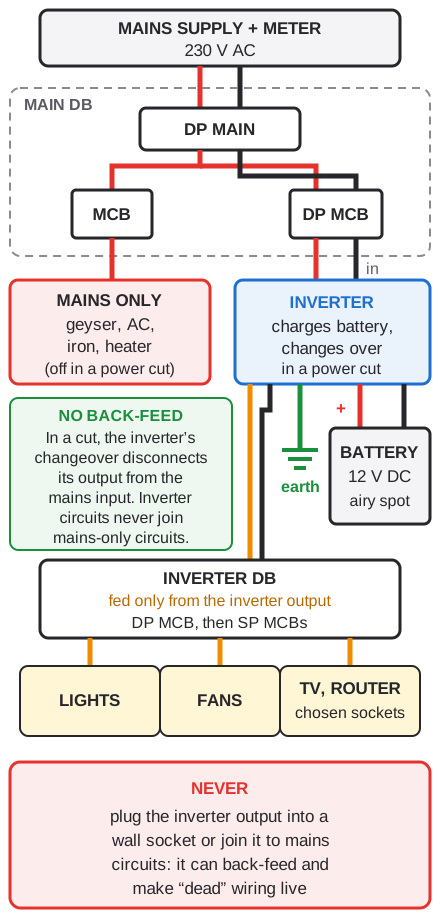
Drawn by us, simplified; mains-only neutral wiring is not shown. The inverter’s own changeover switches its output between mains and battery. Follow the inverter maker’s manual. Tap the diagram to open it full size.
Read it top to bottom. Mains comes into the main DB. One MCB feeds the inverter’s input. The inverter charges the battery and, in a cut, its internal changeover switches its output to battery power. The output feeds a small inverter DB for lights, fans and chosen sockets.
Two things stop the inverter back-feeding the mains wiring. In a cut, its internal changeover disconnects its output from its mains input. And electricians keep the inverter circuits’ phase and neutral separate from the mains-only circuits, so the two systems never mix.
Never connect the inverter output to a wall socket with a lead that has a plug at both ends, and never join inverter and mains wires. That can make wiring live that everyone believes is off, including the supply company’s line during a cut.
Inverter wiring at home: which MCBs, switches and sockets?
Inverter wiring at home typically uses a double pole MCB on the inverter’s input, another double pole MCB or isolator on its output feeding a small board of single pole MCBs, and ordinary switches and sockets on the chosen circuits, all sized by your electrician to the inverter’s rated current.
From our VIYONA range, at catalogue MRP: the 411 double pole MCB, 6 to 32 A, at ₹350, and the 401 single pole MCB at ₹145, both in our 10 kA MCB range; the 442 40 A double pole isolator at ₹230. A double pole device switches phase and neutral together, which is what an inverter circuit needs.
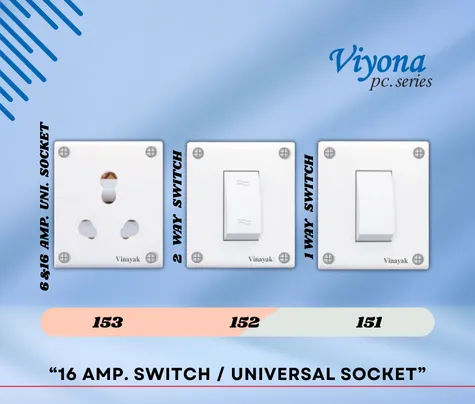
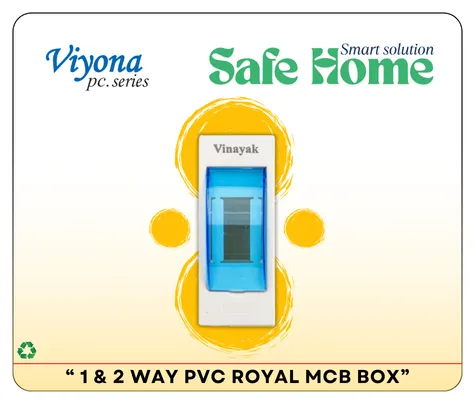
Near the inverter itself, a 32 A DP switch lets you cut it locally: ₹195 for the 175 surface type, ₹205 for the 176 concealed type. For an inverter that plugs in, a 6 and 16 A universal socket 153 with shutter is ₹90, and our 16 A plug top 244 is ₹110. A small two-MCB enclosure such as the 1 and 2 way PVC royal surface MCB box 377 is ₹66.
MCB ratings follow the cable and the inverter’s rated current, not a guess. See which MCB for home and isolator vs MCB.
Inverter battery connection at home: polarity, ventilation and earthing
The installer connects an inverter battery with the inverter switched off, red cable to the positive terminal and black to the negative, using the cables and lugs the inverter maker supplies; the battery sits in a ventilated spot away from flames and sparks, and the inverter’s earth terminal goes to the house earth.
Polarity: red to +, black to −. Reversed polarity can damage the inverter. Both lugs must be fully tight: a loose terminal heats and corrodes. Keep the cables short, as supplied.
Ventilation: a flooded lead-acid battery gives off hydrogen gas while charging, and hydrogen burns. Keep the battery in an airy place, on a stand off a damp floor, not in a closed cupboard or under a bed, and out of reach of children.
Earthing: the inverter’s metal body and its output circuits need a sound earth, connected to the house earth by your electrician. Our types of earthing guide explains the earth electrode.
Never lay a spanner or any metal across both battery terminals: a battery can deliver a very large current in a short circuit, enough to burn and spark.
What should not be connected to a home inverter?
A typical home inverter should not run heating appliances such as a geyser, an iron, a room heater or an induction cooktop, or an air conditioner, because each typically draws from about 750 W to 3,000 W, at or beyond the whole capacity of a 500 to 1,000 VA inverter, and would drain the battery quickly even if it started.
Geyser typically 2,000 to 3,000 W. Iron typically 750 to 1,000 W. Room heater and induction cooktop typically 1,000 to 2,000 W. A 1.5 ton AC typically draws about 1,500 W at full cooling. Systems built to run an AC exist, but they are sized for it from the start.
Fridge and water pump motors draw a surge several times their running current when they start, so they need an inverter sized for it; ask the inverter maker. Fans, LED lights, TV and router are what a home inverter is for.
The simplest way to enforce this is in the wiring: keep geyser, AC and iron circuits off the inverter DB altogether. Our appliance power consumption guide lists typical watts room by room.
All wattages here are typical ranges, not figures for any one model. The rating plate or BEE star label on your appliance is the real number.
FAQs
How do I choose an inverter for my home?
Ghar ke liye kitne VA ka inverter chahiye?
Inverter battery kitne ghante chalegi?
What size battery do I need for 8 hours of backup?
Can I run a geyser or AC on a home inverter?
Does Vinayak Electricals make inverters or batteries?
Why buyers choose Vinayak Electricals
- VIYONA 10 kA single and double pole MCBs for the inverter input and output, made under BIS licence CM/L-2544151.
- 32 A DP switches, 6 and 16 A universal sockets and 16 A plug tops for the inverter point.
- PVC surface MCB boxes from ₹40 MRP (375) and SPN white line boxes from ₹380 (371) for a small inverter board.
- Made at our works in Mumbai since 1995; ISO 9001:2015 certified.
- MRPs published openly in our catalogue.
- All-India delivery through our dealers, in full boxes.
MCBs and switches for your inverter circuit
See our VIYONA 10 kA MCBs and DP switches, then order through a dealer or call us.
View VIYONA MCBs