Electrical vs electronics: the difference, with examples from your home
Electrical vs electronics is the difference between power and control. Electrical equipment carries 230 V mains to make light, heat and motion; electronics uses semiconductors and tiny currents to control that power or to process information. Below we explain the difference between electrical and electronics with examples from a real home, show which devices are both, draw what an LED driver does, and set out what each engineering course studies.
Key takeaways
- Electrical — moves power to do work: wire, switches, sockets, MCBs, holders, heaters, motors.
- Electronics — semiconductors steer tiny currents to control or compute: chargers, TVs, routers, LED drivers.
- AC vs DC — home mains is 230 V AC at 50 Hz; electronics run on low-voltage DC made from it.
- Both — an LED lamp is LEDs plus an electronic driver; an electronic fan regulator replaces a resistor coil.
- ⚠ Electronic is not low voltage outside — anything on mains is live. MCB off before any work.
Electrical vs electronics: the short answer
Electrical vs electronics comes down to what the current is used for: electrical equipment carries and converts power to do physical work, as wiring, switches, MCBs, motors and heaters do, while electronics uses tiny currents, controlled by semiconductor parts such as diodes, transistors and chips, to process information or to control that power precisely.
Put simply, electrical is the muscle and electronics is the brain. A ceiling fan motor is electrical; the circuit inside a remote-controlled fan that decides its speed is electronic. A geyser element is electrical; the chip in a phone that charges from the same socket is electronic.
Most modern home products are a mix of the two, and that is where the confusion starts. Below we set out the difference between electrical and electronics with examples, the voltages and currents each works at, the devices that are both, and what each engineering course studies. Our examples come from what we make at our works in Mumbai: switches, sockets, MCBs and holders on one side, and electronic dimmers, fan regulators and LED lights with drivers on the other.
What is the difference between electrical and electronics?
The difference between electrical and electronics is energy versus control: electrical systems move power, usually as 230 V AC at amps of current, to make light, heat or motion, while electronic circuits run on low-voltage DC at milliamps and use semiconductors to switch, shape and process signals that control power or carry information.
Electrical vs electronics at a glance
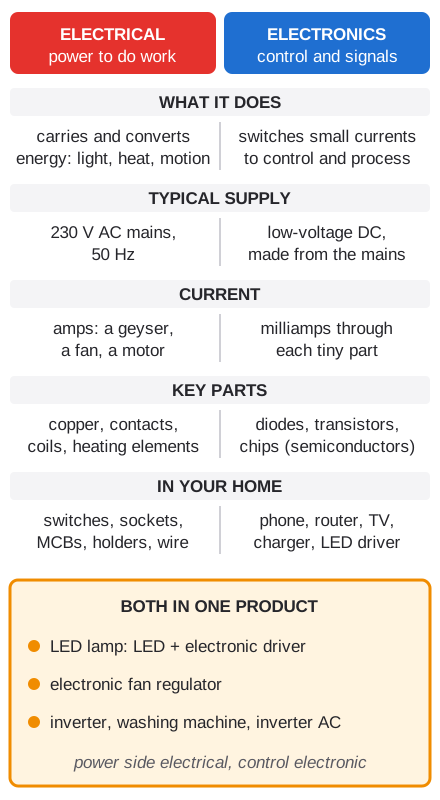
Drawn by us. A general comparison, not a rule without exceptions: some electrical systems run on DC, and some electronics switch large power. Tap the diagram to open it full size.
Four things separate them. Job electrical does work, electronics makes decisions. Supply electrical gear in an Indian home runs on 230 V AC, 50 Hz mains, while electronic circuits run inside on low-voltage DC. Current a heater draws amps, a chip draws milliamps. Material electrical parts are mostly copper and brass conductors with insulation; electronics depends on semiconductors such as silicon, which conduct only when told to.
A semiconductor is a material whose ability to conduct can be switched on and off electrically. That single property is what makes a circuit electronic rather than just electrical.
| Point | Electrical | Electronics |
|---|---|---|
| Main job | Carry and convert power to do work | Control power or process signals |
| Typical supply in a home | 230 V AC, 50 Hz mains | Low-voltage DC made from the mains |
| Typical current | Amps | Milliamps in most parts |
| Key materials | Copper, brass, insulation, steel | Semiconductors such as silicon |
| Typical parts | Wire, contacts, coils, heating elements | Diodes, transistors, chips, capacitors |
| Home examples | Switch, socket, MCB, holder, fan motor | Charger, TV, router, LED driver |
| Our example (MRP) | VIYONA 101 1 way switch, ₹22 | VIYONA 137 electronic regulator, ₹215 |
Difference between electrical and electronics devices
An electrical device converts or controls power by plain physical means, such as a switch contact, a heating element, a coil or a motor, while an electronic device contains at least one semiconductor part, such as a diode, transistor or chip, that steers current according to a signal.
Here is a quick test you can apply to almost anything in your home. Ask whether it would still work if every diode, transistor and chip were removed. A 1 way switch would: it is two contacts and a spring. A lamp holder would: it is two contacts that hold the bulb. A ceiling fan motor would: it is copper windings and a rotor. These are electrical.
A phone charger would not, nor would a TV, a Wi-Fi router or the driver inside an LED lamp. These are electronic.
Engineers also sort components into passive and active. Passive parts, such as resistors, capacitors, coils and contacts, cannot amplify anything; purely electrical equipment uses only these. Active parts, such as transistors, let a small signal at one terminal control a larger current through the others, and they are what electronics adds.
A device being electronic does not make it low voltage on the outside. An LED lamp, a dimmer and a charger all connect to 230 V mains and are treated with the same care as any socket.
If it still works with no diode, transistor or chip, it is electrical.
Amps of current usually means electrical work; milliamps usually means electronics.
Electronics needs DC, so it starts with a power supply or driver.
Most appliances pair an electrical power side with an electronic control side.
Difference between electrical and electronics with examples
The clearest examples of electrical products in a home are wire, switches, sockets, lamp holders, MCBs, heaters and fan motors, and the clearest electronic ones are phones, TVs, routers, chargers and the drivers inside LED lights; our own catalogue has products on both sides of that line.
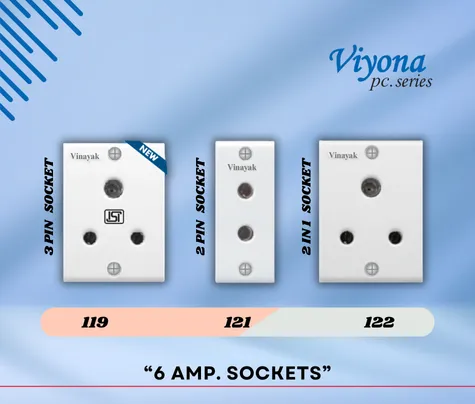
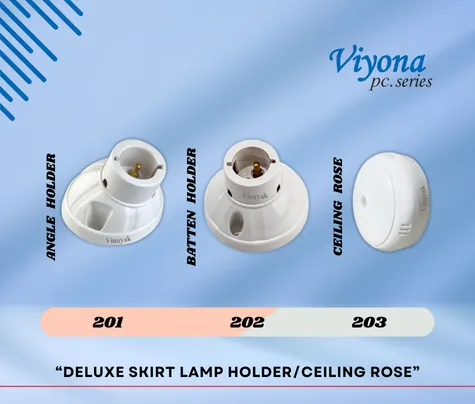
Electrical, from our range: our VIYONA 6 A deluxe 1 way switch 101 at ₹22 MRP, the 3 pin socket 119 at ₹40, the polycarbonate batten holder 202 at ₹26 and the 10 kA single pole MCB 401 at ₹145. None of them contains a semiconductor.
Electronic, from our range: the VIYONA electronic dimmer and fan regulator family, such as the 135 mini 300 W dimmer at ₹130 and the 137 mini 4 step regulator at ₹215, and our LED panel drivers, such as the 1041 for 9 W to 15 W panels at ₹180.
Our LED lamps sit on both sides at once: the 9 W LED lamp 1065 at ₹70 has an electrical cap and body, and an electronic driver inside. We make no fans, geysers, inverters or phones; they appear here only as examples.
The table above sets the two side by side, and the four quick tests below work on any product in your home.
Which devices are both electrical and electronic?
Most modern appliances are both: an electrical power section does the work, and an electronic control section decides how much power it gets and when, so an inverter AC, a washing machine, an induction cooktop, an inverter, an LED lamp and an electronic fan regulator are all electrical and electronic at the same time.
Take the washing machine. The motor and the heater are electrical. The control board that reads the programme, opens the water valve and sets the drum speed is electronic. An inverter AC is the same story: an electronic drive varies the compressor speed instead of switching it fully on and off.
A home inverter charges a battery and turns its DC back into AC with power electronics, and feeds ordinary electrical circuits. We cover it in our inverter for home guide.
The branch of engineering that sits exactly on this border is called power electronics: semiconductors that switch large currents. It is behind LED drivers, chargers, inverters and variable-speed motors.
When a product has both sections, a fault can be on either side. A dead LED lamp can be a failed driver even when the LEDs are fine, and an AC that will not start can be a control board or a supply fault. Diagnosis on mains is for a licensed electrician or the maker’s service.
Electronic fan regulator vs resistor regulator: electrical or electronic?
An old resistor step regulator is purely electrical, because it slows the fan by switching resistor coils into the circuit and burns the unused power as heat, while an electronic fan regulator controls the power to the fan with electronic components, runs cool and wastes far less at low speed.
This is the best everyday example of the difference. Both do the same job, both sit in the phase between the fan switch and the fan, and both offer steps. The resistor type is large, heavy and warm to the touch, and at low speed it saves little electricity because the difference is lost in the coil. The electronic type is a small module or plate.
Every regulator in our catalogue is electronic; we do not make resistor regulators. In VIYONA, the 137 mini 4 step is ₹215, the 138 medium 5 step ₹225 and the 145 ABS plate type 5 step regulator ₹230 MRP. Our fan regulator types guide covers the KEMPS and VIZA modular versions too.
A light dimmer is also electronic, but it is made for lamps, not fan motors. Never fit a dimmer to a ceiling fan.
How does an LED driver turn mains into LED power?
An LED driver is the electronic circuit that turns 230 V AC mains into the steady, low-voltage DC current an LED needs: it rectifies the AC into DC with diodes, converts it to the right level and then holds the current steady, because an LED fed directly from the mains would fail almost at once.
LED lamp block diagram: the electrical part, then the electronic driver
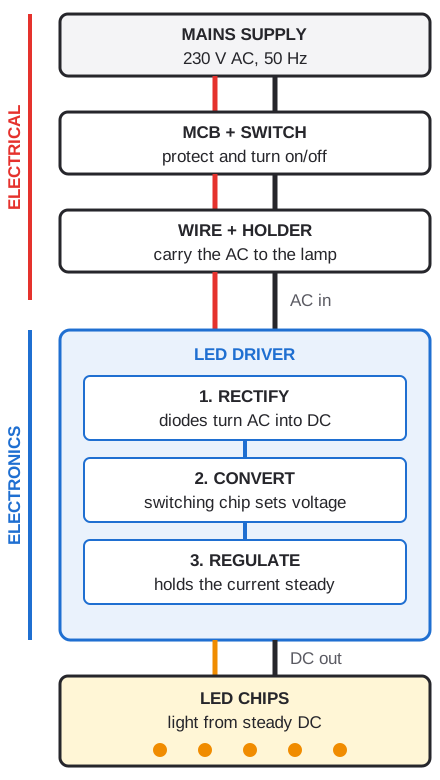
Drawn by us, simplified. Real drivers differ in detail, and some low-cost designs skip a stage. Everything above the driver is electrical; the driver is electronics. Tap the diagram to open it full size.
Everything up to the lamp is electrical: the MCB, the switch, the wire and the holder. The driver is where electronics takes over. The label printed for our 1041 LED panel driver in our catalogue reads input 90–240 V AC, 50 Hz and output 40–75 V DC at 180 mA. The same label also warns output not mains isolated.
Not mains isolated means the LED side of that driver is not separated from the mains. Treat every part of an LED fitting as live: MCB off before opening or changing it.
Electrical vs electronics: AC or DC, and how much voltage?
Electrical equipment in an Indian home mostly runs on AC, alternating current, at 230 V and 50 Hz, while electronic circuits almost always run on DC, direct current, at much lower voltages, so nearly every electronic product starts with a power supply that converts the mains AC into the DC it needs.
AC reverses direction 50 times a second in India. It suits motors and heaters, and it is how power is generated and distributed. DC flows one way. A chip needs a steady, low DC voltage to work.
Three voltages you meet in one home
Bars to scale against 230 V. Mains is the nominal Indian supply; the 75 V figure is the top of the output range printed on our 1041 driver label; 5 V is the standard USB supply. Voltage alone does not decide safety: anything connected to mains is treated as live.
The box that does this conversion is often an SMPS, a switched-mode power supply: an electronic circuit that switches the current on and off many thousands of times a second to change its voltage efficiently. Your phone charger is one. So is the power supply inside a TV or a computer.
Is an MCB electrical or electronic?
A standard MCB is electrical, or more exactly electromechanical: it trips on overload when a bimetal strip heats and bends, and on a short circuit when a magnetic coil pulls a plunger, so it protects the wiring with heat, magnetism and springs and contains no electronic parts.
That is why an MCB works with no battery, no power supply and no software. Our MCB working principle guide draws the parts. Our VIYONA 10 kA MCBs run from the 401 single pole at ₹145 to the 433 four pole 63 A at ₹1,035 MRP, made to IS/IEC 60898-1 under BIS licence CM/L-2544151, as printed in our catalogue.
Other protective devices in a board work differently, and some use electronics; follow the maker’s datasheet for any one product. We do not make RCCBs or surge protectors.
The same is true of most of a switch board: switches, sockets, kit kat fuses, DP switches and isolators are all electrical. Only modules such as dimmers, regulators and USB chargers bring electronics onto the board.
Do not judge a device by its looks. A smart switch looks like a switch but has electronics inside; an old MCB looks technical but has none.
Electrical vs electronics engineering: what does each study?
Electrical engineering studies how power is generated, transmitted, distributed, protected and used in machines, while electronics engineering studies semiconductor devices and the circuits built from them, from amplifiers and digital logic to communication systems and embedded chips; both start from the same circuit theory.
Electrical engineering (often taught as EE or EEE) typically covers circuit theory, electrical machines such as motors, generators and transformers, power systems, protection and switchgear, control systems and power electronics.
Electronics engineering (often ECE, or electronics and telecommunication) typically covers semiconductor devices, analog and digital circuits, signals and systems, communication, microprocessors, embedded systems and VLSI, the design of chips.
“Electrical vs electronics engineering, which is better?” has no single answer. The useful question is which work interests you: machines, power and installations, or circuits, signals and chips. Read each college’s syllabus, because subjects and names vary between universities and diploma boards.
This section describes the subjects, not careers or pay. We do not rank one branch over the other.
Difference between electrical and electronics in Marathi and Hindi terms
In Marathi and Hindi the English words are used as they are: electrical work is about bijli in Hindi or vij in Marathi (विद्युत in formal writing), the power that runs lights, fans and motors, and electronics is about circuits with chips and semiconductors, written इलेक्ट्रॉनिक्स in Devanagari, that control that power or carry signals.
One-line versions you can remember:
- Electrical power ka kaam: light, heat, motion. Marathi: vijecha vapar karun kaam (वीज = electricity).
- Electronics control ka kaam: chhota current, semiconductor, signal.
- Electrician wiring, switch board, MCB, earthing.
- Electronics technician circuit boards, TVs, chargers, drivers.
That last pair is also how the trades split. An electrician wires and protects the installation. An electronics repair technician fixes the circuit boards inside appliances. An LED lamp that will not light can need either one: the electrician checks the supply at the holder, the technician the driver.
Whatever the language, the safety rule is the same: MCB off before any work, and a neon tester only shows that a phase is present; it never proves a circuit dead.
Electrical and electronics at home: safety differences
Electrical items usually fail through heat at loose joints, overloads and undersized wire, while electronic items are more sensitive to trapped heat, moisture and voltage spikes on the mains, so the electrical side needs correct MCBs and tight connections and the electronic side needs ventilation and a stable supply.
For the electrical side: the right MCB per circuit, tight terminals and wire sized to the load. Our which MCB for home guide goes circuit by circuit.
For the electronic side: ventilation around TVs, routers and inverters, no damp near chargers and drivers, and switching off sensitive equipment in a lightning storm. A voltage stabilizer may suit some appliances where the supply swings widely; follow the appliance maker. We do not make stabilizers.
Both sides share one rule: anything connected to mains is treated as live, whether the label says electrical or electronic. Our electrical safety tips list the basics.
Never open a charger, LED driver or regulator while it is plugged in or wired. Capacitors inside some electronics can hold a charge for a while after power is removed.
FAQs
What is the difference between electrical and electronics?
Electrical aur electronics mein kya antar hai?
Electrical ani electronics madhye kay pharak aahe?
Fan regulator electrical hota hai ya electronic?
Is an LED bulb electrical or electronic?
Which is better, electrical or electronics engineering?
Why buyers choose Vinayak Electricals
- Switches, sockets, holders and MCBs, the electrical side of a home, made at our works in Mumbai since 1995.
- Electronic dimmers and fan regulators in VIYONA, KEMPS and VIZA; we make no resistor regulators.
- LED lamps, panels and drivers listed with their IS numbers in our catalogue.
- VIYONA 10 kA MCBs made to IS/IEC 60898-1 under BIS licence CM/L-2544151.
- ISO 9001:2015 certified; MRPs published openly in our catalogue.
- All-India delivery through our dealers, in full boxes.
Switches, regulators and LED lights from one maker
See our VIYONA electronic dimmers and fan regulators, then order through a dealer or call us.
View regulators