MCB vs Fuse: How a Kit Kat and a Breaker Differ, and Which to Fit
MCB vs fuse comes down to what happens when something goes wrong. A rewirable fuse, the kit kat on older boards, protects by melting a thin wire that someone must replace. An MCB protects with a mechanism you reset by pushing a toggle. Below we compare the two on trip point, short-circuit capacity, reset, cost and safety, using the standards and our own catalogue MRPs, and say when an old fuse can stay.
Key takeaways
- Verdict — for a home circuit an MCB is the safer, more predictable choice; a kit kat fuse is cheaper up front.
- Trip point — an MCB must trip within an hour at 1.45 × its rating (IS/IEC 60898-1); under IS 2086 a kit kat’s fuse wire need only blow within 30 minutes at 1.9 ×.
- Short circuit — our VIYONA 401–433 MCBs are rated 10 kA; a 10 or 16 A rewirable fuse is rated 2 kA under IS 2086 (4 kA above 16 A).
- Cost — VIYONA 131 10 A kit kat fuse MRP ₹60; VIYONA 401 10 kA single pole MCB MRP ₹145.
- ⚠ Neither — protects people from earth leakage shock; that needs a 30 mA RCCB as well.
MCB vs fuse: the short answer
MCB vs fuse is a choice between two ways of doing the same job: stopping too much current from overheating the wire behind your walls. A rewirable fuse, the kit kat on older boards, does it by sacrificing itself. A thin wire melts and the circuit stays dead until someone fits a new one. An MCB, a miniature circuit breaker, does it with a mechanism: a bimetal strip for slow overloads, a magnetic coil for short circuits, and a latch that throws the contacts apart. Push the toggle back up and the circuit is back.
For a home circuit, the MCB is the better choice on nearly every count that matters. It trips at a closer, tested point. It can break a far larger short-circuit current. Nobody can “repair” it with the wrong wire, and a dropped toggle tells you at a glance which circuit went. The fuse wins on one thing: the price on the box.
We make both, at our works in Marol, Andheri East: VIYONA kit kat fuses, and VIYONA 401–433 MCBs under BIS licence CM/L-2544151 to IS/IEC 60898-1. So this is not a pitch against one of our own products. It is what we tell electricians and dealers who ask us the question, with the numbers, the standards and our catalogue MRPs.
How does a fuse trip compared with an MCB?
A fuse acts when its wire melts; an MCB when its bimetal bends or its coil pulls. The difference is how tightly each standard pins that point down.
How far over its rating each device may run before it must act
MCB: the IS/IEC 60898-1 conventional test at 30 °C. Fuse: IS 2086:1993 cl. 4.4; IS 9926 covers the fuse wire itself. Bars to scale against 1.9 ×.
An MCB carries its rated current indefinitely. It does not trip at its rating. Tested at 30 °C, it must hold 1.13 × rating for an hour, and it must trip within an hour at 1.45 × rating. That is the slow, thermal side. On a short circuit the coil trips it almost at once: B curve: 3–5 × and C curve: 5–10 × the rating. See B curve vs C curve.
A rewirable fuse is looser. Indian kit kats are made to IS 2086, which asks only that the fuse wire blow within 30 minutes at 1.9 × rating. So a 16 A fuse wire may carry well over 16 A for a long time before it melts, while the cable behind it runs hot.
British wiring rules (BS 7671, not an Indian rule) rate a rewirable fuse at no more than 0.725 times the cable’s capacity. For the same protection, a fuse needs a thicker cable.
| Point | MCB (IS/IEC 60898-1) | Rewirable kit kat fuse |
|---|---|---|
| Overload trip point | Holds 1.13 × rating; trips by 1.45 × within 1 hour | Must blow within 30 min at 1.9 × rating (IS 2086) |
| Short circuit | Magnetic trip: B curve 3–5 ×, C curve 5–10 × | Wire melts; speed varies with wire and age |
| Breaking capacity | 10 kA on our VIYONA 401–433 | 2 kA for 10–16 A sizes under IS 2086 (4 kA above 16 A) |
| After a fault | Push the toggle back up | Switch off, pull carrier, fit new wire |
| Risk of wrong rating | Fixed in a sealed case | Any wire can be fitted by hand |
| Shows which circuit tripped | Yes, toggle drops | Only by pulling each carrier |
| Earth leakage (shock) | No, needs an RCCB | No, needs an RCCB |
| Our MRP, 10 A | VIYONA 401: ₹145 | VIYONA 131: ₹60 |
Inside a kit kat fuse and an MCB
A kit kat fuse is two parts: a fixed base wired into the board, and a carrier that plugs into it with a length of fuse wire screwed between two terminals. An MCB is a sealed case with a coil, a bimetal strip, a pair of contacts, an arc chute and a latch, all in line between the supply terminal and the circuit terminal.
Kit kat fuse vs MCB: what is inside
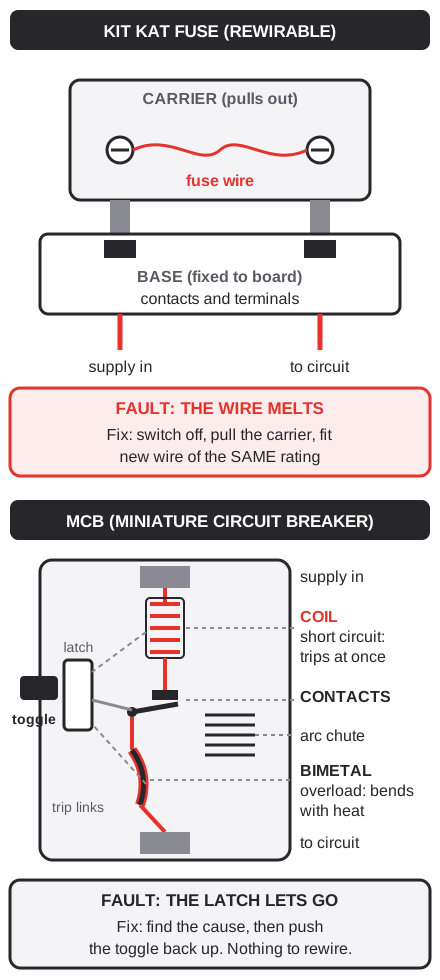
Drawn by us, simplified and not to scale. Real MCB layouts differ from maker to maker. Tap the diagram to open it full size.
Follow the current through each. In the fuse it runs from the base contact through the fuse wire and out of the other contact. Too much current heats the wire until it melts. That is the whole mechanism.
In the MCB it passes the coil, the contacts and the bimetal strip. A sustained overload heats the bimetal until it bends and trips the latch. A short circuit makes the coil pull the latch at once. The contacts spring apart, and the arc chute splits and cools the spark that forms as they open. More on each part in our MCB working principle guide.
The fuse is destroyed every time it does its job. The MCB is built to do its job, be reset, and do it again.
An MCB must trip within an hour at 1.45 × its rating; a kit kat’s fuse wire need only blow within 30 minutes at 1.9 × (IS 2086).
Our VIYONA 401–433 MCBs break 10 kA; a 10 or 16 A rewirable fuse is rated 2 kA under IS 2086.
Push the toggle up; no fuse wire, no guessing its size.
Neither a fuse nor an MCB protects people from earth leakage shock.
Short circuits: why breaking capacity matters
Breaking capacity is the largest fault current a device can interrupt safely. Our VIYONA 401 to 433 MCBs are rated 10 kA. Indian rewirable fuses are made to IS 2086, which rates them at 2 kA up to 16 A and 4 kA above that. On a short circuit, that gap decides whether the device clears the fault or fails along with it.
Rated breaking capacity, kA
MCB: our catalogue. Fuses: IS 2086:1993 cl. 4.3.1. Bars to scale against 10 kA.
On a dead short, the current is not limited by your appliance. It is limited only by the wiring back to the transformer, and it can be far more than any appliance draws for a moment. A device rated below that may not clear it cleanly: it can arc, scorch or burst. The 10 and 16 A fuses in a home are rated 2 kA under IS 2086, and the standard itself limits rewirable fuses to installations with fault levels up to 4 kA.
An MCB rated 10 kA leaves headroom over the 6 kA devices also sold for homes. More in 6 kA vs 10 kA MCB.
An MCB normally has its breaking capacity printed on the front. If a board has no marking at all on its fuses or breakers, treat its short-circuit rating as unknown.
Reset vs rewire: what happens after a fault
When an MCB trips, you open the board, find the toggle that has dropped, deal with the cause and push it back up. When a fuse blows, you switch off the main, pull carriers one by one until you find the melted wire, then fit new fuse wire of the right rating.
Picture a 2BHK in Andheri in July. The mixer’s cord has frayed where it bends; it shorts as you switch on, and the kitchen sockets go dead. With MCBs: one dropped toggle, unplug the mixer, push it up, done in a minute. With kit kat fuses: a torch, a screwdriver, the main switched off, pulling carriers one by one, and a hunt for a reel of fuse wire of the right rating. If your board has no main switch ahead of the fuses, the bases stay live: call an electrician rather than pulling carriers.
That last step is where fuses go wrong. Nothing stops someone fitting thicker wire, two strands twisted, or a copper strand from a cable. Each one raises the melting point, and the circuit then has little real protection. NICEIC names it as a drawback of rewirable fuses.
If an MCB trips again as soon as you reset it, stop. Repeated resetting on a fault is how wiring gets damaged. Our MCB tripping again and again guide walks through the safe checks, and how to check an MCB covers a breaker that may itself be faulty.
MCB vs fuse cost: our MRPs side by side
At our catalogue MRPs, a VIYONA 131 10 A kit kat fuse is ₹60 and a VIYONA 401 single pole 10 kA MCB is ₹145, so an MCB costs about ₹85 more per circuit. Across a six-circuit 2BHK board, that is about ₹510 at MRP, before the cost of the box both of them sit in.
MRP of fuses and MCBs in our catalogue, ₹
MRPs from our printed catalogue; dealer prices differ. Bars to scale against ₹350.
For the DB itself, the 401 at ₹145 covers 6 to 32 A; the 402 40 A is ₹185 and the 403 63 A is ₹215. A 411 double pole MCB for the main is ₹350. All of them are on our MCB price list.
The fuse’s lower price is real, but it is a first-cost saving. Every blown fuse needs new wire; the MCB is bought once. Our kit kat fuse guide covers the fuse wire sizes if you keep one.
On a whole flat, the gap between fuses and MCBs is a few hundred rupees at MRP. It is a small line in any wiring job.
Which is safer, an MCB or a fuse?
An MCB is safer for a home circuit. Its trip point is tested and cannot be changed by hand, it breaks a larger short-circuit current, and you reset it without touching anything live. A fuse is only as safe as the last wire someone fitted, and an old wire can drift as well.
Four reasons in practice:
Tamper-proof rating An MCB’s rating is fixed inside a sealed case. A fuse’s rating is whatever wire is in the carrier today.
No live parts to handle Resetting is a toggle. Rewiring a fuse means pulling a carrier from a base that may still be live.
Double pole option A double pole MCB such as our 411 switches phase and neutral together. See SP vs DP MCB.
Ageing fuse wire Fuse wire left open to air can oxidise and thin over time. It may then blow below its rating, which leads to nuisance blowing, and often to someone fitting a thicker wire.
Neither a fuse nor an MCB protects a person from an electric shock through earth leakage. That needs a 30 mA RCCB on the circuit, as well as the MCB. We make MCBs, not RCCBs. Read RCCB vs ELCB for how one works.
When is a fuse still fine?
A rewirable fuse is still acceptable on an existing circuit that is in sound condition, has the correct fuse wire fitted, and has cable matched to it. Britain’s NICEIC tells inspectors not to recommend replacing such fuses without a good reason. It is a case for planning an upgrade, not for panic.
Fuses as a technology are far from dead. Supply companies still buy rewirable fuse carriers: MSEDCL’s 2021 specification covers carriers rated 32 to 200 A for its distribution network. Industry uses HRC cartridge fuses, sealed fuses filled with powder, to IS 13703. One maker’s range is rated to 120 kA, far beyond the 6 or 10 kA of a home MCB.
So the question is not whether fuses work. It is whether a kit kat with hand-fitted wire is the right device for your flat. Signs that it is time to change:
Brown or burnt carrier Wire wound twice or twisted Blowing every few weeks Adding an AC or geyser No markings on the board
Any of these, and the board deserves an electrician’s look. Our when to rewire a house guide covers the cable side too.
A carrier that has been hot leaves a mark: brown or blackened plastic around its contacts. Do not plug it back in. Have the base and the circuit checked.
Changing fuses to MCBs: what your electrician will do
A licensed electrician turns off the supply, fits a distribution board with a double pole main and one single pole MCB per circuit, and sizes each MCB to the wire on that circuit, not to the appliance. This is not a DIY swap. Plan for an RCCB in the same board.
A typical single-phase flat board, from our VIYONA range at MRP:
SPN DB 2–4 way, 371: ₹380 6–8 way, 372: ₹480 DP main 411: ₹350 SP MCB 401: ₹145 each
The MCB protects the wire, so its rating must not exceed what the cable can carry. Common Indian practice is 1.5 sq mm: 6–10 A for lights and fans, 2.5 sq mm: 16 A for socket circuits, and 4 sq mm: 20–25 A for an AC or geyser. Our MCB size calculation guide shows the working, and SPN MCB box covers board sizes.
An isolator only switches. It does not trip on overload, so it is not a substitute for a main MCB. See isolator vs MCB.
Never put a 20 A MCB on 1.5 sq mm wire to stop it tripping. The trips are the MCB doing its job. Upsizing the breaker without the cable moves the failure into your wall.
Kit kat fuse or MCB inside a switch board?
Both also come as modules that sit in a switch board next to an appliance point. We make a VIZA V193 kit kat fuse, 10 and 16 A, at MRP ₹130, and a VIZA V401 single pole tiny trip MCB, 1 module, in 6 to 32 A, at MRP ₹230. Either adds local protection; neither replaces the MCB in the DB.
Across our ranges: VIYONA 131 / 132 kit kat: ₹60 / ₹66 VIYONA 133 SP MCB: ₹150 VIZA V193 kit kat: ₹130 VIZA V401 tiny trip: ₹230 KEMPS K225 tiny trip, white: ₹295.
A board-mounted MCB is handy at a geyser, AC or kitchen appliance point. Whoever is at the board can switch that one load off or reset it without walking to the DB. The same rule applies as in the DB: the rating follows the wire feeding that point. Our MCB in switch board guide and the KEMPS tiny trip page have the details.
A switch board MCB is an extra, local layer. The circuit still needs its own MCB in the distribution board.
Where MCCBs, isolators and RCCBs fit
An MCB is one of four devices people mix up with a fuse. An MCCB does the same job at higher currents. An isolator only switches. An RCCB trips on earth leakage. A home usually needs a DP MCB as the main, one MCB per circuit and a 30 mA RCCB. Use an isolator as the incomer only where your electrician has overcurrent protection upstream of it, never in place of the main MCB.
MCB overload and short circuit; our range runs 6 to 63 A, from the 401 to the 433. MCCB the same protection at currents above an MCB’s range, for buildings and industry; see MCB vs MCCB. We do not make MCCBs.
Isolator an on–off switch with no trip; our 442 40 A DP is ₹230. RCCB 30 mA for shock protection in wet areas, outdoor circuits or the whole house; our RCCB tripping guide covers what makes one trip.
Fuse, MCB, MCCB: protect the wire. RCCB: protects the person. Isolator: lets you switch off safely. A good board has the right mix.
FAQs
Which is better, MCB or fuse?
Fuse aur MCB mein kya antar hai?
Can I replace a kit kat fuse with an MCB?
Is a rewirable fuse still safe to use?
How much does an MCB cost compared with a kit kat fuse?
Does an MCB protect against electric shock?
Why buyers choose Vinayak Electricals
- VIYONA 10 kA MCBs, 6 to 63 A, single, double, three and four pole, made under BIS licence CM/L-2544151 to IS/IEC 60898-1.
- Kit kat fuses and tiny trip MCB modules in our VIYONA, VIZA and KEMPS ranges, for boards that keep a local fuse or breaker.
- SPN MCB boxes from MRP ₹380 (371) and double door DBs from ₹750 (381) for a fuse-to-MCB upgrade.
- Making electrical accessories since 1995, today at our works in Marol, Andheri East, Mumbai; ISO 9001:2015 certified.
- MRPs printed openly in our catalogue, and test reports on request before an order.
- All-India delivery through 500+ dealers and distributors, in full boxes.
Upgrading from fuses to MCBs?
See our VIYONA 10 kA MCBs and isolators, then order through a dealer or call us.
Vinayak Electricals is an MCB manufacturer in Mumbai, supplying dealers, electricians and contractors across India by the box. Ask us for prices and stock.
View VIYONA MCBs WhatsApp for prices Download catalogue