LED Bulbs Keep Dying Early? What Kills Them and What to Check

Why an LED bulb fuses quickly almost always comes down to something outside the bulb stressing its driver: voltage swings and spikes, heat trapped in a closed fitting, a loose holder or a loose neutral, or a dimmer it was never built for. The LED chips themselves rarely fail first. Below we go through each cause, how to tell which one you have from the pattern of failures, what LED bulb life really means, and the LED lamps we make in Mumbai.
Key takeaways
- The driver dies, not the LEDs — the small electronic board in the neck is what fails in most early deaths.
- Top causes — voltage swings and spikes, heat in closed or upside-down fittings, loose holders, loose neutral, dimmers.
- Read the pattern — one holder keeps killing bulbs: the holder or fitting. Many bulbs at once: the supply or a loose neutral.
- Fix the cause — replacing bulbs without finding it just repeats the failure. A loose neutral is urgent.
- Our lamps — 9W at ₹70 to 50W at ₹720 MRP, listed to IS 16102 (Part 1) under R-71026514.
Why do LED bulbs fuse quickly?
LED bulbs fuse quickly mostly because of what happens around them rather than a fault in the LEDs: an unsteady supply with spikes and swings, heat that cannot escape from a closed or small fitting, a loose or sparking connection in the holder or wiring, a loose neutral that pushes the voltage far too high, or a dimmer or regulator on the circuit.
Inside every LED bulb is a driver, a small electronic board in the plastic neck that turns 230V mains into the low-voltage current the LEDs need. That board is the weak point. Heat ages its parts, and spikes from the supply or from a sparking joint strike it directly. When people say a bulb has fused, the LEDs are often fine; the driver has given up.
That is good news, because the causes can usually be found and fixed. A home where bulbs die every few months almost always has a pattern: the same holder, the same room, the same time of day, or every bulb in the house at once. The sections below take each cause in turn, then show how to read the pattern. Anything involving the wiring itself is a job for a licensed electrician.
Does high or fluctuating voltage damage LED bulbs?
Yes, high or fluctuating voltage is one of the commonest reasons LED bulbs fail early, because repeated spikes and long periods of over-voltage stress the small capacitors and chips in the driver, and a supply that swings widely through the day ages a bulb faster than a steady one.
Signs that voltage is the cause:
Fans speed up at night Lights brighten and dim Bulbs fail in several rooms Failures after power cuts
Two different problems hide here. A high or swinging supply from the grid affects the whole area, and neighbours see it too; our voltage fluctuation and stabilizer guide covers what to do about it. Spikes come from switching of motors, pumps and lifts on the same supply, and from lightning; these hit electronics everywhere in the building.
A mainline stabilizer is not usually bought just for lights, but if the same supply is killing your fridge and AC electronics too, it is worth a conversation with your electrician.
If neighbours on the same transformer also lose bulbs, the cause is the supply. Report it to your power distribution company with dates and times.
| Pattern | Likely cause | First step |
|---|---|---|
| Same holder keeps killing bulbs | Worn holder or heat in the fitting | Replace the holder or use an open fitting |
| Bulbs in one room fail | Loose joint, switch board or dimmer | Electrician checks the circuit |
| Bulbs fail all over the house | Supply swings or loose neutral | Electrician checks the supply and neutral |
| Failures after power cuts or storms | Voltage spikes | Ask about surge protection |
| Only bulbs in closed globes fail | Trapped heat | Lower wattage or a ventilated fitting |
| Bulb blinks for days then dies | Failing driver | Replace the bulb; check if it repeats |
Can heat inside a fitting make an LED bulb fail?
Yes, heat is the second big killer of LED bulbs: a bulb inside a fully closed glass fitting, a small lampshade, a recessed can or hung cap-up traps its own heat around the driver in the neck, and the driver’s parts wear out far faster when they run hot.
An LED bulb gives off much less heat than an old filament bulb, but its driver is more sensitive to heat. Common heat traps:
Sealed glass fittings Small closed lampshades Bulb hanging cap-up High watts in a small fitting Fitting under a hot slab
A bulb hanging cap-up, with the base above the glass, lets heat rise into the driver. A high-wattage bulb in a fitting made for a small one is worse still. If one fitting keeps killing bulbs while open holders elsewhere do not, heat is the likely cause.
The fix is airflow: an open fitting, a lower-wattage bulb, or an LED fitting with its driver built for the job. For a bathroom or balcony, a purpose-made enclosed light such as a bulkhead light handles this better than a bulb in a sealed globe.
Spikes and over-voltage age the driver in every bulb.
Closed globes and cap-up bulbs cook the driver.
A sparking contact kills each new bulb in the same spot.
Many bulbs dying at once is urgent. Call an electrician.
Can a loose holder kill an LED bulb?
Yes, a loose or worn bulb holder can kill LED bulbs repeatedly, because a poor contact between the bulb cap and the holder sparks and heats, sending small spikes into the driver and cooking the base of the bulb, so the same holder keeps fusing every new bulb you put in it.
Look at the failed bulb and the holder with the power off at the MCB. Warning signs:
Brown or blackened cap Melted holder plastic Weak spring pins Bulb loose in holder Crackle when tapped
In a B22 bayonet holder, two spring-loaded plungers press on the bulb’s contacts. When the springs weaken or the contacts burn, the bulb flickers and fails. Replacing the holder costs far less than a box of bulbs. Our bulb holder connection guide shows how a holder is wired, and our B22 vs E27 guide explains the two cap types.
Loose terminals in the switch board do the same thing further back. A switch that is warm or crackles is worth an electrician’s visit.
Switch off the MCB and confirm the holder is dead with a tester before removing a bulb that has burnt in. A melted holder must be replaced, not reused.
Why do many bulbs fail at once? The loose neutral
When several LED bulbs, and often other appliances, fail at the same time or within days of each other, the likely cause is a loose or broken neutral in the supply or the main board, which can push the voltage in some circuits far above 230V and destroy electronics within seconds.
The pattern is distinctive: lights very bright in one room while dim in another, fans racing, and then several bulbs, a TV adapter or a charger dead together. It is most common in buildings where the neutral at the meter, the main switch or the street pole has corroded or come loose.
This is urgent. A loose neutral can damage every appliance in the house and can overheat the connection itself. Switch off the main switch and call a licensed electrician or your supply company. Our loose neutral symptoms guide explains the signs in detail.
An older installation with aluminium wiring, crumbling insulation or a board that has been extended many times is more likely to develop loose joints; see when to rewire a house.
Lights suddenly much brighter than normal and appliances failing together is an emergency. Switch off the main switch and call an electrician.
Do dimmers and regulators damage LED bulbs?
Yes, a dimmer or fan regulator used on an ordinary LED bulb can damage it, because a standard LED bulb is built for a full, steady 230V supply and its driver is stressed by the chopped waveform a dimmer produces, which causes flicker, buzzing and early failure unless the bulb is sold as dimmable.
Common mistakes:
Dimmer on a non-dimmable bulb Fan regulator on a light Old dimmer left after upgrade
When a house moves from filament bulbs to LED, an old dimmer is often left in the board. Switch it to full or replace it with a plain switch. A fan regulator must only control a fan, never a light. If you want dimming, buy bulbs marked dimmable and a dimmer made for LED loads.
An indicator switch or a switch that breaks the neutral instead of the phase causes a faint glow when off rather than a fused bulb, but the constant trickle can shorten life too; our LED glowing when switched off guide explains how to fix it.
Our lamps are not marked dimmable in our catalogue. Use them on a plain switch, not a dimmer or regulator.
Why does an LED bulb blink and then die?
An LED bulb that blinks, strobes or flickers for days and then dies usually has a failing driver, most often a worn capacitor that can no longer smooth the supply, so the bulb is already on its way out; replace it, and if bulbs in the same holder keep doing it, check the holder and the circuit.
The blink is the driver struggling to hold a steady current. It may start only when warm, then spread to switch-on, then become constant before the bulb goes dark.
Not every flicker means a dying bulb. A loose connection, a dimmer, a switch with a neon indicator, or a voltage dip can all cause flicker in a healthy bulb. We cover every cause and its fix in why LED lights flicker, so here is just the rule: one bulb flickers suspect the bulb; many flicker together suspect the supply or wiring.
Panels and tube fittings work the same way, but their driver is often separate and can be replaced on its own; see our LED driver guide.
How long should an LED bulb last?
An LED bulb should last many years of normal home use when it runs on a steady supply in an open, ventilated holder, and the rated life printed by a maker, usually in thousands of hours, describes good conditions; heat, spikes and poor connections cut that life sharply in real homes.
Two points help set expectations. First, LEDs rarely burn out like a filament; they slowly dim over their life, and a rated life is usually the point at which output has dropped by a set amount. A bulb that goes suddenly dark early has almost always lost its driver.
Second, a rated life assumes good conditions. A bulb in a closed globe on a swinging supply will not reach it. That is why the causes above matter more than the number on the box.
Warranty terms differ by maker and product, so read what is printed on the carton or bill; our FAQs cover how warranty claims work with us. For how LED compares with old bulbs, see LED bulb vs normal bulb.
Keep the bill and carton of bulbs for a new house. If several fail early, the dates help you and your electrician see the pattern.
How do you find why your LED bulbs keep fusing?
To find why LED bulbs keep fusing, note which bulbs fail and when: failures in one holder point to the holder or fitting, failures in one room point to that circuit or its switch, failures all over the house point to the supply or a loose neutral, and failures after power cuts or storms point to spikes.
A simple check you can do without opening anything:
Same holder again holder, fitting heat or the switch on it. Same room or circuit a loose joint, the switch board or a dimmer. Whole house supply voltage or a loose neutral. After cuts or storms spikes on the supply. Only closed fittings heat.
Move a new bulb to an open holder in another room for a few weeks. If it survives there and fails in the original spot, the spot is the problem. Write down dates; patterns are easy to see on paper and hard to remember.
Anything beyond swapping a bulb, such as checking terminals, the holder wiring or the neutral, needs a licensed electrician with the circuit switched off at the MCB.
Switch off the MCB and test dead before opening any switch board or holder. If you are unsure, leave it to a licensed electrician.
Which LED lamps do we make, and at what MRP?
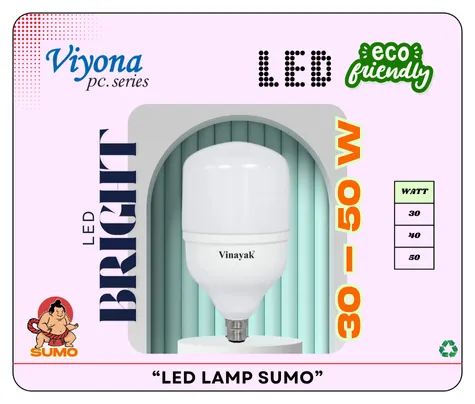
We make LED lamps from 9W to 50W at our works in Marol, Andheri East, Mumbai: 9W at ₹70, 12W at ₹145, 15W at ₹212, 18W at ₹268 and 23W at ₹410, plus the Sumo range at 30W for ₹480, 40W for ₹600 and 50W for ₹720 MRP, each in boxes of 10.
MRP of our LED lamps by wattage
MRPs from our current catalogue, bars to scale with ₹720 as the full bar.
VIYONA LED 1065 is a 9W LED lamp with an MRP of ₹70. Our lamps are listed to IS 16102 (Part 1) under BIS registration R-71026514. The Sumo lamps are large, high-wattage bulbs; give them an open holder, not a small closed fitting. See them on our LED lamp Sumo page.
LED lamp price per watt: which size is best value?
In our range the 9W LED lamp is the best value per watt at under ₹8 a watt, the 30W to 50W Sumo lamps sit at about ₹14 to ₹16 a watt, and the 23W costs most per watt, so for an ordinary room a 9W or 12W lamp in each holder is both cheaper and kinder to the holder than one oversized bulb.
MRP per watt of our LED lamps
Our arithmetic: MRP from our current catalogue divided by rated watts. Bars to scale with ₹17.8 as the full bar.
Price per watt is not the only test: a high-watt bulb in a small fitting runs hot and fails early. Match the wattage to the room using our how many lights in a room guide.
FAQs
Why do my LED bulbs keep blowing in one light fitting?
Can low voltage damage LED bulbs?
Why do all my LED bulbs fail at the same time?
Do LED bulbs last longer if switched off often?
Can I use an LED bulb in a closed light fitting?
What is the price of your LED bulbs?
Why buyers choose Vinayak Electricals
- LED lamps from 9W to 50W made at our works in Marol, Andheri East, Mumbai.
- Lamps listed to IS 16102 (Part 1) under BIS registration R-71026514.
- A 9W LED lamp at ₹70 MRP, and Sumo lamps up to 50W for large spaces.
- Bulb holders and switches from the same catalogue, so the whole light point comes from one maker.
- MRPs published openly; sold through 500+ dealers with delivery across India.
- Manufacturing in Mumbai since 1995; ISO 9001:2015 certified.
LED lamps from 9W to 50W
See our LED lamps and Sumo lamps with codes and MRPs, then order through a dealer or call us.
View LED lamps