B22 vs E27 Bulb Holder: Which Cap Does Your Lamp Need?
B22 vs E27 is the question of which cap a lamp has and which holder it fits: B22 is the push-and-twist bayonet cap with two side pins that most Indian homes use, and E27 is the 27 mm screw cap found on many decorative and imported lamps. Below we explain what the letters and numbers mean, add the small E14 and B15 caps, show how to tell your holder apart in ten seconds, and cover converters, safe wiring and the MRPs of the holders we make in Mumbai.
Key takeaways
- B22 — bayonet cap, 22 mm across, two pins; push in and twist. The usual Indian household cap.
- E27 — Edison screw cap, 27 mm across; screw it in. Common on decorative and imported lamps.
- E14 and B15 — the small screw and small bayonet caps, for chandeliers, fancy and small lights.
- A holder takes only its own cap. Match the lamp to the holder, or change the holder; a converter is a stopgap.
- Our holders — VIYONA angle, batten and pendant holders from ₹24 to ₹65 MRP; confirm the cap with your dealer before ordering a box.
B22 vs E27: the short answer
B22 and E27 are names for the cap at the bottom of a lamp, and each one fits only its own holder. In B22, the B stands for bayonet and 22 for a cap about 22 mm across with two small pins on the side. In E27, the E stands for Edison screw and 27 for a threaded cap about 27 mm across.
The difference matters at the counter. A B22 lamp is pushed into the holder against two springs and turned until the pins lock into slots. An E27 lamp is screwed in like a bottle cap. Put a B22 lamp in front of an E27 holder and it simply will not go in, and the reverse is the same.
In most Indian homes the ceiling and wall holders are B22, which is why the bayonet LED bulb is the one stocked in every shop. E27 turns up on table lamps, decorative pendants, imported fittings and some outdoor lights. We make angle, batten and pendant holders at our works in Marol, Andheri East, Mumbai, and this guide uses them as worked examples. The full run-down of holder mounting types is in our electric holder types guide.
What is a B22 bulb holder?
A B22 bulb holder is a lamp holder made for a bayonet cap 22 mm across: inside its mouth are two L-shaped slots that catch the two side pins of the lamp, and at the bottom are two spring-loaded contacts that press on the two soldered contact pads of the cap when the lamp is pushed in and turned.
The springs do two jobs. They push the lamp outwards so the pins sit firmly in the slots, and they keep steady pressure on the contacts. That is why a bayonet lamp rarely shakes loose on a fan-vibrated ceiling or a slammed door, and why it can be changed with a quarter turn.
Look into a B22 holder with the supply off and you will see two slots at the rim and two plungers at the base, both well back from the mouth. Neither contact is on the outside of the lamp, so a fingertip at the rim touches plastic, not metal.
In India, bayonet lamp holders come under IS 1258. As with any ISI item, the mark and licence number belong on the product; our guide to spotting a fake ISI mark shows how to check a licence.
A holder whose plungers no longer spring back, or whose slots are cracked, will make poor contact and run warm. Replace it with the next lamp.
| B22 | E27 | E14 | |
|---|---|---|---|
| Type | Bayonet (push and twist) | Edison screw | Edison screw (small) |
| Cap diameter | About 22 mm | About 27 mm | About 14 mm |
| Contacts on the lamp | Two pads on the base | Centre tip and threaded shell | Centre tip and threaded shell |
| Typical use in India | Ceiling and wall points in homes | Decorative, table and imported lamps | Chandeliers and small fancy lights |
| Holds under vibration | Very well (spring and pins) | Well if fully screwed in | Well if fully screwed in |
| Wiring rule | Switch in the phase | Phase to centre, neutral to thread | Phase to centre, neutral to thread |
What is an E27 bulb holder?
An E27 bulb holder is a lamp holder with a threaded metal sleeve about 27 mm across that a screw-cap lamp turns into, with one contact at the centre of the base for the tip of the lamp and the threaded sleeve itself forming the second contact for the side of the cap.
E27 is the medium Edison screw, the most widely used cap in much of the world, so decorative pendants, designer table lamps and imported fittings often arrive with an E27 holder already inside. Screwing in gives a firm, even contact all round the thread, and there are no springs to tire.
The trade-off is the thread. On a screw lamp the threaded shell is a live part of the circuit, and a lamp only half screwed in leaves part of that shell exposed at the mouth. That is why the wiring rule for screw holders is strict: the switched phase to the centre contact and the neutral to the thread. Get it backwards and the part your fingers are nearest is the live one.
Never change a screw-cap lamp with the switch on. With the MCB off, the thread and the centre contact are both dead; with it on, a half-turned lamp can expose a live shell.
Two pins, push and twist. The usual Indian household cap.
27 mm thread. Common on decorative and imported lamps.
14 mm thread for chandeliers and fancy lights.
A holder takes only its own cap; change the holder, not the lamp.
Bayonet vs screw: which bulb holder is better?
Neither bayonet nor screw is better in every place: a B22 bayonet holder is quicker to change and holds a lamp tighter under vibration, while an E27 screw holder gives a firm contact and fits the wide choice of decorative lamps, so the right one is whichever matches the lamps you will buy for that point.
Where bayonet wins: quick quarter-turn change, resists vibration, contacts recessed, and the standard Indian household cap, so replacement LED bulbs are easy to find in any town.
Where screw wins: large contact area, no springs to weaken, and decorative and filament-style lamps come in E27 far more often. A designer pendant that arrives with an E27 holder is usually best left that way.
Where to be careful: mixing caps in one house. A home with B22 on the ceilings and E27 in a few fancy lights needs two kinds of spare lamp on the shelf. If you are fitting holders from scratch, pick one cap for the whole house unless a fitting forces the other.
For ordinary ceiling and wall points in an Indian home, a bayonet holder is the practical default: lamps are cheap and stocked everywhere.
What do E14, B15 and other cap sizes mean?
The letter in a lamp cap name gives its type, B for bayonet and E for Edison screw, and the number gives its diameter in millimetres, so E14 is a small 14 mm screw cap for chandeliers and fancy lights and B15 is a small 15 mm bayonet cap for small decorative and appliance lamps.
Lamp cap diameters in millimetres
The number in the cap name is its nominal diameter in millimetres; general practice, not a measurement of any product. Bars to scale with 27 mm as the full bar.
So E14 is the slim screw cap of candle lamps in a chandelier, and B15 the small bayonet cap of some fancy and appliance lamps. Each needs its own holder; an E14 lamp will drop straight through an E27 thread.
You may also meet GU10 and MR16 on spotlights. Those are pin bases, not caps, and they belong to spotlight fittings we do not make. If your lamp name has a letter and a number you do not recognise, take the old lamp to the shop.
How do I know if my holder is B22 or E27?
To tell a B22 holder from an E27 one, switch off and look into its mouth: two slots at the rim and two spring plungers at the base mean B22 bayonet, while a threaded metal sleeve with a single contact at the centre means E27 screw. The cap of the lamp you take out tells you the same thing.
Three quick checks, in order:
1. Read the old lamp The cap is often stamped B22 or E27, and the carton always says. 2. Look at the cap Two side pins means bayonet; a spiral thread means screw. 3. Look into the holder Slots and plungers, or a thread.
If the cap looks screw-type but small, it is probably E14; measure it with a ruler. A cap about 2.7 cm across is E27, about 1.4 cm is E14.
Do this with the switch and MCB off, and do not push a finger or a screwdriver into a holder to feel for slots. A torch from below shows everything you need.
Buying lamps for a new flat? Check two or three holders in different rooms before buying a box of lamps. Builders sometimes mix caps between rooms.
Can I use an E27 bulb in a B22 holder?
An E27 bulb will not fit a B22 holder directly; the only way is a B22-to-E27 converter that pushes into the bayonet holder and offers a screw socket, which works for a light lamp but adds length and extra contacts, so changing the holder is the cleaner fix.
What a converter changes: the lamp sits further out, so it may no longer fit a shade or a fitting cover. It adds two more joints, each a place for a poor contact to heat up. And a heavy lamp on a long converter levers on the holder, loosening the springs over time.
Where a converter is fine: a temporary fix for a decorative lamp in a table light, or trying a lamp before deciding. Where it is not: wet or outdoor points, enclosed fittings and anything that vibrates.
Our pendant group includes the 230 adaptor at ₹30 MRP. Our catalogue does not say which caps it converts, so ask your dealer before buying it for this job. For a permanent change, fit a holder that takes the lamp you want.
Changing a holder costs from ₹24 to ₹65 at our MRPs. That is usually less than a replacement fancy lamp in the other cap.
Which cap do LED bulbs use in India?
Most LED bulbs sold for Indian homes use the B22 bayonet cap, because that is what most ceiling and wall holders take, while E27 screw-cap LED bulbs are widely stocked too for decorative lights, table lamps and imported fittings; the cap is always printed on the carton.
An LED lamp needs no new holder. If your old filament bulb or CFL was B22, a B22 LED lamp fits the same holder, and the holder simply runs cooler with it. The same is true for E27.
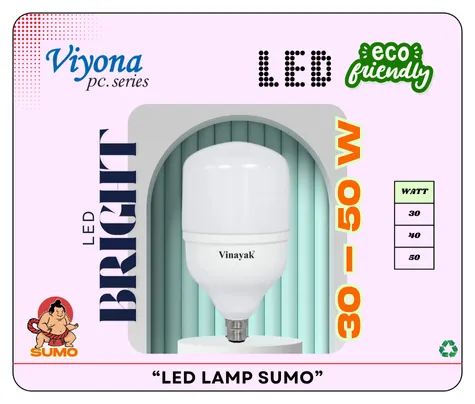
We make LED lamps from 9W (code 1065, ₹70 MRP) to the 50W Sumo (1070B, ₹720). Our catalogue lists them by wattage, not by cap, so confirm the cap with your dealer before ordering a box for a particular job. The LED Lamp Sumo page shows the larger lamps.
One thing to check on big lamps: a heavy, high-wattage LED lamp hanging on a pendant holder puts more weight on the flex and holder than a small bulb. For a 30W to 50W lamp, a batten or angle holder fixed to the surface is the steadier choice. Whether a bulb or a tube suits the room at all is covered in our LED bulb vs tube light guide.
Which bulb holders do we make, and what do they cost?
We make 21 VIYONA holder and ceiling rose codes at our Mumbai works, with angle, batten and pendant holders from ₹24 to ₹65 MRP; our catalogue lists them by pattern, not by cap, so confirm the cap with your dealer when you order.
MRP of our batten holders, by family
MRPs from our current catalogue, bars to scale with ₹65 as the full bar. Each batten holder has an angle twin at the same MRP (201, 211, 206, 213, 217, 221).
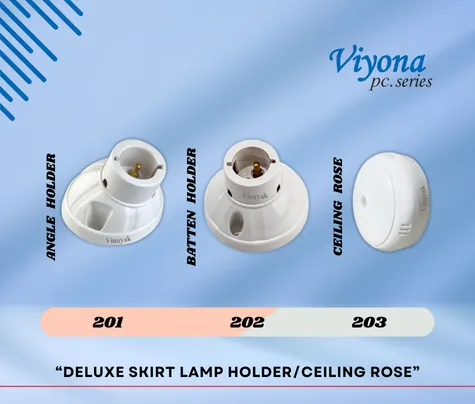
The VIYONA 202 is a polycarbonate Deluxe batten holder at ₹26 MRP, and its angle twin 201 is the same price. The Deluxe skirt holder family is plain polycarbonate; Decent, Sumo, Royal and Square add an aluminium ring at the mouth, where the lamp is pushed and twisted.
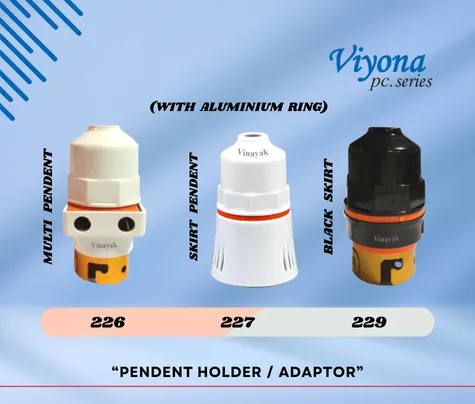
For hanging lamps, the 229 black skirt pendant holder is ₹24 and the 226 multi pendant holder ₹34. The bulb holder and pendant lamp holder pages group the range by use.
How should a B22 or E27 holder be wired?
Both B22 and E27 holders have two terminals, one for the switched phase and one for the neutral, and the rule for both is that the wall switch sits in the phase; on an E27 screw holder the switched phase must also go to the centre contact and the neutral to the threaded shell.
On a B22 holder the two plungers are identical, so either terminal can take the phase, as long as the switch breaks the phase. On an E27 holder the terminals are marked or obvious: centre for phase, shell for neutral. Reversing them leaves the touchable thread live.
The step-by-step job, from stripping to tightening, is in our bulb holder connection guide, and the colour code for phase and neutral is in phase, neutral and earth.
Switch off the MCB for the circuit and confirm the holder is dead with a tester before touching any terminal. A light switch alone may break the neutral, not the phase. Anything beyond swapping a like-for-like holder is a job for a licensed electrician.
B22 or E27: which should you choose for a new home?
For a new Indian home, B22 bayonet holders are the practical choice for ordinary ceiling and wall points because B22 lamps are the cheapest and easiest to find, with E27 kept for decorative pendants, table lamps and imported fittings that arrive with a screw holder built in.
A simple plan: B22 for every plain point, E27 only where the fitting needs it, and E14 only inside a chandelier. Note each room’s cap on the electrical drawing so the spare lamp is right first time.
Buy one holder family across the house so every point matches: our families come as angle and batten twins at the same MRP. A skirt holder is worth it at any point a hand can reach. Packs are 20 per box.
If you are planning the points as well as the holders, our house electrical layout plan goes room by room, and the ceiling rose guide covers the fitting above every pendant.
FAQs
What is the difference between B22 and E27?
Is B22 the same as a pin type bulb?
Can I put an E27 bulb in a B22 holder?
Which is better, B22 or E27?
What does E14 mean on a bulb?
What is the price of a bulb holder?
Why buyers choose Vinayak Electricals
- Angle, batten and pendant holders made in-house at our works in Marol, Andheri East, Mumbai.
- 21 VIYONA holder and ceiling rose codes, from ₹24 to ₹65 MRP.
- Every angle holder has a batten twin at the same MRP, so one family covers the house.
- LED lamps from 9W to 50W in the same catalogue, listed against IS 16102 (Part 1).
- MRPs published openly; sold through 500+ dealers with delivery across India.
- Manufacturing in Mumbai since 1995; ISO 9001:2015 certified.
Bulb holders for every point
See our VIYONA angle, batten and pendant holders with codes and MRPs, then order through a dealer or call us.
View lamp holders