What Is a Ceiling Rose? Wiring, Types and Prices Explained
A ceiling rose is the round fitting on the ceiling where the fixed house wiring meets the flexible cord of a hanging light, so a pendant can be taken down or changed without opening the wiring. Below we explain what a ceiling rose is used for, how a ceiling rose connection is wired, the difference between 2 part, 3 part and square roses, what one can and cannot hold, the standard it is made to, and the MRPs of the roses we make at our works in Mumbai.
Key takeaways
- What it is — a small terminal box on the ceiling that joins the fixed wiring to the flex of a pendant light.
- Connection — switched phase and neutral from the house wiring in; two flex cores out to the pendant, held by a cord grip.
- 2 part vs 3 part — usually the number of terminal plates inside; the third gives room to loop or terminate one more conductor.
- Weight — a rose and its flex carry a light shade only; a heavy fitting or a fan hangs from a hook in the slab.
- Our roses — VIYONA 203 (2 part) ₹28, 204 (3 part) ₹36, 223 square ₹54 MRP.
Ceiling rose: the short answer
A ceiling rose is a small round or square fitting screwed to the ceiling. Inside it are terminal plates. The fixed house wiring, coming down through the slab or along the ceiling from the switch, is clamped into one side of those terminals. The flexible cord of a pendant light is clamped into the other side and held by a cord grip in the cover.
That arrangement does three useful things. It gives the pendant a neat, insulated point to hang from. It lets the pendant be taken down, shortened or replaced by undoing two screws, without touching the house wiring. And it keeps every joint inside an enclosed, non-conducting body instead of a taped twist in the ceiling.
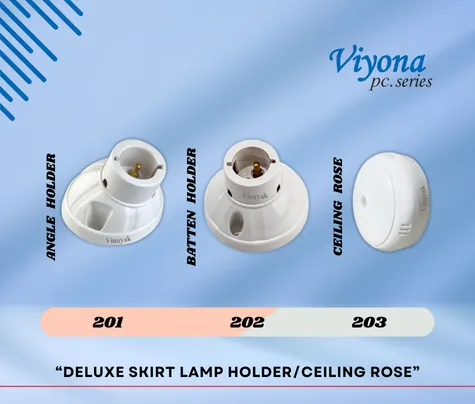
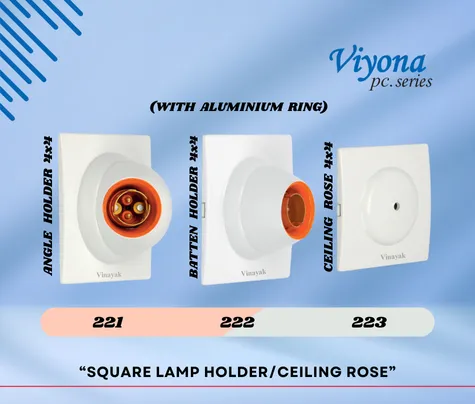
We make three ceiling roses in our VIYONA range at our works in Marol, Andheri East, Mumbai: a 2 part and a 3 part polycarbonate rose and a square rose that matches our square holders. The different holder types that go with them are covered in our electric holder types guide; this page is about the rose itself.
What is a ceiling rose used for?
A ceiling rose is used to connect a hanging light, such as a pendant over a dining table, counter or stairwell, to the fixed wiring in the ceiling, and in older homes it also served as the wiring point for a ceiling fan and as a junction where the lighting circuit looped on to the next point.
Its main uses today:
Pendant lights Decorative hanging shades Loop-in point on old circuits Older ceiling fan points
In a pendant job the rose is the top of a short chain: rose, flex, then pendant holder. The pendant holders we make, the 229, 227 and 226, are on our pendant lamp holder page.
Where a flat has a false ceiling, the rose is often replaced by a junction box above the ceiling and a fitting that takes its supply directly. Our guide to junction box vs concealed box covers that choice.
A ceiling rose is a wiring point, not a hook. Whatever hangs below it should be light enough for the flex to carry.
| 2 part rose | 3 part rose | Square rose | |
|---|---|---|---|
| Our code | 203 | 204 | 223 |
| Body (our catalogue) | Polycarbonate | Polycarbonate | Square, to match square holders |
| Terminal plates (trade usage) | Two: phase and neutral | Three: adds a loop or earth plate | Open one to check |
| Typical use | Single pendant | Pendant with a loop-in or earth | Rooms with square holders |
| Carries | Holder and light shade | Holder and light shade | Holder and light shade |
| Our MRP | ₹28 | ₹36 | ₹54 |
2 part vs 3 part ceiling rose: what is the difference?
In the trade, a 2 part and a 3 part ceiling rose usually differ in the number of terminal plates inside: a 2 part rose has two, for the phase and neutral of a single pendant, while a 3 part rose adds a third plate to loop a conductor on to another point or terminate an earth.
Our catalogue names them 203: 2 part and 204: 3 part, both in polycarbonate, but it does not draw their internal terminal layout. So treat the description above as general trade usage, and open one at the counter to see the plates before buying a box for a particular job.
A practical way to choose:
One pendant, no loop The 2 part rose is enough. Looping on, or an earth to terminate The 3 part rose gives the extra plate. Unsure Ask your electrician which the point needs; the price gap is small.
MRP of our ceiling roses
MRPs from our current VIYONA catalogue, bars to scale with ₹54 as the full bar.
The VIYONA 204 is a three-part polycarbonate ceiling rose at ₹36 MRP, ₹8 more than the two-part 203.
House wiring in, pendant flex out, all inside one enclosed body.
Two plates for one pendant; a third for a loop or an earth.
Heavy fittings and fans hang from a hook fixed in the slab.
Look for the ISI mark and licence number on the rose itself.
How is a ceiling rose connected?
A ceiling rose is connected by clamping the switched phase and the neutral from the house wiring into the supply side of its terminal plates, then clamping the two pendant flex cores into the matching plates, threading the flex through the cover and its cord grip so the grip, not the screws, carries the weight.
Step by step, with the MCB off and the wires tested dead:
1 Pass the house wiring through the hole in the base and screw the base firmly to the ceiling. 2 Clamp the switched phase and the neutral under separate plates; any looped conductor shares the plate of the wire it continues. 3 Thread the flex through the cover first. 4 Secure it in the cord grip. 5 Connect the two flex cores to the phase and neutral plates. 6 Screw the cover on, hang the pendant and test.
The pendant holder at the other end of the flex is wired as our bulb holder connection guide shows. Phase and neutral colours are in phase, neutral and earth.
Switch off the MCB and confirm the point is dead with a tester before opening a rose. A loop-in rose can carry live conductors for other points even when its own switch is off.
Can a ceiling fan be connected through a ceiling rose?
A ceiling fan can take its supply through a ceiling rose or a connector at the ceiling, which was common in older Indian homes, but the rose only joins the wires: the fan’s weight must hang from a proper fan hook or down-rod bracket fixed into the slab, never from the rose or its flex.
Where you find a fan wired through a rose, check three things. The hook The fan should hang from a hook cast into or bolted to the slab. The canopy The rose should sit inside the fan canopy with room to spare, not squashed. Hot or browned plastic means a poor joint; have it remade.
Many modern fans come with a connector block in the canopy instead, and the electrician wires the ceiling supply straight to it. Either way the joint must be enclosed and tight.
The fan’s own parts, the capacitor and the regulator, are covered in our fan capacitor guide and fan regulator types guide.
Never hang a fan from a ceiling rose. A fan swings and vibrates; only a hook or bracket fixed to the slab is designed for that load.
How much weight can a ceiling rose hold?
A ceiling rose is designed to carry only a pendant holder and a light shade on its flex, with the cord grip taking that small pull; anything heavier, such as a glass or metal fitting, a chandelier or a fan, must hang from its own hook or bracket fixed into the slab, with the rose used only for the wiring.
Our catalogue does not give a weight rating for our roses, and we do not quote one. What we can say is general practice: the flex and cord grip are made for the weight of a holder, a lamp and a light shade, not for a fitting you would hesitate to hold in one hand.
Warning signs that a rose is overloaded: the cover pulling away from the base, the flex stretched taut at the grip, or bare copper showing where the flex enters. Switch off and take the fitting down.
For a heavy decorative fitting, ask the electrician for a separate hook in the slab and a chain or rod to it, with the flex hanging slack alongside.
If a pendant has ever been pulled and the flex jerked, check the rose: a cord grip that has slipped leaves the terminals carrying the weight, and they can pull out live.
Which ceiling rose should you choose?
Choose a 2 part ceiling rose for a single pendant with no loop, a 3 part rose where a conductor loops on or an earth must be terminated, and a square rose where the room uses square holders and you want the fittings to match; in every case pick one that carries the ISI mark.
VIYONA 203, 2 part ₹28. Plain polycarbonate, part of our Deluxe skirt holder and ceiling rose family. VIYONA 204, 3 part ₹36, same family. VIYONA 223, square ₹54, to match the square 221 angle and 222 batten holders at ₹65; see the square lamp holder and ceiling rose page.
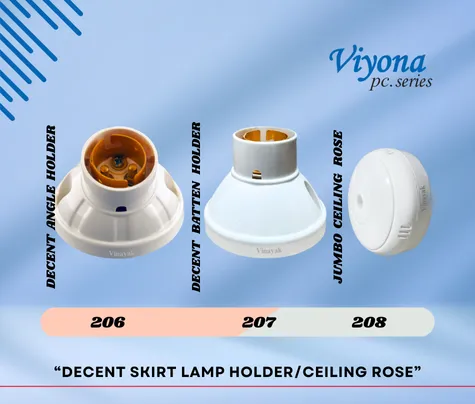
Our Decent family page also lists a jumbo ceiling rose alongside the 206 and 207 holders; our current price list does not give its MRP, so ask your dealer.
Buy roses in the same family as the pendant holders so the colours match, and a few spare: they are cheap, and a cracked one is a ten-minute swap.
What does a pendant drop cost at MRP?
A complete pendant drop from our range, a ceiling rose plus a pendant holder, costs ₹52 to ₹88 at MRP before the flex, shade and lamp: the 2 part rose 203 with the 229 black skirt pendant holder is ₹52, and the square rose 223 with the 226 multi pendant holder is ₹88.
Ceiling rose plus pendant holder, at MRP
Sums of MRPs from our current catalogue, bars to scale with ₹88 as the full bar. Flex, shade and lamp are extra.
Add a lamp: our 9W LED lamp (1065) is ₹70 MRP. Keep pendant lamps light: a big 30W to 50W lamp is better on a fixed batten holder. The cap your lamp needs is explained in B22 vs E27.
What standard does a ceiling rose follow?
In India, ceiling roses are made to IS 371, the Indian Standard for ceiling roses, and a product sold under the ISI mark should carry that mark and a licence number on its body, which you can check against the licence holder’s name before buying a box.
The checks take a minute at the counter: the ISI mark on the product itself, not only the carton; a CM/L licence number beside it; and the maker’s name. A rose with no name and no number is the one to put back.
Our guide to spotting a fake ISI mark shows how to check a licence number in the BIS Care app, and our guide to IS codes for electrical products lists the standards for switches, sockets, holders and MCBs side by side.
The body material matters too. Our catalogue lists the Deluxe roses as polycarbonate, a tough plastic that resists impact. An old cracked bakelite rose is worth replacing the next time the pendant comes down.
Ceiling rose problems: why does it spark or get hot?
A ceiling rose usually sparks, buzzes or gets hot because a terminal screw has worked loose, a flex core has pulled partly out after the cord grip slipped, or old brittle insulation has cracked inside; each one is a poor joint heating up, and the fix is to switch off and remake or replace the rose.
Symptoms and what they point to: burning smell a joint heating now; pendant flickers when touched a loose flex core; brown ring on the ceiling long-term heat; MCB trips a short between cores.
When you remake a rose, cut the flex back to clean copper, re-grip it, and replace the rose if its plastic is discoloured. The same faults at the lamp end are in our bulb holder connection guide.
A rose that heats repeatedly may be on a circuit carrying more than lighting. Our switch getting hot or socket sparking guide covers what heat at a fitting means.
Switch off the MCB before opening a rose and test it dead. If the ceiling around a rose is scorched, call a licensed electrician to check the cable above it.
FAQs
What is a ceiling rose?
What is the use of a ceiling rose?
What is the difference between a 2 part and 3 part ceiling rose?
How do you connect a ceiling rose?
Can I hang a ceiling fan from a ceiling rose?
What is the price of a ceiling rose?
Why buyers choose Vinayak Electricals
- Ceiling roses and pendant holders made in-house at our works in Marol, Andheri East, Mumbai.
- Three roses: 2 part ₹28, 3 part ₹36 and square ₹54 MRP.
- Roses in the same families as our angle, batten and pendant holders, so fittings match.
- Polycarbonate bodies on the Deluxe holders and roses, per our catalogue.
- MRPs published openly; sold through 500+ dealers with delivery across India.
- Manufacturing in Mumbai since 1995; ISO 9001:2015 certified.
Ceiling roses and pendant holders
See our VIYONA Deluxe holder and ceiling rose family with codes and MRPs, then order through a dealer or call us.
View ceiling roses