
Fan Capacitors Explained: Which µF, How It Connects, What It Costs

A fan capacitor is the small part that gives a ceiling fan’s motor its start and keeps it turning at full speed, and for most ordinary ceiling fans its value is commonly in the low single digits of microfarads, printed on the part itself. When it weakens, the fan hums, starts slowly or runs slow at every step. Below: what “AC MFD” means, how to read the rating, how a capacitor connects, why an AC’s tonnage does not tell you its capacitor, and the MRP of every one of our sixteen capacitors.
Key takeaways
- Match the µF. The right capacitor is the value printed on the old one or in the manual; replace like for like.
- Ceiling fans commonly use low values such as 2.25, 2.5 or 3.15 µF; our VIYONA 501 and 502 are ₹38 MRP, 503 is ₹46.
- “AC” means alternating current and MFD means µF; our 501–516 range covers fans, motors and AC units.
- AC tonnage does not decide the capacitor. The label on the AC’s capacitor does; our 20–50 µF parts are ₹170–₹300.
- ⚠ MCB off, prove it dead. Capacitors can hold charge; leave AC units to a technician.
Fan capacitor: what it does and why a fan needs one
A fan capacitor is the small box, usually a plastic or metal can with two or more wires, that sits inside the canopy of a ceiling fan or the casing of a motor. An ordinary single-phase motor cannot start turning on its own from a single supply. The capacitor feeds one of its two windings slightly out of step with the other, which gives the rotor a push in one direction and keeps it running smoothly once it is up to speed.
When the capacitor weakens, the fan does not usually stop dead. It hums, starts slowly or needs a push, and runs slower than it used to at every regulator step. It is a cheap part compared with a new fan.
Larger motors, including those in air conditioners, use the same idea with bigger capacitors. Our VIYONA brand has a range of sixteen AC MFD capacitors.
What does “AC MFD capacitor” mean?
An AC MFD capacitor is a capacitor built for alternating-current circuits, with its value given in MFD, which is simply an older way of writing microfarads (µF); the “AC” refers to the alternating-current supply, not to an air conditioner, so the same term covers fan, motor and AC-unit capacitors.
So 2.5 MFD and 2.5 µF are the same value, and you will see both on labels, invoices and price lists. Our catalogue prints the values as UF, the plain-keyboard spelling of µF. The point about AC = alternating current matters because people searching for an “AC capacitor” may want a fan part, while people with a faulty air conditioner may assume the range is only for fans.
Our sixteen VIYONA capacitors, codes 501–516, cover the whole range of everyday uses: ceiling fans, motors and AC units. What changes between them is the µF value, from 2.25 µF to 50 µF. The table below lists every one with its MRP and box quantity.
The µF value is the number to match. If your old capacitor says 2.5 MFD, you need a 2.5 µF part; they are the same thing written two ways.
| Code | Value | MRP | Per box |
|---|---|---|---|
| 501 | 2.25 µF | ₹38 | 48 |
| 502 | 2.5 µF | ₹38 | 48 |
| 503 | 3.15 µF | ₹46 | 48 |
| 504 | 4 µF | ₹62 | 48 |
| 505 | 5 µF | ₹76 | 24 |
| 506 | 6 µF | ₹90 | 24 |
| 507 | 8 µF | ₹98 | 30 |
| 508 | 10 µF | ₹100 | 50 |
| 509 | 12.5 µF | ₹120 | 50 |
| 510 | 15 µF | ₹130 | 50 |
| 511 | 20 µF | ₹170 | 25 |
| 512 | 25 µF | ₹175 | 25 |
| 513 | 30 µF | ₹220 | 25 |
| 514 | 36 µF | ₹256 | 25 |
| 515 | 45 µF | ₹270 | 25 |
| 516 | 50 µF | ₹300 | 25 |
What is the right fan capacitor rating for a ceiling fan?
The right fan capacitor rating for a ceiling fan is the µF value printed on the fan’s existing capacitor or in its manual, and for an ordinary ceiling fan that value is commonly in the low single digits, such as 2.25, 2.5 or 3.15 µF; always replace like for like with the same µF.
Our three smallest values are the ones fan owners usually ask for: 501: 2.25 µF, 502: 2.5 µF and 503: 3.15 µF. Larger values in the range, such as 4 µF to 10 µF, serve motors whose label calls for them; the label on the part decides it, not the appliance type.
Read the label first. It typically shows the µF value, often a tolerance and other markings. Two fans that look alike can use different values.
A capacitor of the wrong µF can make a motor run badly and may stress it. Match the value on the old part exactly; if the label is unreadable, check the fan’s manual or ask the fan maker.
Low values such as 2.25, 2.5 and 3.15 µF are common; read the old label.
Values from 4 to 15 µF in our range, for motors whose label calls for them.
Compressor capacitors run larger, 20 to 50 µF in our range; the AC’s own label decides.
Same µF as the part you remove, every time.
Fan capacitor price: what do our capacitors cost?
Our VIYONA fan capacitors cost ₹38 MRP for the 2.25 µF and 2.5 µF values most ceiling fans use, ₹46 for 3.15 µF, and up to ₹300 for the 50 µF capacitor at the top of the range, with every value from 501 to 516 printed in our current catalogue.
VIYONA 501 is a 2.25 µF AC MFD capacitor with an MRP of ₹38, and VIYONA 503 is a 3.15 µF capacitor with an MRP of ₹46. In the middle of the range, 508: 10 µF is ₹100, and at the top, VIYONA 516 is a 50 µF AC MFD capacitor with an MRP of ₹300.
Our AC MFD capacitors: MRP by µF (current catalogue)
Printed MRP per piece from our current catalogue, codes 501 to 516. Bar length is proportional to MRP; the full bar is ₹300 (code 516, 50 µF).
These are printed MRPs per piece; your dealer’s price can be lower. We supply in full boxes only, so a dealer orders a box and sells you the single piece you need.
Why does a bigger capacitor cost less per µF?
A bigger capacitor costs more in total but less per microfarad: in our range the 2.25 µF part works out at about ₹16.89 per µF, while the 45 µF and 50 µF parts work out at ₹6.00 per µF, since every capacitor needs a case, terminals and assembly whatever its value.
MRP per µF: what each microfarad costs across our range
MRP divided by µF, worked out from our catalogue MRPs. Bar length is proportional to rupees per µF; the full bar is ₹16.89 (code 501, 2.25 µF). A lower figure is not a reason to pick a different value: always fit the µF your fan or AC states.
The pattern is broadly downward: ₹14.60–₹16.89 per µF up to 6 µF, falling to ₹10 at 10 µF and to ₹6.00–₹7.33 per µF from 25 µF up. 501 and 502 share the ₹38 MRP.
This is a pricing curiosity, not buying advice. A capacitor is chosen by the µF its appliance needs, never by which value is cheapest per µF.
Fan capacitor 2.5 mfd: when is it the right one?
A 2.5 mfd fan capacitor is the right one when the capacitor you are replacing, or the fan’s manual, says 2.5 MFD or 2.5 µF; it is one of the values commonly used in ordinary ceiling fans, but it is not interchangeable with a 2.25 µF or 3.15 µF part.
VIYONA 502 is a 2.5 µF AC MFD capacitor with an MRP of ₹38, packed 48 to a box. The neighbouring values are 501: 2.25 µF, ₹38 and 503: 3.15 µF, ₹46. All three come in boxes of 48.
If your fan hums or runs slow and the old label reads 2.5 MFD, check two things before buying. First, the number on the label: read it, do not assume. Second, the number of wires and how the old one was fitted, so the new part connects the same way.
Take the old capacitor to the counter. Matching a label by eye is faster and safer than describing it over the phone.
How do I know a fan capacitor is failing?
A failing fan capacitor typically shows itself through a fan that hums but will not start, starts only when pushed by hand, takes a long time to reach speed, or runs noticeably slower than before at every regulator setting, while the lights and other points on the same circuit work normally.
The common signs, in the order people usually notice them: slow at every step, then slow to start, then hums, will not start. A fan that needs a push to start is a classic capacitor symptom. A capacitor that looks swollen, cracked or leaking should be replaced, and the fan not used until it is.
Not every slow fan is a capacitor problem. A regulator fault can make a fan slow at some steps but not others, which is where our guide to fan regulator types helps. If a new capacitor of the correct µF does not fix it, stop and have an electrician check the fan and the board.
A fan that hums without turning is drawing current and getting warm. Switch it off rather than leaving it on and hoping it starts.
Fan capacitor connection: how is it wired?
A ceiling-fan capacitor is connected between the run and start terminals of the fan’s motor, so it sits in series with the start winding: the switched phase from the switch and regulator feeds both windings, one directly and one through the capacitor, and the windings’ common end goes to neutral.
Fan capacitor connection, concept only
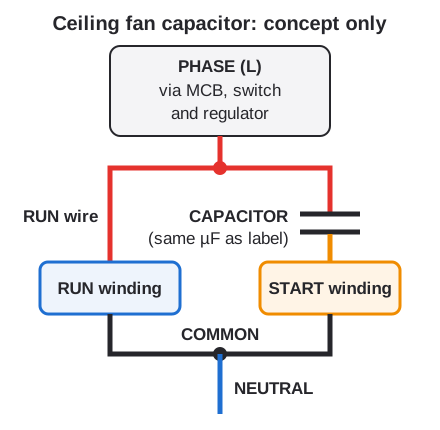
A concept drawing, not a wiring instruction. Fans differ in wire colours and terminal markings; the label on your fan or its capacitor is the one to follow, and a licensed electrician should make the connection. Tap the diagram to open it full size.
Every fan capacitor wiring diagram shows this same idea. In practice the motor’s wires come out as common, run and start, and wire colours vary between fan makers, so follow the fan’s own wiring label, not a colour you saw on another fan. The supply side, from the board to the fan, is the same as any fan point: phase through the switch and regulator, neutral direct.
Our switch board wiring diagram shows how the fan’s phase leaves the board. The capacitor work happens at the fan, with the MCB off and the circuit proved dead.
What capacitor does a 1.5 ton AC need?
A 1.5 ton AC needs the capacitor whose µF value is printed on the AC unit’s existing capacitor or in its service documents; the tonnage does not decide the capacitor, because two 1.5 ton units from different makers, or with different compressors, can use different values.
The same goes for a 1 ton or a 2 ton AC. Tonnage is cooling capacity, not an electrical rating, so any chart mapping tonnage to µF is a guess. The label on the capacitor is the answer. AC units commonly use much larger values than fans for the compressor, and some carry more than one capacitor or a dual one with two values in one can, which a single-value part does not replace like for like, so the technician reads every label before ordering.
Our larger values cover this end of the range, from 20 µF to 50 µF. If the AC keeps tripping its breaker at start-up, a tired capacitor is one possible cause; our guide to the MCB for an AC covers the others.
Leave AC unit capacitors to a technician. Capacitors can hold a charge after the power is off, and the outdoor unit has other live parts close by.
AC capacitor price and replacement cost
Our AC capacitor prices run from ₹170 MRP for 20 µF to ₹300 for 50 µF, with 25, 30, 36 and 45 µF in between; the replacement cost you pay also includes the technician’s visit and labour, which we do not set and which varies by city and service provider.
VIYONA 515 is a 45 µF AC MFD capacitor with an MRP of ₹270, and the 50 µF part, code 516, is ₹300. The rest of the top of the range: 511: 20 µF, ₹170, 512: 25 µF, ₹175, 513: 30 µF, ₹220 and 514: 36 µF, ₹256. These six are packed 25 to a box.
When you get a quote for an AC capacitor replacement, ask the technician to name the µF and show you the old part. A capacitor costs a few hundred rupees at MRP, so most of a replacement bill is labour and the visit.
Keep the old capacitor until the AC has run normally for a few days. It is your record of the value that was fitted.
Replacing a fan capacitor safely
Replacing a fan capacitor is a simple part swap in principle, but it is done at ceiling height inside the fan canopy, close to the supply wires, so it starts with the circuit isolated at the MCB, the fan proved dead with a tester, and, if you are at all unsure, a licensed electrician.
The order of safety steps: MCB off, then prove it dead at the fan with a tester. Handle the old capacitor by its body and insulated leads, never its bare terminals, because a capacitor can hold a charge for a while after the power is off. Note or photograph how the old capacitor was connected before anything is moved, and fit a new one of the same µF the same way.
If the fan is still slow afterwards, or the MCB trips, switch off and call an electrician. Our electrical safety tips for Indian households cover the habits that apply to every job like this.
Never work on a fan with the switch off but the MCB on. A switch breaks only one wire, and a miswired board can leave the fan live.
Ordering our capacitors: boxes, dealers and the full range
We sell capacitors alongside our switches, MCBs and regulators, so an electrician can stock a whole fan point from one company. Our VIYONA AC MFD capacitor page shows the range, and the regulator guide covers the other half of a fan’s speed control.
Box quantities follow the size of the part: 48 per box for 501 to 504, 24 per box for 505 and 506, 30 per box for 507, 50 per box for 508 to 510, and 25 per box for 511 to 516. We sell full boxes only, never single pieces, through 500+ dealers across India.
We do not sell online. Dealers and electricians order by phone or visit us, and we deliver all-India, with 15-day returns in the same condition. More on who we are is on our electrical accessories company page, made in Mumbai since 1995 and ISO 9001:2015 certified.
Dealers: stock the three small fan values (501, 502, 503) deepest. They are the ones homeowners walk in asking for.
FAQs
What is the price of a fan capacitor?
Which capacitor is used in a ceiling fan?
What does 2.5 mfd mean on a capacitor?
What capacitor does a 1.5 ton AC need?
Can I buy a single fan capacitor from you?
Can I use a higher µF capacitor in my fan?
Why buyers choose Vinayak Electricals
- Sixteen AC MFD capacitor values, 2.25 µF to 50 µF, for fans, motors and AC units.
- MRPs printed openly in our catalogue, from ₹38 to ₹300.
- Sold under our VIYONA brand by Vinayak Electricals, Mumbai, since 1995; ISO 9001:2015 certified.
- Regulators, switches and MCBs from the same maker for the whole fan point.
- Sold through 500+ dealers with all-India delivery, in full boxes.
- 15-day returns in the same condition.
Capacitors for every fan and motor
See the VIYONA AC MFD capacitor range, 2.25 µF to 50 µF.
View capacitors