Fan Regulator Connection: The Wiring, Drawn Out
A fan regulator connection diagram has three wires and one rule: the regulator goes in series with the fan on the phase wire, after the fan switch, while neutral and earth run to the fan without passing through the switch or regulator. Below we draw that connection, explain what a 4 step regulator does inside its box, separate the regulator from the fan’s capacitor, show how a regulator fits a modular board with our catalogue codes and MRPs, and list the mistakes that leave a fan live when it is switched off.
Key takeaways
- Connection — MCB → fan switch → regulator → fan, all on the phase; neutral and earth never pass through the switch or regulator.
- Never on neutral — a switch or regulator on the neutral leaves the fan live when it is turned off there.
- Capacitor — the fan’s capacitor sits in its canopy and is not the regulator; match its µF and voltage when replacing.
- BLDC with remote — usually a plain switch, no regulator, unless the fan maker’s manual explicitly allows one.
- Our regulators — 4 and 5 step, MRP ₹215 (VIYONA 137) to ₹495 (KEMPS K614 in G.Grey).
Fan regulator connection: the short answer
A fan regulator is connected in series with the ceiling fan on the phase wire: phase comes from the MCB to the fan switch, from the switch to the regulator, and from the regulator up to the fan. The neutral and the earth do not pass through the switch or the regulator at all; they run from the DB to the fan point, even when the neutral is looped through the switch board box on the way.
That one sentence is the whole fan regulator connection diagram. Everything else on this page is detail: how a 4 step regulator changes speed inside its box, how the fan’s own capacitor fits in, how much room a regulator takes on a modular board, what changes with a BLDC fan and a remote, and the mistakes we hear about from electricians at the counter.
We make fan regulators, dimmers and switches at our works in Andheri East, Mumbai, under our KEMPS, VIZA and VIYONA ranges, so every code and price quoted below is a printed MRP from our current catalogue. We do not make fans. For anything inside the fan itself, the fan maker’s manual decides.
Fan regulator connection diagram, drawn out
The diagram below shows one ceiling fan point the way most Indian homes wire it: a single pole MCB in the DB, a fan switch and a regulator on the switch board, and a ceiling rose or fan box above.
Fan regulator connection diagram: supply, switch, regulator, fan
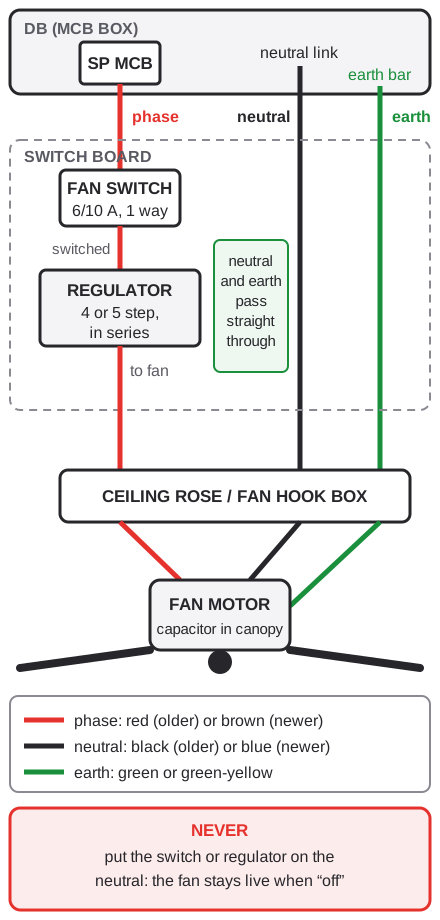
Drawn by us, simplified to one fan point. Older homes often use red for phase and black for neutral; newer wiring often uses brown and blue, the internationally harmonised colours. Colour is only a hint: test before you touch. Tap the diagram to open it full size.
Follow the red line. Phase leaves the SP MCB, enters the fan switch, comes out as a switched phase, goes into the regulator, and leaves the regulator for the fan. The neutral goes from the neutral link to the fan, passing the switch board box without touching the switch or regulator. The earth goes to the fan’s body and hook.
Because the switch and regulator sit on the phase, turning the switch off leaves the fan wiring dead, not just stopped. Put either of them on the neutral and the fan stops, but its wiring stays live, which is how people get a shock while cleaning blades or changing a capacitor.
Switch and regulator go on the phase, never the neutral. A fan that stops when switched off is not proof the wiring is dead; check with a tester.
| Control | How it connects | Use it for | Our example |
|---|---|---|---|
| 4 step fan regulator | In series on the phase, after the fan switch | Ordinary ceiling fan | VIYONA 137, ₹215; VIZA V275, ₹340 |
| 5 step fan regulator | In series on the phase, after the fan switch | Ordinary ceiling fan, finer low speed | VIYONA 138, ₹225; KEMPS K214, ₹450 |
| Plate type regulator | In series on the phase, on its own plate | Conventional board, on its own plate | VIYONA 145, ₹230 |
| Light dimmer | In series on the phase | Dimmable lamps only, never a fan | KEMPS K211 450 W, ₹275 |
| Plain on/off switch | On the phase, no regulator | BLDC fan with remote, unless its manual allows a regulator | VIZA V000 6 A, ₹45 |
| Resistor regulator | In series on the phase | Found in old homes; runs warm | Not made by us |
Fan regulator connection, step by step
A licensed electrician connects a fan regulator in five steps: power off at the MCB, identify the phase, take the switch output to the regulator’s input, take the regulator’s output to the fan wire, and leave neutral and earth untouched by the board.
1. Power off. Switch off the fan circuit’s MCB, not just the wall switch, and confirm with a voltage tester or multimeter that nothing in the box is live.
2. Find the phase. Identify the incoming phase at the board. Do not go by colour alone in an old Mumbai flat where wiring has been patched over the years.
3. Switch to regulator. Take the switch output to one regulator terminal. Most regulators print which terminal is which; follow the marking on the product.
4. Regulator to fan. Connect the other regulator terminal to the wire that runs up to the fan point. The fan’s neutral comes from the DB’s neutral link, often looped through the switch board box, but never through the switch or regulator.
5. Tighten and test. Screw terminals fully tight, no bare copper showing, then power on and run every step from slowest to full.
Our modular 4 and 5 step regulators clip into the same frame as the switches. Our switch board wiring diagram shows how the rest of the board is looped, and fan regulator types compares the regulators themselves.
Switch and regulator both sit on the phase wire, in series with the fan.
The fan’s own capacitor lives in its canopy; the wall regulator only sets the speed.
Modular regulators take one or two modules; check the width before choosing the plate.
A licensed electrician switches off the MCB and tests before touching the board.
4 step fan regulator circuit diagram: what happens inside the box
Inside a 4 step fan regulator, a rotary selector chooses how much the regulator holds back the voltage reaching the fan; the lower steps drop more voltage and the top step passes nearly all of it, so the fan runs at four speeds plus off.
There are three ways a regulator does that. The old resistor type drops voltage across a wire coil and burns the difference as heat. A capacitor step type puts a capacitor of a chosen value in series with the fan; a capacitor limits the AC current by its reactance rather than by burning it, so it wastes far less. A TRIAC type chops part of each AC cycle off electronically.
Each has a trade-off. Resistor regulators run warm. TRIAC regulators can make a fan hum at low speed, because the chopped waveform is not a smooth sine wave. Capacitor step regulators are generally quiet, but the speed on each step depends on the fan they are paired with.
Our catalogue lists our regulators as electronic EME step regulators under HSN 84149030, in 4 step and 5 step versions. A 5 step gives one extra setting between slow and full, not a faster top speed; our 4 step and 5 step guides compare them.
Whatever is inside, the outside wiring is the same: two connections, in series, on the phase.
Capacitor for fan connection: the fan’s capacitor is not the regulator
The capacitor for a fan connection sits inside the fan’s canopy, wired to the motor’s windings by the fan maker’s diagram; it helps the motor start and run, and it is a separate part from the regulator on the wall, which only sets the speed.
People mix the two up because both involve capacitors and both affect speed. A fan with a weak capacitor typically starts slowly, needs a push, or runs slow even on full. A new regulator will not fix that. A faulty regulator usually shows as a step that does nothing or a fan stuck at one speed.
When the fan capacitor is replaced, match the µF value and voltage printed on the old one, and connect it exactly as the fan maker’s wiring diagram shows. From our catalogue, the 501 AC MFD capacitor is 2.25 µF at MRP ₹38, the 502 is 2.50 µF at MRP ₹38, and the 503 is 3.15 µF at MRP ₹46; the label printed on them reads 440 V AC.
Our fan capacitor guide covers values and the signs of a failing one in more detail.
A capacitor can hold a charge after power is off. Your electrician discharges it before handling, and never fits a value other than the one the fan maker specifies.
Wiring a regulator into a modular switch board
On a modular board, the fan regulator clips into the frame like a switch, takes one or two modules depending on the model, and must be counted with the switches and sockets when you choose the plate size.
Width is in the catalogue name for our VIZA Royal regulators: the V278 1M Royal EME 4 step at MRP ₹360 takes 1 module, and the V279 2M Royal EME 5 step at MRP ₹425 takes 2 modules. For our other models, count the width from the product or ask your dealer before you order the plate. Our 1 module and 2 module guide explains the counting.
A typical bedroom board in a Powai 2BHK might hold a light switch, a fan switch, a regulator and a 6 A socket. Swap a 1M regulator for a 2M one and the board may need the next plate size. The plate size calculator does the sum. Our plates start from 1M upwards, are UV-protected and carry a 5-year warranty.
One fan point’s controls: switch + 4 step regulator, by range (MRP)
Catalogue MRPs, white finish: KEMPS K101 10AX 1 way ₹65 + K213 Tiny EME 4 step ₹405; VIZA V000 6 A 1 way ₹45 + V275 Tiny EME 4 step ₹340; VIYONA 101 deluxe 1 way ₹22 + 137 mini 4 step ₹215. Plate and box not included. Bars to scale against ₹470, rounded to 5%.
Keep the regulator from the same range as the switches beside it: KEMPS in a KEMPS frame, VIZA in a VIZA frame. See KEMPS modular and VIZA modular.
Our fan regulator codes and MRPs
Our fan regulators run from MRP ₹215 for the VIYONA 137 mini 4 step on a conventional board to MRP ₹495 for the KEMPS K614 Duro EME 5 step in G.Grey; in white, the KEMPS K214 is ₹450, with the VIZA modular regulators in between.
Our fan regulators by MRP (current catalogue)
Printed MRPs, white unless stated; VIZA Black is the matt black range. In G.Grey, KEMPS K613 is ₹440 and K614 ₹495. Bars to scale against ₹450, rounded to 5%.
For a conventional piano-style board, VIYONA has the 137 mini 4 step at ₹215, the 138 medium 5 step at ₹225 and the 145 ABS plate type 5 step at ₹230, which comes on its own plate. See the VIYONA range.
Matt black boards take the VIZA Black V1276 4 step at ₹374 or the V1277 5 step at ₹433. All are sold in full boxes through dealers, not as single pieces. Our fan regulator price list has the dimmers alongside.
Within one range, the 5 step costs ₹10 (VIYONA) to ₹59 (VIZA Black) more than the 4 step.
BLDC fan with a remote: where does the regulator go?
A BLDC fan sold with a remote usually goes on the board with no regulator at all: the fan’s own electronics control the speed, and fan makers state that most BLDC fans are meant to be run from their own remote or app, not from a wall regulator.
A BLDC fan runs on an electronic controller inside the fan. One fan maker’s guide puts it plainly: a BLDC fan does not work with an old mechanical wall regulator. So the usual connection is: phase from the MCB, through an ordinary on/off switch, straight to the fan, with neutral and earth as before. Speed comes from the remote or app.
If the fan maker’s manual explicitly allows a wall regulator, follow it; otherwise assume no regulator.
On a modular board, the space the regulator used can take a blank plate or a socket. Our KEMPS K218 blank plate is MRP ₹24 and the VIZA V284 1M blank is MRP ₹20. More in our BLDC fan regulator guide.
Changing one fan in a room to BLDC? Change that fan’s regulator position to a plain switch at the same time, before the new fan is switched on.
Common fan regulator connection mistakes
The four fan regulator connection mistakes we hear about most are a regulator wired on the neutral, a light dimmer used in place of a fan regulator, a regulator left in circuit on a remote-controlled BLDC fan, and loose terminals that heat up.
Regulator on the neutral. The fan still slows down, so nobody notices, but when it is turned off at the regulator, the fan stays live. It usually happens when a board is re-done and the loop wires are swapped.
A dimmer for a fan. A light dimmer is made for lamps. Fan control makers warn that a standard dimmer can damage a fan motor; on a fan it may hum or overheat. Our dimmers, such as the KEMPS K211 Tiny 450 W at ₹275, are for lighting loads only. See dimmers for LED lights.
Regulator on a BLDC fan with a remote. Covered above: bypass it unless the fan maker’s manual explicitly allows a regulator.
Loose or overlapping terminals. A half-tight screw on a regulator in a humid July can heat, discolour the plate and make the speed jump. Strip only enough wire to fit the terminal.
A regulator that is hot to touch, smells of burning or has a scorched plate: switch off at the MCB and have it replaced.
Fan humming, not slowing, or stuck at full: reading the symptoms
If a fan hums only at low steps, suspect the regulator type or a mismatch with the fan; if it runs at full speed on every step, suspect a regulator that is bypassed or failed short; and if it is slow even at full, suspect the fan’s capacitor before the regulator.
Hums on low steps only: common with TRIAC-type speed controls and with dimmers used as regulators. Try a step regulator from the same range as the board before blaming the fan. Full speed on every step: the regulator may be bypassed (its two wires joined), or failed short. Slow on full, needs a push to start: usually the fan capacitor.
No change at one step: a worn step contact inside the regulator. Fan runs when switched off: the switch has failed shut or is bypassed, or a phase wire reaches the fan without passing through it; stop using that point until an electrician has checked it. A switch on the neutral does the opposite: the fan stops, but its wiring stays live.
Our fan humming noise guide goes through the mechanical causes too, such as a loose canopy or blade. For what a fan actually draws on each setting, see ceiling fan power consumption.
Swap one part at a time. Change the regulator and the capacitor together and you will never know which one was faulty.
Safety: MCB, wire size and who should do the work
Fan regulator wiring is fixed wiring, so the safe way is a licensed electrician, the circuit’s MCB switched off first, and a light and fan circuit protected by a 6 A or 10 A MCB on 1.5 sq mm copper wire, which is common practice in Indian homes.
The MCB protects the wire, so its rating must not exceed what the wire can carry. A light and fan circuit is commonly 1.5 sq mm on a 6 A or 10 A MCB. An MCB carries its rated current continuously and trips on sustained overload above it or short circuit. Our VIYONA 401 single pole MCB, 6 to 32 A, is MRP ₹145; see which MCB for home.
An RCCB, 30 mA, adds protection against earth leakage for the whole house; we do not make RCCBs, but your electrician will advise one. The fan’s body and hook must be on a sound earth: how to check earthing.
Never work on a fan point with only the wall switch off. Switch off the MCB, test, and if someone gets a shock, follow electric shock first aid.
FAQs
How do you connect a fan regulator?
Fan regulator ka connection kaise kare?
Can a fan regulator be connected on the neutral wire?
What is the difference between the fan capacitor and the fan regulator?
Does a BLDC fan need a regulator?
Can I use a dimmer as a fan regulator?
Why buyers choose Vinayak Electricals
- Fan regulators in 4 and 5 step under KEMPS, VIZA and VIYONA, from MRP ₹215 (VIYONA 137) to ₹495 (KEMPS K614 in G.Grey).
- Matching switches, dimmers and blank plates in the same range, so one board stays one design.
- Switches made under ISI licence IS 3854 CM/L-7567794; VIYONA MCBs under IS/IEC 60898-1 CM/L-2544151.
- Making electrical accessories since 1995, today at our works in Andheri East, Mumbai; ISO 9001:2015 certified.
- MRPs printed openly in our e-catalogue.
- All-India delivery through 500+ dealers and distributors, in full boxes.
Fan regulators for every board
See our 4 and 5 step regulators in KEMPS, VIZA and VIYONA, then order through a dealer or call us.
Vinayak Electricals is a fan regulator manufacturer in Mumbai, supplying dealers, electricians and contractors across India by the box. Ask us for prices and stock.
View fan regulators WhatsApp for prices Download catalogue