4 step fan regulator: speeds, wiring and our codes
Key takeaways
- Four fixed speeds plus off: step 1 slowest, step 4 full speed.
- Connected in series in the phase, after the fan switch; neutral goes straight to the fan.
- Our 4 step codes: VIYONA 137 ₹215, VIZA V275 ₹340, V278 ₹360, V1276 ₹374, KEMPS K213 ₹405.
- V278 is 1M, so it fits a 4M plate beside three switches.
- Suits living rooms, halls, kitchens and offices.
What is a 4 step fan regulator?
A 4 step fan regulator gives a ceiling fan four fixed speeds and an off position. Turn the knob clockwise from OFF and each click moves the fan up one step, from step 1, the slowest, to step 4, full speed. Nothing in between: that is what makes it a step regulator rather than a smooth one.
Our VIYONA 137 is printed as an electronic regulator: it controls the power reaching the fan electronically instead of burning the surplus in a coil, as the old heavy resistor regulators did. Our VIZA and KEMPS 4 step codes are printed as EME regulators (Tiny EME, Royal EME); ask us about the EME types. All of them are compact enough for their board.
The 4 step knob and how it is connected
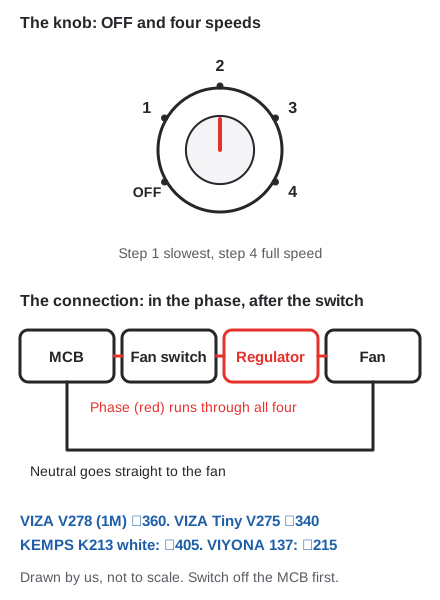
Drawn by us, not to scale. The regulator sits in the phase after the fan switch; the neutral goes straight to the fan.
4 step fan regulator price
We make a 4 step regulator in every range, so there is one to match any board. Printed MRPs and box quantities:
- VIYONA 137 mini 4 step regulator: ₹215, box of 10 (conventional boards)
- VIZA V275 Tiny EME 4 step regulator: ₹340, box of 15
- VIZA V278 1M Royal EME 4 step regulator: ₹360, box of 15
- VIZA black V1276 Tiny EME 4 step regulator: ₹374, box of 15
- KEMPS K213/K613 Tiny EME 4 step fan regulator: ₹405 white, ₹440 G.Grey, box of 10
4 step fan regulator price by code
Printed MRPs from our current catalogue. Bars to scale.
The full list, with the 5 step regulators and dimmers, is in our fan regulator price list.
We sell in full boxes only: 15 regulators for the VIZA codes, 10 for KEMPS and VIYONA. Homeowners buy through our dealers; a contractor fitting out a building can order by the box through our office, with delivery all over India. When ordering KEMPS, give both the code and the colour, since K213 and K613 are the same regulator in white and G.Grey.
| Code | Range | Board | MRP |
|---|---|---|---|
| 137 | VIYONA mini | Conventional | ₹215 |
| V275 | VIZA Tiny | Modular | ₹340 |
| V278 | VIZA Royal, 1M | Modular | ₹360 |
| V1276 | VIZA black Tiny | Modular | ₹374 |
| K213 / K613 | KEMPS Tiny, white / G.Grey | Modular | ₹405 / ₹440 |
The 1 module 4 step: V278
The V278 is the only regulator in our catalogue printed as 1M, one module wide. That matters on a small board. A 4M plate holds three switches and the V278; a 2M regulator in the same plate would leave room for only two switches.
It is named for our VIZA Royal series, so it sits naturally beside the Royal 1M switches, V141 to V148, under a VIZA Royal plate. A 4M Royal plate with three Royal switches and the V278 gives a complete door board for a light, a second light and the fan.
The catalogue does not print a module size for the Tiny regulators (V275, V1276, K213), so confirm with your dealer before you choose the plate. Our modular plate sizes guide shows what fits each plate.
Buy the regulator before the plate. If the plate is sized first, a regulator that turns out to need two modules will not fit.
Step 1 slowest to step 4 full speed, plus off.
Fan switch, then regulator, then fan.
V278 fits a small plate beside three switches.
VIYONA 137 for conventional boards.
Which rooms suit 4 steps
Four steps is enough wherever the fan is mostly run fast: a living room, a hall, a kitchen or an office. In these rooms people tend to use the top two steps through the day and the lower ones only on cool evenings, so a finer split of the slow end adds little.
- Living room Fan mostly at steps 3 and 4 while the room is in use.
- Kitchen High steps for the heat; drop a step if the draught disturbs a gas flame.
- Office or shop A fixed speed through the working day.
- Children’s room Fine on 4 steps by day; consider 5 steps if it is also where they sleep.
Where you want fine control at low speed, such as a bedroom at night, a 5 step regulator gives one more position in the same range. Our 5 step fan regulator guide covers that case, and the fan regulator types guide compares the two in general.
What each step does to the fan
Each step lets a little more power through to the fan motor, so the fan turns faster. At step 4 the fan gets close to the full supply and runs at its rated speed; at step 1 it gets much less and turns slowly.
On an electronic regulator, such as our VIYONA 137, the power the fan does not take is not burnt off as heat in the regulator, so running the fan on a lower step does reduce what it draws. An old resistor regulator did not do this in the same way: it slowed the fan by turning the difference into heat in its coil.
How much a fan draws at each step depends on the fan, not on the regulator, and our catalogue does not print a figure for it. Our ceiling fan power consumption guide gives typical watts for normal and BLDC fans.
Leaving a fan on step 2 or 3 through a mild evening is a simple way to cut its running cost on an electronic regulator.
Old resistor regulator or one of ours
Many older flats still have a resistor regulator: a large, heavy square knob that runs warm. Our 4 step regulators differ from it in three practical ways:
- Size Ours clip into a modular plate (the V278 is printed as 1M) or come in a mini VIYONA body, instead of a deep box.
- Heat The VIYONA 137 is printed as electronic, so it does not burn the surplus power as heat; ask us about the EME types.
- Steps The four positions are the same idea: off, then four speeds, slowest first.
If you are moving from a conventional board to modular at the same time, the regulator moves with the switches into the new plate. Our modular vs normal switch guide covers that upgrade, and the fan regulator types guide explains the resistor type in more detail.
4 step fan regulator connection
A fan regulator is connected in series with the fan, in the phase wire, after the fan switch. Follow the phase from the board: MCB, fan switch, regulator, fan. The neutral is never switched or regulated; it goes straight to the fan.
- The switch turns the fan on and off; the regulator only sets the speed.
- The wire from the fan switch goes to the regulator’s input; the wire to the fan leaves from its output.
- Use the terminal markings on the module; they differ between designs.
Our switch board wiring diagram shows the regulator in a full board.
Switch off the MCB and prove the board dead with a tester before you open it. A regulator must never be fitted in the neutral.
Replacing an old regulator
Swapping an old resistor regulator, or a failed electronic one, for one of ours is a common small job:
- Switch off the MCB for that circuit and check the board is dead.
- Remove the plate and the old regulator; note which wire came from the switch and which goes to the fan.
- Connect the two wires to the new regulator in the same order and clip it into the frame.
- Refit the plate, switch on, and check every step from 1 to 4.
On a conventional board the VIYONA 137 mini takes the old regulator’s place; check the size of the cut-out before you buy. On a modular board, match the regulator to the plate series. Our switch replacement guide covers the safe way to work on any board.
Mistakes to avoid
A few mistakes come up again and again with 4 step regulators:
- A dimmer on a fan A light dimmer is not a fan regulator. On a fan motor it can cause humming and overheating.
- Hum at step 1 A low hum at the slowest step can come from the fan’s capacitor as well as the regulator; see our fan humming guide.
- BLDC fan Many BLDC fans set their own speed by remote and are meant for a plain switch. Read the fan’s sheet; our BLDC regulator guide explains.
- Loose wiring A warm plate or a crackle when turning the knob means a loose terminal. Switch off and have it tightened.
A fan that runs slow at every step, even step 4, usually needs a new capacitor, not a new regulator; a capacitor is a far cheaper part. Our fan capacitor guide explains the signs, and our capacitor guide lists the MFD values we make.
What a fan point costs with a 4 step
The regulator is the dearest part of a fan point. Add the fan switch and here is what one fan point costs in each range, before the plate and box:
One fan point with a 4 step regulator, at MRP
Our arithmetic from printed MRPs: 101 ₹22 + 137 ₹215; V541 ₹56 + V278 ₹360; K101 ₹65 + K213 ₹405.
For a whole board, our switch board price guide adds the plate and box. For billing, the HSN code printed for all our regulators is 84149030.
Where we supply
The 4 step regulators on this page are made at Marol, Andheri East and sold through dealers and distributors across Maharashtra and in many states. Beyond the state, see where we supply in Maharashtra and how we supply the rest of India. Office orders are delivered all over India in full boxes. Full boxes only.
From our catalogue: VIYONA mini 4 step regulator and the VIZA switches, sockets and regulators.
FAQs
What is a 4 step fan regulator?
What is the price of a 4 step fan regulator?
How do you connect a 4 step fan regulator?
Is a 4 step or 5 step regulator better?
Is your 4 step regulator 1 module?
What is the HSN code for a fan regulator?
Why buyers choose Vinayak Electricals
- Made in our own works at Marol, Andheri East, Mumbai, since 1995.
- ISO 9001:2015 certified; BIS licence CM/L-7567794 to IS 3854 for switches. Ask us which codes carry the ISI mark.
- Switches, sockets, MCBs, boxes, regulators and LED lights: 2,000+ products from one maker.
- Printed MRPs, published code by code in our catalogue.
- Warranty of 5 to 10 years by product.
- Dealers and distributors across Maharashtra and in many states, and delivery all over India.
Need regulators for a project?
Tell us the board type and number of fan points and we will quote by the box.
Contact us