Ceiling fan power consumption: watts, units and BLDC vs normal fan

Ceiling fan power consumption is small per hour but large over a summer, because fans run for many hours in every room. A normal fan typically draws 60 to 80 W at full speed and a BLDC fan 25 to 35 W. Below we work out the units per hour, day and month, a BLDC vs normal fan saving with an example tariff, how speed and the regulator change the watts, why a BLDC fan should not go on a wall regulator unless its maker allows it, and what the capacitor does in a normal fan. We make regulators and capacitors in Mumbai, not fans.
Key takeaways
- Normal fan — typically 60–80 W at full speed: about 0.75 units in 10 hours, 22.5 a month at 75 W.
- BLDC fan — typically 25–35 W: about 0.3 units in 10 hours, 9 a month at 30 W.
- Saving — about 13.5 units a month per fan at 10 hours a day; ₹108 at an example ₹8 a unit.
- Regulator — electronic regulators cut the watts at low speed; old resistor ones waste it as heat.
- ⚠ BLDC — no wall regulator unless the fan maker says so. We make regulators and capacitors, not fans.
Ceiling fan power consumption: the short answer
Ceiling fan power consumption is typically 60 to 80 watts at full speed for a normal fan with an induction motor and 25 to 35 watts for a BLDC fan, so ten hours a day comes to about 18 to 24 units a month for a normal fan and about 7.5 to 10.5 units for a BLDC fan.
Those are typical ranges for an ordinary home ceiling fan, not measurements of any model. The real figure is on the fan’s rating plate, its carton or its BEE star label. Large-sweep and high-speed fans draw more.
We should say plainly where we stand: we do not make fans. We make the parts around a normal fan, the fan regulators on the switch board and the capacitors inside the fan, at our works in Mumbai. That is why this guide spends time on regulators and capacitors, and why it tells you not to put a wall regulator on a BLDC fan unless the fan maker says so.
Ceiling fan power consumption in watts
A normal ceiling fan typically draws about 60 to 80 watts at full speed and a BLDC ceiling fan about 25 to 35 watts, which is why a BLDC fan commonly uses well under half the power of a normal fan of the same size, and both draw less on lower speeds when the speed is set correctly.
Normal fan: 60–80 W An induction motor, the standard ceiling fan motor for decades, with a capacitor to start and run it. BLDC fan: 25–35 W A brushless DC motor driven by an electronic controller inside the fan, which needs fewer watts for the same air.
Where to find the real number: the rating plate on the motor housing or canopy, the box, and the BEE star label. On a fan, more stars means more air moved per watt, so a higher-star fan does the same job on fewer units.
A fan’s watts are not printed on the regulator. Read the fan’s own plate or label; our fan regulator types guide explains what a regulator’s own rating means.
| Normal fan | BLDC fan | |
|---|---|---|
| Motor | Induction motor with a capacitor | Brushless DC motor with an electronic controller |
| Typical watts at full speed | 60 to 80 W | 25 to 35 W |
| Units in 10 hours, full speed | 0.6 to 0.8 | 0.25 to 0.35 |
| Units a month, 10 hours a day | 18 to 24 | 7.5 to 10.5 |
| Speed control | Wall regulator | Remote or the fan’s own controller |
| Wall regulator | Yes, a fan regulator | No, unless the fan maker says so |
| Common repair part | Fan capacitor | Controller or remote from the fan maker |
| Made by us | No; we make its regulator and capacitor | No |
Ceiling fan power consumption per hour
Ceiling fan power consumption per hour is its watts divided by 1,000, so a normal fan drawing a typical 75 watts at full speed uses 0.075 units an hour, about one unit every 13 hours, while a BLDC fan drawing 30 watts uses 0.03 units an hour, about one unit every 33 hours.
The formula is the one on every bill: units = W × hours ÷ 1000. For one hour: 75 ÷ 1000 = 0.075 and 30 ÷ 1000 = 0.03.
Per hour these are tiny numbers. Fans matter because they run for 8 to 24 hours a day in an Indian summer, often in every room at once. A 1.5 ton inverter AC can use about as much in one hour as a 75 W fan does in 13 hours; our appliance power consumption chart sets the fan beside the rest of the house.
Units per hour × hours a day × 30 = units a month. Do this once for your own fan with the watts on its plate.
Induction motor and capacitor, typically 60 to 80 W at full speed.
Brushless motor and controller, typically 25 to 35 W at full speed.
Cuts the watts at low speed instead of burning them as heat.
Starts and runs a normal fan; match the µF on the old one.
Ceiling fan power consumption per month in units
A ceiling fan running 10 hours a day for 30 days uses its watts multiplied by 300 and divided by 1,000 in units, which gives 22.5 units a month for a typical 75 W normal fan and 9 units for a typical 30 W BLDC fan, and three fans in a flat triple those figures.
Ceiling fan power consumption per month in units (10 h a day, full speed)
Units = W × 10 h × 30 days ÷ 1000, using typical full-speed watts, not any model’s test result. Lower speeds use less. Bars to scale against 24 units.
Three normal fans at 75 W come to 67.5 units a month; three BLDC fans at 30 W come to 27 units. In our worked 2BHK, fans are the second-largest line after the AC; the whole month is priced in our how to calculate electricity bill guide.
How many units does a fan consume in a day?
A fan consumes its watts multiplied by the hours it runs, divided by 1,000, in a day: a typical 75 W normal fan uses 0.75 units in 10 hours, 0.9 in 12 hours and 1.8 if left on for 24 hours, while a typical 30 W BLDC fan uses 0.3, 0.36 and 0.72 units over the same hours.
Units a day by hours of use: normal 75 W vs BLDC 30 W
Typical full-speed watts. Bars to scale against 1.8 units.
The hours matter as much as the motor. A fan left on in an empty room all day uses more than a BLDC fan saves. Switch off when you leave, and in a bedroom set a lower speed at night.
BLDC fan vs normal fan electricity consumption
On electricity consumption a BLDC fan typically uses well under half the units of a normal fan: at 30 W against 75 W for 10 hours a day, it saves about 13.5 units a month per fan, which at an example rate of ₹8 a unit is about ₹108 a month, or ₹1,296 over twelve such months.
Step 1 Difference in watts: 75 − 30 = 45 W. Step 2 45 × 10 h × 30 days ÷ 1000 = 13.5 units a month. Step 3 13.5 × ₹8 = ₹108. Three fans: 40.5 units, ₹324 a month.
The ₹8 is an example rate, not your tariff. Use the rate on your own bill, and remember that in a heavy month the last units cost more than the average, so a saving can be worth more than the average rate suggests.
Then compare the saving with the price difference you are quoted between a BLDC fan and a normal one of the same sweep. Fans that run long hours pay back soonest; a fan used an hour a day may never pay back.
We do not make fans and do not quote fan prices. Ask your dealer for both prices and check both BEE star labels before you decide.
BLDC fan vs normal fan: which is better?
A BLDC fan is better where a fan runs many hours a day or on inverter backup, because it uses roughly half the power or less and usually comes with a remote, while a normal fan is better where the budget is tight, the fan runs only a little, or you want simple repairs and an ordinary wall regulator.
BLDC: lower watts Fewer units every hour it runs. BLDC: inverter backup Fewer watts means more hours from the same battery. BLDC: remote Speed, and on many models a timer, from the bed. BLDC: electronics Repairs mean the maker’s controller or remote.
Normal: lower price Cheaper to buy. Normal: simple repair The commonest fault, a weak capacitor, is a small, cheap part. Normal: wall regulator Works with an ordinary fan regulator on the board. Normal: more watts Costs more to run every hour.
For a bedroom or living room fan that runs most of the day and night, BLDC usually wins on running cost. For a fan used for an hour, a normal fan with an electronic regulator is a sensible choice.
Does fan speed change power consumption?
Yes, fan speed changes power consumption: a fan moving less air needs less power, and the power a fan needs rises steeply as speed goes up, so a normal fan on an electronic regulator or a BLDC fan on its remote draws noticeably fewer watts on a low step than on full speed.
Power drawn from the supply on a low speed: shape, not scale
An illustration of the idea only, not a measurement: real figures depend on the fan, the regulator and the step. The point is the resistor regulator’s wasted heat.
The exception is the old resistor regulator: the fan slows, but the regulator burns the difference as heat, so the meter sees only a small saving. With an electronic regulator, turning the fan down really does cut the units.
How do fan regulators work: resistor vs electronic?
A resistor (step) regulator slows a fan by putting resistance in series with it, so the surplus voltage is burnt off as heat inside the regulator, while an electronic regulator reduces the power reaching the fan with capacitors or a triac circuit that waste very little, so turning the fan down actually reduces the units used.
Resistor regulator The large, heavy square box in older boards, warm at low speed. Capacitor-type electronic Capacitors in series drop the voltage at each step with very little loss as heat. Triac-type electronic Switches the supply on for part of each cycle to set the speed.
Which of these a regulator uses is set by its maker; ask before you buy if it matters to you. In our range, for conventional boards our VIYONA fan regulators are the 137 mini 4 step at ₹215 MRP and the 138 medium 5 step at ₹225, and the plate type 145 5 step is ₹230. For modular boards, the KEMPS K213 Tiny EME 4 step is ₹405 and K214 Duro EME 5 step ₹450 in white, and the VIZA V1276 4 step is ₹374 and V1277 5 step ₹433.
Codes, sizes and wiring for each are in our fan regulator types guide.
Can a BLDC fan use a normal regulator?
A BLDC fan should not be put on a conventional wall regulator unless the fan maker says it can be, because a BLDC fan sets its own speed through the electronic controller inside it, usually from a remote, and its installation sheet commonly asks for a plain on/off switch, not a regulator feeding it a reduced supply.
Normal fan vs BLDC fan: where the speed control sits
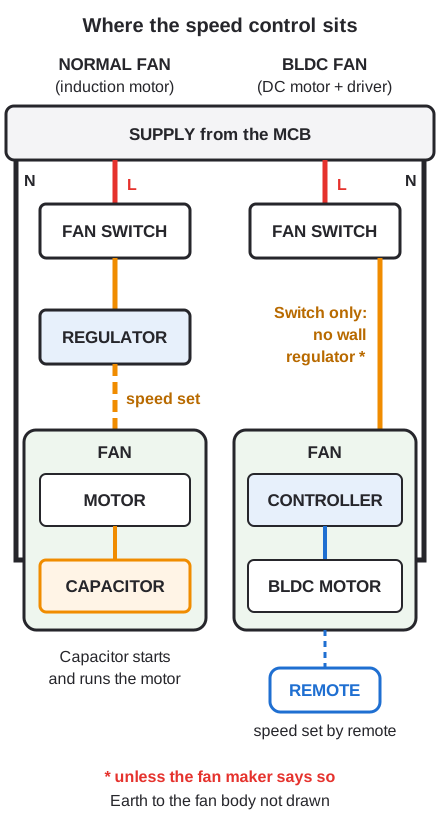
Drawn by us, simplified. Red is the phase from the MCB, orange the switched phase, black the neutral; earth to the fan body is not drawn. Follow your fan’s own installation sheet. Tap the diagram to open it full size.
In a normal fan the speed control is on the wall: switch, then regulator, then fan. In a BLDC fan the controller is in the fan, and the wall point only switches it on and off.
Changing an old fan to BLDC? Ask the electrician to follow the fan’s sheet, which may mean replacing the regulator with a switch. Our catalogue makes no statement about BLDC fans for any of our regulators, so we make no claim either way.
Any change at the switch board or the fan is done with the MCB off and the circuit proved dead. A neon tester shows phase is present; no glow does not prove a circuit dead. Leave it to a licensed electrician.
What does the capacitor do in a normal fan?
In a normal ceiling fan the capacitor feeds one of the motor’s two windings out of step (shifted in phase) with the other, which gives the rotor the turning push it needs to start and keeps it running smoothly, so a weak capacitor typically shows up as a fan that hums, starts slowly or runs slow at every speed.
A BLDC fan does not use this separate motor capacitor; its controller does that job electronically. For a normal fan, the value to match is the µF printed on the old capacitor, commonly a low figure such as 2.25, 2.5 or 3.15 µF.
Our VIYONA AC MFD capacitors cover those values: 501: 2.25 µF and 502: 2.5 µF at ₹38 MRP each, and 503: 3.15 µF at ₹46. A new capacitor of the right value is far cheaper than a new fan. Our fan capacitor guide covers the signs, the connection and safe replacement.
A capacitor can hold a charge after the power is off. Replacement is done with the MCB off, by someone who knows how, handling the part by its body.
BLDC fan vs normal fan in Hindi terms
In simple words, a BLDC pankha (fan) uses a brushless DC motor and its own electronic controller, so it takes about 25 to 35 watts and saves bijli (electricity), while a normal pankha uses an induction motor with a capacitor, takes about 60 to 80 watts, and is slowed down by a regulator on the wall.
The words you will hear: BLDC = brushless DC motor normal fan = induction motor condenser = capacitor regulator = speed control unit = kWh.
Quick answers in plain terms: BLDC saves about 13.5 units a month per fan at 10 hours a day. Regulator goes with a normal fan, not with a BLDC fan unless its maker allows it. Slow normal fan often means a tired capacitor.
For the rest of the house, our guide to saving electricity at home covers LED lighting, standby and the AC.
FAQs
What is the ceiling fan power consumption per hour?
Pankha 1 din mein kitni unit bijli khata hai?
BLDC fan aur normal fan mein kya fark hai?
BLDC fan vs normal fan: which is better?
Can I use a fan regulator with a BLDC fan?
Does a fan regulator save electricity?
Why buyers choose Vinayak Electricals
- Fan regulators made at our own works in Mumbai, for conventional and modular boards.
- VIYONA 137, 138 and 145 regulators from ₹215 MRP; KEMPS K213 and K214; VIZA V1276 and V1277.
- VIYONA AC MFD capacitors 501 to 516, with the common fan values 2.25, 2.5 and 3.15 µF from ₹38.
- We say plainly that we do not make fans, so every fan figure here is a typical range.
- Switches, sockets and plates in the same ranges, so the regulator matches the board.
- Sold through dealers across India, in full boxes, with ISO 9001:2015 certification.
Fan regulators and capacitors
See codes and MRPs for our VIYONA, KEMPS and VIZA regulators and our fan capacitors, then order through a dealer or call us.
View fan regulators