Electric shock first aid: the steps in order, a printable chart, and how to prevent shocks at home
Electric shock first aid starts with one rule: do not touch the person until the power is off. Switch off at the MCB or main switch; only if you cannot, separate them from the source with something dry that does not conduct; call 112 or 108, check their breathing, and get a medical check even if they say they are fine. Below are the steps in order as a printable chart, what not to do, why a small tingle from an appliance is a fault to fix, and how to prevent shocks at home. This is first aid information, not medical advice.
Key takeaways
- Power off first — at the MCB or main switch; touching someone still in contact with the supply can pass the current to you.
- Call 112 or 108 — 112 is India’s emergency number, 108 the emergency ambulance in most states.
- CPR only if trained — and only if they are not breathing normally; the operator can guide you.
- Every shock gets a medical check — burns can be internal and heart-rhythm effects can be delayed.
- A tingle is a fault — leakage plus a poor earth. We make MCBs and shuttered sockets; we make no RCCB.
Electric shock first aid: the short answer
Electric shock first aid is what you do in the first minutes after someone at home touches a live wire or a faulty appliance: make the scene safe by cutting the power, separate the person from the source without touching them, call for help, check whether they are breathing, and make sure a doctor sees them afterwards.
An electric shock is current passing through the body. Household supply in India is 230 V single phase, enough to burn, to make muscles clamp so a person cannot let go, and to upset the rhythm of the heart. That is why the order of the steps matters more than speed: a rescuer who grabs the person while the supply is still on often becomes the second casualty.
We make MCBs, MCB boxes and shuttered sockets at our works in Mumbai, the parts that help prevent shocks. We are not doctors, and this page is first aid, not medical advice. Follow the emergency operator and the doctor over anything written here.
What is the first aid for electric shock? The steps in order
The first aid for electric shock is, in order: switch off the power at the MCB or main switch, separate the person with something dry and non-conducting only if you cannot, call 112 or 108, check whether they respond and breathe normally, start CPR only if you are trained, and get a medical check.
Electric shock first aid chart: the six steps
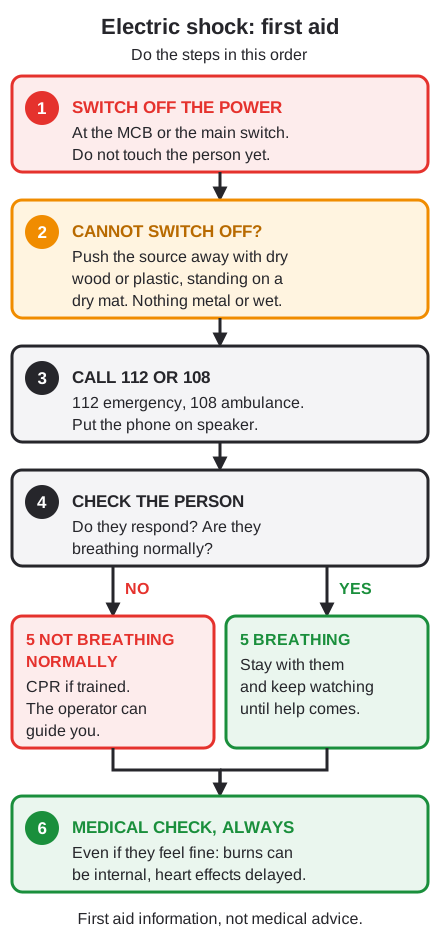
Drawn by us from standard published first aid guidance. First aid information, not medical advice. Print it and keep it by the MCB box. Tap the diagram to open it full size.
1 Switch off The MCB for that circuit, or the main switch if you do not know which one. 2 Separate Only if the power cannot be cut: a dry wooden broom handle or a plastic chair, while you stand on a dry mat or a folded newspaper. 3 Call 112 or 108. 4 Check Do they respond? Are they breathing normally?
5 CPR if trained Only if they are not breathing normally; the operator can talk you through it. 6 Medical check For everyone, every time, even a person who stands up and says they are fine.
If an overhead line or a pole wire has fallen, do not go near the person at all. Keep everyone back and call 112. That supply cannot be switched off from your board, and dry wood is no protection at high voltage.
| Step | What to do | Why |
|---|---|---|
| 1. Switch off | MCB or main switch | Touching a person still in contact can pass the current to you |
| 2. Separate | Only if you cannot switch off: dry wood or plastic, standing on something dry | Dry wood or plastic conducts very poorly at household voltage |
| 3. Call | 112 (emergency) or 108 (ambulance) | Help is on the way while you do the next steps |
| 4. Check | Do they respond? Are they breathing normally? | Decides whether CPR is needed |
| 5. CPR or watch | CPR only if trained and not breathing normally; otherwise stay with them | The operator can guide you |
| 6. Medical check | Always, even if they feel fine | Burns can be internal; heart-rhythm effects can be delayed |
Electric shock first aid treatment: what NOT to do
The most important thing not to do after an electric shock is touch the person while they may still be in contact with the supply; after that, never use anything metal or wet to separate them, never switch the power back on to check, and never decide they are fine just because they are talking.
Bare hands Not until the supply is off. Current that is still flowing through them can flow through you. Metal or wet No steel rod, wet cloth or wet broom; water and metal both conduct. Wet floor Do not step into water around them while the power may be on.
Power back on Leave the MCB off until an electrician has found the fault, even if the room is dark. “I’m fine” Not a reason to skip the doctor. Leaving them Stay with them until help arrives and follow the operator.
A neon tester that does not glow does not prove the supply is off. Switch off at the MCB or main and treat every wire as live until then.
MCB or main switch before you touch anyone.
Only if you cannot switch off: dry wood or plastic.
Emergency or ambulance; put the phone on speaker.
Every shock, even when the person feels fine.
When to call 112 or 108 after an electric shock
Call 112 or 108 straight away after any electric shock where the person was unconscious even briefly, is not breathing normally, has a burn, was thrown or fell, is confused, has chest pain or a racing or uneven heartbeat, could not let go of the source, or is a child, pregnant or elderly; if in doubt, call.
Unconscious Not breathing normally Burns A fall Chest pain Confusion Any one of these is a reason to call, not to wait and see.
112 is India’s single emergency number, connecting police, fire and ambulance. 108 is the emergency ambulance number in most states. If the shock started a fire, 101 is the fire brigade, and our guide to short circuit and electrical fire at home covers what to do next.
Tell the operator the address and a landmark, that it was an electric shock, whether the power is off, and whether the person is responding and breathing. Put the phone on speaker so your hands are free.
For a mild shock with none of these signs, the person still needs a medical check. The next section explains why.
Why every electric shock needs a medical check, even if they feel fine
Every electric shock needs a medical check, even when the person feels fine, because current can burn tissue inside the body along its path while the skin shows only a small mark, and effects on the heart’s rhythm do not always show at once; only a doctor can examine for both and decide what tests are needed.
Small skin mark A tiny mark where the current went in or out can sit over deeper damage. Delayed effects A heart-rhythm problem can appear after the person has walked away. The path Current that crosses the chest, such as hand to hand or hand to foot, passes close to the heart.
Take these facts to the doctor: what was touched, how long the contact lasted, whether they fell or blacked out, and the time it happened. That is all the doctor needs from you; the examination is theirs to do.
Write down the time, what was touched and how long contact lasted while it is fresh. It helps the doctor more than a guess an hour later.
Electric shock first aid in Hindi: बिजली का झटका लगे तो क्या करें
In Hindi an electric shock is बिजली का झटका (bijli ka jhatka), and the first aid is the same in every language: बिजली बंद करें (switch off the power), व्यक्ति को सीधे न छुएँ (do not touch the person directly), 112 या 108 पर कॉल करें (call 112 or 108), and डॉक्टर से जाँच कराएँ (get a medical check).
- पहले बिजली बंद करें: MCB या मेन स्विच से। Switch off at the MCB or main.
- बंद न हो सके तो सूखी लकड़ी या प्लास्टिक से अलग करें। Separate with dry wood or plastic.
- 112 या 108 पर कॉल करें। Call 112 or 108.
- देखें: होश में हैं? साँस ठीक से चल रही है? Check response and breathing.
- साँस ठीक न हो और आपको CPR आता हो, तो CPR दें। CPR only if trained.
- ठीक लगे तब भी डॉक्टर से जाँच कराएँ। Always a medical check.
बिजली बंद comes first, 112 / 108 next, and डॉक्टर से जाँच last, every time. On a site or in a market you will also hear “current lag gaya”; it means the same thing.
गीले हाथ या धातु की किसी चीज़ से कभी न छुएँ। Never use wet hands or anything metal.
Electric shock first aid chart and poster: where to put it
An electric shock first aid chart only helps if it is where people will see it in a hurry, so print the flowchart above and put one copy inside the door of the MCB box or on the wall beside it, and another in the kitchen, where people at home handle water and appliances together most often.
Beside the MCB box The first step happens there. Kitchen Wet hands, a mixer, a kettle and a fridge in one place. Labelled MCBs Write on each MCB which room or appliance it feeds, so nobody has to guess in an emergency. Clear access No cupboard or stored boxes in front of the board.
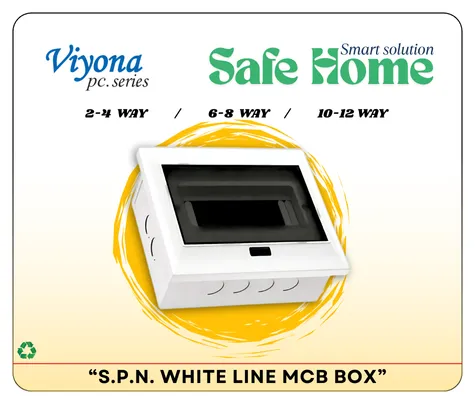
A well-kept board makes step one quick. Our VIYONA SPN MCB box 371 for 2–4 ways is ₹380 MRP and the 372 for 6–8 ways is ₹480. For the yearly look over the whole installation, see our home electrical maintenance checklist.
Show everyone at home, including older children and anyone who works in the house, where the main switch is, and let each of them switch it off once while you watch.
Small electric shock at home: why an appliance gives a tingle
A small electric shock or tingle at home from an appliance, such as a washing machine, a fridge door, a geyser tap or an iron, means current is leaking from the phase onto metal you can touch and is not being carried away by a sound earth wire; it is a fault to fix, not a normal feature.
Why a metal appliance gives a shock: with and without earth
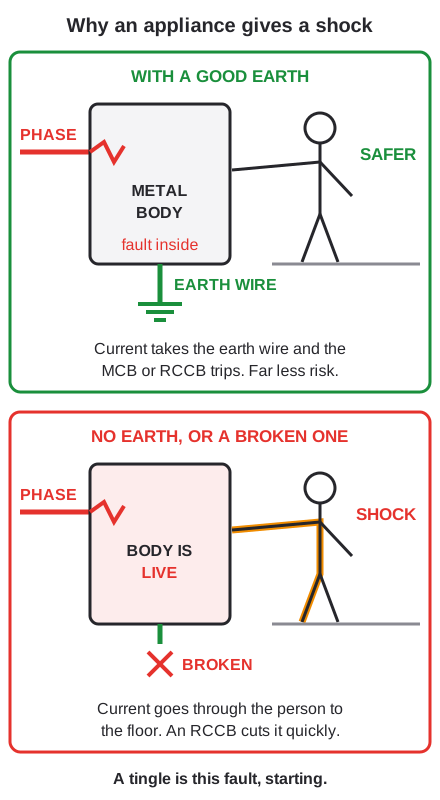
Drawn by us, simplified. The earth wire only works if it is connected all the way from the appliance to the earth electrode. Tap the diagram to open it full size.
Two things have to go wrong together. Leakage Damaged insulation, moisture inside the appliance, or a heating element breaking down lets phase reach the metal body. No earth path A 3 pin appliance on a 2 pin socket, a cut-off earth pin, a broken earth wire or a socket whose earth terminal was never connected leaves that current nowhere to go but through you.
Our guides to phase, neutral and earth and types of earthing explain the earth wire’s job and how an electrician checks it. Several appliances tingle That points to the house earth, not one appliance.
A tingle today can be a full shock tomorrow when you touch the same metal with wet hands. Unplug it and stop using it until it is fixed.
Electric shock at home treatment: after a mild shock from an appliance
After a mild electric shock at home, deal with the person and the fault separately: the person still gets a medical check, even if it was only a jolt, and the appliance is switched off at the MCB, unplugged and left unused until an electrician finds why it leaked current.
MCB off first If the plug, socket or cord looks scorched or damaged, switch off at the MCB before you unplug. Tag it Stick a “do not use” note on the appliance so nobody else tries it. Electrician Checks earth continuity at the socket and the insulation of the wiring. Service centre Repairs the appliance itself.
A neon line tester such as our VIYONA line tester 811 (code 198, ₹36 MRP) shows whether phase is present at a point. Not a dead test It says nothing about earth, and no glow does not prove a circuit is safe to touch.
Do not open the appliance or the socket yourself to look for the fault. The leak is somewhere you cannot see, and finding it safely needs the supply off and the right meter.
How to prevent electric shock at home: MCB, RCCB and earthing
To prevent electric shock at home, three protections work together: a sound earth to every 3 pin socket and metal appliance, an RCCB that cuts the supply when current leaks to earth, and an MCB on each circuit sized for its wire, with shuttered sockets added wherever young children can reach.
An MCB trips on too much current; the current through a person is tiny by comparison, so an MCB does not protect against shock (see which MCB for home). An RCCB, commonly 30 mA where it protects people, trips when current leaks to earth. We make no RCCB; your electrician specifies one.
What we do make for the board: VIYONA 10 kA MCBs, the 401 single pole at ₹145 and the 411 double pole at ₹350 MRP, made to IS/IEC 60898-1 under licence CM/L-2544151.
A home with MCBs but no RCCB is protected against overloads and short circuits, not against the leakage current that passes through a person. Bathrooms, kitchens and outdoor points are where that gap matters most.
Shuttered sockets: how to prevent electric shock to children
Shuttered sockets prevent the most common way a young child gets a shock at home, a hairpin, key or wire pushed into a socket hole, because a spring-loaded shutter behind the face keeps the holes closed until a plug is inserted, so a single thin object meets plastic instead of a live contact.
Every socket below is marked “with shutter” in our catalogue. KEMPS K192 6A 3 pin socket ₹110; KEMPS K193 6A & 16AX universal socket ₹205; KEMPS K594 universal socket (Sumo, grey) ₹245.
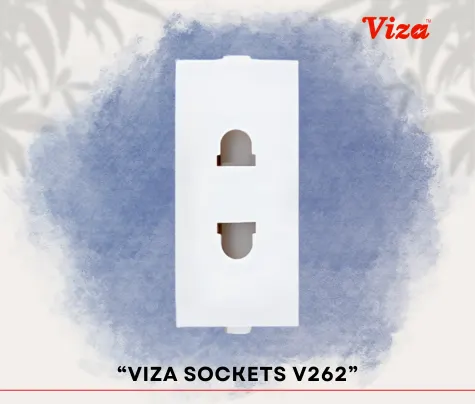
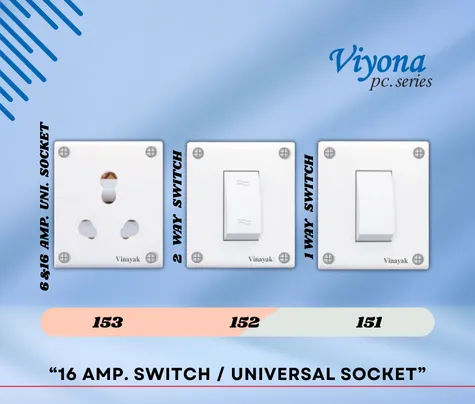
VIZA V262 6 A 2 pin socket ₹78; VIZA V1269 6 A 3 pin socket ₹85; VIYONA 153 6 & 16 A universal socket ₹90. All MRPs, inclusive of taxes.
Below table height Skirting points, the TV wall and anything near a play area matter most. For ratings and where each size goes, see 6A vs 16A socket.
Shutters stop the hairpin. They do not replace an RCCB or supervision; the RCCB is what acts if a shock still happens.
Everyday habits that prevent electric shock at home
The everyday habits that prevent electric shock at home are simple: switch on and unplug only with dry hands, keep water away from sockets and boards, replace damaged cords and cracked plugs at once, never cut off an earth pin to fit a 2 pin socket, and never repair a fitting with the supply on.
Dry hands Especially in the kitchen and bathroom. Grip the plug Pull the plug top, never the cord. Cut earth pin Have a 3 pin point fitted instead. Taped joints A taped cord is a temporary repair that became permanent; replace it.
Monsoon Water seeping near a board or a socket on an outside wall means switch off that circuit and call an electrician. Bathroom No portable heater or hair dryer near a filled bucket or a wet floor. Live repairs Changing a switch or socket starts with the MCB off, and the work is for a licensed electrician.
Any work on a switch, socket, fan point or board starts with the MCB or main switch off. Work on the installation itself is a licensed electrician’s job.
FAQs
What is the first aid for electric shock?
Bijli ka jhatka lage to kya kare?
Halka current lagne par doctor ko dikhana zaruri hai kya?
Can you touch someone who got an electric shock?
Why do I get a small shock from my washing machine?
Does an MCB protect against electric shock?
Why buyers choose Vinayak Electricals
- Shuttered sockets in KEMPS, VIZA and VIYONA, from ₹78 (VIZA V262) to ₹245 (KEMPS K594) MRP.
- VIYONA 10 kA MCBs made to IS/IEC 60898-1 under licence CM/L-2544151.
- VIYONA SPN MCB boxes from 2 to 18 ways, and double door distribution boards.
- Every 3 pin socket and 3 pin plug top we make carries the earth contact.
- We say plainly what we do not make: RCCBs, earth electrodes and medical products.
- Manufacturing in Mumbai since 1995.
Shuttered sockets for a safer home
See our sockets with shutters, with codes and MRPs, and find a dealer near you.
View sockets