Short circuit and electrical fire at home: causes, warning signs and what to do
A short circuit at home is phase touching neutral or earth with nothing in between, and it is one of the ways an electrical fire starts. Below we cover the common causes in Indian homes, the warning signs, exactly what to do during an electrical fire (switch off if safe, never water, a CO2 or ABC extinguisher only on a small fire, otherwise get out and call 101 or 112), what to do after the MCB trips, and how to prevent it.
Key takeaways
- Short circuit — phase touches neutral or earth directly; a healthy MCB trips at once.
- Common causes — loose connections, old insulation, overloaded boards, water, rodents, thin wire.
- Electrical fire — supply off if safe, never water, CO2 or ABC extinguisher on a small fire only, otherwise get out.
- Call 101 or 112 — fire brigade or national emergency number, even if the fire seems out.
- After a trip — do not keep resetting the MCB; an electrician finds the fault first.
Short circuit at home: the short answer
A short circuit at home happens when the phase wire touches the neutral or earth with almost nothing in between, so a very large current flows in an instant, and a healthy MCB on that circuit trips at once and cuts it off before the wire behind the wall can heat up. When the protection is wrong, missing or bypassed, that current heats wires and fittings until insulation melts and a fire can start.
This guide covers what causes short circuits in Indian homes, the warning signs that come first, what to do during an electrical fire, what to do after the MCB trips, and how to prevent both. The emergency numbers are 101 fire and 112 emergency.
We make MCBs, MCB boxes, spike guards and flex boxes at our works in Mumbai, so we use them as examples where they belong. We do not make fire extinguishers, RCCBs or wire as a manufacturer, and we say so where it matters.
What is a short circuit, and how is it different from an overload?
A short circuit is a fault where current takes a shortcut from phase to neutral or earth without passing through any appliance, so almost nothing limits it and it can rise to hundreds or thousands of amps, while an overload is a healthy circuit simply asked to carry more current than its wire was sized for.
Short circuit A bare phase conductor touches neutral or earth: a nail through a cable, chewed insulation, water in a box. It happens in a split second, often with a bang, a flash or a black mark. Overload A heater, an iron and a kettle on one circuit. Nothing touches; the wire just runs hot, slowly.
An MCB handles each with a different part: a magnetic coil for the instant short circuit and a bimetal strip for the slow overload. We draw both in our MCB working principle guide, so we do not repeat the mechanics here.
Both can start a fire. A short circuit does it with a sudden arc; an overload does it with hours of heat inside a wall or behind a board.
| Cause | Warning sign | Prevention |
|---|---|---|
| Loose connection at a terminal | Warm plate, buzzing, flicker, scorch mark | Tight terminals at installation; yearly check by an electrician |
| Old or damaged insulation | Trips in damp weather, burning smell | Inspect and rewire old circuits; replace damaged cords |
| Overloaded extension board | Hot plug or cord, melted socket | Heavy appliances on a 16A wall socket; no board-into-board |
| Water or damp in a fitting | Trips in rain, tingle, rust in the box | Fix seepage; keep water away from sockets and boards |
| Rodents chewing cables | Sudden trips, droppings in the ceiling | Cables in conduit; seal gaps in false ceilings |
| Wire too thin for the load or MCB | Warm walls near a point, repeated overload trips | Wire and MCB sized together by an electrician |
What causes a short circuit at home?
The usual causes of a short circuit at home are loose connections that arc and burn, old or damaged insulation, overloaded extension boards and multi-plugs, water or damp getting into a fitting, rodents chewing cables, and wire too thin for the load or the MCB protecting it; most give warning signs before they fail.
Short circuits and wiring fires: six causes and the fix for each
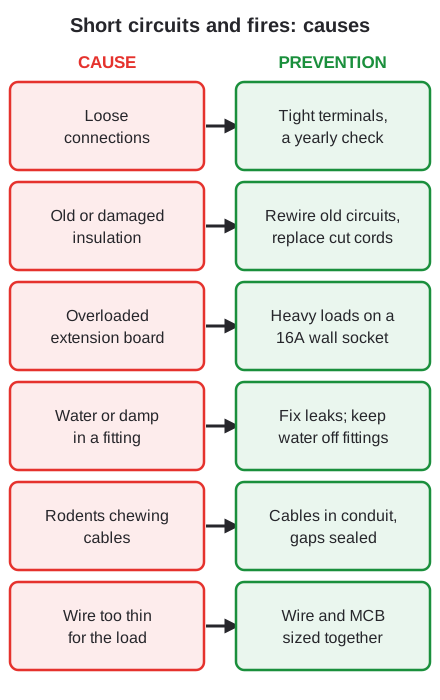
Drawn by us from common causes electricians report; not ranked by frequency. Tap the diagram to open it full size.
Loose connections A screw that was never tight, or worked loose with heat, sparks at the terminal. Old insulation Rubber and early PVC go brittle over decades. Overloaded boards Covered in detail below. Water Monsoon seepage into a ceiling box or an outside-wall socket. Rodents Rats and squirrels chew cable sheaths in false ceilings. Thin wire Wire sized for lights, used for a geyser.
Wire and MCB are chosen together; our house wire guide covers sizes. Our VIYONA house wire is made by a partner, not by us.
Main switch or MCB, only if you can reach it safely.
Water conducts and can carry current back to you.
Only on a small fire that has just started.
Get out, close the doors, then call.
Warning signs before a short circuit or electrical fire at home
The warning signs before a short circuit or electrical fire at home are a burning or fishy smell, a switch, socket or plug that is warm or discoloured, buzzing or crackling from a fitting, lights that flicker or dim, sparks when you plug in, and an MCB that trips again and again on the same circuit.
Burning smell Melting plastic often smells fishy or acrid before you see anything. Scorch marks Brown or black around a socket hole or switch. Sparks More than a tiny blue flash when a plug goes in. Warm plate A dimmer or fan regulator runs a little warm; a plain switch should not. Buzzing A loose contact arcing. Flickering On one circuit only, it points to a loose joint.
Repeated trips The MCB is telling you something. Our guide to a switch getting hot or a socket sparking goes through each sign, its cause and the fix.
A burning smell with no obvious source means switch off at the main and find it. Do not go to bed with it unexplained.
Short circuit at home: what to do right now
If you have a short circuit at home, with a bang, a flash, a burning smell or a tripped MCB, keep away from the fitting, switch off that circuit’s MCB or the main switch at the board, unplug nothing that is scorched, keep children away, and call a licensed electrician before switching that circuit on again.
1 Step back from a smoking or sparking point. 2 Switch off at the board; the switch on the plate is not enough, because a fault behind it can stay live. 3 Leave scorched plugs in place until the supply is off. 4 Check for smoke in the false ceiling and behind furniture. 5 Call an electrician, and say what you saw and heard.
If you see flames or the smoke keeps coming, go straight to the fire steps below and call 101. If anyone was touching the fitting, follow our electric shock first aid steps.
Know where your main switch is before you need it. Label each MCB with the room it feeds.
Electrical fire at home: what to do, step by step
In an electrical fire at home, raise the alarm, switch off the supply at the main switch or MCB if you can reach it safely, never throw water on it, use a CO2 or ABC dry powder extinguisher only on a small fire that has just started, and otherwise get out and call 101 or 112.
Electrical fire at home: what to do, in order
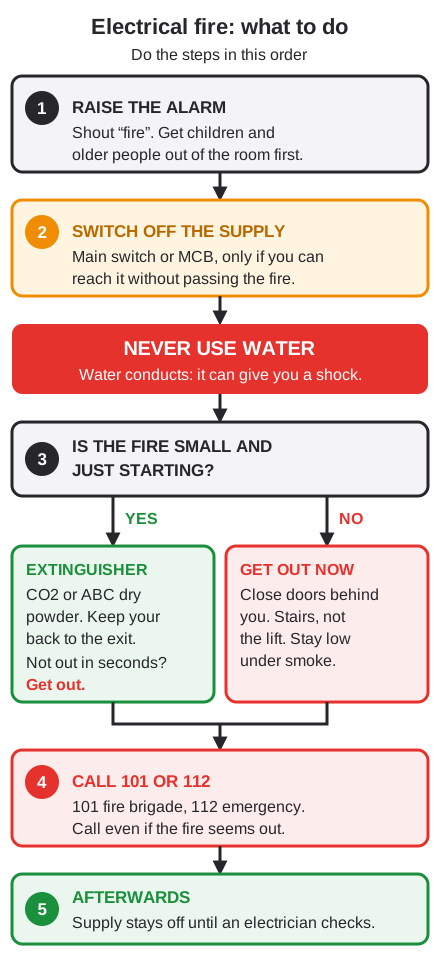
Drawn by us from standard fire safety guidance. Print it and keep it beside the MCB box. Tap the diagram to open it full size.
Never water Water conducts, so it can carry current back to you, and it spreads burning oil from a kitchen appliance. Supply off first Once the power is cut, the fault stops feeding the fire, though burning plastic can keep going. Small and just starting A smouldering plug or a small flame on an appliance, not a burning wall or curtain.
Get out Close doors behind you to slow the smoke, use the stairs, not the lift, and stay low. 101 Fire brigade. 112 National emergency number.
Which fire extinguisher is used for an electrical fire at home?
The fire extinguisher used for an electrical fire at home is a carbon dioxide (CO2) extinguisher or an ABC dry powder extinguisher, both of which do not conduct electricity; a water extinguisher must never be used, and a foam one only if its label says it is safe on electrical equipment.
CO2 Smothers the fire and leaves nothing behind, so it suits TVs, computers and boards; avoid using it at length in a tiny closed room. ABC powder Works on most household fires, but leaves a fine powder that is hard to clean from electronics.
Read the label It shows the fire types it is for and whether it is safe on electrical equipment. Check it Look at the gauge where there is one and keep to the service date. Keep it near the kitchen door and the board, not inside a cupboard. We do not make extinguishers.
PASS: Pull the pin, Aim at the base of the fire, Squeeze the handle, Sweep side to side. Keep your back to the way out.
How to put out an electrical fire at home, and when not to try
To put out an electrical fire at home, cut the supply at the main switch or MCB, then aim a CO2 or ABC extinguisher at the base of a small fire that has just started; get out instead if it is not out within seconds, smoke fills the room, or the fire is in a wall or ceiling.
Try A plug, a cord or a small appliance smouldering, the supply off, an extinguisher in your hand and the door behind you. Do not try A burning board, flames in a false ceiling, fire spreading to curtains or furniture, thick smoke, or no clear way out.
Fire blanket Can smother a small appliance fire once the supply is off. No water, no wet cloth Not while anything may be live. Do not open the board A burning distribution board is for the fire brigade.
Even when it is out, call 101 if anything burned inside a wall or ceiling, because fire can carry on out of sight.
If in doubt, get out. Possessions can be replaced; nobody should go back into a smoky flat for them.
After a short circuit: why you should not keep resetting the MCB
After a short circuit, do not keep resetting the MCB, because each reset sends fault current through the damaged point again and can turn a burn mark into melted wiring or a fire; if there was no bang, smell or scorch mark, try once with everything unplugged, and if it still trips, call a licensed electrician.
Holds with all unplugged The short is probably in one appliance; plug them back one at a time, and leave out the one that trips it. Trips with all unplugged The fault is in the fixed wiring. Never tape the toggle up, hold it on or fit a bigger MCB.
The electrician tests the insulation of that circuit and finds the point. Our guide to an MCB tripping again and again reads the trip patterns in detail. If the MCB itself is damaged, a VIYONA 10 kA MCB 401 single pole is ₹145 and the 411 double pole ₹350 MRP, made to IS/IEC 60898-1.
An MCB that trips is doing its job. The fault is the problem, not the breaker.
How overloaded extension boards and spike guards start fires
Overloaded extension boards and spike guards start fires because every socket on them shares one cord and one plug rated for a fixed current, so a heater or kettle, or several mid-sized loads together, pushes more current through them than they were built for, and the cord, plug and contacts heat until the plastic melts.
The arithmetic is simple: watts = volts × amps. A 6A board at 230 V carries about 1,380 W in total. A room heater rated at, say, 2,000 W (check its rating plate) draws about 8.7 A on its own: already past the limit.
Our VIYONA Royal spike guard is a 6A strip, from ₹370 MRP for the 311 (1 × 4, 1.5 m cord). The Classic 291 is also ₹370. They suit TVs, routers, chargers and computers. For a socket box on a longer cord, our 271 V2 flex box (2 × 4 m) is ₹285 MRP.
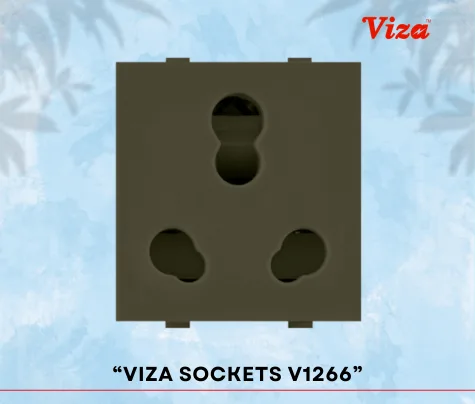
Never on a board Heater, iron, geyser, AC, microwave, induction cooker. Those go on a wall socket of the right rating, 16A for the heaviest, such as our VIZA V1266 16 A socket at ₹179 MRP. More in our spike guard guide.
Never plug one extension board into another, run a cord under a rug, or use a board with its cord coiled up.
Electrical fire safety at home: the board, the MCBs and the wire
Electrical fire safety at home starts at the distribution board: each circuit needs its own MCB rated for the wire it protects, the board needs a proper enclosure with a cover, and old or undersized wiring needs replacing, because no breaker can make a wire carry more than its size allows.
One MCB per circuit Lights, sockets, kitchen, each AC and the geyser on their own, so one fault does not take the house down or hide. Rating matches wire A breaker bigger than the wire lets the wire overheat first. See which MCB for home.
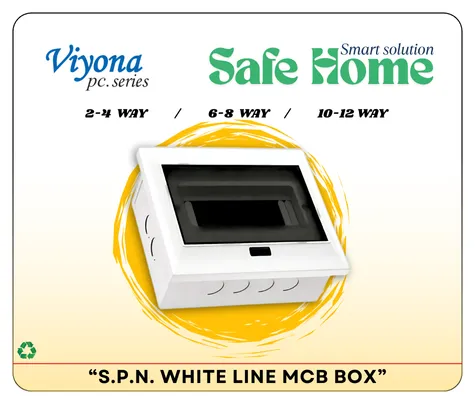
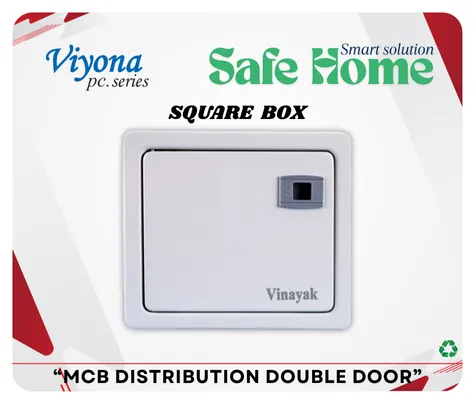
A closed board Our VIYONA SPN MCB box 371 for 2–4 ways is ₹380 MRP, and the double door distribution board 381 for 4 ways is ₹750. RCCB An RCCB adds protection against earth leakage; we make none, so your electrician specifies it.
Wiring that is twenty or thirty years old, with cloth or brittle insulation or no earth wire, is worth an electrician’s inspection before you add an AC or a geyser.
Electrical fire safety at home: a yearly routine
A yearly electrical fire safety routine at home takes an hour: switch off each MCB in turn to check its label, look and sniff at every socket and switch for heat marks, retire cracked plugs and frayed cords, check that heavy appliances use wall sockets, and have an electrician tighten the board connections.
Labels Every MCB named. Plates No brown marks, no loose sockets. Cords No tape, no kinks, none under carpets. Before monsoon Check outside-wall sockets and ceiling points for seepage. Extinguisher Gauge and service date checked.
Our home electrical maintenance checklist turns this into a printable list, and our electrical safety tips cover children, kitchens and bathrooms.
Looking and smelling is a homeowner’s job. Opening the board, tightening terminals and replacing fittings is for a licensed electrician, with the MCB or main switch off.
FAQs
What should I do if there is a short circuit at home?
Ghar me short circuit kyon hota hai?
Electrical fire lage to kya kare?
Can you put water on an electrical fire?
Which fire extinguisher is best for an electrical fire at home?
Why does my MCB trip again after a short circuit?
Why buyers choose Vinayak Electricals
- VIYONA 10 kA MCBs made to IS/IEC 60898-1 under licence CM/L-2544151, single to four pole.
- VIYONA SPN MCB boxes from 2 to 18 ways, and double door distribution boards from ₹750 MRP.
- VIYONA spike guards and flex boxes in 1.5 m to 8 m cords, with MRPs printed in our catalogue.
- 16A sockets in KEMPS, VIZA and VIYONA for heavy appliances that must not go on a board.
- We say plainly what we do not make: extinguishers, RCCBs and wire as a manufacturer.
- Manufacturing in Mumbai since 1995.
MCBs and MCB boxes for a safer board
See our VIYONA 10 kA MCBs and distribution boards, with codes and MRPs.
View MCBs