Home Electrical Maintenance Checklist: What to Check and When
A home electrical maintenance checklist turns “get the wiring checked sometime” into a few minutes a month and one electrician’s visit a year. Below: what to check monthly, every six months, yearly and every few years; what you can check safely and what needs an electrician; the signs old house wiring needs rewiring; what decides rewiring cost; and a checklist for a new home.
Key takeaways
- Monthly — look and smell for scorch marks, press the RCCB test button, check cords and plugs.
- Yearly — a licensed electrician tightens DB and socket terminals, tests earthing and checks MCB ratings.
- Every five years or so — a full inspection with an insulation test (common practice, not a legal rule); sooner for an old house.
- Rewire signs — aluminium wire, rubber or cloth insulation, no earth wire, fuses instead of MCBs.
- ⚠ A neon tester never proves a wire dead. MCB off first; opening boards is the electrician’s job.
Home electrical maintenance checklist: the short answer
A home electrical maintenance checklist is a short list of checks done at set intervals: you look, smell and test the RCCB button every month, check plates, plugs and outdoor points every six months, and have a licensed electrician check the board, terminals and earthing every year, with a full inspection about every five years as common practice.
Below we set out the house electrical checklist by frequency and by area of the house: the distribution board (DB) and MCBs, switches and sockets, earthing, the kitchen and bathroom, appliances, and the balcony and terrace. Then we cover the signs that old house wiring needs replacing, what decides old house rewiring cost, and a checklist for taking over a new home.
We make MCBs, MCB boxes, switches, sockets and line testers at our works in Marol, Andheri East, Mumbai, and every code and MRP below is from our current catalogue. Anything that means opening a board, a switch plate or a socket is a job for a licensed electrician.
How often should house wiring be checked?
House wiring should be looked over by you every month, checked more closely every six months, inspected by a licensed electrician every year, and given a full inspection with an insulation test about every five years; an old house, a water leak, a fire, a new owner or a heavy new load are reasons to do it sooner.
Home electrical maintenance checklist by frequency
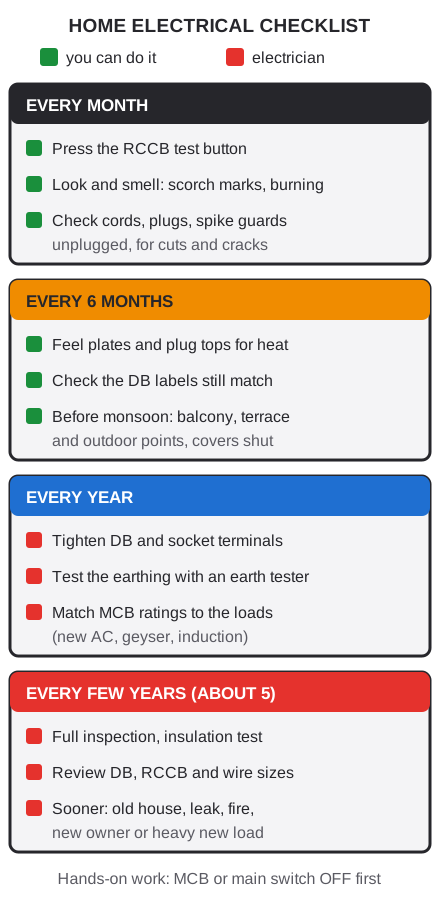
Drawn by us. The intervals are common practice, not a legal requirement for an ordinary home; follow your electrician and your housing society if they ask for more. Tap the diagram to open it full size.
Monthly and six-monthly checks use your eyes, nose and the RCCB test button. Yearly and five-yearly checks need tools and an opened board, so they belong to the electrician.
An insulation test is done with an insulation tester, often called a megger, and shows whether the insulation on the wires has broken down. It is the closest thing to an X-ray of the wiring inside the walls.
| Area | You check | How often | Electrician checks |
|---|---|---|---|
| DB and MCBs | Door shut, labels, no scorch marks, RCCB test button | Monthly | Terminals tight, MCB ratings vs cable, yearly |
| Switches and sockets | Warmth, marks, cracks, loose plug grip | Every 6 months | Terminals, worn contacts, replacement |
| Earthing | Tingles from appliances or taps, pit cover reachable | Every 6 months | Earth resistance test, yearly |
| Kitchen and bathroom | Cords, plug tops, sockets away from water | Monthly | Circuits and 16A points for heavy loads |
| Balcony and outdoor | Covers shut, no seepage, cords indoors | Before the monsoon | Weatherproofing, trips in rain |
| Whole house | Note any trips, smells or flicker | Ongoing | Full inspection and insulation test, about 5 years |
What can a homeowner check safely, and what needs an electrician?
A homeowner can safely look, smell and listen, feel the face of a plate or plug for warmth, press the RCCB test button, reset a tripped MCB once, and inspect unplugged cords; opening any board, plate or socket, tightening terminals, testing earth and replacing an MCB or switch is work for a licensed electrician.
You can Look for brown marks, melted plastic and cracks. Notice a burning or fishy smell. Listen for buzzing. Put the back of your hand on a switch plate, never inside it. Keep the DB door shut and clear of storage.
Electrician only Removing a switch plate or the DB cover, tightening screws, measuring earth, an insulation test, and changing any MCB, switch or socket.
A line tester (neon tester) is handy at home: our VIYONA line tester 811 is ₹36 and 812 ₹42 MRP. It glows when its tip touches a live phase.
A neon line tester shows that a phase is present. It never proves a wire dead. Before anyone touches a conductor, the MCB or main switch is switched off and the electrician confirms the circuit dead with a proper voltage tester.
Scorch marks, warm plates, burning smell, cracked cords, every month.
Press the RCCB test button as often as its maker says; it should trip at once.
Terminals tightened, earthing tested, MCB ratings matched to the loads.
Aluminium or rubber-insulated wire, no earth, fuses: plan an inspection and likely a rewire.
House wiring checklist: the DB and MCBs
For the distribution board (DB), the box of MCBs where the supply enters your home, check every month that the door shuts, nothing is scorched, every MCB is labelled and the RCCB test button trips it; once a year an electrician should tighten the terminals and check each MCB rating against its cable and load.
Labels Every MCB named by room or appliance, so anyone can switch off the right one in a hurry. Test button If the board has an RCCB (residual current circuit breaker, which trips on current leaking to earth), press its test button as often as its maker says; many say monthly. It should trip at once. We do not make RCCBs.
Repeat tripping An MCB that trips again and again is reporting overload or a fault. Never upsize Fitting a bigger MCB lets the cable overheat first. Warm or brown MCB Often a loose terminal.
Our VIYONA 10 kA MCBs are made to IS/IEC 60898-1 under BIS licence CM/L-2544151: single pole 6A to 32A (401) is ₹145 and double pole (411) ₹350 MRP. Our SPN MCB boxes run from ₹380 for 2-4 way (371) to ₹950 for 16-18 way (374). Which rating each circuit takes is in our which MCB for home guide.
Switches and sockets: what should you check?
Check switches and sockets for warmth, brown or black marks, cracks, a loose plug grip, crackling or sparks when you plug in, and plates that move on the wall; any one of these means the point should be switched off at the MCB and opened by an electrician, usually to tighten a terminal or replace the fitting.
Warm plate A plate warm to the touch with an ordinary load points to a loose screw or a worn contact. Sparks A socket that sparks as the plug goes in has worn contacts. Loose grip A plug that falls out is not making a firm contact.
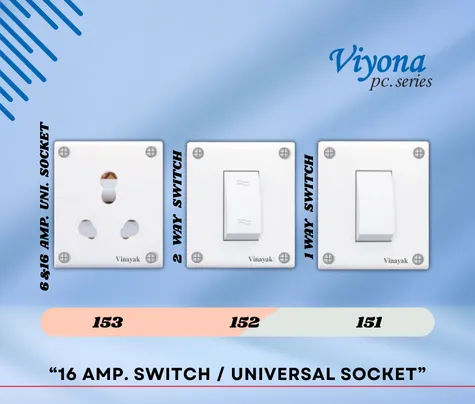
6A or 16A Heavy appliances such as an iron, a geyser, an induction cooktop or a microwave belong on a 16A socket, not a 6A one with an adaptor; our 6A vs 16A socket guide explains why.
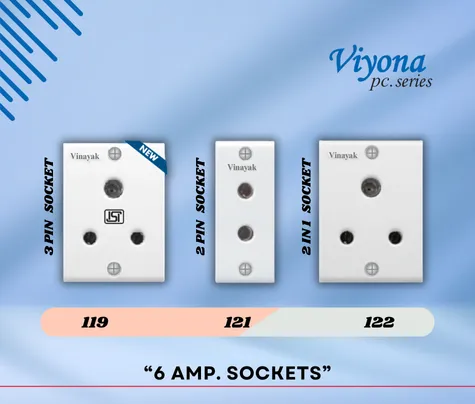
Replacement fittings are not expensive. In our VIYONA range a 6A one way switch (101) is ₹22, a 6A 3 pin socket (119) ₹40, and a 16A switch (151) ₹74 with the 6 and 16A shuttered universal socket (153) at ₹90 MRP.
The causes, ranked by urgency, are in our switch getting hot or socket sparking guide.
Earthing: how do you know it still works?
You cannot tell whether earthing works by looking at a socket or by a lamp lighting up; an electrician measures it with an instrument, and you should ask for that test every year, after any work on the earth pit, and at once if you feel a tingle from an appliance, a tap or a metal fitting.
Earthing The green or green-yellow wire that joins every metal appliance body and every socket’s earth pin to an electrode in the ground. In a fault it carries the current so the MCB or RCCB trips. Our types of earthing guide shows how the electrode is built.
Tingle A mild shock from a washing machine, fridge door or geyser pipe usually means current is leaking and the earth is weak or missing. Switch that circuit off and call the electrician. 2-pin plugs on metal appliances, or sockets with no earth pin, mean there is no earth path at all.
Earth pit Keep the pit cover visible and reachable, and do not concrete over it during renovation.
If someone gets a shock, do not touch them until the supply is off at the MCB or main switch. Call 112 or 108. Our electric shock first aid guide covers the steps.
Kitchen, bathroom and appliance checks
In the kitchen and bathroom, check that heavy appliances such as the geyser, microwave, induction cooktop and water purifier run on their own correctly rated sockets or circuits, that no socket or cord sits near water or a gas flame, and that cords are not cracked, kinked, taped up or pinched behind a cabinet.
Cords Unplug and look along each cord for cuts, tape and flattened sections. Taped joints A cord joined with tape should be replaced, not re-taped. Plug tops A brown or melted plug top means heat at the socket.
Geyser Switch it off at its own switch when not needed, and have its circuit and earth checked yearly. AC An AC needs a dedicated circuit; our MCB for AC guide covers sizing.
Spike guards Check that the total load on a spike guard stays within its rating, and never chain one into another.
Never pour water on an electrical fire. Switch off at the MCB if it is safe to, use a CO2 or ABC dry-powder extinguisher, and get out and call 101 or 112 if it spreads. See short circuit and electrical fire at home.
Balcony, terrace and outdoor points before the monsoon
Before the monsoon, check that balcony, terrace and outdoor sockets and lights have their covers shut, that no cable runs through a puddle or a window gap, that water is not entering the DB or a ceiling point, and that any extension cord used outdoors is brought inside, because water and a live point together cause both shocks and trips.
Seepage A damp patch near a switch board or a ceiling light is a reason to switch that circuit off and call the electrician. Trips in rain An RCCB or MCB that trips only when it rains points to water reaching a point.
Covers Outdoor points should have weatherproof covers that close. Gate lights Lights at the gate or terrace often run all night; their units add up, as our LED bulb vs tube light guide shows.
More rainy-season habits are in our electrical safety tips for Indian households.
Old house wiring: what are the signs it needs rewiring?
Old house wiring usually needs rewiring when it has aluminium conductors, rubber or cloth insulation that cracks, no earth wire, rewireable fuses instead of MCBs, switches that run warm, frequent tripping or a burning smell, or when an insulation test shows the wire has broken down; one sign means an inspection, several mean a rewire.
Old house wiring: rewire or not?
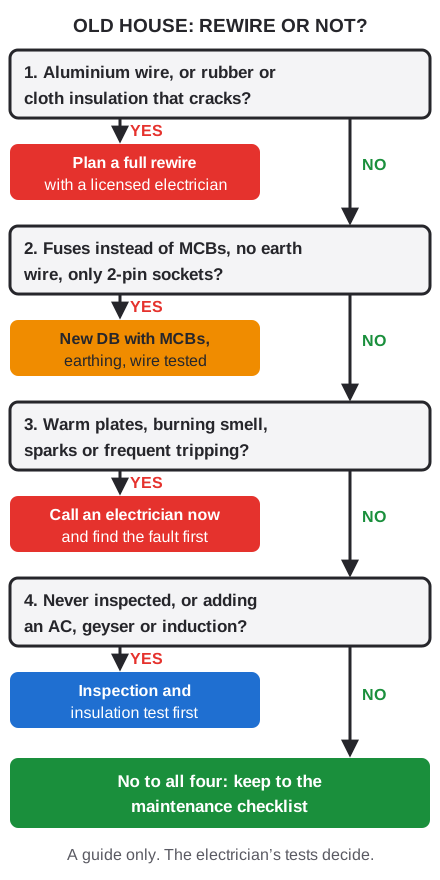
Drawn by us as a guide only. The electrician’s inspection and insulation test decide. Tap the diagram to open it full size.
Aluminium wire Silver-coloured conductors instead of copper; common in older Indian homes. Rubber or cloth Insulation that crumbles when bent. No earth Only two wires at each point. Fuses Rewireable kit kat fuses instead of MCBs. Wooden boards Switches mounted on wooden boards. Too few sockets Adaptors and spike guards everywhere.
We still make a 10A kit kat fuse (131) at ₹60, but a fuse must be rewired by hand after it blows, while an MCB such as our 401 at ₹145 simply trips and resets; our MCB working principle guide compares them.
Old house wiring colours: what do they tell you?
Old house wiring in India usually follows the older colour code of red for phase, black for neutral and green for earth, while newer work uses brown, blue and green-yellow; a house with no green wire at all, or with every wire the same colour, has either no earth or wiring nobody can trace without a tester.
Older code Red phase, black neutral, green earth. Newer code Brown phase, blue neutral, green-yellow earth. Mixed Both codes in one house after repairs. No green No earth wire.
Colour is a clue A previous repair may have used whatever wire was at hand. Only a tester, in an electrician’s hands, decides which wire is which.
Our phase, neutral and earth guide has the full colour chart and how each wire is identified.
Old house rewiring cost: what decides it?
Old house rewiring cost depends on the floor area and number of points, whether wires are pulled through existing conduit or walls must be chased and replastered, the wire sizes, the new board, MCBs and RCCB, the earthing work, the switches and sockets chosen, and local labour rates, so only an electrician’s site visit gives a real figure.
Points The number of lights, fans and sockets. Conduit Reusable conduit means wire can be pulled through; no conduit means chasing walls. Wire size Lights, sockets and AC or geyser circuits take different sizes; see our house wire guide. Earthing A new earth pit adds civil work. Finish Modular or conventional switches.
Here is the MRP of parts only for one piece of a typical job, replacing an old fuse board in a small flat with an MCB board, using our VIYONA codes: a 6-8 way SPN box (372) ₹480, a 40A double pole main MCB (412) ₹435 and five single pole MCBs (401) at ₹145 each, ₹725. That is ₹1,640 at MRP.
For one bedroom board: four 6A switches (101) ₹88, two 6A sockets (119) ₹80, and a 16A switch (151) with a 16A socket (153) ₹164, so ₹332 at MRP.
These are MRPs of parts only, as an example. They leave out wire, conduit, plates, boxes, the RCCB (we do not make RCCBs), earthing and labour, and the electrician decides every rating.
Electrical checklist for a new home: what to check before you move in?
Before you move into a new home, check that the DB is labelled circuit by circuit with an RCCB, that ACs and the geyser have their own MCBs and 16A points, that every socket has an earth pin, that the electrician has tested the earthing and insulation, and that you receive a wiring layout and the fittings’ warranty papers.
DB Labelled MCBs, an RCCB, and spare ways for future circuits; our MCB box size list shows how many ways a flat usually needs. Heavy loads Own circuit for each AC and the geyser.
Sockets 16A where heavy appliances go, shuttered sockets where children can reach. Test results Ask for the earth and insulation readings in writing. Layout A drawing of which wire runs where saves money at every later repair.
ISI marks Check the ISI mark and licence number on the wire, switches and MCBs. Our VIYONA MCBs carry CM/L-2544151. Switch everything Try every switch, socket, fan and light once before signing the handover.
Our 6 way double door MCB distribution box (382) is ₹880 MRP, for a board that needs a covered door.
FAQs
How often should house wiring be checked?
Ghar ki wiring kitne saal mein badalni chahiye?
Purane ghar ki wiring kaise check kare?
What is the cost of rewiring an old house?
What should be on an electrical checklist for a new home?
Can I check my home wiring with a line tester?
Why buyers choose Vinayak Electricals
- MCBs, isolators, MCB boxes, switches, sockets and line testers made at our works in Marol, Andheri East, Mumbai.
- VIYONA 10 kA MCBs to IS/IEC 60898-1 under BIS licence CM/L-2544151, from ₹145 MRP.
- SPN MCB boxes from 2-4 way to 16-18 way, and double door boxes from 4 way to 16 way.
- Switches and sockets in 6A and 16A, including a shuttered 6 and 16A universal socket.
- MRPs published openly; sold in full boxes through 500+ dealers with delivery across India.
- Manufacturing in Mumbai since 1995; ISO 9001:2015 certified.
MCBs, MCB boxes and switches for an upgrade
See codes, ratings and MRPs for our VIYONA MCBs and MCB boxes, then order through a dealer or call us.
View MCBs and MCB boxes