Electrical Safety Audit: An Area-by-Area Checklist
An electrical safety audit checklist tells you what to inspect in a home, office or shop so wiring faults are found before they cause a fire or a shock. Below is the checklist, area by area: the distribution board, earthing, wiring, switches and sockets, appliances and extension boards, and wet and outdoor areas. It marks what you can check yourself, what needs a licensed electrician and an instrument, the red flags that cannot wait, and how often the rules say an installation must be inspected.
Key takeaways
- Start at the DB — no heat marks, a main switch that cuts phase and neutral, a 30 mA RCCB that trips on test, and MCBs no bigger than their wire allows.
- Earth and wiring — an unbroken earth to every 3-pin socket and metal appliance; 1.5 sq mm for lights, 2.5 for 16 A sockets including AC and geyser points, 4 for a 20 A circuit.
- Sockets and boards — nothing warm or sparking, heavy loads on 16 A sockets, no extension board feeding another.
- How often — look yearly and before the monsoon, press the RCCB test button regularly (makers advise monthly to six-monthly; follow its leaflet); the CEA rules cap formal inspection intervals at 5 years.
- ⚠ Stop signs — burning smell, a buzzing board, a shock from a tap or appliance, or water in a box: switch off the main MCB and call an electrician.
Electrical safety audit checklist: what it covers
An electrical safety audit checklist is a list of things to inspect, in a set order, so that faults in your wiring are found before they start a fire or give someone a shock. For a home, an office or a shop it covers six areas: the distribution board (DB), earthing, the wiring, switches and sockets, appliances and extension boards, and wet and outdoor areas. You can do the looking yourself, with the DB cover left on. Anything that means opening a board, touching a conductor or measuring with an instrument is a job for a licensed electrician.
Use this checklist to walk a 2BHK in Andheri, a small office or a shop counter, one area at a time. Print it, tick it, date it. We have made switches, sockets and MCBs since 1995, today at our works in Marol, Andheri East; the audit itself is a job for a licensed electrician or electrical consultant.
Why an electrical audit matters, and what the rules say
An electrical audit matters because faulty circuits start a large share of building fires. After a fire in the electric meter box of a 23-storey SRA building in Dahisar killed two people in September 2025, the BMC said it would propose mandatory electrical audits to the state government.
In January 2024 the Mumbai Fire Brigade’s chief fire officer said about 80% of fire incidents in the city occur due to electrical failures. Across India the share is smaller but rising:
India: share of accidental fires caused by electrical short circuits
NCRB data 2016–2020 as analysed by FactChecker (May 2022); share of all accidental fires. Bars to scale against 25%.
Regulation 32 of the Central Electricity Authority’s 2023 safety regulations says installations must be inspected and tested at intervals set by the state, never more than 5 years apart, and installations at or below the voltage the state notifies, which covers most homes and shops, are self-certified by the owner. Regulation 44 says a domestic installation’s residual current device must trip at 30 mA or less.
In Maharashtra, the Form B certificate filed in January and July is about fire-fighting systems, not wiring.
No one is coming to audit your flat’s wiring for you. So most boards go unchecked until something smells of burning.
| Area | What to check | Who checks | How often |
|---|---|---|---|
| Distribution board | Heat marks, door and cover, labels, MCB rating against wire size | You look; electrician opens | Yearly and before the monsoon |
| RCCB | Trips when the test button is pressed | You | Monthly to six-monthly, as its leaflet says |
| Earthing | Earth wire intact; resistance of every pit | Electrician with an earth tester | At each professional audit |
| Wiring | Wire size, insulation, joints, conduit | Electrician with a megger | At each professional audit |
| Switches and sockets | Warmth, sparking, loose grip, ISI mark | You | Yearly |
| Extension boards | No chaining, no heaters, no blackened pins | You | Whenever one is moved or added |
| Wet and outdoor areas | RCCB cover, IP rating, seepage into boxes | You, then electrician | Before the monsoon |
| Whole installation | Inspection and testing under the CEA rules | Licensed contractor | As the state directs, never over 5 years |
Checklist 1: the distribution board (DB)
Audit the distribution board first, since every circuit starts there: check that the door shuts, nothing is scorched, the main switch cuts both phase and neutral, a 30 mA RCCB is present and trips on test, each MCB suits its wire, and every circuit is labelled.
Distribution board audit points
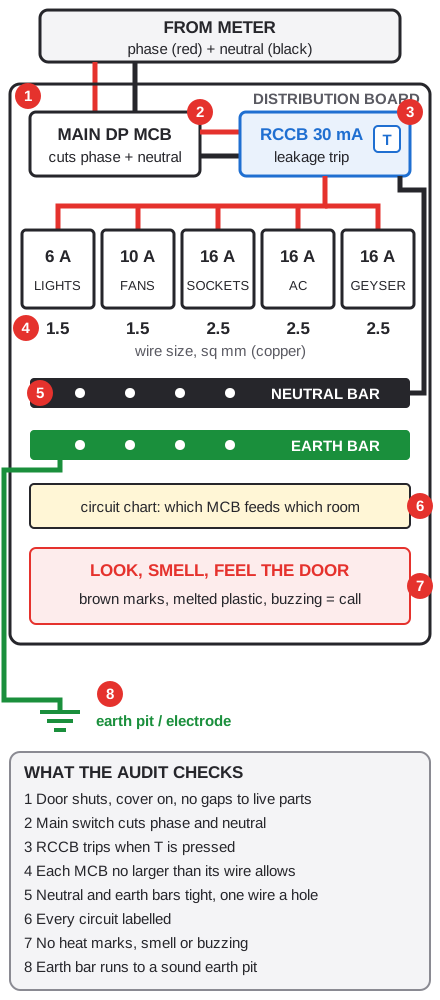
Drawn by us, simplified and not to scale. MCB ratings and wire sizes show common Indian practice for a flat; your electrician sizes each circuit. Tap the diagram to open it full size.
Brown marks, melted plastic, a buzzing sound or a fishy burning smell fail the board on the spot. Gaps where a blanking piece is missing let fingers reach live parts. An isolator only switches; it never trips on overload or a short circuit, so it is not a substitute for an MCB or main breaker. Old kit kat fuses still in use usually mean the board is due for an upgrade.
Look for an RCCB 30 mA and press its test button: it must trip. Read each MCB rating against its circuit. A missing circuit chart costs minutes in an emergency.
Never take the DB cover off to look. The incoming side stays live even with every MCB off. Point 5, the neutral and earth bars, and point 8, the earth lead to the pit, are for a licensed electrician with the main supply isolated.
Every circuit begins there; look for heat marks and a working RCCB first.
Three-pin plugs and an unbroken earth wire to a sound pit.
1.5 sq mm to 10 A, 2.5 to 16 A, 4 to 20 A in common practice.
Date, findings, photos and fixes, so the next audit starts from the last.
Checklist 2: earthing
A tingle from a tap, a washing machine or a geyser body fails this check on the spot. A sound earth needs a real earth pit or electrode, an unbroken earth wire from it to the DB’s earth bar, and an earth connection to every three-pin socket and metal-bodied appliance.
What you can check: find the earth pit and see that it is accessible and its strip or wire is not rusted through or cut by later building work. A third pin cut off a plug, or a two-pin plug on an iron or a fridge, means no earth. Every three-pin socket should have its earth terminal wired, which only an electrician can confirm with the supply off.
What the electrician checks: the earth resistance of every pit with an earth tester, and continuity of the earth conductor from the pit to each piece of equipment.
See how to check earthing at home, the types of earthing and the right earth wire size. If an appliance already gives a shock, read washing machine giving shock before you touch it again.
An RCCB and an earth work as a pair. The RCCB senses current leaking away; a sound earth gives that leak a path other than the person touching the appliance.
Checklist 3: wiring and cable sizes
Wiring passes the audit when each circuit’s wire is thick enough for its MCB, the insulation is sound, joints sit inside boxes, and no bare single-core wire is clipped straight to a wall.
Usual MCB for each copper wire size (common Indian practice)
The MCB protects the wire, so its rating must not exceed what the wire can carry. Long or bunched runs may need more. Bars to scale against 25 A.
The classic failure: a 16 A socket on 1.5 sq mm wire behind a 20 A MCB. Under IS/IEC 60898-1 an MCB carries its rated current indefinitely and trips only on sustained overload above it or a short circuit, so this one lets the wire run hot without tripping.
Look for taped joints hanging above a false ceiling, brittle insulation at switch boxes, and cables that run without conduit or casing. For AC and geyser runs, see wire size for AC and geyser; for whole-house signs, when to rewire a house.
A bigger MCB is never the fix for a circuit that trips. If the wire is too thin for the load, the load moves or the wire is replaced.
Checklist 4: switches and sockets
A switch or socket should never be warm to the touch. None should spark or crackle when a plug goes in, every plug should grip firmly, heavy appliances should use 16 A sockets, and each piece should carry a genuine ISI mark.
A warm switch plate, a brown ring round a socket hole or a spark at the pins means a loose or overloaded contact; our guide to a switch getting hot or socket sparking covers what to do. A plug that falls out has a worn socket; see socket loose.
A geyser, an AC or an induction hob belongs on its own circuit: a 16 A socket on a 16 A MCB with 2.5 sq mm wire, never a 6 A socket through an adapter. A larger 20 A circuit on 4 sq mm wire is wired through a DP switch rated for it, never a 16 A socket; see 6A vs 16A socket. For homes with children, shuttered sockets are worth the upgrade: our KEMPS K192 6 A 3-pin socket with shutter is MRP ₹110, and the VIYONA 153 6 and 16 A universal socket with shutter is MRP ₹90.
Switches are made to IS 3854; ours carry licence CM/L-7567794. Here is how to spot a fake ISI mark.
Broken plates and cracked switch covers are not cosmetic. They expose terminals at finger height, often in the room where children play.
Checklist 5: appliances, extension boards and heavy loads
Extension boards deserve the closest look of anything you can unplug. Every heavy load needs its own socket and circuit, no extension board should feed another, nothing that heats should run off one, and no cord should be cracked, taped or hot at the plug.
Look for daisy-chained boards, a heater or iron on a spike guard, boards under rugs, and blackened pins. See extension board burning and multi plug vs extension board.
A second AC, an induction hob, a dishwasher or an EV charger can push a circuit past what it was built for. An electrical load calculation shows whether the board still copes.
Heavy fixed loads such as the geyser and AC should switch through a double pole switch or their own double pole MCB, so both phase and neutral can be cut. Our VIYONA 176 concealed 32 A DP switch is MRP ₹205; see which geyser switch for ratings.
Never run a geyser, room heater, iron or AC from an extension board, however thick its cord looks.
Checklist 6: bathroom, kitchen, balcony and outdoor
Wet and outdoor areas pass the audit when their circuits are protected by a 30 mA RCCB, switches and sockets sit away from splash zones, outdoor fittings carry a suitable IP rating, and no water has reached a switch box or the DB.
In Mumbai this is the part to audit before the monsoon. Rain driven against an outside wall seeps into the switch boxes on it. Look for rust stains, damp patches around boxes and RCCB trips that start every June; our guide to RCCB tripping explains the usual causes.
In bathrooms, the geyser switch and any socket belong outside the shower area, and bell pushes and switches stay away from wet zones; see bathroom electrical points. On balconies and terraces, an IP65 or higher fitting suits exposed spots; our page on IP ratings for lights explains the numbers.
If water has entered a switch board or the DB, switch off the main MCB from a dry spot and do not touch the wet board. Call an electrician before switching back on.
Extra checks for offices and shops
An office or shop audit adds instruments and paperwork to the home checklist: a single line diagram, phase load balance, thermal imaging of panels, a test of every earth pit, and safety signs, insulating mats and extinguishers at the panels.
These items come from the scope of an electrical safety audit tender SBI published for its branches in 2023:
Single line diagram of the installation with equipment ratings. Load unbalance and overloading across phases and DBs, measured. Hot spots in panels and DBs found by thermal imaging, with photographs. Earth resistance of every pit and earth continuity to equipment. Adequacy and settings of earth leakage protection. Cable terminations, loose hanging wires and broken switches, plugs and sockets.
Around the panels: a danger board showing the voltage, a shock treatment chart in Hindi and the local language, ISI-marked insulating mats in front of panels, and DCP or CO2 extinguishers nearby. See also shop electrical points and modular switches for offices.
Keep the audit report, its photographs and the list of fixes in one file. The next audit starts from it.
What a professional electrical audit includes
A professional electrical audit is a walk-through plus instrument tests, ending in a written report with photographs and a prioritised list of fixes; the minimum kit is an insulation resistance tester (megger), an earth tester, a thermal imaging camera and, for three-phase premises, a power analyser.
The megger finds insulation that has broken down inside walls. The earth tester gives each pit a number. The thermal camera shows a loose terminal glowing hot behind a DB door long before it smells. Every RCCB should be trip-tested too.
Under the 2023 CEA rules, wiring work beyond like-for-like swaps of lamps, fans, fuses and switches needs a state-licensed contractor, and the self-certification form carries a Chartered Electrical Safety Engineer’s signature.
Book one after any big change: a renovation, a new AC or geyser, a water leak into a board. Between audits, press the RCCB’s test button regularly. Makers differ: Schneider Electric advises a monthly test of its residual current breakers and ABB every six months where no regulation says otherwise, so your device’s leaflet has the final word.
Ask for the report in writing, with photos and test values. A verbal “sab theek hai” is not an audit.
Red flags: stop and call an electrician today
Some findings cannot wait for the rest of the audit. Any of these means switching off and calling a licensed electrician now.
A burning or fishy smell, buzzing from the DB, shock or tingle from a tap, geyser or washing machine, sparks or smoke at a socket, lights dimming and brightening together, and water in a box or the DB.
An MCB that keeps tripping is protecting you, not failing; our guide to MCB tripping again and again walks through the safe checks, and how to check an MCB covers a breaker you suspect. If the fault has already caused a fire, read short circuit and electrical fire at home.
Do one thing first in every case: switch off at the main MCB from a dry place, then keep people away from the fault until the electrician arrives.
If someone is in contact with a live wire, do not touch them with bare hands. Switch off at the main first. Our electric shock first aid guide has the steps.
Fixing what the audit finds: parts and MRPs
Most audit findings are fixed with ordinary parts: correctly rated MCBs, a proper MCB box, a 30 mA RCCB, shuttered sockets and DP switches, fitted by a licensed electrician.
From our VIYONA range: the 401 single pole MCB, 6 to 32 A, MRP ₹145; the 411 double pole MCB, 6 to 32 A, MRP ₹350; both 10 kA, made to IS/IEC 60898-1 under licence CM/L-2544151. For a modular switch plate, the KEMPS K225 Tiny Trip single pole MCB (10 to 32 A) is MRP ₹295; it protects that point and does not replace the MCB in the DB.
To replace a fuse board, the 371 2–4 way SPN white line MCB box is MRP ₹380 and the 372 6–8 way MRP ₹480; the 381 4 way double door box is MRP ₹750. See the MCB box size list, the MCB price list and our kit kat fuse upgrade guide.
Two things we do not make: RCCBs, so buy a 30 mA RCCB from a maker that does, and wire, which we trade under VIYONA from a partner’s production.
Fix in this order: anything that burns or shocks, then protection (RCCB and correct MCBs), then earthing, then sockets and switches, then labels and looks.
FAQs
What is included in an electrical safety audit checklist?
How often should an electrical safety audit be done?
Is an electrical audit mandatory in Mumbai?
Can I do an electrical safety audit myself?
Ghar ki wiring safe hai ya nahi kaise check karein?
Does Vinayak Electricals make RCCBs?
Why buyers choose Vinayak Electricals
- VIYONA 10 kA single and double pole MCBs made under BIS licence CM/L-2544151 to IS/IEC 60898-1.
- Switches made to IS 3854 under ISI licence CM/L-7567794, and shuttered sockets for homes with children.
- SPN white line and double door MCB boxes to replace old fuse boards, from MRP ₹380 (371).
- Making electrical accessories since 1995, today at our works in Marol, Andheri East, Mumbai; ISO 9001:2015 certified.
- MRPs published openly in our e-catalogue; test reports available on request before an order.
- All-India delivery through 500+ dealers and distributors, in full boxes.
MCBs and MCB boxes for the fixes your audit finds
See our VIYONA 10 kA MCBs, isolators and MCB boxes, then order through a dealer or call us.
Vinayak Electricals is a manufacturer of switches, MCBs and LED lights in Mumbai, supplying dealers, electricians and contractors across India by the box. Ask us for prices and stock.
View VIYONA MCBs WhatsApp for prices Download catalogue