Why a Washing Machine Giving Shock Is a Warning, and How to Fix It

A washing machine giving shock is telling you that current is leaking onto its metal body and the earth path that should carry it away is broken or missing, so the current looks for a way through you. Below we explain both halves of that fault, how to find the cause by pattern, why a fridge or switch board tingles for the same reasons, the difference between leakage and touch current, what to do in the next five minutes, what an electrician checks, and the earthed plug tops, sockets and MCBs we make in Mumbai.
Key takeaways
- Two faults together — a leak onto the metal body, and a missing or poor earth.
- Read the pattern — one appliance points to the appliance; every appliance to the house earth; one socket to its wiring.
- Usual culprits — 2 pin adaptors, cut earth pins, extension boards without earth, damp wall boxes.
- Right now — MCB off, unplug with dry hands, tag it, call an electrician.
- ⚠ An RCCB trips on the leak an MCB never sees. We make MCBs and earthed sockets; we do not make RCCBs.
Washing machine giving shock: the short answer
A washing machine giving shock, even a faint tingle on the lid or the metal body, means two faults are present together: current is leaking from the live parts inside onto the body, and the earth path that should carry that leak away is broken, weak or missing. Either fault alone is often silent. Together, your hand becomes the path to ground.
The usual places the earth gets lost are ordinary ones: a 3 pin plug in a 2 pin socket or adaptor, a cut-off earth pin, an extension board with no earth, a socket whose earth terminal was never wired, or a house earth that has corroded. The leak usually comes from damp, a worn heater or motor winding, or a damaged supply cord.
This guide sorts the causes by pattern, covers the fridge and the switch board that tingle for the same reasons, explains what to do in the next five minutes and what the electrician checks. We make the plug tops, sockets and MCBs at the wall end of the circuit, at our works in Marol, Andheri East, Mumbai. We do not make washing machines or RCCBs.
Why does my washing machine give a shock?
A washing machine gives a shock when live current leaks onto its metal body through damp, damaged insulation or a failing heater or motor, and the earth wire that should carry that leak to ground is missing or poor, so the current flows through whoever touches the machine instead.
The leak, from inside the machine: moisture around the motor, pump or wiring; a heater element breaking down in a model that heats water; a pinched or chewed cord behind the machine. The machine sits in water and vibrates for hours, which is hard on insulation.
The missing earth, outside the machine: 2 pin socket or adaptor, cut earth pin, extension board without earth, loose earth terminal in the socket, or a poor house earth.
A machine with a sound earth and a small leak usually gives no tingle at all, because the earth carries the leak and, if the leak grows, an RCCB trips. Our earthing vs grounding guide explains why the earth is the path that matters, and electric shock first aid explains the mechanism with a diagram.
Do not keep using a washing machine that tingles, even mildly. Switch it off at the MCB or wall switch, unplug it with dry hands, and leave it unplugged until it is checked.
| Pattern | Likely cause | First step | Who fixes it |
|---|---|---|---|
| One appliance tingles on any socket | Leak in the appliance plus weak earth | Unplug and tag it | Electrician, then service centre |
| Every metal appliance tingles | House earth, earth lead or pit | Stop using metal appliances | Electrician |
| One socket only | Earth terminal or wire at that socket | Stop using that socket | Electrician |
| Only in the monsoon | Seepage into a box or outdoor point | Switch that circuit off | Electrician |
| Only through an extension | No earth or damaged extension | Stop using the extension | Replace it |
| Switch board plate or screw | Damp or stray wire in the box | MCB off for that circuit | Electrician |
Is a small tingle from a washing machine dangerous?
Yes, a small tingle from a washing machine is dangerous, because it proves the earth path is not working, and the same leak that buzzes through dry fingers can drive a far larger current through wet hands, bare feet on a wet floor, or a hand on a metal tap.
Three things raise the risk in a laundry corner: water on the floor, wet hands, and metal taps or drains within reach, which give the current a second path. A bathroom or balcony with no RCCB in the board adds a fourth.
A tingle also tends to get worse, not better. Damp spreads inside the machine, an element breaks down further, and a loose earth works looser with vibration.
Children and older family members feel shocks more and react more slowly. Keep them away from the machine until the fault is fixed.
If anyone has had more than a tingle, do not touch them until the supply is off. Call 112 or 108, and follow our electric shock first aid steps.
Both faults together make the tingle.
One appliance, every appliance, or one socket.
A metal appliance needs a 3 pin earthed point.
Trips on the leak an MCB cannot see.
Find the cause by pattern
To find why a washing machine or another appliance gives a shock, note the pattern: one appliance on any socket points to the appliance, every metal appliance points to the house earth, one socket only points to that socket’s earth wiring, and tingles only in the monsoon point to damp in a socket, wall or the machine.
Read the pattern before anyone opens anything:
One appliance, any socket A leak inside that appliance, plus a weak earth. Service centre and electrician. Every metal appliance The house earth, the earth lead or the pit. Electrician first. One socket only That socket’s earth terminal or wire. Electrician. Only in rain Seepage into a wall box or outdoor socket. Switch that circuit off. Only through an extension The extension has no earth, or a damaged one.
Note what you saw: which appliance, which socket, wet or dry, and whether the board has an RCCB and whether it tripped. That list saves the electrician time. Safe homeowner checks for the earth itself are in how to check earthing at home.
Write the pattern down before you call: appliance, socket, wet or dry, RCCB or not. It turns a guessing visit into a targeted repair.
Washing machine socket, plug and extension board: the usual culprits
The commonest cause of a washing machine shock in Indian homes is not the machine but the connection: a 3 pin plug forced into a 2 pin socket, an adaptor or multi-plug with no earth, an extension board run from another room, or a 6A socket asked to carry a machine with a heater, any of which can break the earth path.
What a washing machine point should be: a 3 pin socket, on a circuit your electrician has sized for it, close enough that no extension is needed, and above the floor so splashes cannot reach it. A machine that heats water can draw about 2,000 W while heating, which puts it on a 16A socket.
What to avoid: 2 pin adaptor, cut or bent earth pin, multi-plug shared with an iron, and a taped cord. If a temporary extension is unavoidable, it must have an earth and the right rating; our guide on extension boards for a fridge or washing machine covers that.
A cracked or loose plug top is a cheap fix. VIYONA 244 is a 16A 3 pin plug top at ₹110 MRP, and VIYONA 243 the 6A at ₹68.
Never cut, bend or break off an earth pin to fit a socket. Have a proper 3 pin point fitted instead.
Fridge giving shock: same causes, different places
A fridge giving shock, usually felt on the door handle, the side panels or the back grille, has the same two causes as a washing machine, a leak onto the metal body plus a poor or missing earth, with the leak often coming from moisture in the compressor area, a defrost heater or a damaged cord behind the fridge.
The fridge adds its own risks. It runs 24 hours, so a leak is always present. It often stands on a wet kitchen floor from defrost water or mopping. And it is often pushed hard against the wall, which pinches its cord.
The fix follows the same order: switch off, unplug with dry hands, check the plug top and socket for damage, then an electrician for the earth and a service centre for the fridge. A fridge belongs on its own 3 pin point, never on a shared multi-plug.
If several appliances in the kitchen tingle, think of the house earth before the fridge. The typical running watts of a fridge, washing machine and other kitchen loads are in our appliance power consumption chart.
Typical watts of appliances that most often give a tingle (W)
Typical ranges from our appliance power consumption chart, not measurements of any model; bars use the top of each range, scaled to 3,000 W. All have metal bodies or metal parts within reach, which is why each needs an earth.
Tingling from the switch board: what it means
Tingling from a switch board, felt on a metal or metallic-finish plate, a fixing screw or the wall around it, means current is reaching something it should not: often damp in the wall box after seepage, a loose wire touching a screw or frame, or a damaged switch, and it calls for switching that circuit off at the MCB straight away.
Usual causes: seepage into the concealed box on an outside or bathroom wall; a stray wire touching a fixing screw; a cracked switch or socket; and on metal boxes or frames, a missing earth to the box.
What not to do: do not open the plate to look, and do not keep using the board with dry hands as a workaround. Switch off at the MCB, label it, and call an electrician. If the plate is warm or brown as well, our guide to a switch getting hot or socket sparking covers that.
Plates themselves are rarely the cause. A plain plastic or glass-style plate conducts nothing; what you feel is current reaching a screw or the wall behind.
A board that tingles in the monsoon has water reaching live parts. Switch that circuit off and keep it off until the wall is dry and an electrician has checked it.
Current in appliance body: leakage vs touch current
Current in an appliance body comes in two kinds: a fault leakage, where damaged insulation lets phase reach the metal, which needs a repair, and a small touch current that many appliances let through their internal filter parts by design, which a sound earth carries away unnoticed but which can be felt as a faint buzz when the earth is missing.
That second kind explains a puzzle: a brand-new machine can tingle in a house with no earth. The appliance is not faulty; it was built to be earthed. Earth it properly and the buzz goes.
It also explains why a line tester may glow faintly on an unearthed appliance body. A glow means phase voltage is reaching the body somehow. It does not tell you whether it is a design touch current or a real fault, which is why the next step is always an earth check, not a guess.
Either way, the answer starts at the socket: a 3 pin point with a tested earth. The difference between the earth and the neutral, and why the neutral must never stand in for it, is in our phase, neutral and earth guide.
A faint glow from a line tester on a metal appliance body is a warning sign, not a diagnosis. Have the earth at that socket tested.
What to do right now if an appliance gives a shock
If an appliance gives a shock, switch it off at the MCB or wall switch first, then unplug it with dry hands standing on a dry floor, tag it so nobody uses it, keep children away, and call an electrician to check the socket’s earth before the appliance goes to a service centre.
In order: 1. Switch off at the MCB for that circuit, or the main if unsure. 2. Unplug with dry hands, gripping the plug top, not the cord. 3. Tag it “do not use”. 4. Check others: does anything else tingle? 5. Call the electrician, then the service centre.
Do not open the appliance, swap sockets to see if it stops, or wrap the body in plastic. Each hides the fault without fixing it.
If the person who felt the shock has more than a brief tingle, or any burn, chest pain or confusion, they need a medical check; our electric shock first aid guide lists when to call 112 or 108.
If the plug, socket or cord looks scorched, switch off at the MCB before you touch the plug at all.
What the electrician checks
An electrician checking a washing machine or fridge shock tests earth continuity from the socket to the main earth bar, measures the earth resistance at the pit, checks the socket’s wiring order, tests the insulation of the circuit, and confirms whether the board has a working RCCB, before the appliance itself goes to its service centre.
Typical tests: earth continuity socket to board; earth resistance at the pit; polarity at the socket; insulation resistance of the circuit with an insulation tester; RCCB trip test. The appliance gets its own insulation check at the service centre.
Typical fixes: tighten or reconnect the earth terminal; replace the socket or plug top; re-run an earth wire; new electrode if the pit reading is high; add an RCCB. Moving the machine to a dry spot with its own 3 pin point solves many repeat cases.
Ask for the readings in writing. A shock that came back after a “repair” is usually a missing earth that was never actually fixed.
Ask the electrician to show you the earth reading before and after the repair. A number is proof; “it’s fine now” is not.
RCCB: why it matters for washing machines
An RCCB matters for a washing machine because it trips when even a small current leaks to earth, commonly within a fraction of a second at a 30 mA sensitivity for protecting people, which covers exactly the fault that makes a machine tingle, whereas an MCB trips only on overload or short circuit and never notices that leak.
The two devices protect different things: the MCB protects the wiring; the RCCB protects people. A board with MCBs and no RCCB is protected against fire from overloads, not against shock. Wet areas, such as the bathroom, balcony and kitchen, are where that gap matters most.
An RCCB that trips when the machine starts is reporting a leak, not misbehaving. Never bypass it. Our guide to an RCCB tripping again and again sorts trips by pattern.
We do not make RCCBs; your electrician specifies one. We make the 10 kA VIYONA MCBs that sit beside it: the 401 single pole at ₹145 and the 411 double pole at ₹350 MRP, to IS/IEC 60898-1.
An earth and an RCCB work together. An RCCB still trips without a good earth, but only after current starts flowing through someone.
Our parts for a safe washing machine point
A safe washing machine or fridge point needs a properly earthed 3 pin socket of the right rating, a matching plug top in good condition, and a circuit protected by an MCB in the board, and we make each of those at our Mumbai works, with MRPs from ₹68 for a 6A plug top to ₹205 for a shuttered universal socket.
MRP of the parts for an earthed appliance point (₹)
MRPs from our current catalogue, bars to scale with ₹205 as the full bar. VIYONA 153 and KEMPS K193 are listed with a shutter.
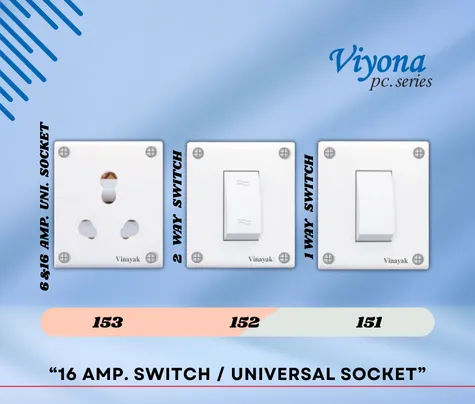
Which socket each appliance needs is in 6A vs 16A socket. Codes and photos are on the Royal 3 pin plug top and 16A switch and universal socket pages. Fitting is for a licensed electrician, MCB off first.
FAQs
Why does my washing machine give a shock?
Is it safe to use a washing machine that gives a small shock?
Why does my fridge give a shock when I touch it?
Why do I feel tingling from my switch board?
Will an MCB trip if a washing machine gives a shock?
Can I fix a washing machine shock with a new plug?
Why buyers choose Vinayak Electricals
- 16A and 6A 3 pin plug tops (VIYONA 244 at ₹110, 243 at ₹68 MRP) made at our works in Marol, Andheri East, Mumbai.
- Shuttered universal sockets, VIYONA 153 at ₹90 and KEMPS K193 at ₹205, for appliance points.
- 10 kA VIYONA MCBs to IS/IEC 60898-1 under BIS licence CM/L-2544151.
- VIYONA line testers from ₹36 MRP for finding the phase.
- MRPs published openly; sold through 500+ dealers with delivery across India.
- Manufacturing in Mumbai since 1995; ISO 9001:2015 certified.
Earthed plug tops for every appliance
See codes and MRPs for our Royal 3 pin plug tops in 6A and 16A, then order through a dealer or call us.
View 3 pin plug tops