Fridge, Washing Machine or AC on an Extension Board: Is It Safe?

Can we use an extension board for a fridge? Not as a regular arrangement: a fridge, like a washing machine, induction cooktop, microwave, iron or AC, should plug straight into its own earthed wall socket, usually a 16A point. Below we go appliance by appliance, show the arithmetic of what a 6A board can carry, and price the real fix, a 16A socket where the appliance stands, from our Mumbai catalogue.
Key takeaways
- Fridge — its own earthed wall socket. The compressor cycles all day and surges at every start.
- Washing machine — a dry 16A wall socket, mounted high. Never a board on a wet floor.
- Iron, induction, microwave, AC — heavy loads. A 16A wall socket; the AC needs its own circuit and MCB.
- A 6A board carries about 1,380 W in total at 230 V; one 1000 W iron uses most of it.
- The fix — a 16A or universal socket at the appliance; our VIYONA 153 is ₹90 MRP.
Can we use an extension board for a fridge? The short answer
No, a refrigerator should not run from an extension board as a regular arrangement; it should be plugged straight into its own earthed wall socket, which in most homes is a 16A point or a combined 6A and 16A universal socket. The same applies, more strongly, to a washing machine, an induction cooktop, a microwave, an iron and an air conditioner.
The reason is not that a fridge draws a huge amount of power. It is the way it draws it. The compressor starts and stops many times a day, every start pulls a brief surge, and it does this all day and all night for years. A portable board’s plug, contacts and cord are built for light loads used on and off, and they are usually rated at 6A. Weak points warm up slowly and quietly, often behind the fridge where nobody looks.
Below we go appliance by appliance, show the simple arithmetic of what a board can carry, and price the proper fix: a 16A socket where the appliance stands. Plug and earth basics are in our 2 pin vs 3 pin plug guide.
Why should a fridge not run on an extension board?
A fridge should not run on an extension board because its compressor cycles on and off around the clock, drawing a start-up surge each time, it needs a reliable earth for its metal body, and it sits for years behind a cabinet where a warming plug or a crushed cord goes unnoticed until it scorches.
Three things add up: 24 hours a day start-up surge at every cycle hidden behind the unit. An extension cord pushed against the wall by the fridge is also easily crushed or kinked, which damages insulation from the inside.
Earth matters as much as load. A refrigerator has a metal body and sits on a kitchen floor that gets wet, so it ships with a 3 pin plug. A two pin extension, or an old board with a loose earth contact, removes that protection without any sign. Plug the fridge into a 16A or universal wall socket, or into a correctly rated 3 pin wall socket where your electrician has confirmed the circuit suits it.
If a fridge gives even a faint tingle when touched, stop using it and have an electrician check the earth. Do not move it onto an extension to see if that helps.
| Appliance | Extension board? | Where it should plug in | Main reason |
|---|---|---|---|
| Refrigerator | No | Its own earthed wall socket | Runs all day, start-up surge, needs earth |
| Washing machine | No | 16A socket, high and dry | Motor, heater, water |
| Induction cooktop | No | 16A or universal socket | Heavy heating load |
| Microwave | No | 16A or universal socket | Heavy load, often shares a counter |
| Iron | No | 16A or universal socket | Heating load, metal sole plate |
| Air conditioner | Never | Own circuit with MCB, 16A socket or DP switch | Heavy current for hours |
| TV, router, chargers | Yes, within rating | Spike guard or wall socket | Light electronic loads |
Can a washing machine run on an extension board?
No, a washing machine should not run on an extension board, because it combines a motor, often a water heater in front-loading models, a metal or partly metal body and a wet floor, so it needs a fixed, earthed 16A wall socket that stays dry and is not shared with anything else.
The risks stack up in a bathroom or utility area: water on the floor, vibration that loosens a plug in a portable board, and heating load during a hot wash. A board lying on a damp floor is the worst place for a socket in the house.
The right point is a 16A socket mounted well above the floor, close enough that the machine’s own cord reaches without strain. If the machine moved and the cord no longer reaches, move the socket, not the machine onto an extension. Our guide to bathroom electrical points covers heights and positions in wet areas, and washing machine giving shock covers what a tingle from the drum means.
A washing machine on a board on the floor is one leak away from a wet socket. Mount the socket high and dry.
Own wall socket; the compressor surges at every start, day and night.
A 16A socket mounted high and dry, never a board on the floor.
Its own circuit and MCB. No extension board, of any rating.
A 16A or universal socket at the appliance, fitted by an electrician.
Is an extension board OK for an induction cooktop or microwave?
No, an induction cooktop or microwave should not be run from an extension board, because both are heavy kitchen loads whose rating plates often show well over 1,000 watts, used for long stretches, and a typical 6A board shares about 1,380 watts across all its sockets before anything else is plugged in.
Kitchen boards also tend to collect a kettle and a mixer on the same strip, which is how a modest-looking setup ends up above the board’s rating. Read the watts on the rating plate of each appliance and add them up; watts ÷ 230 = amps gives the current at India’s supply.
Each heavy kitchen appliance is better on its own 16A or universal socket at counter height. The guide to kitchen electrical points lists the usual positions for a hob, chimney, microwave and purifier, and our 6A vs 16A socket guide explains why the plug sizes differ.
An induction cooktop and a kettle on the same 6A board can exceed its rating within seconds. Give each heavy appliance its own wall socket.
Can you plug an AC into an extension board?
No, an air conditioner must never be plugged into an extension board; it draws a heavy current for hours, its compressor pulls a surge at every start, and it needs a dedicated circuit from the distribution board with its own MCB, a suitably sized wire and a 16A socket or a DP switch at the indoor unit.
An AC point is planned at the board, not at the socket. The MCB rating comes first, and our MCB for 1, 1.5 and 2 ton AC guide covers it; the wire is then sized by your electrician to suit. At the wall, the AC commonly takes a 16A socket or a DP switch; our DP switch guide explains why a double pole switch is often used there.
Signs an AC is on the wrong point: plug warm after an hour MCB trips at start-up lights dim when it starts. Any of those needs an electrician, not a bigger extension.
No portable board, of any brand or rating, is a substitute for an AC’s own circuit. If the AC socket is in the wrong place, have it moved.
Which extension board for an iron?
None: an iron should be plugged directly into a fixed 16A or universal wall socket, not an extension board, multi plug or spike guard, because it is a heating load drawing its full rating for as long as you iron, and its metal sole plate needs a dependable earth through a 3 pin plug.
Our own dry irons show the size of the load. Every VIYONA dry iron, codes 601 to 605, is rated 1000 W, which is about 4.3 A at 230 V. That is most of a 6A board’s capacity from one appliance, held for twenty or thirty minutes at a time, on a cord that people pull and twist while ironing.
If the iron’s cord does not reach the ironing board, move the ironing board or have a socket added nearer. Our dry iron vs steam iron guide also covers how much electricity an iron actually uses. VIYONA 601 is a 1000 W dry iron with an MRP of ₹920.
A plug that is warm after ironing is a sign of a worn socket or plug. Replace them; do not switch to an extension board.
How much load can an extension board carry?
An extension board can carry no more than the lowest rating in its path, which is usually its own 6A plug and sockets, about 1,380 watts in total at 230 volts, shared by every socket on it, while a 16A wall socket on a 16A circuit can carry about 3,680 watts.
What a socket can carry at 230 V, against one 1000 W iron
Amps x 230 V arithmetic, not a test result; the iron wattage is from our current catalogue. Bars to scale with 3,680 W as the full bar.
Two points the arithmetic hides. First, a board’s cord may be thinner than its plug suggests; the best extension board brand guide shows how cord size limits current. Second, a fridge or AC compressor pulls a surge well above its running watts at every start, which the rating plate does not show.
Is there a heavy duty extension board for a fridge?
Boards sold as heavy duty or 16A do exist, but even a correctly rated one is a portable cord and plug that moves, gets stepped on and ages faster than fixed wiring, so for a fridge, washing machine or other permanent appliance a wall socket is still the right answer.
What we make, plainly: our Royal ABS spike guards are catalogued as 6A, and our catalogue does not print an ampere rating against the flex box codes. We do not sell any portable board as a heavy-duty fridge or washing machine board, and we would not advise one. Our flex box guide lists the loads a flex box suits.
If you are offered a heavy-duty board, check: 16A plug and sockets marked on the body conductor size printed on the cord a maker named on the product. Then still use it only for temporary jobs, not for an appliance that runs every day.
A 16A plug on a board means nothing if the wall socket it goes into is 6A. The circuit is only as strong as its weakest point.
The socket is too far: what is the right fix?
The right fix when an appliance’s cord does not reach a socket is a new or moved 16A wall socket at the appliance, fitted by an electrician on a circuit sized and protected for that load, which usually costs less than the trouble a permanent extension board causes.
MRP of our sockets that take a 16A plug
MRPs from our current catalogue, bars to scale with ₹205 as the full bar. VIYONA codes are conventional; VIZA and KEMPS are modular.
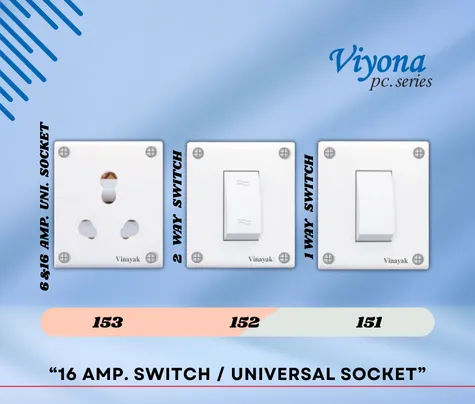
VIYONA 153 is a 6 and 16A universal socket with shutter at ₹90 MRP. The work order: MCB off, prove dead with a tester, then a licensed electrician runs the wire. See the 16A switch and universal socket page.
Warning signs on an extension board already in use
An extension board is overloaded or failing if its plug or body feels warm, the plastic around any socket has turned brown, it smells of hot plastic, it crackles or buzzes, the cord is flattened or stiff, or the board’s indicator flickers when a heavy appliance starts, and any of these means unplug it now.
The signs in order of urgency: smell or smoke brown marks crackling warm plug flattened cord flickering indicator
After unplugging, look at the wall socket too, because heat travels both ways. Our hot switch and sparking socket guide explains what each symptom points to, and short circuit and electrical fire at home covers what to do if things go further. Replacing a cord with tape on it is not a repair; our insulation tape guide explains where tape belongs.
If a board smells hot, switch off the wall socket before pulling the plug, and do not plug the appliance back in until the socket has been checked.
Can a voltage stabiliser for a fridge go on an extension board?
No, a voltage stabiliser for a fridge should also plug directly into the wall socket, with the fridge plugged into the stabiliser, because putting an extension board anywhere in that chain adds the same weak contacts and cord the stabiliser was never meant to share.
The chain should be short: wall socket → stabiliser → fridge. Many modern refrigerators are built to cope with a wide voltage range and may not need a stabiliser at all; our voltage stabiliser for AC and fridge guide explains how to tell.
The same logic covers the multi plug behind the fridge that also feeds a purifier or a microwave. It is the most common arrangement we hear about, and the hardest one to see. Our guide on multi plug vs extension board covers what those adaptors can and cannot run.
Behind the fridge, look once a year: one plug, one socket, no adaptor, no warm plastic.
FAQs
Can we use an extension board for a fridge?
Can I use an extension board for a washing machine?
Which extension board is best for an iron?
Can I run an AC on an extension board?
Can an induction cooktop be used with an extension board?
How many watts can an extension board handle?
Why buyers choose Vinayak Electricals
- Sockets in 6A, 16A and combined 6 and 16A ratings, made at our works in Marol, Andheri East, Mumbai.
- VIYONA 153 universal socket with shutter at ₹90 MRP; VIZA and KEMPS 16A modular sockets from ₹160.
- Royal 16A 3 pin plug tops at ₹110 to replace a damaged plug on a heavy appliance.
- Flex boxes and spike guards for the light loads that suit them.
- MRPs published openly; sold through 500+ dealers with delivery across India.
- Manufacturing in Mumbai since 1995; ISO 9001:2015 certified.
16A sockets for heavy appliances
See codes and MRPs for our 16A and universal 6 and 16A sockets, then order through a dealer or call us.
View 16A sockets