Dry Iron vs Steam Iron: Which One Suits Your Clothes?
Dry iron vs steam iron comes down to what you iron and how much care you want to give the iron. A dry iron presses with heat alone and has no tank to fill, scale or leak; a steam iron adds built-in steam that helps on thick, heavily creased fabric. Below: cotton, steamers, the units a 1000 W iron uses with the sums shown, the socket and wiring an iron needs, and the MRPs of our five VIYONA dry irons.
Key takeaways
- Mostly cotton and daily clothes? A dry iron, with a sprinkle of water, is simpler: no tank, no scale, no leaks.
- Thick, very dry or deeply creased fabric? A steam iron earns its extra care; a garment steamer only refreshes hanging clothes.
- A 1000 W iron uses at most 1 unit an hour. 30 minutes a day is at most 15 units a month; multiply by your own tariff.
- Use a fixed 16A wall socket, never a 6A socket and adaptor, a multi-plug or a spike guard.
- Our VIYONA dry irons 601 to 605 are all 1000 W, ₹920 to ₹1,480 MRP. We sell no steam iron or steamer.
Dry iron vs steam iron: which is better?
A dry iron is better for most everyday Indian wardrobes of cotton shirts, kurtas, school uniforms and bedsheets, because it has no water tank to fill, descale or leak, while a steam iron is better for thick, heavily creased or very dry fabrics that need moisture pushed into the weave as you press.
Neither is better for everyone. The question is which fabrics you iron most, how often, and how much looking after you want to give the iron itself. A dry iron is a heated metal soleplate and nothing else. A steam iron adds a water tank and steam holes, so it presses with heat and moisture together. A garment steamer, the third option people compare, does not press at all; it relaxes creases on clothes that hang.
We should say plainly where we stand. Our VIYONA range has five dry irons, all rated 1000 W. We do not make a steam iron or a garment steamer. So this guide gives the steam iron its due where it earns it, and shows the sums for running a 1000 W iron so you can check any claim against your own electricity bill.
What is the difference between a dry iron and a steam iron?
The difference between a dry iron and a steam iron is moisture: a dry iron presses with heat and pressure from a hot soleplate alone, while a steam iron also boils water from a small built-in tank and pushes steam through holes in the soleplate, so the fabric is dampened and heated in the same stroke.
Everything else follows from that tank. A steam iron needs water filled before use and emptying after, and over time hard water leaves scale inside it. A dry iron has no tank, no scale and nothing to leak. You add moisture yourself, with a sprinkle of water or a spray bottle, only when a fabric needs it.
How each option works
Dry iron Heat Pressure Water by hand, if needed
Steam iron Heat Pressure Built-in steam Tank to fill and descale
Garment steamer Steam No pressing plate Clothes hang vertically
A plain comparison of method, not a measurement. Green marks what each tool brings; amber marks what you have to manage. Check the manual of any iron or steamer for its own instructions.
Both are electric heating appliances, and both belong on a proper wall socket, which we cover below.
| Dry iron | Steam iron | Garment steamer | |
|---|---|---|---|
| How it works | Hot soleplate, heat and pressure | Hot soleplate plus built-in steam | Steam on hanging fabric, no plate |
| Water tank | None | Yes, fill each session | Yes |
| Scale or limescale care | None | Descale as the manual says | Descale as the manual says |
| Leaks or spitting | Nothing to leak | Possible at low heat or with scale | Possible |
| Best for | Cotton and daily clothes, lightly damp | Thick, very dry or heavily creased fabric | Refreshing hanging clothes, curtains |
| Sharp creases | Yes | Yes | No |
| Units used | Wattage × hours ÷ 1000 | Wattage × hours ÷ 1000 | Wattage × hours ÷ 1000 |
| Wall point | 16A socket | 16A socket | As its manual states |
| From us | VIYONA 601–605, 1000 W | We do not make one | We do not make one |
Dry iron vs steam iron for cotton: which works better?
For cotton, a dry iron works well when the cloth is slightly damp, either taken off the line a little early or sprinkled with water, because cotton presses smoothly with high heat and moisture; a steam iron supplies that moisture itself, which saves the sprinkling on heavy cotton, denim and bedsheets.
Cotton and linen are the fabrics that take the highest heat setting on most irons, and both crease hard once fully dry. The usual trick on a dry iron is simple: iron cotton slightly damp, or keep a spray bottle beside the board. A light mist on a stubborn collar does the same job as a burst of steam, only by hand.
Where steam pulls ahead is volume and thickness. A pile of bone-dry heavy cotton, thick denim or a starched bedsheet takes many passes on a dry iron, and steam reaches into the weave faster. For synthetics, silk and blends, which want low heat, follow the care label, and press on the reverse or through a thin cloth if you are unsure.
For a household that irons cotton shirts, kurtas and uniforms most days, a dry iron plus a spray bottle covers almost everything.
A dry iron and a spray bottle handle shirts, kurtas and uniforms.
A steam iron helps on denim, heavy bedsheets and deep creases.
A garment steamer refreshes; it does not press a crease.
Any iron belongs on a fixed 16A point, never a spike guard.
Dry iron vs steam iron vs steamer: which should you buy?
Buy a dry iron if you mainly press cotton and want the simplest tool to own, a steam iron if you regularly press thick or heavily creased fabrics and do not mind filling and descaling a tank, and a garment steamer only to refresh hanging clothes, curtains or delicate pieces where a sharp crease is not the goal.
A garment steamer is a different tool, not a stronger iron. It holds steam against fabric that hangs vertically, which relaxes wrinkles in a saree, a suit jacket or a curtain without a board. What it does not give is a sharp crease: no plate presses the cloth flat, so trouser creases and crisp collars still need an iron.
Many homes end up with one iron for daily pressing and nothing else. A few add a steamer for clothes that hang. If you are choosing only one, choose by the fabric you iron most often, not the one you iron once a month.
Compare like with like. The wattage on the rating plate tells you how much power each appliance draws while heating, whichever kind it is.
When is a steam iron the better choice?
A steam iron is the better choice when you regularly press thick fabrics, deep creases or very dry clothes, such as denim, heavy cotton bedsheets, linen or wool blends, because steam carries moisture into the fibres and loosens them faster than heat alone, which can mean fewer passes over each garment.
Steam also helps on fabrics that shine under a hot dry plate, and many steam irons let you steam a hanging garment for a quick touch-up. Those are real strengths, and if they describe your laundry basket, a steam iron is worth its extra care. Most steam irons can also press dry, with the tank empty and the steam control off, so one iron can cover both jobs.
That care is the trade-off. The tank needs water every session. Hard water leaves limescale that can block steam holes or spit brown water onto a white shirt. Many manuals ask for regular descaling or a particular kind of water, so follow yours. Steam at too low a temperature can drip or leak. And a steam iron left with water inside needs emptying before it is put away.
If you buy a steam iron, read its manual on water type and descaling before the first use. That one page decides how long the steam holes stay clear.
When is a dry iron the better choice?
A dry iron is the better choice when you mostly press cotton and everyday clothes and want the simplest iron to own: there is no water tank to fill, no limescale to clear, nothing to leak onto clothes or the board, and less to maintain, while a sprinkle of water handles the occasional stubborn crease.
The list of things that cannot go wrong is the case for it. No tank to fill or forget. No scale building up in hard-water areas. No leaks or spitting onto a white shirt. Simpler to clean: wipe the cool soleplate as the manual says. And nothing to empty before you put it away.
A dry iron also suits quick daily pressing: a shirt before work, a uniform before school. Heat it, press, switch off at the wall, let it cool. In homes that iron a little every day rather than a big pile once a week, that rhythm is exactly what a dry iron is good at.
The trade-off is effort on thick fabric: on bone-dry denim or a heavy bedsheet, a dry iron needs more passes or a spray bottle.
How much power does a 1000W iron consume?
A 1000W iron consumes at most 1 unit of electricity, one kilowatt-hour, for every hour its heating element runs, because one unit on your bill is a 1000-watt load for one hour; an iron that switches its element on and off to hold temperature uses less than that full figure over the same hour.
The formula is the one our guide to saving electricity at home uses: units = watts × hours ÷ 1000. For a 1000 W iron that simplifies neatly, because the watts and the 1000 cancel: units equal hours of heating. Half an hour a day is at most half a unit a day.
1000 W iron: units a month, at most, by daily ironing time (30 days)
Worked from 1000 W × hours × 30 days ÷ 1000. Full bar = 60 units; bar lengths are proportional, rounded to 5%. These are ceilings at the rated 1000 W: an iron that cycles its element on and off uses less, and the actual draw can differ a little from the rating with your supply voltage.
So 30 minutes a day comes to at most 15 units a month. Treat every figure here as a ceiling, not a reading from a meter.
How do you work out what a 1000W iron costs to run?
To work out what a 1000W iron costs to run, multiply its hours of use by 1 unit per hour to get the units, then multiply those units by the rate per unit printed on your own electricity bill; the answer is the most it can cost, since an iron that cycles its element draws less.
Step by step for 30 minutes a day: 1000 W × 0.5 h = 500 watt-hours a day. Over 30 days that is 15,000 watt-hours, or 15 units at most. Then 15 × your tariff per unit.
As an example only, at a hypothetical ₹8 a unit, 15 units would be ₹120 a month at most. That ₹8 is not your tariff; it is the same example rate our energy guide uses so the two pages agree. Tariffs vary by state, supplier and slab, so redo the last step with the rate on your bill.
Ironing time, not iron type, moves the bill most. A steam iron and a dry iron of equal wattage, heating for the same minutes, draw the same units; compare the wattage on each rating plate.
Batching helps a little: one session for the week’s clothes means heating up once, not seven times.
Electric iron price: what do our 1000W dry irons cost?
Our five VIYONA 1000W dry irons are priced from ₹920 to ₹1,480 MRP: the 601 Diamond and 602 Crystal at ₹920, the 603 Royal at ₹1,080, and the 604 Jumbo and 605 King at ₹1,480, all made at our Mumbai works and packed one to a box.
VIYONA dry iron MRP by model (all 1000 W)
MRP from our current catalogue, inclusive of all taxes. Full bar = ₹1,480; lengths are proportional, rounded to the nearest 5%.
VIYONA 601 Diamond is a 1000 W electric dry iron with an MRP of ₹920. VIYONA 603 Royal is a 1000 W dry iron at ₹1,080 MRP. VIYONA 605 King is a 1000 W dry iron at ₹1,480 MRP. Our catalogue lists the same 1000 W rating for all five, so the running-cost sums above apply to each one; the models differ in body and design. See the Diamond, Royal and King pages, the whole VIYONA dry iron range, or our VIYONA dry iron page.
Electric iron brand names: what to check besides the name
Shops in India stock irons from many makers, among them Bajaj, Philips, Usha, Havells and Morphy Richards, and ours, sold under the VIYONA name. Whichever name is on the box, a few checks on the iron itself tell you more than the brand does.
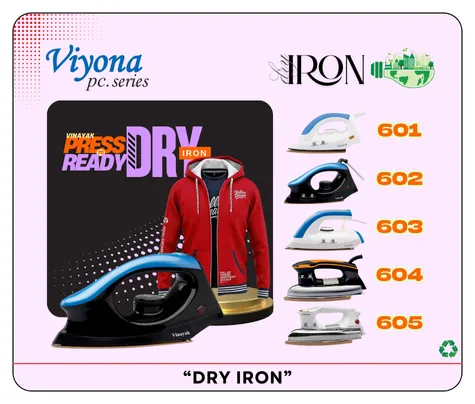
Our VIYONA dry irons, codes 601 to 605
Catalogue card for the range. All five are listed at 1000 W; MRPs are in the chart above.
Wattage: read it on the rating plate; it sets the units per hour. Plug: an iron has a metal body, so it should come with a 3-pin earthed plug. Cord: no cuts, kinks or exposed copper, and a firm grip where it enters the iron. Maker named: the box and the iron should say who made it.
For our own range, we publish the MRP of every code in our catalogue, and our electrical accessories range lists the dry irons beside the sockets and plug tops they plug into.
Warranty terms vary by product, from 5 to 10 years across our range; ask our office to confirm the term for the iron code you are buying.
Which socket does an electric iron need?
An electric iron needs a fixed 16A wall socket, because it is a heavy heating load like a geyser, room heater or microwave, and it should never run through a 6A socket with an adaptor, a multi-plug, a flex box or a spike guard, however short the ironing session is meant to be.
That is the line our 6A vs 16A socket guide draws: 6A for chargers, lamps and the TV; 16A for heating and motor loads, the iron among them. The same guide suggests a 16A point in the utility area for the iron. Our spike guard guide is equally plain: never an iron on a spike guard, because a portable strip, its cord and its plug are built for light loads.
For the wall point we make the VIZA V263 16 A socket at ₹160 MRP and the VIYONA 153 6 & 16 amp universal socket with shutter at ₹90, in our VIYONA 16 amp range.
A plug or socket that feels hot after ironing, smells of burning or sparks is overheating. Stop using it, switch off at the MCB and call a licensed electrician; see switch getting hot or socket sparking.
Electric iron wire connection: which wire goes where?
In an electric iron’s plug, the live wire goes to the terminal marked L, the neutral to N and the earth to E; on newer cords live is typically brown, neutral blue and earth green-and-yellow, while older Indian wiring often used red, black and green, so follow the terminal letters, not colour alone.
Brown / red = live Blue / black = neutral Green-yellow / green = earth. The earth matters on an iron because its body and soleplate are metal: if a fault makes them live, the earth gives that current a safe path. Never cut off the earth pin or use a 2-pin plug on a 3-pin iron.
Our 3 pin plug guide covers wiring a plug top step by step. For an iron, the usual top is a 16A 3-pin such as our VIYONA Royal 244 at ₹110 MRP.
Unplug the iron and let it cool before touching the cord or plug. A damaged cord or a fault inside the iron is a job for a service centre or a licensed electrician, not a home repair. If you are unsure, do not use it.
FAQs
Dry iron vs steam iron: which is better?
Is a dry iron or a steam iron better for cotton clothes?
How many units does a 1000W iron use in an hour?
Does Vinayak Electricals make a steam iron or a garment steamer?
Can I plug an iron into a spike guard or extension board?
What is dry iron vs steam iron in Hindi?
Why buyers choose Vinayak Electricals
- Five VIYONA dry irons, 601 to 605, all 1000 W, sold through our dealer network.
- MRPs published openly in our catalogue: ₹920 to ₹1,480 for the dry irons.
- The 16A sockets and 16A plug tops an iron needs, from the same works: VIZA V263, VIYONA 153 and VIYONA 244.
- Making electrical products in Mumbai since 1995; ISO 9001:2015 certified.
- 500+ dealers and all-India delivery, in full boxes; 15-day returns in the same condition.
- Warranty of 5 to 10 years depending on product; our office confirms the term for each code.
See the VIYONA dry iron range
Five 1000 W dry irons from ₹920 MRP. Order through a dealer, by phone or at our works.
View dry irons