Dry Iron Settings: Which Heat for Cotton, Silk and Synthetics
Iron temperature settings decide whether a shirt comes out crisp or a saree comes out scorched. Below we explain what the dots on an iron and a care label mean, give a settings chart by fabric, and cover dry iron settings for cotton, silk, synthetics, wool and linen, how to use a dry iron step by step, soleplate cleaning, why irons stick or shine, and the MRPs of our five VIYONA 1000 W dry irons.
Key takeaways
- One dot — low, about 110°C: nylon, acrylic, polyester and other synthetics.
- Two dots — medium, about 150°C: wool, polyester-cotton blends; silk on low to medium.
- Three dots — high, about 200°C: cotton, linen and denim, ironed slightly damp.
- Order and care — iron low-heat fabrics first; clean the soleplate only unplugged and cold, never with steel wool.
- Our irons — VIYONA 601 to 605, all 1000 W, ₹920 to ₹1,480 MRP, on a 16A wall socket.
Iron temperature settings: the short answer
Iron temperature settings follow the fibre: the lowest heat for synthetics such as nylon, acrylic and polyester, a low to medium heat for silk, medium for wool and polyester-cotton blends, and the highest heat for cotton and linen. When a garment mixes fibres, use the setting for the most delicate one, and when in doubt, start low and work up.
Most irons, dry or steam, mark the dial with fabric names, with one, two or three dots, or both. Clothes carry the same dots on the care label, inside a small iron symbol. Matching the two is the whole system, and it is the same in India as anywhere else, because the care-label symbols are an international convention.
This guide covers what the dots mean, the right setting for each common fabric in an Indian wardrobe, how to use a dry iron step by step, why an iron sticks or leaves shine, and how to clean the soleplate safely. We make five 1000 W dry irons, VIYONA 601 to 605, at our works in Marol, Andheri East, Mumbai; the advice below applies to any dry iron, and the manual of your own iron always comes first.
What do the dots on an iron mean?
The dots on an iron and on a care label are the international ironing symbols: one dot means low heat, up to about 110°C, for synthetics; two dots mean medium heat, up to about 150°C, for silk, wool and blends; three dots mean high heat, up to about 200°C, for cotton and linen; a crossed-out iron means do not iron.
Maximum soleplate temperature by care-label dots
The care-labelling convention used on clothes internationally, not a measurement of any particular iron. Bars to scale with 200°C as the full bar. Your iron’s dial may mark fabrics, dots or both.
Read the label first, then the dial: one dot, two dots, three dots. A label with an iron and a cross means no ironing at all, and an iron with lines crossed out beneath it means no steam, which a dry iron never gives anyway.
Not every iron prints dots; some print fabric names only. Our catalogue lists our VIYONA irons by model and wattage, so check the dial and manual of the iron you have.
| Fabric | Setting | Care-label dots | Tip |
|---|---|---|---|
| Nylon, acrylic, polyester | Lowest | One | Reverse side, test a hidden seam |
| Silk | Low to medium | One to two | Reverse side, pressing cloth, no water spots |
| Wool | Medium | Two | Damp pressing cloth, press and lift |
| Polyester-cotton blend | Medium | Two | Lower if mostly polyester |
| Cotton | High | Three | Slightly damp, dark colours inside out |
| Linen | High | Three | Damp, inside out for dark colours |
| Denim | High | Three | Reverse side to avoid shine |
| Zari, sequins, prints | Low, or none | Check label | From the back on a folded towel |
Iron temperature settings chart by fabric
An iron temperature settings chart by fabric runs from low to high: nylon, acrylic and polyester on the lowest setting, silk on low to medium, wool and polyester-cotton blends on medium, and cotton, linen and denim on high, with the setting for a blended garment taken from its most delicate fibre.
Dial setting by fabric, in care-label dots
General practice following the care-labelling convention, not a test result. Bars to scale with three dots as the full bar. The garment’s own care label always wins.
Two rules cover the exceptions. Mixed fibres take the lowest setting of any fibre in them. Embellished or printed areas, sequins, zari and prints, are ironed on the reverse at low heat, or not at all. A pressing cloth, a clean thin cotton cloth between iron and fabric, makes almost any setting safer.
The dots on the care label match the dots on the dial.
Iron synthetics first and cotton last.
Cotton and linen press best slightly damp.
Unplug and cool before cleaning; no steel wool.
What dry iron setting should you use for cotton?
For cotton, use the highest dry iron setting, three dots, and iron the fabric slightly damp, either taken off the line a little early or sprinkled lightly with water, because cotton presses smoothly with high heat and moisture together and creases hard once it is bone dry.
Cotton is the fabric a dry iron handles best. Shirts, kurtas, school uniforms, bedsheets and handkerchiefs all take high heat. The tricks that help:
Iron slightly damp Keep a spray bottle handy Collar and cuffs first Dark cotton inside out
Dark cotton and denim can turn shiny under a hot plate, so press them on the reverse side. Linen takes the same setting as cotton and likes even more moisture.
For thick denim and heavy bedsheets, a steam iron pushes moisture in faster; our dry iron vs steam iron guide weighs that up. With a dry iron and a spray bottle, a household that irons cotton most days has almost everything covered.
Sprinkle water on the cloth, never into the iron. A dry iron has no tank, and water inside it can damage the element.
What dry iron setting should you use for silk?
For silk, use a low to medium dry iron setting, one to two dots, and iron the garment on the reverse side, ideally through a thin cotton pressing cloth, keeping the iron moving and avoiding water sprinkled directly on the silk, which can leave marks.
Silk sarees, dupattas and kurtas need care rather than heat:
Low to medium heat Reverse side Pressing cloth No direct water spots Do not linger
Test first on a hidden part, such as the inside of a hem or the blouse piece, before pressing the body. If the fabric shines, puckers or the iron drags, the heat is too high: turn the dial down and wait for the soleplate to cool before carrying on.
Zari and embroidery on a silk saree are pressed from the back, on a towel folded on the board, so the raised work sinks into the towel instead of being flattened. Heavy zari is often best left unpressed and only aired.
Follow the care label on any silk garment. Some silks are marked dry clean only, and those should not be ironed at home at all.
Which setting for polyester, nylon and synthetics?
Polyester, nylon, acrylic and other synthetics take the lowest dry iron setting, one dot, because they soften and can melt at the heat cotton needs, so press them on the reverse side, keep the iron moving, and test on a hidden seam first, using a pressing cloth for anything shiny or thin.
Synthetics are the fabrics most often ruined by an iron that was set for cotton a minute earlier. The signs: a glazed shine, a sticky soleplate, or a hole the shape of the iron’s tip.
Habits that prevent it: lowest setting test a hidden seam reverse side iron synthetics first.
Polyester-cotton blends sit in the middle at two dots, but treat a blend with a high polyester share as a synthetic. Many synthetics shed creases on their own when hung damp, so ask whether a garment needs ironing at all.
Melted synthetic on the soleplate drags across the next garment and can stain it. The cleaning section below covers how to remove it safely.
If a synthetic sticks to the iron, switch off at the wall, unplug, and let the iron cool fully before trying to clean it. Never scrape a hot plate.
Wool, linen and khadi: which settings?
Wool takes a medium dry iron setting, two dots, pressed through a damp cotton cloth, linen takes the highest setting while slightly damp, and khadi follows the fibre it is spun from, usually cotton on high, though khadi silk and khadi wool take their own lower settings.
Wool Medium heat, through a damp pressing cloth, pressing down and lifting rather than sliding, so the fibres are not flattened or made shiny.
Linen High heat, slightly damp, inside out for dark colours. Linen creases easily and presses well.
Khadi Hand-spun, often thicker and textured. Cotton khadi takes high heat with moisture; khadi silk and wool follow silk and wool.
For any hand-woven or hand-printed fabric, test on the reverse first. Natural dyes and block prints can bleed when hot and damp together.
Thick wool coats and heavy linen are where a steam iron or garment steamer earns its keep; our dry iron vs steam iron guide explains when that trade-off is worth making.
How do you use a dry iron, step by step?
To use a dry iron, plug it into a fixed wall socket, set the dial for the most delicate fabric in the pile, wait for it to reach temperature, iron low-heat fabrics first and work up to cotton, keep the iron moving, and switch off at the wall and let it cool on its heel or stand when finished.
1. Sort the pile by setting: synthetics, then silk and wool, then cotton and linen.
2. Plug in at a fixed 16A wall socket, never a 6A socket with an adaptor, a multi plug or a spike guard. Our 6A vs 16A socket guide explains why.
3. Heat to the lowest setting you need. If your iron has a pilot lamp, wait for it to cycle.
4. Iron in long strokes, sprinkling cotton as you go.
5. Turn up the dial as you move to heavier fabrics.
6. Finish: switch off at the wall, unplug by the plug top, not the cord, and leave the iron to cool where children cannot reach it.
An iron has a metal body, so it needs a 3 pin earthed plug. Never cut off the earth pin or use a 2 pin plug on a 3 pin iron.
Why iron low-heat fabrics first?
Iron low-heat fabrics first because a dry iron heats up faster than it cools down: starting with synthetics and silk and finishing with cotton lets you simply turn the dial up as you go, while going the other way means waiting for a hot soleplate to cool before every delicate garment.
An iron holds temperature by switching its element on and off, which is why a 1000 W iron uses at most 1 unit an hour and usually less. Turning the dial up brings the element on at once. Turning it down only stops the heating; the plate then has to lose heat on its own.
So the order saves time, units and clothes. One weekly session, sorted low to high, also means heating the iron once instead of seven times.
What a 1000 W iron costs to run, with the sums worked out, is in our dry iron vs steam iron guide, and our appliance power consumption chart puts the iron beside the geyser, AC and fridge.
After turning the dial down, test the plate on a hidden seam before pressing a delicate garment. A plate that looks ready may still be at the cotton setting.
How do you clean an iron soleplate?
To clean an iron soleplate, switch off at the wall, unplug and let the iron cool fully, then wipe the plate with a soft cloth dampened with a little mild detergent, and for stubborn starch or residue use a paste of baking soda and water, wiped off with a damp cloth, never steel wool or a metal scraper.
The safe method, in order: unplugged and cold soft damp cloth mild detergent baking soda paste for residue wipe dry.
What to avoid: steel wool, scouring powder and metal knives, which scratch the plate so it drags on every garment afterwards. Melted synthetic can be eased off a cold plate with a wooden or plastic spatula, gently.
Check the manual for your soleplate’s finish before using any cleaner; a coated plate may need gentler treatment. While the iron is cold and unplugged, look along the cord for cuts or kinks and at the plug top for brown marks. A damaged cord is replaced by a service centre or electrician, not taped. A replacement plug top should carry the ISI mark for plugs, IS 1293; our guide to IS codes for electrical products lists it.
Never clean an iron that is plugged in or still hot, and never put it in water. Electricity, water and a hot element do not mix.
Why does an iron stick, shine or leave marks?
An iron sticks, leaves shine or marks clothes mostly because the setting is too high for the fabric, the soleplate carries starch or melted synthetic from earlier, or the garment was ironed on the right side when it needed the reverse, and turning the heat down and cleaning the plate fixes most cases.
Match the symptom to the cause:
Sticks or drags setting too high, or residue on the plate. Shine on dark cloth ironed on the face at high heat. Brown marks scorching, or old starch burning on the plate. Water spots on silk water sprinkled directly on the fabric. Creases stay heat too low for cotton, or cotton too dry.
If the iron gets hotter than the dial suggests, scorches at the lowest setting, or does not heat at all, stop using it. That is a fault inside the iron for a service centre.
If the plug or socket gets hot, smells of burning or sparks, the problem is at the wall point. Our guide to a switch getting hot or socket sparking covers what to do.
Unplug an iron that scorches at its lowest setting or overheats. Do not open it; a fault inside the iron is a job for a service centre.
What do our VIYONA dry irons cost?
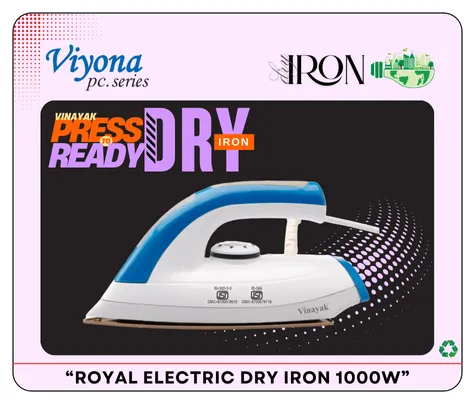
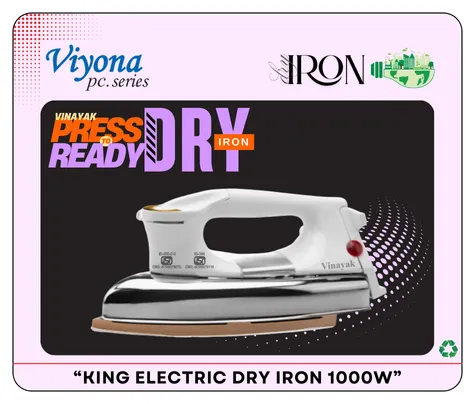
Our VIYONA dry irons are five models, codes 601 to 605, all rated 1000 W in our catalogue and priced from ₹920 to ₹1,480 MRP: the 601 Diamond and 602 Crystal at ₹920, the 603 Royal at ₹1,080, and the 604 Jumbo and 605 King at ₹1,480, all made at our Mumbai works.
VIYONA dry iron MRP by model (all 1000 W)
MRPs from our current catalogue, bars to scale with ₹1,480 as the full bar. The models differ in body and design; all five are listed at 1000 W.
VIYONA 601 Diamond is a 1000 W dry iron with an MRP of ₹920. See the Diamond, Royal and King pages for photographs. We do not make a steam iron or garment steamer.
An iron needs a 16A 3 pin plug top on a 16A wall socket; our VIYONA Royal 16A 3 pin plug top (244) is ₹110 MRP.
FAQs
What temperature should an iron be for cotton?
What is the dry iron setting for silk?
What do 1, 2 and 3 dots mean on an iron?
Can I iron polyester with a dry iron?
How do I clean the bottom of my iron?
What wattage are VIYONA dry irons?
Why buyers choose Vinayak Electricals
- Five VIYONA dry irons, 601 to 605, all 1000 W, from our works in Marol, Andheri East, Mumbai.
- MRPs published openly: ₹920 to ₹1,480 for the dry irons.
- The 16A sockets and 16A 3 pin plug tops an iron needs, from the same catalogue.
- At most 1 unit per hour of heating for any of the five, worked from the 1000 W rating.
- 500+ dealers and delivery across India, in full boxes.
- Manufacturing since 1995; ISO 9001:2015 certified.
Five 1000 W dry irons
See the VIYONA dry iron range with codes, photographs and MRPs, then order through a dealer or call us.
View VIYONA dry irons