Why Your Iron Is Not Heating, and What to Check First
An iron not heating usually has a simple cause: a dead socket, a loose plug top, a broken cord or a dial left near off. Less often, the thermostat or the heating element inside has failed. Below we take a dry iron not working step by step, from the checks you can make safely at the socket to what the indicator light tells you, how the iron thermostat works, when the iron cord is the culprit, and when to repair or replace, with the MRPs of the VIYONA dry irons we make in Mumbai.
Key takeaways
- Check first — socket switch, MCB, a test lamp in the same socket, and the dial turned fully up.
- Plug and cord — a loose plug top or a broken conductor near either end is the most common iron fault you can see.
- Light on, iron cold — usually the element or an internal cut-out; a technician’s job.
- Overheating — a stuck thermostat is dangerous; unplug and stop using it.
- Replace? — a failed element often costs close to a new iron; our VIYONA dry irons start at ₹920 MRP.
Iron not heating: the short answer
A dry iron is one of the simplest appliances in the house. Current comes in through the plug and cord, passes a thermostat that switches it on and off to hold the temperature you set, and flows through a heating element sealed into the soleplate. When an iron stops heating, the fault is almost always in one of four places: the socket, the plug and cord, the thermostat, or the element.
The first two are where most faults turn up, and they are the ones a homeowner can check without opening anything. Is the wall socket live? Is the plug top cracked or loose? Is the cord kinked or broken near either end? The thermostat and element sit inside the iron, behind its body and soleplate, and they belong to a service technician.
This guide walks through the checks in that order, explains what the indicator light is telling you, covers an iron that overheats instead, and helps you decide between repair and replacement. We make the VIYONA range of dry irons in Mumbai; their MRPs are near the end. For heat settings by fabric, see our iron temperature settings guide.
Why is my iron not heating?
An iron usually stops heating because the wall socket or its switch is dead, the plug top or its pins are loose or burnt, the cord has a broken conductor near the plug or the iron, the thermostat dial is at off or minimum, the thermostat contacts have worn, or the heating element or its internal safety cut-out has failed.
Sorted from most likely and easiest to check, to least likely and hardest:
Socket or switch off Dial at minimum Loose plug top Broken cord Worn thermostat Element failed Internal cut-out open
Green ones take a minute and need no tools. Amber ones are visible from outside but may need a replacement part. Red ones are inside the iron and need a service technician; opening a sealed iron yourself can leave the body live when it is reassembled.
Before every check, switch the iron off at the wall, pull the plug and let it cool fully. A soleplate stays hot enough to burn long after the light goes out.
| Symptom | Likely cause | Who fixes it |
|---|---|---|
| No light, iron cold | Socket, plug, cord or dial | Homeowner checks, electrician if socket |
| Light on, iron cold | Element or internal cut-out | Service technician |
| Heats only at some cord angles | Broken conductor in cord | Technician, new cord |
| Heats weakly on every setting | Worn thermostat contacts | Service technician |
| Light never goes off, scorches | Thermostat stuck closed | Stop use, technician or replace |
| Trips the MCB when plugged in | Short in iron or cord | Stop use, technician |
Is it the socket or the iron?
To find out whether the socket or the iron is at fault, plug a lamp or phone charger that you know works into the same socket and switch it on: if it works, the socket is fine and the fault is in the iron, and if it does not, the socket, its switch or the circuit’s MCB is the problem.
Check in this order:
Socket switch ON MCB at the board ON Test lamp works
A socket that works for a lamp but not for the iron can still be at fault. Worn socket contacts may pass a small load but heat and lose contact under the iron’s full current. If the iron’s plug feels loose in the socket, or the socket face is brown, see our loose socket fix and switch hot or socket sparking guides.
An iron belongs on a 16A wall socket, not a 6A socket with an adaptor and not an extension board; our extension board guide explains why heavy heating loads go straight to the wall.
A test lamp in the same socket settles whether the iron is the problem.
Most cord breaks sit near the plug or where it enters the iron.
A bimetal strip switches the element; stuck contacts mean overheating.
An iron whose light never goes out is a fire risk.
How to check an iron cord for damage?
Check an iron cord with the plug out and the iron cold: run it slowly through your fingers from plug to iron, feeling for flat spots, kinks, bulges or soft sections, and look closely at both ends, where the cord bends most during ironing and where broken conductors inside the insulation are most common.
What to look for:
Exposed copper Burn or melt marks Kink near the iron Stiff or flattened spot Cord pulled from the plug
A broken conductor often shows up as an iron that heats only when the cord is held at a certain angle, or that flickers its indicator as you move it. That is a cord fault, not a thermostat fault, and it can arc inside the insulation.
Cord damage usually comes from wrapping a hot iron tightly, from the cord hanging off the board edge, or from the iron being pulled by its cord.
Do not tape a damaged iron cord and keep using it. A cord with exposed copper or burn marks needs replacing by a technician, or the iron needs replacing.
Can I replace the plug on an iron?
Yes, a cracked or loose plug top on an iron can be replaced like any plug, with the iron unplugged, using a 16A three pin plug top and connecting phase, neutral and earth to the right pins with every strand clamped and the cord grip tightened, or by an electrician if you are unsure of the wiring.
Signs the plug top needs changing:
Cracked body Loose or bent pins Brown or black marks Cord pulls out easily
MRP of plug tops and sockets for an iron point
MRPs from our current catalogue, bars to scale with ₹160 as the full bar. An iron needs a 16A plug top on a 16A socket.
Our Royal 3 pin plug top comes in 6A at ₹68 and 16A at ₹110 MRP. Our 3 pin plug guide shows which wire goes to which pin.
How does an iron thermostat work?
An iron thermostat is a bimetal strip, two metals bonded together that bend by different amounts as they heat; as the soleplate reaches the temperature set on the dial, the strip bends and opens a pair of contacts to cut the element, then closes them again as it cools, which is why the indicator light cycles on and off.
The dial simply sets how far the strip has to bend before the contacts open. Turn it to one dot and the contacts open early; turn it to three dots and they open late.
Thermostats fail in two ways:
Contacts worn open the iron stays cold or heats weakly.
Contacts stuck closed the iron keeps heating past the setting.
Neither is a home repair. The thermostat sits inside the body, close to the element, and its setting and insulation have to be right after reassembly. If the dial turns freely with no click or feel at any point, the linkage inside may have broken.
Before blaming the thermostat, turn the dial fully to the highest setting and back once. A dial left near off is the most common “not heating” complaint.
Iron light on but not heating: what does it mean?
If the iron’s indicator light comes on but the soleplate stays cold after a few minutes, the supply is reaching the iron and the thermostat is calling for heat, so the fault is most likely an open heating element or an internal safety cut-out that has blown, both of which need a service technician or a replacement iron.
The light tells you more than people realise:
Light off, iron cold supply, plug, cord or dial.
Light on, iron cold element or internal cut-out.
Light flickers when moved broken conductor in the cord.
Light never goes off thermostat stuck; iron overheats.
Where the element is sealed into the soleplate, it cannot be changed separately, so a failed element usually means a new soleplate assembly or a new iron. Compare that repair cost with a new iron’s MRP before you agree to it.
A quick sketch of what the light does, and when, saves the technician time and you money.
Iron overheating or not switching off: is it dangerous?
Yes, an iron that keeps heating past its setting, scorches fabric on a low setting, or whose indicator light never goes out is dangerous, because a stuck thermostat lets the element run without limit; unplug it at once, let it cool somewhere safe, and do not use it again until it is repaired or replaced.
Signs of a stuck thermostat:
Scorch on one dot Light never cycles Smoke or burning smell Handle too hot to hold
An overheating iron left face down can burn through a board cover or start a fire. If it smells of burning plastic, the internal wiring may already be damaged.
Our short circuit and electrical fire guide covers what to do if anything goes further. Never pour water on an iron that is plugged in.
Unplug an overheating iron by switching off the socket first, then pulling the plug top, never the cord. Leave it to cool on a heat-proof surface.
Dry iron not working after a fall or water spill: what now?
A dry iron that stops working after a fall or a water spill should not be plugged in again until a technician has checked it, because a drop can crack the body, shift the thermostat or break internal insulation, and water inside can bridge live parts to the metal soleplate.
What a fall or spill can do:
Cracked body exposes live terminals.
Water inside can make the soleplate live.
Bent thermostat changes the setting.
Loose element joint heats unevenly or not at all.
Do not try to dry it with a hair dryer and plug it straight back in. Let a technician open, dry, inspect and test it, including the earth connection to the soleplate. A dry iron uses no water in normal use, so moisture inside is never expected; our dry iron vs steam iron guide explains the difference.
Repair or replace an iron that is not heating?
Repair is worth it when the fault is a plug top, a cord or a thermostat and the body and soleplate are sound, while replacement usually makes more sense when the element has failed, the body is cracked or the soleplate is badly worn, because those repairs cost a large share of a new dry iron.
MRP of our VIYONA dry irons
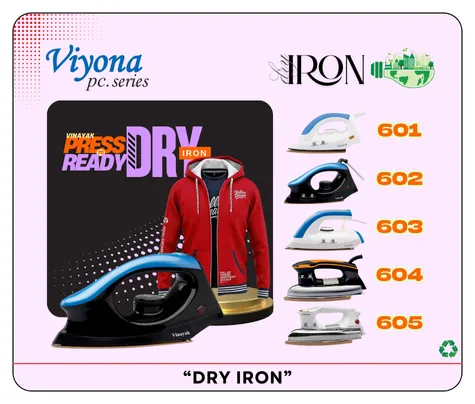
MRPs from our current catalogue, bars to scale with ₹1,480 as the full bar. All five are listed at 1000 W.
A new plug top costs ₹110 MRP; a new element usually means a new soleplate. VIYONA 601, the Diamond dry iron, is a 1000 W iron at ₹920 MRP. See the range on the VIYONA dry iron page.
How to keep an iron heating properly for years?
An iron lasts longest when it runs from its own 16A wall socket, is never wrapped while hot, is unplugged by the plug top and not the cord, is stood on its heel between strokes, and has its soleplate wiped clean when cold, because heat, strain on the cord and bad sockets cause most failures.
The habits:
16A wall socket Cool before wrapping Pull the plug, not cord Stand it on its heel Clean when cold
Avoid extension boards and multi plugs for the iron; our multi plug vs extension board guide explains why. A soleplate with burnt starch on it also heats unevenly and sticks; our iron temperature settings guide covers cleaning it.
If your iron trips the MCB the moment it is plugged in, stop using it. That points to a short inside the iron or its cord.
FAQs
Why is my iron not getting hot?
How do I know if my iron thermostat is bad?
Why does my iron work only when I hold the cord a certain way?
Can a dry iron heating element be repaired?
Is it safe to use an iron after dropping it?
What is the price of a VIYONA dry iron?
Why buyers choose Vinayak Electricals
- Five VIYONA dry irons, 601 to 605, listed at 1000 W, from ₹920 MRP.
- 16A plug tops and 16A sockets from the same catalogue for a proper iron point.
- Made at our works in Marol, Andheri East, Mumbai, since 1995.
- ISO 9001:2015 certified manufacturing.
- MRPs published openly; no hidden mark-ups.
- 500+ dealers with delivery across India.
A new dry iron when repair does not pay
See the five VIYONA dry irons, from the ₹920 Diamond to the ₹1,480 King, and buy through a dealer near you.
View VIYONA dry irons