Loose Socket Fix: When the Plug Slips or the Socket Wobbles

Socket loose is a common complaint with two different causes: the plug can be loose in the socket because its contacts or the plug pins are worn, or the socket can be loose in the wall because its screws, clips or box have given way. Below we show how to tell which, why a loose socket is a fire risk, why bending contacts is not a fix, how a socket is replaced safely, and what our replacement sockets and plug tops cost.
Key takeaways
- Two problems — plug loose in the socket (worn contacts or pins) or socket loose in the wall (screws, clips, box).
- Dangerous — poor grip heats the contacts; brown plastic or sparks mean stop. Switch off the MCB
- No wedges — never bend contacts or pack paper or foil in. Replace, not repair
- Find the worn part — try another plug in this socket, and this plug in another socket.
- Our MRPs — VIYONA 119 6A socket ₹40, KEMPS K192 shuttered ₹110, VIYONA 243 plug top ₹68.
Socket loose: the short answer
A loose socket is one of two problems. Either the plug is loose in the socket, so it sags, slips or falls out, which means the socket’s contacts or the plug’s pins are worn. Or the socket itself is loose in the wall, so the whole module or plate wobbles, which means its fixing screws, the plate clips or the box behind it have given way.
Both are worth fixing quickly. A plug that grips poorly touches the contacts over a small area, and a small contact area under load runs hot. A socket that moves strains the wires on its terminals each time a plug goes in.
The fix is nearly always replacement, not repair: a new socket module, a new plug top, or a refixed plate. Bending contacts, wedging paper or foil, or taping a plug in place are all unsafe.
This guide shows how to tell which part is worn, when a loose socket is dangerous, how a socket is replaced safely, how to fix one that wobbles in the wall, and what replacement sockets and plug tops cost in our range.
Why does a plug fall out of the socket?
A plug falls out of a socket because the spring contacts inside the socket have lost their grip after years of plugging and heat, because the plug’s pins are bent, worn or undersized, or because a heavy adaptor, charger or cable is pulling the plug forward under its own weight.
The causes we see most:
Worn socket contacts Bent or loose plug pins Heavy adaptor or charger Cable pulling down Wrong plug for socket
Contacts lose their spring faster when a socket has run hot, for example with a heater on a 6A socket, because heat softens the metal. A socket used daily for a kettle or iron wears faster than one behind a TV.
Multi-plugs make it worse: their weight levers the plug out, and several appliances on one plug add heat. Our multi plug vs extension board guide explains why a board on a cord is usually the safer choice.
A plug that has to be held in place to work is a socket that should not be used until it is replaced.
| Symptom | Likely cause | Fix | Our part | MRP |
|---|---|---|---|---|
| Plug loose in this socket only | Worn socket contacts | Replace socket module | KEMPS K192 6A shuttered | ₹110 |
| Plug loose in every socket | Worn or bent plug pins | Replace plug top | VIYONA 243 6A plug top | ₹68 |
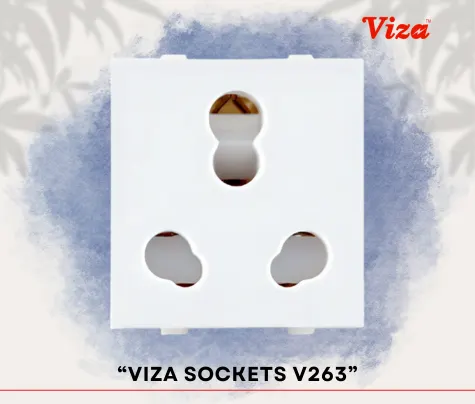
| Heavy plug loose, heater use | Worn 16A contacts | Replace 16A socket | VIZA V263 16A porcelain | ₹160 |
| Whole plate wobbles | Loose screws or cracked plate | Tighten or replace plate | Plate of same size | From ₹102 |
| Screws spin in the box | Broken box lugs | Electrician replaces box | Concealed box | By size |
Is a loose socket dangerous?
A loose socket is dangerous because a plug that grips poorly touches the contacts over a small area, and current through a small contact area heats the socket, which can brown or melt the plastic, cause sparking every time the plug moves and, left long enough, start a fire behind the plate.
Warning signs, from urgent down:
Burning smell Melted or brown plastic Sparks when plug moves Plug warm after use Appliance cuts in and out
A socket that only feels slack, with no heat or marks, is the early stage. That is the moment to replace it, before heat damages the wiring behind it.
If you see any red sign, stop using the socket, switch off its MCB and leave it off until it is replaced. Our hot switch and sparking socket guide explains what each sign means, and our short circuit and electrical fire guide covers what to do if it gets worse.
Burning smell or melted plastic: switch off the MCB at once, unplug nothing by hand, and call a licensed electrician.
Plug loose in the socket, or socket loose in the wall: different fixes.
Poor grip heats the contacts; brown plastic means stop using it.
Never bend contacts or pack paper or foil into a socket.
A new socket costs from ₹40; the plate and other modules stay.
Socket or plug: which one is worn?
To find out whether the socket or the plug is worn, try a different, known-good plug in the same socket and the same plug in a different socket: if the good plug is also loose, the socket contacts are worn, and if the plug is loose everywhere, its pins or plug top are the problem.
Do this with the appliance switched off. What to look for:
Loose in every socket: plug Loose only here: socket Pins bent or blackened: plug Brown marks on face: socket
A plug top is cheap to change. Our VIYONA 243 6A 3 pin plug top is ₹68 MRP, and the 244 16A plug top ₹110. A worn socket is replaced as a module.
If the plug pins are a different size from the socket, that is not wear; it is the wrong pair. Our 2 pin vs 3 pin plug and 3 pin plug sizes guides explain which plug fits which socket.
A blackened pin means the plug has been arcing. Replace the plug top and the socket it was used in.
Can you tighten loose socket contacts?
You should not try to tighten loose socket contacts by bending them, wedging paper or foil into the socket, or squeezing the plug pins apart, because a contact that has lost its spring will not hold its shape, and any of these tricks can cause a short, overheat the socket or leave a live part exposed.
Common “fixes” to avoid:
Bending contacts Paper or foil wedge Spreading plug pins Taping the plug in
The contacts in a socket are springs. Once heat or use has weakened them, they stay weak; the only real fix is a new socket module. In a modular board that is one part, and the plate and other modules stay where they are.
The same applies to a shuttered socket that feels stiff: that is the shutter, not the contacts, and it is meant to resist. Our socket with shutter guide explains why a shuttered socket can feel hard to plug into.
Never put anything other than a plug into a socket, and never work inside a socket that is connected to a live circuit.
Loose socket fix: how is a socket replaced?
A loose socket is fixed by replacing it: switch off the MCB and test the socket dead, remove the plate, release the old socket module, move the phase, neutral and earth wires one at a time to the same terminals of a new socket of the same size and rating, tighten them firmly, refit and test.
The order that keeps it safe:
1. MCB off, test dead 2. Plate off 3. Photo the wiring 4. One wire at a time 5. Earth to earth 6. Refit, then test
Buy the replacement by rating and module size: a 6A 3 pin socket is usually 2M on a modular board, and so is a 16A one. Getting this right means the new socket fits the old slot.
Our guide to removing a modular switch plate covers the plate, and the guide to replacing a switch covers moving wires; the steps for a socket are the same.
If the wires behind the socket are browned, brittle or short, stop and call a licensed electrician. A new socket on damaged wire is not a fix.
Socket loose in the wall: how do you fix a wobbling socket?
A socket that wobbles in the wall is fixed by finding which layer has come loose: tighten the base plate screws if the whole plate moves, re-seat the module if only the socket moves in its slot, and replace the box or its lugs if the screws spin, always with the MCB off and the board tested dead first.
Which layer is loose:
Whole plate moves: screws Only socket moves: clips Screws spin: box lugs Box moves: wall fixing
A plate that rocks often has a cracked base plate or a broken lug behind it. A new plate of the same size fixes the first; a broken box needs an electrician, and sometimes some plaster work. Our concealed box guide covers box sizes.
Fix a wobbling socket promptly. Each time a plug is pushed in, a loose socket flexes its wires at the terminals, which loosens them, and a loose terminal is the most common cause of a hot socket.
Do not pack a loose box with paper or wood. A broken box is replaced, not wedged.
Wrong plug for the socket: is that why it feels loose?
A plug can feel loose simply because it is the wrong size for the socket, such as a 6A plug in the 16A side of a socket, or a plug made to another country’s pattern pushed into a universal socket, in which case the fix is the right socket or plug, not a repair.
Common mismatches:
6A plug in 16A socket Foreign plug in universal 2 pin plug, worn holes
A 16A plug will not go into a 6A socket at all, which is deliberate. The reverse, a small plug in a large socket, does not grip. The combined 6A and 16A universal socket is built to take both; if one size is loose, compare it with a dedicated socket of that size.
Use a socket matched to the appliance’s plug. Our 6A vs 16A socket guide explains which appliances need which, and our universal socket guide covers the combined type.
Never use a travel adaptor as a permanent fix for a loose foreign plug. Change the plug top to the Indian pattern instead.
Which replacement socket should you buy?
Buy a replacement socket with the same rating, pin pattern and module size as the old one, ideally with a safety shutter, so a 6A 3 pin socket replaces a 6A 3 pin socket on the same plate, and in our range that costs from ₹40 MRP for a conventional VIYONA socket to ₹110 for a KEMPS shuttered modular one.
MRP of our 6A replacement sockets
MRPs from our current catalogue, bars to scale with ₹110 as the full bar. VIYONA sockets are conventional; VIZA and KEMPS are modular. V1269 is grey line.
A shutter adds safety for children. Codes are on our KEMPS K192 page and socket range page.
16A sockets and plug tops: what do they cost?
For heavy appliances, a replacement 16A socket in our range costs ₹90 MRP for the VIYONA 153 6 and 16A universal socket with shutter, ₹160 for the VIZA V263 16A socket with porcelain base and ₹205 for the KEMPS K193 universal socket with shutter, and a 16A plug top ₹110.
MRP of our 16A sockets and plug tops
MRPs from our current catalogue, bars to scale with ₹205 as the full bar.
A 16A socket that runs a geyser or heater for hours wears fastest; a porcelain base suits it. See the VIZA V263 page.
How can you stop sockets going loose?
To stop sockets going loose, pull plugs out by the plug body and not the cable, avoid hanging heavy chargers and multi-plugs from wall sockets, use a 16A socket for heaters, irons and geysers, keep the switch off before plugging in heavy loads, and replace a slack socket early, before heat weakens it further.
Habits that help:
Pull by the plug No heavy adaptors 16A for heavy loads Switch off, then plug Replace early
Plan enough sockets so nothing lives on an adaptor. Our kitchen electrical points guide counts sockets for the busiest room, and our extension board burning guide covers the related problem on cords.
Check sockets once a year as part of a routine, as our home maintenance checklist suggests: any warmth, browning or slack grip goes on the list to replace.
A socket that has to be wiggled to work is not ageing gracefully. Switch it off and replace it.
FAQs
Why is my socket loose?
How do I fix a loose plug socket?
Can a loose socket cause a fire?
Why does my plug keep falling out of the socket?
How much does it cost to replace a socket?
Can I put paper in a loose socket?
Why buyers choose Vinayak Electricals
- 6A and 16A sockets in conventional and modular sizes, with and without shutters.
- Replacement sockets from ₹40 MRP, and plug tops from ₹68, so the fix costs little.
- Porcelain-base 16A sockets for geysers and heaters, from ₹93 MRP.
- Modular plates that fit all major systems, so a new socket keeps your board.
- Made at our works in Marol, Andheri East, Mumbai, since 1995; ISO 9001:2015 certified.
- Sold through 500+ dealers with delivery across India.
A new socket for the loose one
Find the matching 6A or 16A socket in our KEMPS, VIZA and VIYONA ranges with MRPs, then order through a dealer or call us.
View sockets