2 Pin vs 3 Pin Plug: Why the Earth Pin Matters
The difference between a 2 pin and 3 pin plug is the earth: a 2 pin plug connects only live and neutral, while a 3 pin plug adds a larger earth pin that gives a fault in a metal-bodied appliance a safe path to ground. Below we cover which appliances need each, which sockets accept which plug, why the earth pin must never be cut, and the MRPs of the 2 pin tops, 3 pin tops and sockets we make in Mumbai.
Key takeaways
- 2 pin plug — live and neutral only. For double-insulated devices such as chargers and plastic lamps.
- 3 pin plug — adds earth. Needed for metal bodies, heating, motors and anything near water.
- Never cut or bend an earth pin, or force a 3 pin plug into a 2 pin socket. Fit a 3 pin socket instead.
- 2 in 1 socket — takes both plugs; our VIYONA 122 is ₹38 MRP.
- Our plug tops — Royal and Decent 2 pin tops ₹21, Royal 3 pin tops ₹68 (6A) and ₹110 (16A).
2 pin vs 3 pin plug: the short answer
The difference between a 2 pin and a 3 pin plug is the earth. A 2 pin plug carries only the two current-carrying conductors, live and neutral. A 3 pin plug adds a third, larger pin that connects the appliance’s body to the earth wire of your house, so a fault has a safe path away from the person holding it.
That one extra pin decides where each plug belongs. Small double-insulated devices with plastic bodies, such as phone chargers, many lamps and small electronics, are designed to run on two pins. Anything with a metal body, anything that heats water or air, and anything used near water needs the earth pin, and the manufacturer ships it with a three pin plug for that reason.
This guide explains what each plug does, which sockets accept which plug, why you must never cut or bend an earth pin, and what the 2 pin tops, 3 pin tops and sockets we make in Mumbai cost at MRP. The choice between a 6A and a 16A three pin plug is a separate question, answered in our 3 pin plug guide.
What is the difference between a 2 pin and 3 pin plug?
A 2 pin plug connects only live and neutral, so the appliance gets power but no earth; a 3 pin plug connects live, neutral and earth, so if a fault makes the metal body live, current flows down the earth wire and trips the MCB or RCCB instead of passing through a person.
What each plug connects
2 pin plug: Live Neutral No earth
3 pin plug: Live Neutral Earth
2 in 1 socket: Takes both Earth only reaches a 3 pin plug
A summary of general practice, not a test result. An earth pin protects only if the socket behind it is actually wired to earth.
The earth pin is also built differently. On a round-pin Indian plug it is thicker and longer than the other two, so it connects first when the plug goes in and breaks last when it comes out. Our phase, neutral and earth guide explains what each of the three wires does inside the wall.
Size is not the difference. A 6A 2 pin plug and a 6A 3 pin plug carry the same current; only the 3 pin one carries an earth.
| 2 pin plug | 3 pin plug | |
|---|---|---|
| Conductors | Live and neutral | Live, neutral and earth |
| Earth protection | None | Yes, if the socket is earthed |
| Typical appliances | Chargers, plastic lamps, small adaptors | Iron, fridge, washing machine, kettle, computer |
| Fits a 2 pin socket | Yes | No, never force it |
| Fits a 3 pin socket | Only where the socket accepts it | Yes, matching 6A or 16A |
| Our plug top | Royal 261, Decent 263 | Royal 243 (6A), 244 (16A) |
| Our MRP | ₹21 | ₹68 (6A), ₹110 (16A) |
Why does a 3 pin plug have an earth pin?
A 3 pin plug has an earth pin so that a metal-bodied appliance stays safe to touch when something inside goes wrong: if a loose live wire touches the body, the fault current runs to earth through that pin, the protective device at your board trips, and the body never stays live.
Without an earth path, the same fault leaves the casing of an iron, a washing machine or a geyser sitting at mains voltage. Nothing trips, the appliance may keep working normally, and the first person to touch it and a tap or a wet floor at the same time completes the circuit. That is the shock an earth pin is there to prevent.
Three things make the protection work, and all three must be in place: an intact earth pin, a socket wired to earth and an earth electrode outside the house. Our types of earthing guide shows how plate and pipe earthing pits are made. A trip at the board needs an MCB for heavy faults and, for small leaks, an RCCB, which we do not make.
Never cut, bend or file the earth pin to make a 3 pin plug fit a 2 pin socket. It turns a protected appliance into one with no fault path at all.
For double-insulated devices only: chargers, plastic lamps, adaptors.
Metal body, heat, motor or water means the appliance needs the earth pin.
A cut or bent earth pin leaves a metal appliance with no fault path.
Replace a 2 pin socket with a 3 pin or 2 in 1 one, not an adaptor.
Which appliances can use a 2 pin plug?
A 2 pin plug is meant for appliances that are double insulated or have no exposed metal, such as phone and laptop chargers, many table lamps, small radios, set-top box adaptors and shavers, because their design keeps live parts behind two layers of insulation and they do not rely on an earth for safety.
Double-insulated appliances are commonly marked with a square inside a square symbol on the rating plate. If you see it, the maker designed the appliance to run without earth, and a 2 pin plug is correct. If the plate shows an earth symbol, or the appliance came with a 3 pin plug, it needs earth.
Good candidates for two pins: Phone chargers Plastic table lamps Small adaptors Decorative lights
A 2 pin plug top is also the usual replacement on a two-core cord, for example on a lamp or a festival light string. The cord itself is a separate product; we make 2 pin cords too, covered on our 2 pin power cord page.
When in doubt, read the rating plate, not the plug. The plate shows whether the maker designed the appliance for earth.
Which appliances need a 3 pin plug?
Any appliance with a metal body, a heating element, a motor or a place near water needs a 3 pin plug, which in a typical home means the iron, kettle, toaster, mixer, refrigerator, washing machine, microwave, geyser, room heater, desktop computer and most power tools, because a fault in any of them can make the body live.
Some of these are light loads and use a 6A 3 pin plug: a mixer, a desktop computer, a pedestal fan. The heavy heating and motor loads, such as a geyser, room heater, iron or microwave, use the larger 16A 3 pin plug and a 16A socket. Our 6A vs 16A socket guide sorts appliances one by one, so we do not repeat that list here.
The rule of thumb is simple: metal body water heat all mean earth. A refrigerator or washing machine that gives a slight tingle when touched is often a sign the earth is missing somewhere between the plug and the earth pit; stop using it until an electrician has checked it.
Can I use a 3 pin plug in a 2 pin socket?
No, you should not use a 3 pin plug in a 2 pin socket, because the only ways to make it fit, cutting or bending the earth pin, pushing it in at an angle or using a travel adaptor with no earth, all leave the appliance running with no earth connection, which removes the protection the third pin exists for.
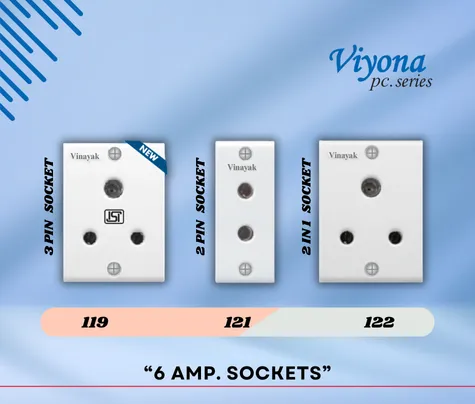
The fix is a socket, not an adaptor. Have an electrician replace the 2 pin socket with a 3 pin socket wired to the earth conductor, or add a new 3 pin point. On a conventional board our VIYONA 119 3 pin socket is ₹40 MRP; on a modular board the KEMPS K192 6AX 3 pin socket with shutter is ₹110.
Some older homes have 2 pin sockets because the wiring has no earth conductor to the board at all. Swapping the socket alone does not help there; the earth wire has to be run first. Our guide to checking earthing at home covers the safe checks you can make, and when to call an electrician.
A 3 pin plug forced into a 2 pin socket works normally right up to the first fault. That is why it is dangerous: nothing warns you.
Can a 2 pin plug go into a 3 pin socket?
A 2 pin plug can go into the live and neutral holes of a 6A 3 pin socket, and that is safe for a double-insulated appliance, but on many shuttered sockets the shutter opens only when the earth pin enters first, so a 2 pin plug will not go in unless the socket is designed to accept one.
That is why the 2 in 1 socket exists. It has holes for both a two pin and a three pin 6A plug in one outlet. Our VIYONA 122 2 in 1 socket is ₹38 MRP, a few rupees more than a plain 3 pin socket, and it saves an adaptor on a wall that serves both kinds of device.
Never push a 2 pin plug into the earth hole and one other hole, or force a shutter open with a pen or key. If a plug will not enter a socket cleanly, the socket is telling you it is the wrong match. A 6 and 16A universal socket is the other option where heavy and light plugs take turns.
A 2 pin plug that sits loose in a 3 pin socket will spark and heat. Replace the socket or the plug top before it scorches.
2 pin plug top: what we make and what it costs
A 2 pin plug top is the replaceable plug fitted to the end of a two-core cord, and we make two designs in our VIYONA accessories range, the Royal 2 pin top (code 261) and the Decent 2 pin top (code 263), each at ₹21 MRP, plus male-female 2 pin connectors at ₹42.
MRP of our plug tops, 2 pin and 3 pin
MRPs from our current catalogue, bars to scale with ₹110 as the full bar.
VIYONA 261 is a Royal 2 pin plug top with an MRP of ₹21. The male-female pair, codes 262 and 264, joins two lengths of two-core cord with a plug and a matching socket, useful on decorative lighting. Earth costs more: the cheapest Royal 3 pin top is ₹68. All are on the Royal and Decent 2 pin top and Royal 3 pin plug top pages.
2 pin socket vs 3 pin socket: which should you fit?
Fit a 3 pin socket, or a 2 in 1 socket that takes both plugs, at almost every point in a home, because it serves earthed and unearthed appliances alike, and keep a plain 2 pin socket only for a spot that will only ever power a charger or a lamp.
MRP of our 6A sockets, 2 pin to 3 pin
MRPs from our current catalogue, bars to scale with ₹110 as the full bar. VIYONA codes are conventional sockets; VIZA and KEMPS are modular.
On a conventional board the step from 2 pin at ₹26 to 3 pin at ₹40 is ₹14, so price is no reason to leave out earth. The VIZA V262 is a 6A 2 pin socket with shutter for modular boards, at ₹78. See every code on the VIYONA 6A sockets page.
How do you wire a 2 pin plug top?
To wire a 2 pin plug top, unplug the appliance first, open the plug, clamp the cord’s outer sheath under the cord grip, connect one core to each pin terminal with no stray strands, tighten both screws firmly and close the cover, checking that no bare copper shows and the cord cannot be pulled out.
The steps in order: Unplug first Strip a short length Twist the strands Sheath under the grip Screws tight
A 2 pin plug is not polarised, so either core can go to either pin. A 3 pin plug is different: live, neutral and earth each have a marked terminal, and our 3 pin plug guide walks through that wiring. Do not wire a three-core cord into a 2 pin plug and leave the earth core loose; that appliance needs a 3 pin top.
Plug tops are the only wiring a homeowner should touch, and only on an unplugged cord. Anything inside a wall socket or board starts with the MCB off, a tester to prove it dead, and a licensed electrician.
Is a 2 pin extension board or flex box safe?
A 2 pin extension board or flex box is safe for chargers, lamps and other two pin devices within its rating, but it has no earth, so anything with a three pin plug or a metal body must run from a 3 pin extension or, better, straight from a wall socket.
Our flex boxes come in 2 x 4 m and 2 x 8 m for two pin plugs and 3 x 4 m for three pin plugs, with MRPs from ₹285 to ₹390; the flex box guide explains the sizes. Using a 2 pin extension for an iron removes its earth even if the wall socket is earthed.
Multi plugs and adaptors raise the same question. Our guide on multi plug vs extension board covers when each is the right tool, and extension boards for a fridge or washing machine covers the heavy appliances that should not be on either.
Count the pins on the extension’s own plug. A strip with 3 pin sockets on a 2 pin plug has no earth at any of its sockets.
FAQs
What is the difference between a 2 pin and 3 pin plug?
Why does a 3 pin plug have a bigger pin?
Can I cut the earth pin to fit a 2 pin socket?
Is it safe to use a 2 pin plug for an iron?
What is the price of a 2 pin plug top?
Can a 2 pin plug go in a 3 pin socket?
Why buyers choose Vinayak Electricals
- Made in-house at our works in Marol, Andheri East, Mumbai, our only manufacturing site.
- 2 pin tops, 3 pin tops, multi plugs and sockets from one VIYONA accessories catalogue.
- Royal and Decent 2 pin tops at ₹21 MRP; Royal 3 pin tops in 6A and 16A, clear or opaque.
- Shuttered 2 pin and 3 pin sockets in our VIZA and KEMPS modular ranges.
- Manufacturing electrical accessories since 1995; ISO 9001:2015 certified.
- MRPs published openly; sold through 500+ dealers with delivery across India.
2 pin and 3 pin plug tops
See codes and MRPs for our Royal and Decent 2 pin tops and Royal 3 pin plug tops, then order through a dealer or call us.
View 2 pin plug tops