LED Bulb vs Normal Bulb: How LED, Filament and CFL Bulbs Differ
The difference between an LED bulb and a normal bulb is how they make light: a normal filament bulb heats a thin wire until it glows, wasting most of its power as heat, while an LED bulb passes current through tiny semiconductor chips that give light directly, so it needs far fewer watts for the same brightness. Below we compare LED, incandescent and CFL on watts, life, heat and safety, cover filament-style LEDs, and list the LED bulbs we make in Mumbai with their MRPs.
Key takeaways
- Normal bulb — an incandescent filament bulb. Glows by heat; most of its power ends up as heat, not light.
- LED bulb — light from semiconductor chips run by a small driver. Roughly a sixth of the watts for similar light.
- CFL — the in-between, a folded fluorescent tube. Better than a filament bulb, but contains a little mercury.
- Life — a filament bulb is typically rated around 1,000 hours; LED bulbs are commonly rated 15,000 hours or more.
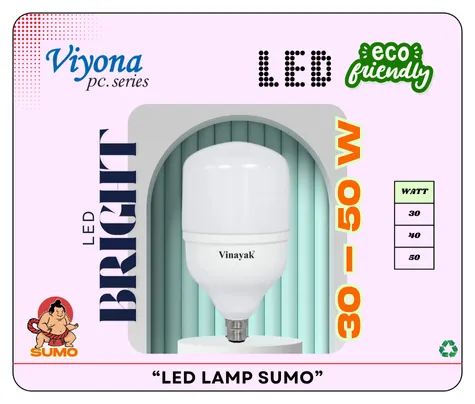
- Our LED bulbs — 9W (₹70 MRP) to 23W, plus LED Lamp Sumo at 30W, 40W and 50W, registered to IS 16102.
Difference between LED bulb and normal bulb: the short answer
When people say “normal bulb” in India they usually mean the old incandescent filament bulb, the clear or frosted glass globe with a glowing wire inside, sold for decades in 40W, 60W and 100W. Some also use it for the twisted CFL that replaced it in many homes.
An LED bulb fits the same holder and looks similar, but works on a different principle. It needs far fewer watts for a similar amount of light, stays much cooler, lights instantly and usually lasts many times longer. It costs more to buy than a filament bulb, and it contains a small electronic driver that a filament bulb does not need.
This guide compares the three on what actually changes in a home: watts, life, heat, safety and the look of the light. It does not repeat units-per-month tables, which our appliance power consumption chart already covers. We make LED bulbs, not filament bulbs or CFLs, at our works in Marol, Andheri East, Mumbai, so the product facts below are for our LED range.
What is a normal bulb?
A normal bulb is an incandescent bulb: a glass envelope holding a thin tungsten filament that glows white-hot when current flows through it, so it gives light as a side effect of heat, which is why it uses many more watts than an LED for the same brightness and gets too hot to touch.
The design is over a century old and very simple: filament, glass, inert gas, cap. There is nothing electronic in it, which is why it works on almost any supply and with old dimmers.
Its weaknesses are the ones you feel. It is hot within seconds. The filament is fragile and often breaks at the moment you switch it on. And the light it gives is always a warm, yellowish white, because that is the colour of a filament at that temperature.
A CFL, or compact fluorescent lamp, works differently again: a folded glass tube coated inside with phosphor, lit by an electric discharge through mercury vapour. It was the first common energy-saving bulb and is now largely being replaced by LEDs.
A “zero watt” bulb is also a small filament bulb, and it does not draw zero watts. Our night lamp guide explains what it really uses.
| Normal (filament) bulb | CFL | LED bulb | |
|---|---|---|---|
| How it makes light | Heated filament | Discharge through mercury vapour | Semiconductor chips and a driver |
| Watts for light like a 60W bulb | 60W | About 13 to 15W | About 8 to 10W |
| Typical rated life | About 1,000 hours | Several thousand hours | 15,000 hours or more |
| Heat | Very hot glass | Warm | Warm base, cool glass |
| Full brightness | Instant | Takes a moment | Instant |
| Mercury inside | No | Yes, a small amount | No |
| Colours | Warm only | Warm or cool | Warm, natural or cool |
How does an LED bulb make light differently?
An LED bulb makes light by passing a small direct current through light-emitting diodes, semiconductor chips that release light when electrons cross a junction inside them; a driver inside the bulb converts the mains supply into the low-voltage direct current the chips need, and a heat sink in the body carries away the little heat they make.
Three parts do the work: the LED chips, the driver and the heat sink. The chips emit blue light, and a phosphor coating turns it into the white you see, warm or cool depending on the phosphor.
The driver is where quality differences live. A well-made driver gives steady, flicker-free light and protects the chips from voltage swings. A poor one can cause flicker or an early failure even when the chips are fine. Our guide to why an LED light flickers covers what goes wrong.
Because the colour comes from the phosphor rather than heat, an LED bulb can be made in warm white, natural white or cool white. Our guide to warm white vs cool white helps you choose.
Most of its power leaves as heat, not light.
Similar light for roughly a sixth of the watts.
Commonly rated 15,000 hours or more against about 1,000.
LED lamps are registered to IS 16102; ours is R-71026514.
LED vs incandescent vs CFL: how many watts for the same light?
For light similar to a 60W filament bulb, a CFL typically needs about 13 to 15 watts and an LED bulb about 8 to 10 watts, so an LED uses roughly a sixth of the power of the normal bulb it replaces and noticeably less than a CFL, though the exact figure depends on the model’s lumens.
Typical watts for light similar to a 60W filament bulb
Typical equivalents used in the trade, general practice and not a test result. Bar length is the upper wattage with 60W as the full bar, rounded to the nearest 5%. Compare lumens on the carton for any real pair of bulbs.
Watts are the power drawn, not the light given. Brightness is measured in lumens, and two LED bulbs of the same wattage can give different lumens. Our guide to lumens vs watts shows how to compare them.
On the bill, the gap is large. A 60W filament bulb used 5 hours a day uses about 9 units a month; a 9W LED about 1.35 units. For other appliances and your own hours, use our appliance power consumption chart.
How long does an LED bulb last compared with a filament bulb?
A filament bulb is typically rated for around 1,000 hours, a CFL for several thousand, and an LED bulb commonly for 15,000 hours or more, so at a few hours a day a good LED bulb can outlast many filament bulbs, though heat, voltage swings and the quality of its driver all shorten real life.
Typical rated life by bulb type (hours, upper end)
Typical rated life figures quoted in the trade, general practice and not a test of our products. Bar length is the upper figure with 25,000 h as the full bar, rounded to the nearest 5%.
They also fail differently. A filament bulb dies suddenly when the wire breaks. An LED bulb usually dims slowly over its life, or stops when the driver fails. Rated life is normally the point at which light output has fallen to a set fraction of new.
What shortens LED life: trapped heat in a closed fitting, frequent voltage spikes, and a bulb pointing cap-up in a hot shade. For our warranty terms, ask your dealer for the code you are buying.
Why does a normal bulb get so hot, and does it matter?
A normal bulb gets hot because it makes light by heating a filament to a very high temperature, so most of the electricity it draws leaves as heat rather than light; that heat browns lamp holders, warms small rooms, attracts insects and can scorch a shade or curtain placed too close.
An LED bulb gets warm, not hot. Its heat is in the base and body, where the heat sink carries it away, rather than in the glass. You can usually change it soon after switching off without burning your fingers.
The heat of a filament bulb shows up on the fittings around it: a brown or cracked holder, a melted shade, or a loose cap from repeated heating. When you switch to LED, check the holder too. Our VIYONA batten and angle holders start at ₹26 MRP for the 201 angle and 202 batten holder.
In a small Mumbai bedroom, several filament bulbs also add heat that a fan or AC then works against. LED removes most of that.
Replace a brown, cracked or loose holder before fitting any new bulb. Switch off the MCB for the circuit first, not just the wall switch.
What are the benefits of an LED bulb over a normal bulb?
The benefits of an LED bulb over a normal bulb are much lower power use for similar light, far longer life, little heat, instant full brightness, a choice of warm, natural or cool white, no fragile filament, and, unlike a CFL, no mercury inside, which makes a broken bulb a simple cleanup.
Lower bill Longer life Runs cool Instant on No mercury Colour choice Survives knocks better
Instant on matters more than it sounds. A CFL takes a moment to reach full brightness, which is annoying on a staircase or in a bathroom at night. An LED is at full light the moment you switch it on, and frequent switching does not wear it out the way it wears a CFL.
The bill saving is the one most people notice first. For room-by-room ideas on cutting lighting units, see our guide on how to save electricity at home.
Changing the most-used bulbs first, the living room, kitchen and passage, gives most of the saving for the fewest bulbs.
Are there any downsides to LED bulbs?
The downsides of LED bulbs are a higher purchase price than filament bulbs, a driver that can fail or flicker if poorly made, glare from a bare bulb at eye level, possible trouble with old dimmers, and shorter life when trapped in a closed, hot fitting; buying a registered bulb and fitting it sensibly avoids most of these.
Price An LED bulb costs more on the day, but it is usually recovered in a few months of saved units on a light used daily.
Dimmers A dimmer made for filament bulbs may make an LED flicker or hum. Use an LED marked dimmable with a dimmer that suits it.
Glare LED light comes from small, bright points. A diffused or frosted bulb, or a fitting that hides the bulb, is easier on the eyes.
Unregistered bulbs LED lamps sold in India must be registered with BIS to IS 16102. A bulb with no registration number gives you nothing to check. Our guide to the best LED light brand in India shows how to verify one in the BIS Care app.
What is a filament LED bulb?
A filament LED bulb is an LED bulb made to look like an old normal bulb, with thin strips of tiny LED chips inside clear glass that glow like filaments; it gives the warm, decorative look of an incandescent bulb while using LED wattages, and is often used in pendant lights and open fittings.
The “filaments” are not tungsten wires. They are LED strips coated in phosphor, so they stay far cooler than a real filament and use a fraction of the power.
They suit places where the bulb is on show: a pendant over a dining table, a café-style fitting or a bare holder on a feature wall. Because the glass is clear, they can glare more than a frosted bulb if hung at eye level.
We do not make filament-style LED bulbs. Our LED bulbs are the standard household type described below. For decorative points, our fancy lamp holders give the look around the bulb instead.
A filament LED bulb is still an LED: it has a driver and needs a suitable dimmer if you want to dim it.
Can you put an LED bulb in a normal bulb holder?
Yes, an LED bulb fits a normal bulb holder as long as its cap matches the holder, the pin-type bayonet cap or the screw cap, so switching from a filament bulb to an LED usually means changing only the bulb; check the cap type printed on the carton against your holder before you buy.
Bayonet (pin) cap and screw cap are the two common types in Indian homes, known as B22 and E27. The cap, not the wattage, decides whether it fits; our guide to B22 vs E27 bulb holders shows how to tell them apart.
Our LED bulbs, from our January 2026 price list:
1065 · 9W · ₹70 1066 · 12W · ₹145 1067 · 15W · ₹212 1068 · 18W · ₹268 1069 · 23W · ₹410
For larger rooms, shops and halls, our LED Lamp Sumo comes in 30W (1070) at ₹480, 40W (1070A) at ₹600 and 50W (1070B) at ₹720. Our catalogue prints IS 16102 and BIS registration R-71026514 for our LED lamps. If you are choosing between a bulb and a tube, see LED bulb vs tube light.
Switch off before changing any bulb, and hold it by the body, not the cap. A cracked holder is an electrician’s job.
FAQs
What is the difference between an LED bulb and a normal bulb?
Which is better, LED or CFL?
How many watts LED bulb equals a 100W normal bulb?
Does an LED bulb really save electricity?
Can I use an LED bulb in an old holder?
Why are LED bulbs more expensive than normal bulbs?
Why buyers choose Vinayak Electricals
- LED bulbs from 9W at ₹70 MRP to 23W, and LED Lamp Sumo at 30W, 40W and 50W, made at our works in Marol, Andheri East, Mumbai.
- LED lamps registered with BIS to IS 16102, registration R-71026514, which you can check in the BIS Care app.
- Batten and angle holders from ₹26 MRP to replace a heat-browned old holder at the same time.
- A 0.5W LED night lamp at ₹40 MRP to replace the old “zero watt” filament bulb.
- MRPs published openly; sold through 500+ dealers with delivery across India.
- Manufacturing in Mumbai since 1995; ISO 9001:2015 certified.
LED bulbs for every room
See wattages and MRPs for our LED bulbs and LED Lamp Sumo, then order through a dealer or call us.
View LED Lamp Sumo