LED Light Flickering or Blinking? Find the Cause and Fix It
Why an LED light flickers usually comes down to one of five things: a loose connection in the holder, switch or ceiling rose, a dimmer the lamp was not made for, a failing driver, unsteady supply voltage, or a switch that leaves a trickle of current flowing when it is off. This guide sorts the causes by the pattern you see, so you can tell a ₹70 bulb swap from a job for an electrician, with MRPs of the parts we make in Mumbai.
Key takeaways
- Flickers all the time — often the lamp or its driver. Try the lamp in another holder before blaming the wiring.
- Flickers when touched or when a fan starts — suspect a loose terminal. Switch off the MCB and call an electrician.
- Blinks only after switch-off — a leakage path, such as an indicator or smart switch, or a switch wired in the neutral.
- Flickers on a dimmer — the lamp and the dimmer must both be meant for each other; plain LED lamps often are not.
- Spare parts we make — panel drivers from ₹180, 9W LED bulb ₹70, 6A switch ₹22, batten holder ₹26 (MRP).
Why does an LED light flicker?
An LED light flickers when the steady current its driver needs is interrupted or disturbed: by a loose wire at the holder, switch or rose, by a dimmer that chops the supply in a way the lamp cannot follow, by a driver that is failing, by voltage that dips when a heavy load starts, or by a small leakage current when the switch is off.
An old filament bulb hid most of these faults. Its glowing wire stayed hot through a brief interruption, so a loose contact showed up as nothing worse than a slight dimming. An LED has no such buffer. Its light follows the current from the driver almost instantly, so the same loose contact becomes a visible blink.
That makes flicker a useful signal rather than just an annoyance. The pattern tells you where to look: constant flicker points at the lamp or driver, flicker when something else starts points at the supply or a shared connection, and a blink after switch-off points at the switch. The sections below take each pattern in turn.
We make LED lamps, panels, tube fittings, drivers, switches and holders at our works in Marol, Andheri East, Mumbai, so we see these faults from both the fitting side and the wiring side. Any check behind a plate or inside a fitting is a job for a licensed electrician with the MCB off.
Is a flickering LED light dangerous?
A flickering LED light is usually not dangerous in itself, because the lamp draws only a few watts, but the cause can be: a loose terminal that makes the light blink is also a connection that heats, and heat at a switch, holder or ceiling rose can scorch the plastic and the insulation around it over time.
Sort the cause by risk before deciding how fast to act:
Lamp or driver ageing low risk, replace the part. Dimmer mismatch annoying and can shorten the driver’s life. Loose terminal the one to act on today. Burning smell or brown marks switch off at the MCB now.
The warning signs are the same ones our guide to a switch getting hot or a socket sparking lists: a switch plate warm with only a light on, a crackle or buzz, flicker when the switch is touched, or discolouration around a screw. If any of those come with the flicker, the light is the symptom and the connection is the problem.
Flicker plus a warm plate, a buzz or a burning smell means a loose or failing connection. Switch off that circuit’s MCB and have a licensed electrician open the board.
| What you see | Likely cause | First step | Who fixes it |
|---|---|---|---|
| Constant flicker | Ageing lamp or driver | Swap the lamp to another holder | You (MCB off), or electrician for a driver |
| Flicker when switch or bulb is touched | Loose terminal or worn holder | MCB off, stop using that point | Licensed electrician |
| Flicker as AC or pump starts | Voltage dip or shared connection | Note which load triggers it | Licensed electrician |
| Lights brighten when a load starts | Possible loose neutral | Switch off, call the same day | Licensed electrician |
| Flicker on a dimmer | Non-dimmable lamp or mismatched dimmer | Use a plain switch or a matched pair | Electrician for rewiring |
| Blinks after switch-off | Indicator, smart switch, neutral switching | Check the switch type | Licensed electrician |
Why does my LED light flicker only sometimes?
An LED that flickers only sometimes is usually reacting to something else on the circuit: a fan, pump, fridge or AC starting and pulling the voltage down for a moment, a loose shared neutral that shifts when another load switches, or a connection that moves with heat and vibration, so note what was running each time it happened.
Keep a simple log for two or three days. The pattern usually points at one of these:
Where to look first, by flicker pattern
An order of urgency from general practice, not a test result or a measurement. A loose connection comes first because it heats.
A pattern that tracks other appliances is a supply or shared-wiring question, not a lamp question. A pattern that tracks nothing is more often the lamp or driver.
When it flickers tells you where to look.
A switched-off light may still be live at the holder.
If the flicker follows the lamp, the lamp is at fault.
Our panel drivers start at ₹180 MRP, so a panel can be repaired.
Why does an LED blink when switched off?
An LED that blinks every few seconds after you switch it off is being fed a tiny current that slowly charges the capacitor in its driver until the driver fires briefly, and that current usually comes from an indicator or smart switch, a switch wired in the neutral, or voltage induced in a long cable run.
The light cannot stay on with so little current, so it charges, flashes, and starts again. A neon or LED indicator built into a switch, an illuminated or touch switch or a two-way run with long cables can all supply it. Our guide to an LED glowing when switched off covers the same causes for a steady faint glow, which is the same fault at a different strength.
The one cause that matters for safety is a switch in the neutral. With the switch off, the lamp holder then stays connected to the phase, so changing a bulb with only the switch off can give a shock. Our phase, neutral and earth guide explains why the switch belongs in the phase.
Never treat a switched-off light as dead. Switch off the MCB before changing a lamp or opening a fitting.
Does a dimmer make LED lights flicker?
A dimmer often makes an LED light flicker or hum when the lamp is not built to be dimmed, or when the dimmer is designed for the heavier load of filament bulbs, because a dimmer cuts part of each mains cycle and a non-dimmable LED driver cannot turn that chopped supply into a smooth, lower current.
The fix is a matched pair: a lamp marked dimmable on its carton, and a dimmer its maker states is suitable for LED loads. A plain LED lamp on any dimmer is a mismatch and may flicker at low settings even if it looks fine at full.
We make the VIYONA electronic dimmer and fan regulator range: the 135 mini 300W dimmer at ₹130 and the 136 medium 300W dimmer at ₹158 MRP. Our catalogue rates them by watts and does not state that they are made for LED loads, so we do not claim that here; ask us or your dealer before pairing one with an LED lamp.
A fan regulator is not a light dimmer. Wiring a light through one is a common mistake that produces exactly this flicker. Our fan regulator types guide explains the difference.
If you do not need dimming, a plain switch is the most reliable way to run an LED. Bypassing a dimmer is wiring work: MCB off, and a licensed electrician.
Can a loose connection cause LED flicker?
A loose connection is one of the most common causes of LED flicker: a wire that is not clamped tight at the switch, the lamp holder, the ceiling rose or a joint makes and breaks contact as it warms, cools or vibrates, and the LED shows every break as a blink that a filament bulb would have hidden.
Where it hides, in rough order of how often electricians find it: the lamp holder where the bulb’s pins sit on worn springs, the switch terminals behind the plate, the ceiling rose above a pendant, and a taped joint in a junction box.
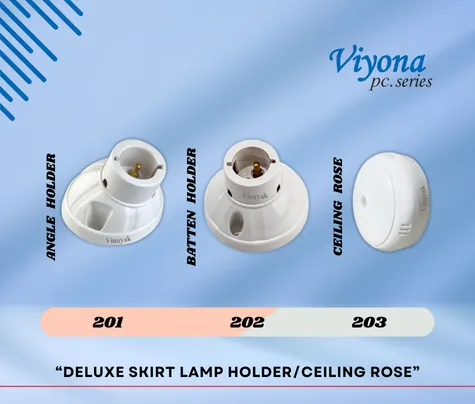
A worn holder is the cheapest fix in the house. Our VIYONA batten holder 202 is ₹26 MRP and the angle holder 201 the same, both in the Deluxe holder and ceiling rose range, with the 2-part ceiling rose 203 at ₹28. Our guide to bulb holder connection walks through how a holder is wired.
Flicker that changes when you tap the switch or wiggle the bulb almost always means a loose contact. Stop there and do not keep tapping it.
Switch off the MCB and confirm the circuit is dead with a tester before anyone opens a switch plate, holder or rose. Tightening a live terminal is never a safe shortcut.
Can low or fluctuating voltage make LEDs flicker?
Low or fluctuating voltage can make an LED flicker when the supply drops below what its driver can regulate, which most often happens for a moment as a heavy load such as an AC, pump, geyser or motor starts on the same supply, or when a loose neutral lets the voltage at your lights swing as other loads switch.
A good LED driver is built for a wide input. The label on our 1041 panel driver, as printed in our catalogue, reads input 90–240 V AC and output 40–75 V DC, so normal day-to-day variation on Indian mains should not show. A driver that flickers well inside that range is more likely failing than starved.
What to watch for: lights that dip together across the house when the AC compressor starts point to the supply or the main connections; lights that brighten when another load starts can mean a loose shared neutral, which is a fault for an electrician to trace without delay.
For the circuit itself, check the board is sized right. Our guide to which MCB for home covers the ratings each circuit needs.
Lights that get brighter, not dimmer, when a big appliance starts can mean a broken or loose neutral. Switch off and call an electrician the same day.
Why does an LED tube light flicker?
An LED tube light usually flickers because its built-in driver is failing, because an LED tube was fitted into an old fluorescent fitting with the choke or starter still in circuit, or because of a loose end connection, while a complete LED tube fitting with its driver inside the body avoids the old-fitting problems altogether.
A tube that flickers at switch-on then settles is often an ageing driver. A tube in an old choke fitting can flicker from the start and wears out early. A tube that flickers only when the fitting is touched has a loose end cap or terminal.
We make complete LED tube fittings: the 1051 6W at ₹160, the T5 PVC 1058 12W at ₹180 and 1059 20W at ₹200, and the 1060 40W at ₹600 MRP. Each is a body and light in one, wired directly, with no choke or starter. Our LED bulb vs tube light guide covers when a tube beats a bulb, and our guide to which tube light is best for home covers wattage by room.
Converting an old fluorescent fitting is wiring work. Switch off the MCB, prove it dead, and let an electrician remove the choke and starter or fit a complete LED fitting instead.
How do you know if the LED driver is failing?
An LED driver is likely failing when a panel or downlight flickers constantly, strobes for a few seconds at switch-on, dims and recovers on its own, or flickers on a circuit where other lights behave normally, because those signs point to the part inside the fitting rather than to the wiring that feeds it.
A separate driver is a repair, not a replacement. We sell our panel drivers on their own, listed against IS 15885 with registration R-71026310: the 1041 for 9W to 15W panels at ₹180 and the 1042 for 18W to 22W at ₹200 MRP. VIYONA LED 1041 is a 9W–15W panel driver with an MRP of ₹180.
MRP of our spare LED drivers by wattage band
MRPs from our current catalogue; bars to scale with ₹400 as the full bar.
Match the wattage band, not just the size. Our panel light vs downlight guide explains what the driver label means.
Is it the LED or the wiring? A simple test
The simplest way to tell whether the LED or the wiring is at fault is to swap: with the MCB off, move the flickering lamp to a holder where another lamp works steadily, and put the steady lamp in the flickering holder; if the flicker moves with the lamp, the lamp is faulty, and if it stays in the holder, the wiring is.
This works for plug-in lamps in a batten, angle or pendant holder. It does not work for panels and tube fittings, which are wired in; for those, the electrician checks the driver and the supply at the terminals.
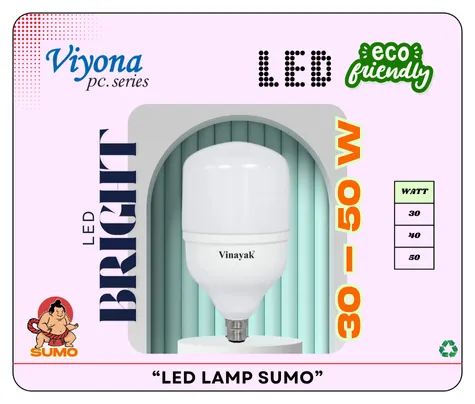
A spare lamp makes the test easy. Our 9W LED bulb 1065 is ₹70 MRP, and our LED lamps run from 9W to 23W, with the LED Lamp Sumo at 30W, 40W and 50W. Our catalogue prints IS 16102 and registration R-71026514 for the LED lamp section.
Whatever the result, do the swap with the MCB off, not just the wall switch. If the switch is in the neutral, the holder is live even with it off.
A line tester shows a phase is present; it never proves a wire is dead. If you are not sure the circuit is off, stop and call an electrician.
Can LED flicker hurt your eyes?
Visible LED flicker is tiring to work under and many people find it causes eye strain or headaches over a long evening, which is reason enough to fix it in a study, kitchen or work area, though a light that flickers because of a fault should be fixed for the fault first and for comfort second.
There are two kinds to separate. Visible flicker from a fault, which this guide is about, is obvious and should be traced. Some lamps also have a fast ripple you may not notice directly but can sometimes see as stripes through a phone camera. That comes from how the driver is built rather than from your wiring.
Where people read, write or work for hours, steady light matters more than raw brightness. Our guide to which light is best for study covers colour, glare and placement, and warm white vs cool white covers colour temperature.
For a child’s room or a study, replace a flickering lamp straight away rather than living with it. A lamp costs less than an evening of headaches.
Phone-camera stripes are a rough clue, not a measurement. Judge a lamp by whether it is comfortable to work under.
What to do when an LED light flickers
When an LED light flickers, first note the pattern, then switch off the MCB and swap the lamp to see whether the fault follows it, replace the lamp or driver if it does, and call a licensed electrician if the flicker stays with the holder, comes with heat or a smell, or tracks other appliances.
1. Note the pattern constant, on touch, with other loads, on a dimmer, or after switch-off.
2. MCB off, then swap move the lamp to a known good holder.
3. Lamp or driver replace it, matching the wattage band for a driver.
4. Holder, switch or rose electrician, and replace the worn part. A VIYONA 6A 1 way switch 101 is ₹22 MRP in the Deluxe switch range.
5. Lights dip or rise together electrician the same day to check the main and neutral connections.
Our full LED range, from lamps to panels and spare drivers, is on the VIYONA LED lights page.
Never work on a live circuit. Switch off the MCB, confirm dead with a tester, and leave anything beyond a lamp swap to a licensed electrician.
FAQs
Why is my LED light flickering?
Why does my LED bulb blink after I switch it off?
Is a flickering LED a fire risk?
Can I use a dimmer with LED lights?
Can low voltage cause LED flickering?
How do I stop my LED tube light flickering?
Why buyers choose Vinayak Electricals
- LED lamps, panels, tube fittings and spare drivers made in-house at our works in Marol, Andheri East, Mumbai.
- Spare panel drivers sold separately, 1041 at ₹180 and 1042 at ₹200 MRP, so a flickering panel can be repaired.
- LED lamps listed under IS 16102 (R-71026514); panels and down lights under IS 10322 (R-71026476).
- Switches, lamp holders and ceiling roses from the same catalogue, from ₹22 MRP.
- MRPs published openly; sold through 500+ dealers with delivery across India.
- Manufacturing in Mumbai since 1995; ISO 9001:2015 certified.
Steady LED lights and spare drivers
See our LED lamps, panels, tube fittings and drivers with codes and MRPs, then order through a dealer or call us.
View VIYONA LED lights