Why Your LED Bulb Glows Faintly After You Switch It Off
An LED glows when switched off because a very small current is still reaching it, and an LED needs so little power that this trickle is enough to light it faintly. The usual sources are an indicator or illuminated switch, a switch wired in the neutral instead of the phase, voltage induced in a long cable, or a smart switch. Some are harmless; one can give a shock when you change the bulb. Below we sort them, with safe checks and the parts we make in Mumbai.
Key takeaways
- The cause — a tiny current still reaches the lamp. Old filament bulbs needed far more to glow, so they hid it.
- Most common — a switch with a built-in indicator or light, or a smart switch with no neutral.
- The risky one — a switch in the neutral leaves the holder live when off. An electrician should move it to the phase.
- Long runs — two-way and staircase wiring can induce enough voltage for a ghost glow.
- Want a glow? — fit a proper night lamp: our 1061 LED night lamp is 0.5W at ₹40 MRP.
Why does an LED glow when switched off?
An LED glows faintly after it is switched off because a tiny current still flows through it, from an indicator or illuminated switch, a switch placed in the neutral wire, voltage induced in a long cable alongside live wires, or a smart switch that powers itself through the lamp, and an LED needs so little current that even this trickle lights it.
The same thing happened with old filament bulbs, but nobody saw it. A filament needs a large current to get hot enough to glow, so a few milliamps leaked through a switch did nothing visible. An LED lamp has a driver with a capacitor inside, and its LEDs give out light at a tiny fraction of their rated current. The result is a dim, steady glow, or a blink every few seconds as the capacitor charges and discharges.
Most of the causes are about the switch, not the lamp. A new LED in an old house often reveals wiring that has always been slightly off, because the old bulb never showed it.
We make LED lamps, switches, indicators and line testers at our works in Marol, Andheri East, Mumbai. This guide explains each cause, the one that matters for safety, and what fixes it. Anything behind a switch plate is a job for a licensed electrician with the MCB off.
Is a faint LED glow after switch-off dangerous?
A faint glow after switch-off is usually not dangerous in itself, because the current is tiny and the lamp is not overheating, but it can be a sign that the switch is wired in the neutral, which leaves the lamp holder connected to the phase when the switch is off and can give a shock to anyone who changes the bulb.
Sort the cause by risk: Indicator or illuminated switch harmless, a nuisance. Smart switch without neutral harmless, fixed with a neutral or a bypass. Induced voltage harmless, but worth a check. Switch in the neutral a shock hazard to correct.
Constant tiny current can also {P(’shorten a lamp’s life’,’watch’)}, as its driver keeps cycling all night. That is a cost issue, not a safety one.
The way to tell them apart is a check at the switch, done by an electrician with a tester. Our phase, neutral and earth guide explains why the switch must break the phase.
Never change a bulb or open a holder with only the wall switch off. Switch off the MCB first; if the switch is in the neutral, the holder is live.
| Cause | What you see | Risk | Usual fix |
|---|---|---|---|
| Indicator or illuminated switch | Steady faint glow or slow blink | Low | Plain switch on that light |
| Smart switch without neutral | Faint glow or flicker | Low | Neutral at the switch or a bypass |
| Switch in the neutral | Faint glow, holder live when off | High | Electrician moves the switch to the phase |
| Long two-way or outdoor run | Very dim steady glow | Low | Bypass at the fitting or a different lamp |
| Sensitive or faulty lamp | Glow follows the lamp | Low | Replace the lamp |
Is the switch breaking the neutral instead of the phase?
A switch wired in the neutral is a common reason for an LED glowing when off: the phase stays connected to the lamp, a small current finds a path to earth through the fitting, its body or damp in the ceiling, and the LED glows, while the holder stays live and unsafe to touch even with the switch off.
The correct rule is simple: switch in the phase, neutral straight to the lamp. When the switch is off, nothing beyond it is live. When it is wired the other way, the switch still turns the light on and off, which is why the mistake survives for years.
An electrician checks it in seconds with a tester at the switch terminals. Our VIYONA line tester 811 (code 198) is ₹36 MRP and the 812 (199) is ₹42. A line tester shows that a phase is present; it never proves a wire is dead. Our guide on how to use a line tester covers its limits.
The fix is to swap the wires at the switch so it breaks the phase. That is wiring work, done with the MCB off.
A switch in the neutral looks and works normally. Only a check at the terminals shows it, so have it done whenever an LED glows when off.
An LED glows on a trickle a filament bulb ignored.
The one cause that leaves the holder live when off.
Fit them on geysers, not on every light.
Use a 0.5W night lamp, ₹40 MRP.
Can an indicator switch make an LED bulb glow?
Yes, a switch with a built-in neon or LED indicator can make an LED bulb glow when off, because the indicator is wired across the switch and passes a small current through the lamp to light itself, which an old filament bulb ignored but an LED driver can turn into a faint glow or a slow blink.
Indicators are useful where you need to see that something is on, such as a geyser or an AC. On a light circuit they are often the whole cause of a ghost glow. The test is easy for an electrician: replace the indicator switch with a plain switch and see whether the glow stops.
Our switches with indicators are mostly the heavier ratings meant for appliances: the VIZA V1248 20A 1 way switch with indicator at ₹160 MRP and the KEMPS K508 20AX 1 way indicator switch at ₹143. For a light, a plain VIYONA 6A 1 way switch 101 is ₹22.
A separate indicator lamp, such as the VIYONA nano 108 at ₹30, sits beside the switch on its own wiring. Our guide to a switch with indicator explains how each type is wired.
Fit an indicator where it tells you something useful, such as a geyser, not on every light switch.
Do smart and touch switches cause a ghost glow?
Smart and touch switches often cause a ghost glow when they are fitted without a neutral wire, because the switch then powers its own electronics by passing a small current through the lamp even when it is off, and a low-wattage LED lights faintly or flickers on that current.
Makers deal with it in two ways: a version that uses a neutral wire in the box, so nothing needs to pass through the lamp, or a minimum load or bypass device fitted at the light. The cleanest answer is a neutral at the switch board.
Our guide to smart switches for home covers why the neutral matters, the box depth the electronics need, and what to keep on a conventional switch. If you are rewiring, ask your electrician to bring a neutral to every switch box; it costs little at that stage and keeps every option open.
Illuminated rocker switches with a locator light can do the same as an indicator, on a smaller scale.
Check whether the smart switch you are buying needs a neutral before you fit it. A model that does not need one will usually push a small current through the lamp.
Can a long wire run make an LED glow?
A long wire run can make an LED glow when off because a switched wire running for many metres beside a live wire, in the same conduit or cable, picks up a small induced voltage, and in two-way staircase wiring, where the cables between the switches are long, that can be enough to light a sensitive LED faintly.
This is called induced or capacitive coupling. Nothing is wrong with the wiring as such, and the current is tiny. It shows up most on two-way runs, long corridors and outdoor lights fed from far away.
Our 2 way switch wiring diagram shows the strappers between the two switches: those are the long parallel wires. Common fixes an electrician may choose are a lamp that draws a little more, a small bypass device at the fitting, or separating the switched wire from other live wires on a rewire.
Induced glow is steady and very dim, and it does not change when you switch other things on. A glow that rises and falls with other loads points somewhere else.
Induced voltage can still make a neon tester glow on a wire that is switched off. That is one more reason a tester never proves a wire dead.
Why does it happen with LED but not old bulbs?
It happens with LED bulbs and not old filament bulbs because a filament needs a large current to heat up and glow, so a few milliamps leaking through a switch did nothing visible, while an LED driver stores that trickle in a capacitor and its LEDs give out visible light at a tiny fraction of their normal current.
How much a lamp shows a small leakage current
An order from general practice, not a measurement or a test result. Lower-wattage LEDs tend to show it more.
Changing to LED therefore does not create the leak; it reveals it. A filament bulb masked it; a low-wattage LED shows it. That is why a ghost glow often appears the day a house switches its last filament bulbs to LED.
Our LED bulb vs normal bulb guide covers the other differences between the two.
Can a faulty LED bulb or driver glow by itself?
A faulty LED bulb or driver can occasionally glow or blink when off, but it is the least likely cause, so the quick test is to swap it with a lamp that does not glow; if the glow stays in the holder, the cause is the switch or wiring, and if it moves with the lamp, that lamp is the odd one.
Some lamps are simply more sensitive than others. Two lamps of the same wattage from different makers can behave differently on the same leaky switch, because their drivers are built differently. A lamp that glows where another does not is not necessarily faulty; it is just showing the leak more.
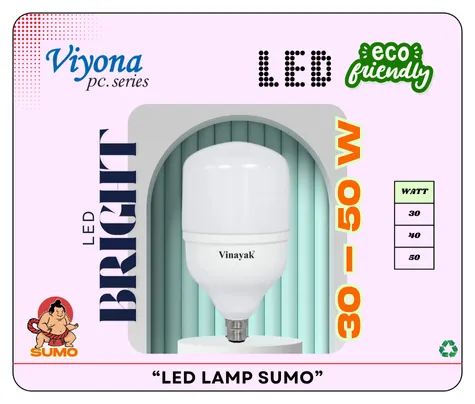
A spare for the swap test costs little. Our 9W LED bulb 1065 is ₹70 MRP, and our LED lamps run from 9W to 23W, with the LED Lamp Sumo at 30W to 50W. Our catalogue prints IS 16102 and registration R-71026514 for the LED lamp section.
Do the swap with the MCB off, not just the wall switch. Until you know where the switch sits, treat the holder as live.
How do you stop an LED glowing when switched off?
To stop an LED glowing when switched off, remove the source of the leakage current: have an electrician confirm the switch breaks the phase, replace an indicator or illuminated switch on that light with a plain one, use a smart switch with a neutral, and for long runs add a small bypass at the fitting or use a lamp that tolerates it.
MRP of the parts that usually fix a ghost glow
VIYONA and LED MRPs from our current catalogue; bars to scale with ₹70 as the full bar.
Work in this order: 1. Check phase switching 2. Plain switch 3. Neutral for smart switches 4. Bypass on long runs. Most glows stop at step 1 or 2. The plain switches are in our 6A Deluxe switch range.
Want a soft glow at night? Use a night lamp
If you actually want a soft glow in a bedroom or passage at night, fit a proper night lamp on its own switch rather than relying on a leaky circuit, because a night lamp is made to run continuously at very low power and gives a steady light, while a ghost glow is uneven and keeps an LED driver cycling all night.
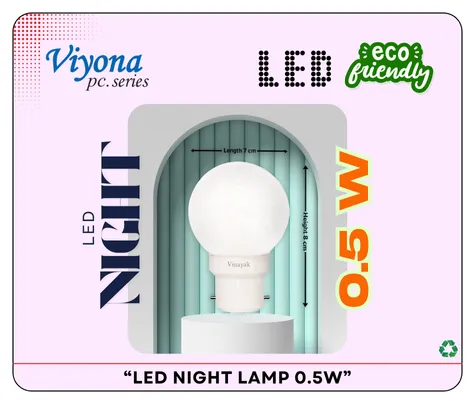
VIYONA LED 1061 is a 0.5W LED night lamp with an MRP of ₹40. At 0.5 watts it uses about one unit in 2,000 hours, a small fraction of what even a 9W bulb would use left on.
For the switch board itself, KEMPS makes a 2-module night lamp with 3 LEDs at ₹280 in white (K216). It sits in the plate like a switch and lights the floor at a low level. Our guide to the night lamp compares the options, and the 1061 lamp is on its product page.
A night lamp should be the only light that glows when everything else is off. If others glow too, find the cause.
When should you call an electrician?
Call a licensed electrician whenever an LED glows when switched off and you have not confirmed which wire the switch breaks, and straight away if the glow comes with a tingle from a fitting, a warm or buzzing switch, a burning smell, or lights that brighten when other appliances start.
Signs that need a visit soon: a glow after switch-off, a neon tester lighting on a switched-off holder, a tingle from a metal fitting, and lights that rise when a load starts. The last can mean a loose neutral.
Ask the electrician to check three things on the visit: that every light switch breaks the phase, that the earth at metal fittings is sound, and that the neutral connections at the board are tight. Our guide on how to check earthing at home covers what to expect, and switch getting hot or socket sparking covers the heat signs.
Never test or tighten anything live. Switch off the MCB, confirm dead with a tester, and leave wiring changes to a licensed electrician.
FAQs
Why does my LED bulb glow dimly when switched off?
Is it dangerous if an LED glows when off?
Does an LED glowing when off use electricity?
How do I stop the ghost glow from my LED light?
Can an indicator switch cause an LED to glow?
Why did my old bulb not glow but the LED does?
Why buyers choose Vinayak Electricals
- LED lamps, night lamps, switches, indicators and line testers made at our works in Marol, Andheri East, Mumbai.
- Plain 6A switches from ₹22 MRP and a 0.5W LED night lamp at ₹40.
- LED lamps listed under IS 16102 (R-71026514) in our catalogue.
- Switches made to IS 3854 under ISI licence CM/L-7567794.
- MRPs published openly; sold through 500+ dealers with delivery across India.
- Manufacturing in Mumbai since 1995; ISO 9001:2015 certified.
Plain switches, indicators and night lamps
See our 6A switches and indicators with codes and MRPs, then order through a dealer or call us.
View 6A switches