Switch with Indicator: What the Lamp Does and When It Is Worth It

Key takeaways
- What it is — a tiny neon or LED lamp in the switch that glows when the point is on.
- Glows when off? — usually locator wiring across the contacts, or a switch wrongly placed in the neutral.
- Best on — geyser, pump, AC, outdoor lights and the main door bell push. Rarely worth it on room lights.
- Not a safety test — a dark lamp never proves a wire is dead. MCB off and test first.
- Our MRPs — KEMPS K108 20AX with indicator ₹120; VIZA V1248 20A ₹160; separate VIYONA 108 lamp ₹30.
Switch with indicator: the short answer
A switch with indicator is an ordinary switch with a small built-in lamp, usually a neon or an LED, that glows to show the state of the point it controls. On most switches the lamp lights when the switch is on, which tells you at a glance that a geyser, pump, AC or outdoor light is still running. Some are wired the other way, so the lamp glows when the switch is off and helps you find it in the dark.
That lamp is a convenience, not protection. It does not trip, it does not prove a wire is dead, and it can occasionally make an LED bulb glimmer when wired a certain way.
We make switches with indicators, and separate indicator modules, across KEMPS, VIZA and VIYONA at our works in Marol, Andheri East, Mumbai. This guide explains what the indicator is, how it works, why it sometimes glows when the switch is off, where it earns its place, and what it adds to the price.
What is an indicator in a switch?
An indicator in a switch is a tiny lamp, either a neon bulb with a resistor or a low-current LED circuit, built into the switch body or rocker and connected so that it glows when the switch is on, showing that the point it controls is connected to the supply.
It usually shows as a small red or amber dot or a lit window in the rocker. On a modular board it may also be a separate 1 module piece, an indicator module, fitted beside a plain switch.
You will find indicators on 1 way switches, DP switches, bell pushes and switch-socket combined units. Our types of electrical switches guide places the indicator switch among the other types, and our DP switch guide covers the 32A double pole switches, every modular one of which we make with an indicator.
| Point | Indicator worth it? | Why | Our example and MRP |
|---|---|---|---|
| Geyser | Yes | Stops all-day heating | VIZA V225 32A DP, ₹295 |
| Water pump | Yes | Shows a pump left running | KEMPS K116 32AX DP, ₹360 |
| AC | Yes | Shows the circuit is live | VIZA V1250 32A DP, ₹330 |
| 16A socket point | Often | Shows a heater or iron is on | KEMPS K108 20AX, ₹120 |
| Main door bell | Yes | Visitor finds it at night | KEMPS K115 bell push, ₹145 |
| Room lights and fans | Rarely | You can see them; LED glow risk | Plain switch |
How does a neon indicator work?
A neon indicator works by passing a very small current through a sealed glass bulb of neon gas, limited by a resistor in series, so the gas glows orange whenever mains voltage appears across it; an LED indicator does the same job with an LED and a current-limiting circuit, often giving a red or other colour.
Neon is the traditional choice: it is robust, runs straight off 230 V with only a resistor, and gives the familiar orange dot. LED indicators are brighter and come in more colours.
Either way the lamp is connected between phase and neutral on the load side of the switch, so it lights when the switch is on and the load has supply. That is the usual arrangement. A locator wiring connects the lamp across the switch contacts instead, so it glows only when the switch is off; the next section covers why.
An indicator connected wrongly can glow at the wrong time. If yours behaves oddly after any wiring work, have the electrician who did it check the connection.
It shows the point is on; it never trips.
Locator wiring or a switch in the neutral.
Geyser, pump and AC gain the most.
A dark lamp never proves a wire is dead.
Why does a switch indicator glow when the switch is off?
A switch indicator glows when the switch is off usually because its lamp is wired across the switch contacts as a locator light, so a tiny current flows through the lamp and the load while the switch is open, or because the switch has been placed in the neutral instead of the phase.
Locator wiring is deliberate: it helps you find a light switch in the dark, and with an old filament bulb the tiny current through the bulb was invisible. With an LED bulb, that same trickle can make the LED glow faintly or flicker.
Switch in the neutral is a wiring fault. The appliance stays connected to the phase even with the switch off, and the indicator can behave oddly. It needs an electrician, because the fitting stays live when you think it is off. Our phase, neutral and earth guide explains why the switch belongs in the phase.
Less often, a long run of cable can couple a small induced voltage that lights a sensitive neon. Our LED glows when switched off guide works through all of these causes for lights.
Can an indicator switch make an LED bulb glow when off?
Yes, an indicator switch can make an LED bulb glow faintly when off if its lamp is wired across the switch contacts, because the small current that keeps the indicator lit also flows through the LED bulb’s driver, which can be enough to light it dimly or make it blink every few seconds.
The fix is to change the wiring or the switch, not to live with it. Options are a switch whose indicator lights when on, a plain switch for that light with a separate indicator elsewhere, or a different indicator connection made by your electrician.
This is the main reason we suggest indicators on heavy loads such as a geyser or pump, where a faint trickle cannot light anything, rather than on every light switch. For plain switches for lights, see the KEMPS range on our KEMPS switches and sockets page.
Before checking any switch wiring, switch off the MCB and test the wires dead. An indicator or a dim bulb tells you nothing reliable about whether a wire is live.
Where is a switch with indicator useful?
A switch with an indicator is most useful on points you cannot see from the switch or might forget are on: the geyser, the water pump, an AC, an outdoor or terrace light, a heater, and a bell push by the main door that a visitor must find at night.
Geyser: the lamp outside the bathroom stops all-day heating; our geyser switch guide covers the full point. Pump: a pump running dry is costly, and the lamp shows it is still on. Outdoor light: you can see from inside that the gate light is on.
Bell push: the KEMPS K115 10AX bell push with indicator is ₹145 and glows so a visitor can find it. Shops and clinics use indicators to show a heater or sterilizer point is live.
For plain lights and fans in a room you can see, an indicator adds cost and little value.
Switch with indicator vs separate indicator module
A switch with an indicator puts the lamp in the switch itself and saves a module on the plate, while a separate indicator module sits beside a plain switch and costs a little more space; the separate module is handy when you want a lamp on a point whose switch you would rather not change.
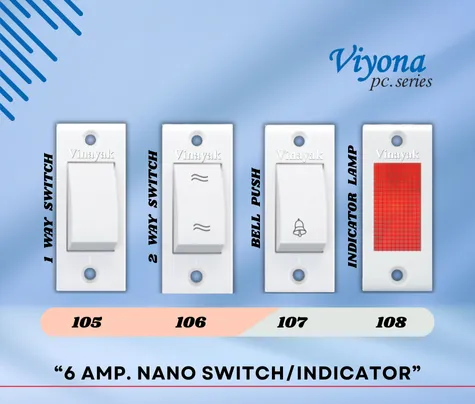
In VIYONA, the VIYONA Nano range lists a 108 indicator lamp at ₹30 beside the 105 1 way switch at ₹22. In modular boards, the KEMPS K217 6A red indicator is ₹95 and the VIZA V1251 6A neon indicator is ₹83.
MRP of our separate indicator modules and lamps
MRPs from our current catalogue; bars to scale with ₹145 as the full bar.
A built-in indicator is usually the neater choice on a new board; a separate module suits an existing board with a spare slot.
Switch with indicator price: how much more does it cost?
A switch with an indicator costs roughly ₹13 to ₹29 more than the same switch without one in our range: the KEMPS K106 20AX 1 way is ₹107 and the K108 with indicator ₹120, and the VIZA V101 10A is ₹56 against ₹85 for the V111 with indicator.
KEMPS K108 is a 20AX 1 way switch with an indicator at ₹120 MRP in white, and the same switch in grey, K508, is ₹143.
Same switch with and without an indicator, at our MRP
MRPs from our current catalogue, white or standard finish; bars to scale with ₹160 as the full bar.
On a board with two or three heavy points, indicators add well under ₹100 in total. See the KEMPS K508 for the grey version.
Does a switch indicator use electricity?
Yes, a switch indicator uses electricity whenever it glows, but the amount is very small, typically well under one watt for a neon or LED indicator lamp, so even one left on all year adds very little to a home electricity bill compared with the appliance it is showing.
The lamp’s current is limited by its resistor or driver to a tiny value; that is why a neon indicator can run straight off the mains. The thing worth worrying about is the appliance the lamp says is on, not the lamp.
If you want to put a number on the appliance itself, our appliance power consumption chart lists units per hour for geysers, pumps and ACs. We do not publish a wattage for our indicators, so we do not quote one here.
Indicator not glowing: what does it mean?
An indicator that does not glow when the switch is on means one of three things: the lamp itself has failed, there is no supply reaching the point because an MCB has tripped or a wire is loose, or the switch is faulty; only a proper test, with the MCB off for any hands-on work, tells you which.
First check the obvious: is the appliance working? If the geyser heats and the pump runs, the lamp has simply failed, which is harmless but means you lose the reminder.
If the appliance is also dead, look at the MCB in the board. If it keeps tripping, see our MCB tripping again and again guide. A line tester can show whether supply reaches the switch, used only as that guide describes.
A dark indicator never proves a point is dead. Switch off the MCB and test the wires before you open a switch or touch a terminal.
How to choose a switch with indicator
Choose a switch with indicator by rating first and lamp second: match the switch to the load, such as a 20A or 20AX switch for a 16A point or a 32A DP switch for a geyser or AC, then pick the indicator version in the range and finish your board already uses.
For a geyser or AC, a 32A DP switch with indicator: KEMPS K116 ₹360, VIZA V225 ₹295 or VIZA V1250 ₹330. For a 16A socket point, a 20AX or 25A 1 way with indicator: KEMPS K108 ₹120, VIZA V1248 ₹160, or VIZA V124 25A at ₹155.
For a door bell, a bell push with indicator. For lights, usually no indicator, which also avoids the LED glow problem. Check the ISI mark: our switches are made to IS 3854 under licence CM/L-7567794. Our switch and socket ratings page has the full rating table.
FAQs
What is the use of an indicator in a switch?
Why does my switch indicator glow when the switch is off?
Does an indicator switch consume electricity?
What is a neon indicator?
Can an indicator switch cause an LED bulb to glow?
What is the price of a switch with indicator?
Why buyers choose Vinayak Electricals
- Switches with indicators, indicator modules and bell pushes with indicators, made at our works in Marol, Andheri East, Mumbai.
- Indicator versions in KEMPS, VIZA and VIYONA, from a ₹30 indicator lamp to 32A DP switches.
- Every modular 32A DP switch we make has a built-in indicator.
- Switches made to IS 3854 under ISI licence CM/L-7567794.
- MRPs published openly; sold through 500+ dealers with delivery across India.
- Manufacturing in Mumbai since 1995; ISO 9001:2015 certified.
Switches with indicators, by code
See codes and MRPs for the KEMPS K508 20AX indicator switch and the rest of the range, then order through a dealer or call us.
View KEMPS K508