2 Way Switch Wiring Diagram, Explained Wire by Wire
A 2 way switch wiring diagram shows one light controlled from two places: the phase to COM of the first switch, two travellers joining L1 to L1 and L2 to L2, and COM of the second switch to the lamp. Below, we draw it for a staircase with one, two and three lights and answer the 3-wire question. We also cover the 2 way bed switch, testing, and the mistakes that make a staircase light work from one end only, with the MRPs of the 2 way switches we make.
Key takeaways
- The diagram — phase to COM of switch A, L1 to L1, L2 to L2, COM of switch B to the lamp, neutral straight to the lamp.
- 3 wires per switch — COM plus two travellers; only the two travellers run between the switch boxes.
- 2 or 3 lights — wire them in parallel off the same pair; separate control needs separate pairs.
- 3 places — needs an intermediate switch between the two 2 way switches; we do not make one.
- ⚠ MCB off, tester on. One traveller is live even with the lamp off; a licensed electrician does the wiring.
2 way switch wiring diagram: the short answer
A 2 way switch wiring diagram has four connections: the phase from the MCB goes to the COM terminal of the first switch, two traveller wires join L1 to L1 and L2 to L2, the COM of the second switch feeds the lamp, and the neutral runs straight to the lamp.
It is the circuit behind every staircase light, long corridor and bedroom light switched from the bed. We draw it four ways below, naming every wire in words as well as colour, because wire colours on site vary from house to house.
If you want the difference between a 1 way and a 2 way switch, or what “1 gang 2 way” means on a box, our 1 way vs 2 way switch guide covers it. We make 2 way switches in our KEMPS, VIZA and VIYONA ranges at our works in Marol, Andheri East, Mumbai, and every MRP below comes from our current catalogue. The wiring itself is a job for a licensed electrician.
How does a 2 way switch work? COM, L1 and L2
A 2 way switch has three terminals, COM, L1 and L2, and its lever always connects COM to either L1 or L2, so a pair of them linked by two travellers lights the lamp when both levers point to the same traveller and leaves it dark when they point to different ones.
Read the back of the switch: COM is the common terminal, L1 and L2 are the two switched terminals. Markings differ between makers, so read the switch body rather than guessing from where a screw sits.
The four positions of a 2 way pair: two light the lamp, two do not
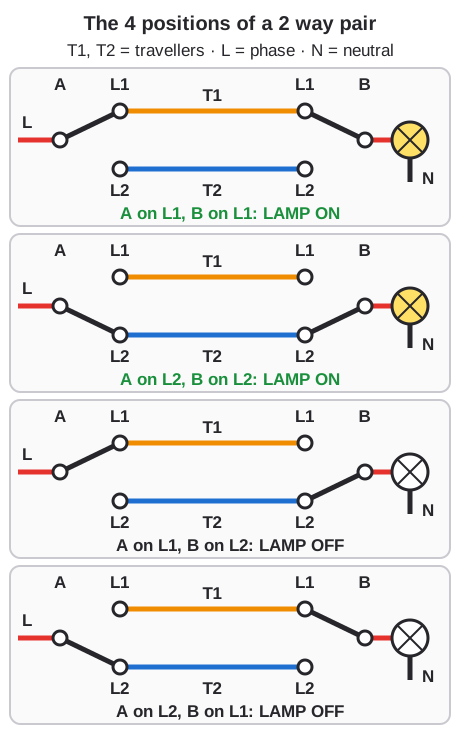
A logic diagram drawn by us. Flipping either switch always moves the pair to a position of the opposite state, which is why either end can change the light. Wire colours vary from house to house; the labels say what each wire does, and a tester confirms which is which on site. Tap the diagram to open it full size.
With both levers on the same traveller the path is complete; on different travellers it is broken. Our types of electrical switches guide shows where the 2 way sits among the other switch types.
| Wire | From | To | What it does |
|---|---|---|---|
| Phase (L) | MCB in the board | COM of switch A | Brings the supply to the pair |
| Traveller 1 | L1 of switch A | L1 of switch B | One of the two paths between the switches |
| Traveller 2 | L2 of switch A | L2 of switch B | The other path; one traveller is always live |
| Switched phase | COM of switch B | Lamp | Live only when both switches sit on the same traveller |
| Neutral (N) | Board neutral | Lamp | Goes straight to the lamp, never through a switch |
| Earth | Board earth | Metal box or fitting | Not part of the switching |
2 way switch wiring diagram with 1 light
The basic staircase circuit uses one lamp and two 2 way switches, one at the bottom of the stairs and one at the top. Follow the diagram from left to right. The phase from the MCB goes into COM of switch A. Traveller 1 runs from A’s L1 to B’s L1 and traveller 2 from A’s L2 to B’s L2. COM of switch B feeds the lamp, and the neutral runs straight to the lamp.
2 way switch wiring diagram: a staircase light with one lamp
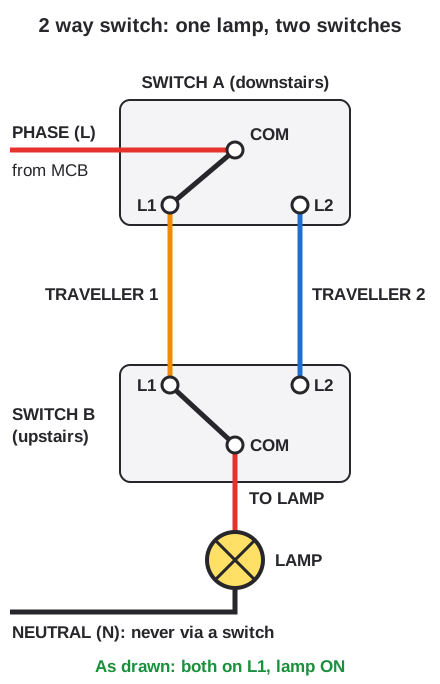
Drawn by us. Earth is not shown; it goes to the earth terminal of any metal box or fitting. Wire colours vary from house to house; the labels say what each wire does, and a tester confirms which is which on site. Tap the diagram to open it full size.
The switches sit in the phase, so when the light is off the lamp holder is dead. And the neutral is never switched; it runs from the board to the lamp untouched.
One traveller always carries the phase from switch A, even with the lamp off. Treat every terminal in both boxes as live until the MCB is off and a tester proves it dead.
The supply lands on COM of the first switch, never on L1 or L2.
Two travellers join the matching terminals of the two switches.
The second switch’s COM feeds the lamp; the neutral goes straight to it.
The lamp should change state every time either switch flips.
How do you wire a 2 way switch with 3 wires?
Each 2 way switch in a pair takes exactly three wires: at switch A the phase goes to COM and the two travellers to L1 and L2, and at switch B the two travellers land on L1 and L2 while COM sends the switched phase to the lamp, so the run between the boxes carries just two travellers.
So when people search for a 2 way switch “with 3 wires”, they usually mean the three conductors on the back of each switch: 1 on COM and 2 travellers. In conduit, your electrician pulls them as separate single-core wires, such as our house wire. The colour of each traveller is his choice, which is why a good electrician marks both ends.
Some runs carry extra wires between the boxes, such as a phase looped on to other switches or an earth for a metal box. They do not change the 2 way part: it is still L1 to L1 and L2 to L2, with the phase only ever on COM of A.
Replacing a switch and found three wires? The one on COM is the one that matters. Label it before you undo anything; putting it on L1 or L2 is the most common 2 way fault.
Staircase wiring step by step
A staircase light is wired in a fixed order. These are the steps an electrician follows, listed so you know what to check when your electrician does the job.
- Isolate. Switch off the MCB for the lighting circuit and prove it dead with a tester at both boxes.
- Plan the run. Phase to one box (say the bottom), two travellers from bottom to top, switched phase from the top box to the lamp point, neutral to the lamp.
- Pull and mark. Pull the travellers through the conduit and mark both ends as 1 and 2.
- Switch A. Phase on COM, traveller 1 on L1, traveller 2 on L2.
- Switch B. Traveller 1 on L1, traveller 2 on L2, and the switched phase from COM to the lamp.
- Lamp. Switched phase and neutral to the holder or fitting; earth to any metal part.
- Test. Restore the MCB and run all 4 positions.
Every screw is tightened on bare copper, never on insulation. A loose traveller gives a light that works from one end only, or flickers.
Never work on a staircase circuit with the MCB on. If you are not sure which MCB feeds it, switch off the main and call a licensed electrician.
Can one 2 way switch pair control 2 lights?
Yes, one pair of 2 way switches can control two lights, as long as the lamps are wired in parallel on the switched side: the wire from COM of the second switch feeds both lamps, each lamp has its own neutral, and both go on and off together from either end of the staircase.
2 way switch wiring diagram with 2 lights in parallel
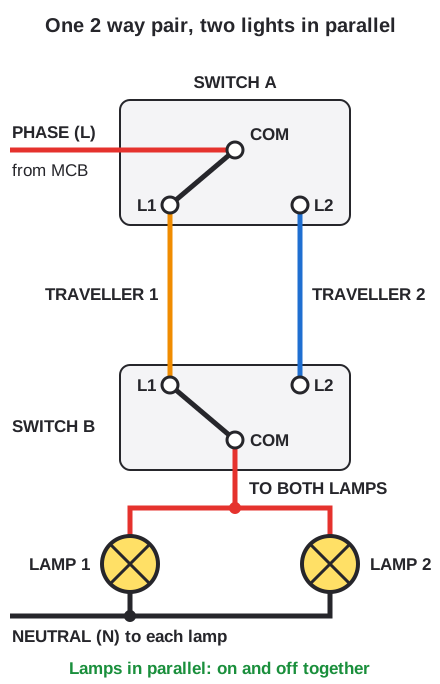
Drawn by us. Both lamps share the switched phase and the neutral and are never wired in series. Wire colours vary from house to house; the labels say what each wire does, and a tester confirms which is which on site. Tap the diagram to open it full size.
Wire the lamps in parallel, never in series: two lamps in series share the voltage and glow dim, if at all. The pair carries the current of both lamps together, which for a few LED lamps sits well inside a 10AX rating. A tall stairwell with a light on each landing is the usual case.
If the two lights must work separately, say a landing light and a passage light, they need two separate 2 way pairs and two sets of travellers, not one pair.
2 way switch wiring diagram with 3 lights
Three lights on one 2 way pair follow the same rule as two: the switched phase from COM of switch B loops to all 3 lamps, each lamp takes its own neutral, and the pair switches all three together. Draw the third lamp as one more branch on the parallel diagram above, never in a chain.
Where three lights must switch independently from two places, say a stairwell, a landing and a corridor, each needs its own pair: three pairs and six travellers between the two boards. That is where a 2 module twin unit saves space. Our KEMPS Aster K172 puts two 10AX 2 way switches in one 2 module unit at ₹268 MRP, and the VIZA V1292 2M 10AX 2 way air switch does the same at ₹300.
Count the load before choosing the rating. A row of LED lamps stays well inside 10AX; a circuit of heavier decorative fittings may justify 20AX switches, such as the KEMPS Aster K177, two 20AX 2 way switches in one 2 module unit at ₹326.
Plan a three-pair layout before the walls are plastered. Pulling extra travellers into a finished conduit is slow, and a full conduit may not take them at all.
2 way bed switch: wiring the bed-head and the door
After the staircase, the bedroom is the most common 2 way circuit: one switch by the door, one by the bed, so you can switch the light off without getting up. The wiring is exactly the staircase diagram, with the door board as switch A, the bed-head board as switch B, and 2 travellers running between them in the wall.
At the bed-head, a 2 module combination saves a slot. The KEMPS Aster K173 is a 2 module unit with one 10AX 1 way and one 10AX 2 way switch, MRP ₹209: the 2 way for the room light, the 1 way for a reading lamp. In VIZA, the V1293 2M 10AX 1 way + 2 way air switch is ₹250.
Some homes prefer a corded bed switch. VIYONA 186 is a 2 way bed switch with an MRP of ₹40, from our bed and surface switches range. As a 2 way it needs all three conductors, COM and both travellers, in its cord, and the cord must be firmly anchored where it leaves the wall so a tug never strains the terminals. Your electrician fits it with the MCB off.
A bed switch hangs where hands, pillows and children reach it. Replace one with a cracked body or a frayed cord straight away, with the MCB off.
Which 2 way switch should you buy: 10AX or 20AX?
For a staircase, corridor or bedroom light, a 10AX 2 way switch is the usual choice because it handles lights and fans comfortably, while a 20AX 2 way is for a heavier load that needs two-place control, and both ends of a pair should carry the same rating.
MRP of 1 module 2 way switches we make
MRPs from our current catalogue, white or standard finish, bars to scale with ₹148 as the full bar. Grey KEMPS versions cost more: the K502 grey partner of the K102 is ₹125.
The rating follows the load, not the wiring: a 2 way circuit is wired the same at 10AX and 20AX. The KEMPS Peony K102 is a 10AX 1 module 2 way switch with an MRP of ₹105, and the KEMPS Peony K107 is its 20AX partner at ₹132. VIZA V1202 is a 10 A 2 way switch with an MRP of ₹90. The switch and socket ratings table lists the rest.
Fit the same rating at both ends. A 20AX at the top and a 10AX at the bottom leaves the circuit only as strong as the 10AX.
2 way vs intermediate switch: can you control a light from 3 places?
Yes, a light can be controlled from three places by fitting an intermediate switch between two 2 way switches; it has four terminals, takes both travellers in and out, and passes them straight through or crosses them over, so flipping any one of the three switches changes the state of the lamp.
Concept: 2 way, intermediate, 2 way for control from three places
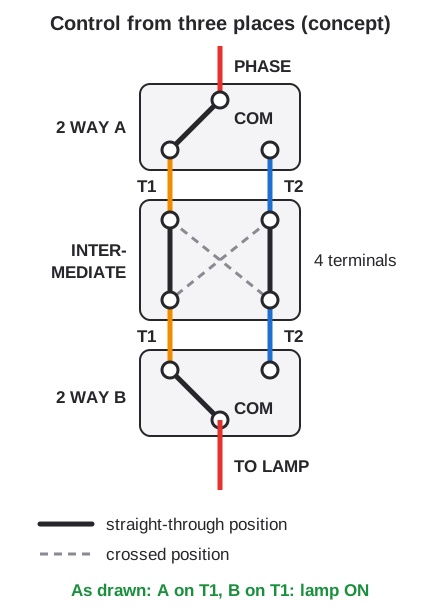
A concept drawing by us, not a wiring instruction. The internal links of an intermediate switch vary by maker; an electrician wires it from the maker’s terminal markings. Wire colours vary from house to house; the labels say what each wire does, and a tester confirms which is which on site. Tap the diagram to open it full size.
Each extra position adds one more intermediate with 4 terminals, and both travellers must run through every box in turn. We do not make an intermediate switch, so your electrician will source one; the 2 way switches at either end can still come from our KEMPS, VIZA or VIYONA ranges.
Two 2 way switches cannot make a three-place circuit on their own, however they are wired. If a third position is wanted, plan the intermediate and its extra conduit before plastering.
How do you test a 2 way switch circuit?
Test a 2 way circuit by running all four switch positions with the plates fitted: the lamp should change state each time either switch flips, lighting in two positions and staying dark in two, and if it works from one end only, the COM wire has been put on L1 or L2 or a traveller is loose.
Run it in this order: start with both levers down, flip A, flip B, flip A again. You should see on, off, on, off or the reverse. Any flip that does nothing points to a fault to be traced with the power off.
Before any wire is touched, the circuit must be proved dead. A line tester shows where the phase is: we make the VIYONA line tester 811 at ₹36 and 812 at ₹42 MRP. A neon tester only shows that a phase is present, so a dim or absent glow is not proof of a dead circuit; electricians confirm with a voltage tester or meter.
Never test by touching wires or by looking for a spark. Switch off the MCB, prove it dead, then work; if the result is unclear, stop and call a licensed electrician.
Common 2 way wiring mistakes and how to avoid them
Most 2 way faults come from four mistakes, and three of them show up in the four-position test.
Traveller swapped with COM: the phase lands on L1 or L2 instead of COM, and the light works from one end only or in odd positions. Switching the neutral: the switches sit in the neutral, so the lamp holder stays live with the light off, a shock waiting for whoever changes the bulb. Loose terminal: a half-tight traveller gives flicker and heat at the switch. Unmarked travellers: harmless in itself, since swapping L1 and L2 at one end only changes which positions are on, but it costs time when a switch is replaced later.
Before a 2 way switch is replaced, photograph and label the three wires. Our guide to replacing a switch in a switch board goes step by step, and our switch board wiring diagram shows how a 2 way pair sits among the other points on a board. A switch that runs warm is covered in switch getting hot or socket sparking.
If the bulb holder tests live with the light switched off, the circuit is switching the neutral. Stop using it and have an electrician correct it.
FAQs
How do you wire a 2 way switch?
How many wires does a 2 way switch need?
Can one pair of 2 way switches control 2 lights?
What do COM, L1 and L2 mean on a 2 way switch?
What is the price of a 2 way switch?
Do you make an intermediate switch?
Why buyers choose Vinayak Electricals
- 10AX and 20AX 2 way switches across KEMPS and VIZA, from 1 module to 2 module twin and 1 way + 2 way units.
- The VIYONA 186 2 way bed switch (₹40 MRP) for corded bedside control.
- Made at our works in Marol, Andheri East, Mumbai, since 1995; ISO 9001:2015 certified.
- Switches made under BIS licence to IS 3854 (CM/L-7567794).
- MRPs published openly in our catalogue; 500+ dealers and all-India delivery, in full boxes.
- Warranty of 5 to 10 years depending on the product, and 15-day returns in the same condition.
2 way switches for every staircase
See the KEMPS range of 10AX and 20AX 2 way switches, then order through a dealer or by phone.
View KEMPS switches