Electrical symbols with names: a house wiring chart for students
Electrical symbols are the short marks that stand for switches, sockets, lights, fans, fuses, MCBs and earth on a house wiring diagram. Learn these 24 and you can read most domestic drawings an ITI student meets. Below we draw them as three charts with names, explain each one, name the real products we make in Mumbai, and read a small bedroom plan symbol by symbol.
Key takeaways
- Switches — a small circle with a stroke: one tick 1-way, two ticks DP, ticks at both ends 2-way.
- Points — half circle for a socket, circle with a cross for a light, a hub with blades for a fan.
- Protection — a box on the line for a fuse, a cross on the contact for an MCB, a bar for an isolator.
- Earth and wires — earth is three shortening lines; a dot means joined, no dot means crossing.
- ⚠ Legend first — drawings differ in detail, so the legend on your drawing always wins.
Electrical symbols: the short answer
Electrical symbols are small standard drawings that stand for the parts of an installation: switches, sockets, lights, fans, fuses, MCBs, the distribution board and the earth. On a house wiring diagram they let one sheet show every point in a home without a word of description beside each one.
Indian drawings broadly follow the international IEC 60617 shapes. The Bureau of Indian Standards publishes graphical symbols in its IS 2032 series, and IS 732 is the code of practice for the wiring itself. Offices and drawing software still differ in small details, so every good drawing carries a legend, and that legend always wins over any chart, including ours.
Below we draw 24 symbols an ITI electrician student meets in house wiring, in three charts, then read a small bedroom plan symbol by symbol. Where a symbol stands for something we make in Mumbai, we name the real product, with its code and MRP.
Why do house wiring diagrams use symbols?
House wiring diagrams use symbols because one drawing must show dozens of points, switches and protective devices on a single sheet, and a standard mark for each lets the architect, the contractor, the electrician and the inspector read the same plan the same way without a note beside every point.
You will meet three kinds of drawing. A layout plan is a floor plan with each point drawn where it goes. A wiring diagram shows how each wire connects, terminal by terminal. A single-line diagram shows the board: meter, main switch and the MCB for each circuit, drawn as one line.
The same device can look different on each. A 1-way switch is a circle with a tick on a layout plan but a hinged line on a wiring diagram. Learn both forms, and always check which kind of drawing you are holding.
Read the legend first. Drawings from other countries can use different marks and names: a US plan calls our 2-way switch a “3-way”.
| Symbol name | Commonly drawn as | Our example (MRP) |
|---|---|---|
| 1-way switch | Small circle, one stroke with one tick | VIYONA 101, ₹22 / KEMPS K101, ₹65 |
| 2-way switch | Circle with strokes both ways, a tick at each end | VIYONA 102, ₹36 / KEMPS K102, ₹105 |
| Bell push | Circle with a dot inside | VIYONA 103, ₹30 / KEMPS K103, ₹105 |
| DP switch | One stroke with two ticks | VIYONA 175 surface DP switch, ₹195 |
| Socket outlet | Half circle with a stem, rating beside it | KEMPS K192 6A, ₹110 / VIZA V1266 16A, ₹179 |
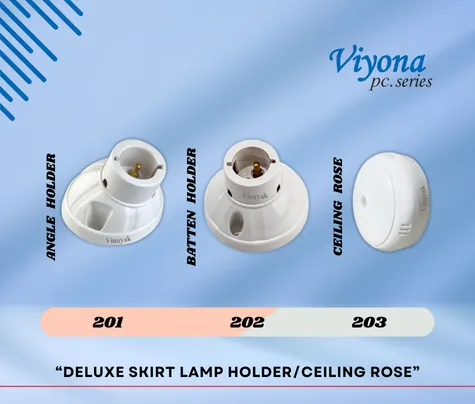
| Lamp (light point) | Circle with a cross | VIYONA 202 batten holder, ₹26 |
| Fan regulator | Box with a diagonal arrow | VIYONA 137 4 step, ₹215 |
| Bell | Dome on two legs | VIYONA 232 classic ding dong bell, ₹210 |
| MCB | Switch with a cross on the contact | VIYONA 401 10 kA SP MCB, ₹145 |
| Isolator | Switch with a bar on the contact | VIYONA 442 40 A DP isolator, ₹230 |
| RCCB | Breaker with a ring, marked with its mA rating | We do not make RCCBs |
| Distribution board | Rectangle, half shaded | VIYONA 381 4 way double door, ₹750 |
Electrical symbols with names: switches and bells
The switch symbols on a house wiring plan come from one idea: a small circle marks where the switch sits, a stroke leaving it shows the switch, and short ticks on the stroke show how many poles it breaks, while bell pushes, bells and buzzers have their own simple shapes.
Electrical symbols chart: switches and bells
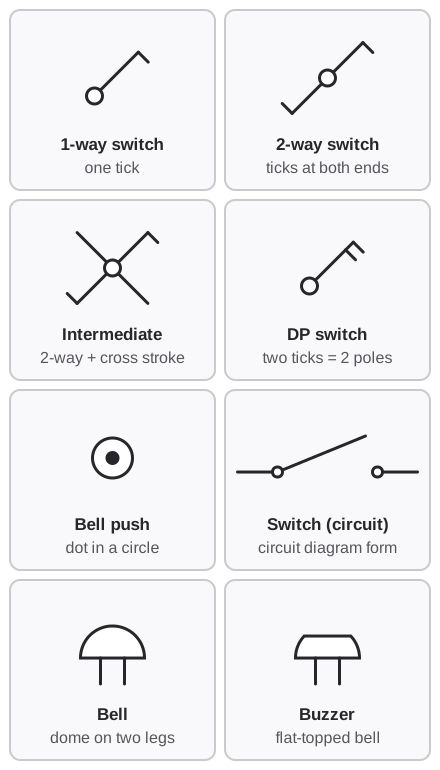
Drawn by us in the common IEC 60617 style used on most Indian drawings. Details vary between offices, so check the legend on your drawing. Tap the diagram to open it full size.
Read the chart by its patterns: one tick 1-way, two ticks double pole, ticks at both ends 2-way, dot in a circle push button. The circuit diagram form is the one you draw in a wiring diagram, where the moving contact is shown open.
Draw each symbol five times from memory, then check it against the chart. It is the fastest way to fix them before a trade theory test.
One tick 1-way, two ticks DP, ticks at both ends 2-way.
The rating, 6A or 16A, is written beside it or shown filled.
It marks the light point; the holder and lamp are chosen later.
A vertical line with three shortening bars below it.
What do the switch symbols mean?
Each switch symbol tells the electrician what kind of switch to fit: one tick is a 1-way switch with two terminals, ticks at both ends a 2-way switch with three, a crossing stroke an intermediate switch with four, and two ticks a double pole (DP) switch that breaks phase and neutral together.
1-way switches one point from one place. Our KEMPS K101 10AX 1-way switch is ₹65 MRP in white, and the VIYONA 101 is ₹22. 2-way switches one light from two places, such as a staircase: our KEMPS K102 is ₹105 and the VIYONA 102 ₹36. Our 2-way switch wiring diagram draws the pair in full.
An intermediate sits between two 2-way switches for a third position; we do not make one. A DP switch is used for a geyser or AC point; the KEMPS K116 32AX DP switch with indicator is ₹360 in white, and the VIYONA 175 surface DP switch ₹195.
The symbol does not show which terminal is COM, L1 or L2. That is marked on the switch itself, so read the terminals before wiring.
Socket outlet symbols: 6A, 16A and switched socket
A socket outlet is commonly drawn as a half circle with a short stem, and the plan shows its rating by writing 6A or 16A beside it or by filling the half circle in for the heavier socket, while a switched socket adds a switch stroke to the same mark.
Electrical symbols chart: sockets, lights, fans and wires
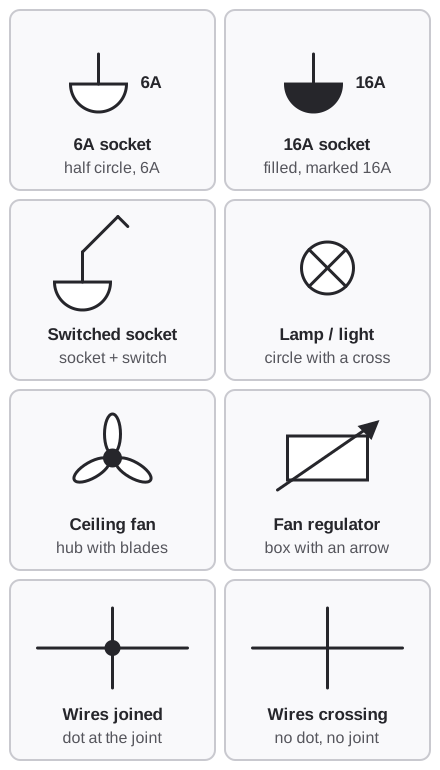
Drawn by us. Plans differ in how they mark a 16A socket, filled or labelled, so read the legend. Tap the diagram to open it full size.
A 6A socket serves lamps, chargers and small appliances; our KEMPS K192 6A 3 pin socket with shutter is ₹110 MRP, and the VIYONA 119 6A 3 pin socket ₹40. A 16A socket is for heavy loads such as a geyser or AC; the VIZA V1266 16 A porcelain socket is ₹179. See 6A vs 16A socket for the difference.
A 16A point on the plan needs 16A wiring, a switch rated for it and the right MCB. Never fit a 6A socket where the drawing says 16A, or the reverse.
Lamp, fan and fan regulator symbols
A lamp or light point is drawn as a circle with a cross through it, a ceiling fan commonly as a small hub with two or three blades, and a fan regulator as a box with a diagonal arrow, the general mark for something adjustable, placed beside the fan switch on the plan.
The circle with a cross marks the light point, not the bulb type. At the point, the lamp hangs from a holder: our VIYONA batten holder 202 is ₹26 MRP and the 2-part ceiling rose 203 ₹28. Some offices draw the fan as a circle marked F.
The regulator goes in series after the fan switch. Our VIYONA electronic fan regulator 137 mini 4 step is ₹215 and the 138 medium 5 step ₹225; fan regulator types explains steps. A dimmer is drawn as a switch with an arrow and is for lamps only.
A light dimmer is not a fan regulator. If a plan shows a dimmer on a fan point, ask before fitting it.
Bell and buzzer symbols
A bell is commonly drawn as a dome on two short legs and a buzzer as the same shape with a flat top, each wired through a bell push, which is drawn as a circle with a dot because it closes the circuit only while it is held down.
Our VIYONA ding dong bells include the 232 classic at ₹210 MRP and the 231 royal at ₹220. The KEMPS K224 electronic buzzer is ₹230 in white. For the push itself, the VIYONA 103 bell push is ₹30 and the KEMPS K103 10AX bell push ₹105.
On a plan the bell push sits at the main door and the bell inside, joined by a run. A bell push is never used to switch a light: it springs back the moment you let go.
Bell and buzzer symbols are easy to mix up on a small drawing. If the label is unclear, ask which one the client wants.
Electrical symbols for protection: fuse, MCB, isolator and RCCB
Protective devices are drawn as variations of a switch: a fuse as a small box with the line running through it, an MCB as a switch with a cross on its fixed contact, an isolator as a switch with a bar on its contact, and an RCCB as a breaker with a ring and the mark IΔn.
Electrical symbols chart: protection, supply and earth
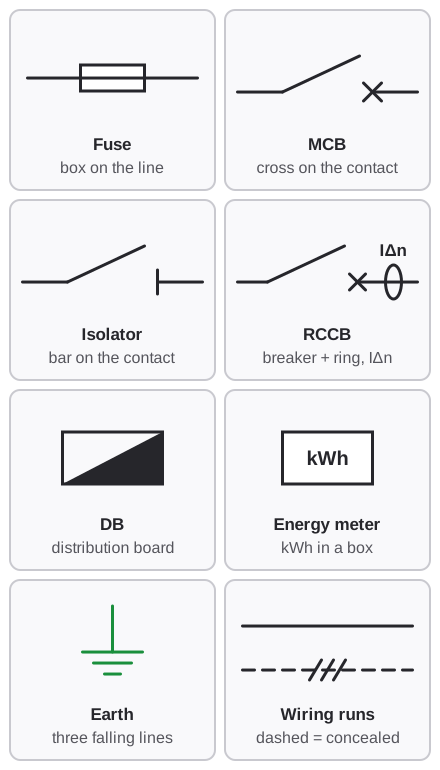
Drawn by us in the common IEC 60617 style. RCCB symbols vary most between drawings; look for the mA rating beside it. Tap the diagram to open it full size.
The cross means the device trips on its own; the bar means it only isolates. Our VIYONA 10 kA MCB 401 (6 to 32 A, single pole) is ₹145 MRP and our 40 A double pole isolator 442 is ₹230. The VIYONA 131 10 A kit kat fuse is ₹60. We do not make RCCBs.
Our isolator vs MCB guide explains what each does in the board.
If a drawing shows an isolator feeding a circuit with no MCB after it, ask why before the board is built. An isolator never trips.
Distribution board and energy meter symbols
A distribution board (DB) is commonly drawn as a rectangle, often half shaded or hatched, with its ways and incomer noted beside it, and the energy meter as a box marked kWh, because it measures energy in kilowatt-hours, the unit on an electricity bill.
On a single-line diagram the order is fixed: meter then main switch then one MCB per circuit. The meter belongs to the supply company; we do not make meters. For the board itself, our VIYONA double door DB 381 (4 way) is ₹750 MRP and the SPN white line MCB box 371 (2 to 4 way) ₹380; the MCB box size list counts the ways. The same order, meter to circuits, is drawn as a full house wiring diagram in our types of wiring system guide.
A DB symbol tells you where the board is, not what is inside it. The schedule of circuits beside it is what to check.
What is the earthing symbol?
The earthing symbol is a vertical line ending in three horizontal lines that get shorter towards the bottom, and it marks a point connected to the earth electrode; drawn inside a circle, the same mark means a protective earth terminal on a device or board.
Earth gives fault current a safe path away from anything a person can touch. On a plan it appears at the earth electrode, the earth bar in the DB and each 3 pin socket. The earth wire is green or green-yellow.
Earthing work, electrode and testing are the installer’s job; we do not make earth electrodes. What we make sits on the earth path: every 3 pin socket’s E terminal. Pipe and plate electrodes are compared in our types of earthing guide.
Never join earth to neutral at a socket, and never leave a socket’s earth terminal empty.
Wire crossing, joined wires and conduit: how are wires drawn?
On a wiring diagram a dot where two lines meet means the wires are joined, two lines crossing with no dot means they pass without touching, a dashed line on a layout plan commonly means concealed wiring, and short slashes across a line count the wires in that run.
The dot is the whole difference: dot = joined, no dot = not joined. Older drawings sometimes show a small hump where one wire hops over another. On a layout plan, solid lines commonly mean wiring on the surface and dashed lines concealed wiring in conduit; three slashes mean three wires.
The conduit size is usually written beside the run. We do not make conduit; the wire inside it, our VIYONA house wire, we do.
A missing or extra dot changes the circuit. If a junction is unclear, ask the person who drew it.
House wiring diagram symbols: reading a bedroom plan
To read a house wiring diagram, go symbol by symbol from the supply outwards: find where the circuit enters from the DB, then the switch board beside the door, then follow each dashed run from a switch to the light, fan or socket it feeds.
Worked example: a bedroom wiring plan read symbol by symbol
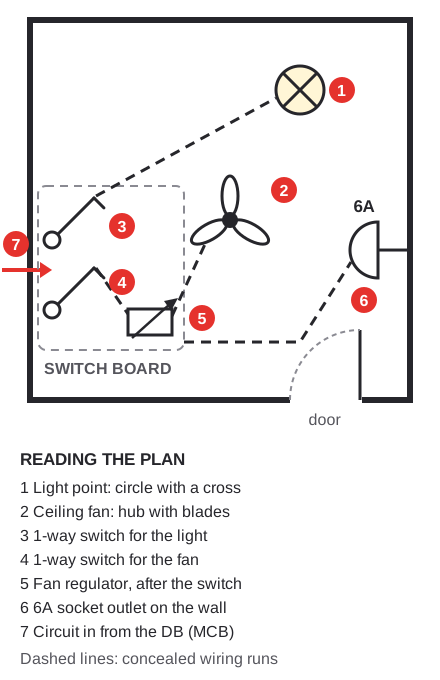
Drawn by us as a reading exercise, not a wiring instruction. Tap the diagram to open it full size.
- 7 The circuit arrives from an MCB in the DB.
- 3 and 4 Two 1-way switches on the board by the door.
- 1 Switch 3 feeds the light: circle with a cross.
- 4 5 2 Switch 4 feeds the regulator, then the fan.
- 6 A 6A socket on the wall.
In our VIYONA range those points come to two 101 switches, a 137 regulator, a 119 socket and a 202 holder: ₹325 at MRP. Point 6 is drawn unswitched to keep the plan small; most Indian homes give a socket its own switch. Our switch board wiring diagram shows how the board is wired.
A plan shows where things go, not how to work safely. Wiring is done with the MCB off and the circuit tested dead with a tester or multimeter; a neon line tester alone does not prove a circuit dead. Work on a live installation is for a licensed electrician.
Electrical symbols chart PDF: how to keep one
There is no separate PDF of this chart, but each symbol chart on this page is a standalone image, so you can tap it to open full size and save it, or print the whole page to PDF from your browser and keep it beside your trade theory notes.
Study the symbols in groups: switches, points, protection, wires. Then test yourself on a real layout plan, naming each mark aloud. Our types of electrical switches guide adds the dimmer and indicator symbols.
Keep your own copy next to the legend of each drawing you work from, and mark any symbol that differs.
Bring this chart to your next site visit and match each symbol on the plan to the fitting on the wall. Symbols stick fastest when you see the real thing.
FAQs
What are electrical symbols?
What is the earthing symbol?
Switch ka symbol kya hota hai?
Electrical symbols PDF kaise milega?
What is the symbol of MCB and isolator?
How are crossing and joined wires shown?
Why buyers choose Vinayak Electricals
- Switches, sockets, regulators, bells and holders for nearly every symbol on a house plan, made at our works in Mumbai.
- 1-way, 2-way, bell push and DP switches in our KEMPS, VIZA and VIYONA ranges.
- 6A and 16A sockets, fan regulators and dimmers from one catalogue.
- VIYONA 10 kA MCBs to IS/IEC 60898-1 (licence CM/L-2544151), isolators and MCB boxes for the DB.
- MRPs published openly; sold through dealers across India, in full boxes.
- Manufacturing in Mumbai since 1995.
Every switch on the plan
See the KEMPS range of switches, sockets and regulators, with codes and MRPs.
View KEMPS switches