Types of Wiring System, from Cleat to Concealed Conduit
The types of wiring system taught in ITI are cleat, casing-capping, batten, lead-sheathed and conduit wiring, the last laid on the wall surface or concealed inside it. Only some are still used in Indian homes. Below we compare all of them, draw a single-phase house wiring diagram from the meter to the switch boards, and show how the wiring system decides which switches you fit, with codes and MRPs from our Mumbai catalogue.
Key takeaways
- Concealed PVC conduit — the usual system in new Indian homes: wires in pipes buried in the wall.
- PVC casing-capping and surface conduit — for additions, rewiring and rented spaces where walls cannot be cut.
- Cleat, wooden casing-capping, batten, lead-sheathed — taught in ITI and found in old buildings, not used for new work.
- The system picks the switch — surface wiring takes surface switches and boards; concealed wiring takes modular switches in wall boxes.
- ⚠ MCB off, test dead — house wiring is a licensed electrician’s job.
Types of wiring system: the short answer
A wiring system is the way a building’s wires are supported and protected between the MCB box and the points they feed. ITI and diploma courses teach five types: cleat wiring, casing-capping wiring (wooden, then PVC), batten wiring with TRS or CTS cable, lead-sheathed wiring, and conduit wiring, laid on the wall surface or concealed inside it.
In a new Indian flat or house today the answer is almost always concealed PVC conduit. Surface PVC conduit and PVC casing-capping are still used where a wall cannot be cut: additions, rewiring, shops and rented premises. Cleat, wooden casing-capping, batten and lead-sheathed wiring survive in old buildings and in the ITI workshop, where you learn them for the practical and the exam.
We make the switches, sockets, MCBs, MCB boxes and house wire that sit at the ends of all these systems, at our works in Mumbai. We do not make conduit pipe or casing-capping, so we name no products of ours for those parts. Wiring a home is a job for a licensed electrician.
What are the types of wiring in electrical installations?
The types of wiring in electrical installations are grouped by what holds and protects the wire: cleat wiring holds it on insulators, casing-capping and batten wiring hold it on strips fixed to the wall, and conduit wiring draws it through a pipe, either on the wall surface or concealed in the wall and slab.
Types of wiring system: how each one holds the wire
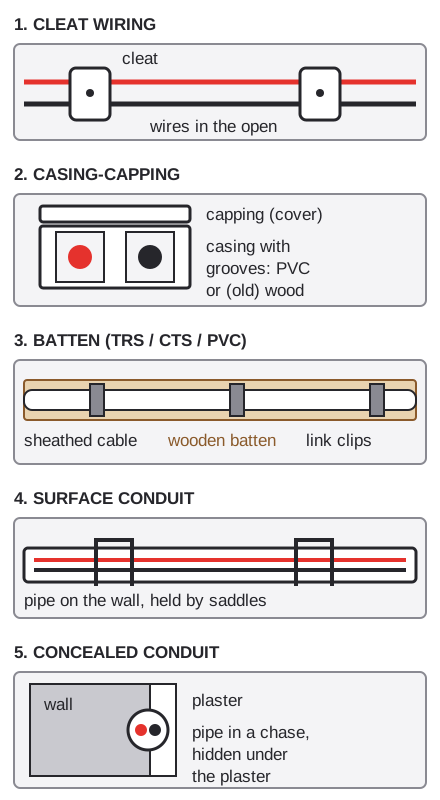
Drawn by us, not to scale. Red is the phase and black the neutral; the earth wire runs with them in a real installation. Tap the diagram to open it full size.
Cleat PVC-insulated wires held clear of the wall in porcelain or plastic cleats. Quick and cheap, but the wire is in the open.
Wooden casing-capping Wires laid in the grooves of a wooden strip and closed with a wooden cover. PVC casing-capping The same idea in PVC: a channel with a cover that snaps or screws on.
Batten Sheathed cable clipped flat to a straight wooden batten. Lead-sheathed Cable with a lead outer sheath, now found only in textbooks.
Conduit Insulated wires drawn through a PVC or metal pipe, either surface or concealed. The table below compares them all.
| Wiring system | Cost | Life | Appearance | Safety | Where used today |
|---|---|---|---|---|---|
| Cleat | Lowest | Short | Poor: wires in the open | Low | Temporary work, ITI practice |
| Wooden casing-capping | Low | Short: damp and termites | Fair | Low: wood burns | Old buildings only |
| PVC casing-capping | Low | Medium | Fair | Medium | Additions, shops, rented premises |
| Batten (TRS, CTS or PVC sheathed) | Low | Medium indoors | Fair | Medium; poor in damp | Old homes; rare in new work |
| Lead-sheathed | High | Long | Fair | Medium; sheath must be earthed | Historical, teaching only |
| Surface conduit, PVC | Medium | Long | Fair to good | High | Rewiring, additions, utility areas |
| Surface conduit, metal | High | Long | Industrial | High; conduit must be earthed | Factories, workshops |
| Concealed conduit, PVC | High | Long | Best: nothing on show | High | New homes and flats |
| Concealed conduit, metal | Highest | Long | Best | High; conduit must be earthed | Some commercial and industrial buildings |
Cleat wiring: why is it taught but not used in homes?
Cleat wiring is taught because it is the simplest system to fix, inspect and take down, which suits temporary work and the workshop, but it is not used in homes because the wires run in the open, where they collect dust and damp and can be damaged or touched.
A cleat is a small two-part block, usually porcelain, with grooves for two or three wires. The halves are screwed to the wall or ceiling with the wires gripped between them, at intervals along the run. Temporary wiring for a function, an exhibition or a construction site is where cleat wiring made sense, because it goes up and comes down in hours.
Its weaknesses are the reason it left homes: exposed wire, not weatherproof, and sagging runs between cleats as the wire warms and cools. It also looks untidy on a finished wall.
As an ITI student you will fix cleats on a practice board. Treat it as training in straight runs, neat bends and firm terminations, which every other system needs too.
Never leave open wiring of any kind within reach in a home. Insulation on an open wall is one knock or one rodent away from a live conductor.
Taught for practice and temporary work; never left in a home.
PVC channel and cover for additions on finished walls.
Sheathed cable on wooden battens, met when rewiring old buildings.
Wires in PVC pipe inside the wall, replaceable later.
Casing-capping wiring: wooden or PVC, which is still used?
Wooden casing-capping is no longer used because wood absorbs damp, attracts termites and burns, while PVC casing-capping, the same channel-and-cover idea made in PVC, is still common in India for surface additions, shops and rewiring jobs where cutting into a finished wall is not wanted.
The casing is the base strip, screwed to the wall, with grooves or a channel for the wires. The capping is the cover that closes it. In the old wooden version the two were separate wooden strips; in PVC the cover usually snaps on.
Why wood went: damp, termites and it burns. Why PVC stayed: it is cheap, quick to fit and neat enough on a painted wall. Its limit is that the cover can be prised off, so the wire inside is protected less than in a pipe.
Surface wiring ends at a surface board. Our VIYONA 191 5″ × 5″ wooden surface plate is ₹46 MRP and the 192 5″ × 7″ is ₹58, for conventional switches fixed on the wall face.
We do not make casing-capping or conduit. Whatever channel is used, size it so the wires lie loose; a packed channel traps heat and makes the next rewire harder.
What is batten wiring (TRS or CTS)?
Batten wiring is a surface system in which sheathed cables, originally TRS (tough rubber sheathed) or CTS (cab tyre sheathed) and later PVC sheathed, run flat along straight wooden battens and are held with tinned brass link clips, a method that was common in Indian homes before conduit took over.
The sheath is a second, outer layer over the insulated conductors, so the cable needs no pipe or channel. The batten is a straight, smooth strip of wood screwed to the wall, and the link clips wrap around the cable at intervals.
It was cheap and easy to inspect, since every metre of cable is in view. Against it: damp and sun attack the sheath and the wood, and the cable is open to knocks.
You still meet batten wiring when rewiring an old building. Fittings on those runs are surface types: our VIYONA 202 polycarbonate batten holder is ₹26 MRP, and the 193 3-inch round plate it can sit on is ₹8.
Old rubber insulation hardens and cracks with age. Cracked TRS or CTS cable is a reason to rewire, not to patch, and that decision is a licensed electrician’s.
Conduit wiring: surface or concealed, PVC or metal?
Conduit wiring draws insulated wires through a continuous pipe, which can be fixed on the surface of a wall with saddles or concealed in chases cut in the wall or laid in the slab before the concrete is poured, and the pipe can be rigid PVC for homes or steel for factories and workshops where it must take knocks.
Concealed PVC is the usual system in new Indian homes: nothing shows on the wall, the pipe protects the wire, and a wire can be drawn out and replaced later without breaking plaster, as long as the pipe was not packed full. Surface PVC gives the same protection on a finished wall, at the cost of a visible pipe.
Metal conduit is for factories, workshops and places where the pipe may be hit. A metal pipe is itself a conductor, so metal conduit must be earthed and electrically continuous along its whole length.
Wires are pulled through with a steel fish wire after the pipe is in. A packed pipe runs warmer and cannot be rewired, so the electrician leaves room in every pipe.
Concealed conduit must be planned before plaster. Once the wall is finished, every forgotten point means cutting a new chase.
Which wiring system is best for an Indian house?
For a new Indian house or flat, concealed PVC conduit wiring is the best general choice, because it protects the wire, keeps the walls clean and lets wires be replaced later, while surface PVC conduit or PVC casing-capping is the sensible choice when walls are already finished or the premises are rented.
The short guide: new home: concealed PVC conduit, finished walls: surface PVC conduit or casing-capping, factory or workshop: metal conduit, and cleat or batten: not for new work.
The system also changes how much current the same wire can carry. Enclosed wire sheds heat more slowly, so our catalogue rates each size lower in conduit than clipped in the open:
Current rating of our VIYONA wire by laying method (2 cables, single phase)
Figures from our catalogue’s technical table: “in conduit or trunking” against “unenclosed, clipped direct to a surface or on cable tray”. Bars to scale against 22 A.
Most house wiring runs in conduit, so the conduit column is usually the one that applies. Your electrician sizes each circuit with that in mind.
How does the wiring system decide the switch type?
The wiring system decides the switch type because surface wiring ends at boards fixed on the wall face, which take conventional or surface switches, while concealed wiring ends at boxes buried in the wall, which take modular switches and a cover plate that sits flush with the plaster.
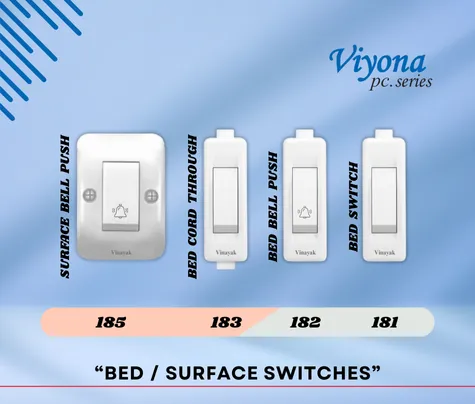
Surface wiring Our VIYONA bed and surface switches are made for it: 184 surface 1-way switch ₹34, 185 surface bell push ₹36, 181 bed switch ₹33, 182 bed bell push ₹38, 183 bed cord through ₹36 and 186 2-way bed switch ₹40, all MRP. A conventional board takes a VIYONA 101 6A 1-way switch at ₹22.
Concealed wiring A modular switch clips into a frame over a wall box: the KEMPS K141 10AX 1-way switch is ₹65 MRP in white, and our VIZA V614 4M concealed unbreakable box is ₹88.
The clearest example is the 32A DP switch: VIYONA 175 is the surface type, ₹195 and 176 the concealed type, ₹205. Modular on surface conduit is possible too, in a VIZA surface gang box such as the V644 4 way at ₹115 in white. Modular vs normal switch compares the two kinds of board.
Buy the box with the switches. A modular switch needs a box and plate of the same module size; a surface switch needs a surface board.
What does a single-phase house wiring diagram look like?
A single-phase house wiring diagram runs in one direction: the supplier’s service line feeds the energy meter, the meter feeds the main switch in the MCB box, the main switch feeds one MCB per circuit, and each circuit runs out to its own switch boards, sockets or appliance point.
House wiring diagram, single phase: meter to MCB box to circuits
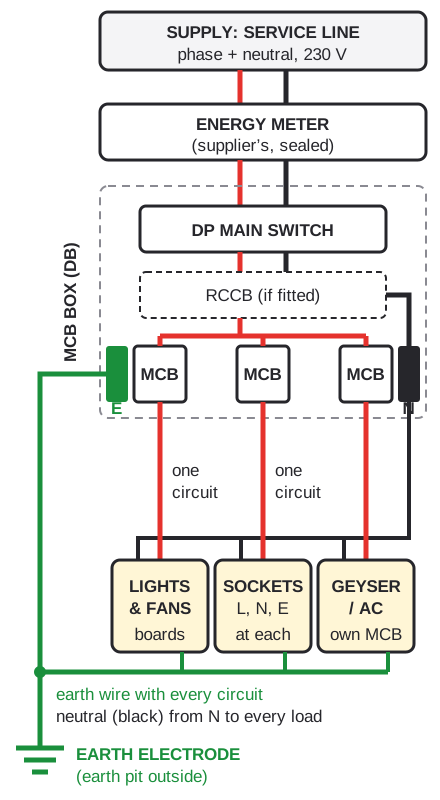
Drawn by us. Phase in red, neutral in black, earth in green. Real homes have more circuits; the pattern stays the same. Tap the diagram to open it full size.
Inside the MCB box: a DP main switch that cuts phase and neutral together, an RCCB where one is fitted for shock protection, which takes both phase and neutral (we do not make RCCBs), one MCB per circuit in the phase, and a neutral link that collects every circuit’s neutral. Our VIYONA 401 single pole 10 kA MCB, 6–32A, is ₹145 MRP, made to IS/IEC 60898-1; how it trips is drawn in our MCB working principle guide.
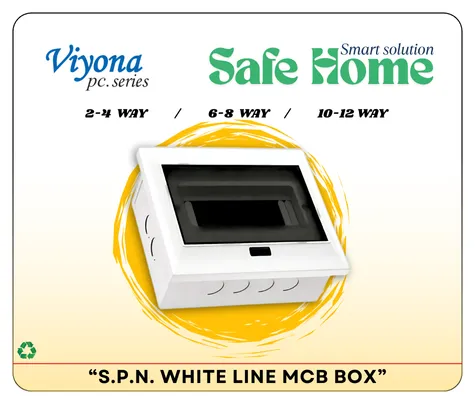
The box is sized by its number of ways: the VIYONA 371 2–4 way SPN white line MCB box is ₹380. Our MCB box size list matches box to home, and which MCB for home gives the rating for each circuit.
The service line and the meter belong to the supplier. Nobody but the supplier opens them, and all work after them starts with the main switch off.
What does a house wiring diagram with earthing add?
A house wiring diagram with earthing adds a third conductor: a green or green-yellow earth wire runs from the earth bar in the MCB box, which is joined to the earth electrode outside, to the earth terminal of every 3 pin socket, metal fitting and appliance point, alongside the phase and neutral.
In the diagram above it is the green line. The earth bar collects every circuit’s earth wire; one earth lead takes them to the electrode in the ground. In conduit wiring the earth wire is drawn through the same pipe as the circuit it protects. How the electrode itself is built is covered in our types of earthing guide.
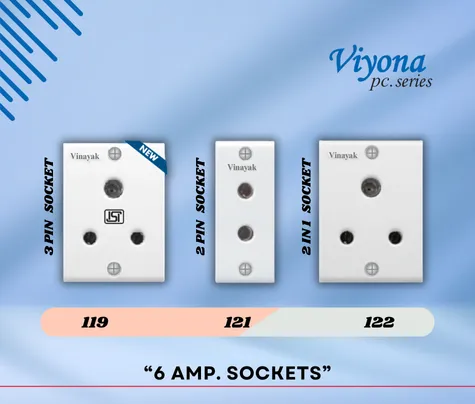
Every 3 pin socket gets its earth. On a surface board that may be our VIYONA 119 6A 3 pin socket at ₹40 MRP; on a modular board, a KEMPS K192 6A 3 pin socket at ₹110. The L, N and E terminals are drawn in our switch board wiring diagram.
Metal boxes and metal conduit are bonded to earth too. Earth joined to neutral at a socket, or no earth at all, both hide a fault until someone touches a metal appliance.
An earth wire that is present is not proof the earthing works. Earth continuity and earth resistance are tested by an electrician with instruments before the supply is switched on.
What wire size is used in house wiring?
House wiring in India commonly uses 1.5 sq mm copper wire for light and fan circuits and 2.5 sq mm for socket circuits, with heavier sizes for geysers, ACs and the main line, but your electrician sets each size for its load, its length and the wiring system it runs in.
1.5 sq mm is the size you will most often find on light and fan circuits and 2.5 sq mm on socket circuits. Our catalogue rates them at 13 A and 18 A in conduit, higher when clipped in the open, as the chart above shows.
Our VIYONA house wire comes in 0.75 to 6 sq mm, in 45 m and 90 m coils, in black, red, blue, yellow and green, so phase, neutral and earth can each have their own colour. Sizes, coil prices and the full current table are in our house wire guide.
The rule that ties wire and protection together: the MCB rating must not exceed what the wire can carry as installed.
A bigger MCB on the same wire does not make a circuit stronger. It lets the wire overheat before the breaker trips.
Wiring kaise karen ghar mein? The steps in order
Wiring in a house is done by a licensed electrician in a fixed order: plan the points and circuits, fix conduit and boxes before plaster, draw the wires through in separate colours for phase, neutral and earth, connect the MCB box, fit the switches and sockets, and test every circuit before the supply is switched on.
“Wiring kaise karen ghar mein” means “how do I wire a house”. For concealed conduit in a new home, the steps are:
- Plan every point and split the points into circuits.
- Choose the MCB box size and its position.
- Mark and cut chases; fix conduit and boxes before plaster.
- Draw the wires through with a fish wire, a separate colour for phase, neutral and earth.
- Connect the MCB box: main switch, MCBs, neutral link and earth bar.
- Fit switches, sockets and plates.
- Test insulation, earth continuity and polarity, then switch on circuit by circuit.
Step 1 decides everything after it; our guide to designing a modern electrical layout covers it room by room. Step 3 is before plaster, and step 7 is every circuit, not just the first.
For any later work on a live house: MCB off, then test dead with a voltage tester or multimeter. A neon line tester such as our VIYONA 198 (₹36 MRP) shows that phase is present; no glow does not prove a circuit dead.
House wiring and any work on a live installation are for a licensed electrician. Students practise on a training board, under an instructor.
FAQs
What are the types of wiring system?
Which type of wiring is best for a house in India?
Wiring ke kitne prakar hote hain? (Types of wiring in Hindi)
Wiring kaise karen ghar mein?
Is there a types of wiring system PDF?
What is the difference between surface and concealed wiring?
Why buyers choose Vinayak Electricals
- Switches, sockets, MCBs and MCB boxes made in-house at our works in Mumbai, for both surface and concealed wiring.
- VIYONA surface and bed switches, wooden surface plates and surface and concealed DP switches for surface wiring.
- KEMPS and VIZA modular switches, sockets and boxes for concealed wiring, so one home can use one maker.
- VIYONA MCBs made to IS/IEC 60898-1, licence CM/L-2544151, with SPN MCB boxes from 2 to 18 way.
- VIYONA house wire from 0.75 to 6 sq mm in five colours, with current ratings published in our catalogue.
- MRPs printed in our catalogue; manufacturing in Mumbai since 1995.
Switches for surface and concealed wiring
See our VIYONA conventional and surface switches and sockets, with codes and MRPs.
View VIYONA switches