Bed Switch Guide: Pendant, Surface and 2 Way Bed Switches Explained
Key takeaways
- Bed switch — a 1 way or 2 way switch on a flexible cord, within reach of the bed. Also called a pendant or cord switch.
- Surface switch — screwed flat to the wall face where there is no recessed box.
- Connection — in the phase of the light, like any switch; MCB off and an electrician for new wiring.
- Uses — lights, bedside lamps, night lamps and a bed bell push. Never heaters or irons.
- Our MRPs — VIYONA 181 bed switch ₹33, 186 2 way bed switch ₹40, 182 bed bell push ₹38.
Bed switch: the short answer
A bed switch is a small switch that hangs on a flexible cord or sits on the surface near a bed, so you can turn a light on or off without getting up. It is one of the oldest fittings in Indian homes, still common in bedrooms, hostels, hospitals and homes with elderly family members, and it costs far less than adding a new wall point.
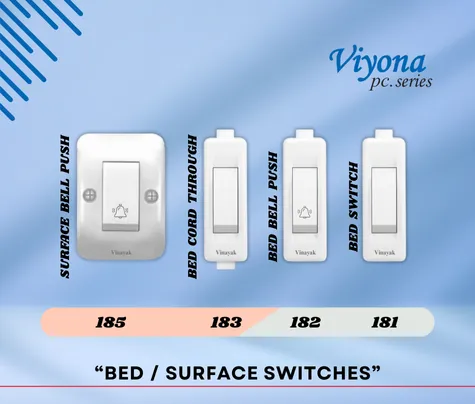
The family includes the bed switch itself, the 2 way bed switch that works with a wall switch, the bed bell push for calling someone, the cord through type, and surface switches that mount on the wall without a recessed box.
We make all of these under our VIYONA range at our works in Marol, Andheri East, Mumbai, at MRPs from ₹33. This guide explains what a bed switch is, how it differs from a surface switch and a pendant switch, how it is connected, where it is the right choice and where a modular bedside board is better.
What is a bed switch?
A bed switch is a compact switch in a small plastic body, connected by a flexible cord to the lighting circuit, that hangs or rests beside a bed so the person lying there can switch a light on or off; it does the same job as a wall switch, just within reach of the pillow.
Inside, it is an ordinary 1 way or 2 way switch. The difference is the cord: the switch body is not fixed into a wall box but hangs from a flexible lead, usually from a junction near the ceiling or a point on the wall above the bed.
Our VIYONA bed and surface switches come in six codes: the 181 bed switch, 182 bed bell push, 183 bed cord through, 184 surface 1 way switch, 185 surface bell push and 186 2 way bed switch. For where the bed switch sits among other switches, see our types of electrical switches guide.
A bed switch is for lights and similar small loads. Never use one for a heater, iron or other heavy appliance.
| Code | Type | Typical use | MRP |
|---|---|---|---|
| 181 | Bed switch | Room light or lamp from the bed | ₹33 |
| 182 | Bed bell push | Calling a carer or nurse | ₹38 |
| 183 | Bed cord through | Partway along a lamp's cord | ₹36 |
| 184 | Surface 1 way switch | A switch on a wall with no box | ₹34 |
| 185 | Surface bell push | A fixed bell button, no box | ₹36 |
| 186 | 2 way bed switch | Light from the bed and the door | ₹40 |
What is a pendant switch?
A pendant switch is another name for a switch that hangs on its own flexible cord, which is exactly what a bed switch is, so in most Indian shops the terms bed switch, pendant switch and cord switch describe the same fitting: a small switch on a lead that dangles within reach of a bed or a work table.
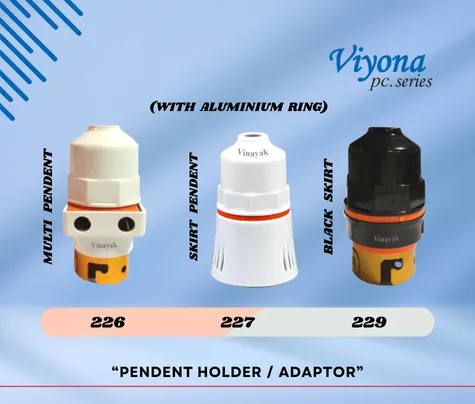
Do not confuse it with a pendant holder, which is a lamp holder on a cord that carries the bulb, not the switch. We make both: our VIYONA pendant holders hold the lamp, and the bed switch controls it.
A cord through switch, our VIYONA 183, is a variant where the flexible cord passes through the switch body, so it can sit partway along a lamp’s lead. It is the type often seen on table and bedside lamps.
A switch on a cord, so you never get up to turn off the light.
The 186 works with the door switch for the same light.
A bed bell push rings a bell only while pressed.
Lights and lamps, never heaters or irons.
Bed switch vs surface switch: what is the difference?
A bed switch hangs on a flexible cord and moves with it, while a surface switch is screwed flat onto the face of a wall or board without needing a recessed box; both are switches, but the bed switch is for reach from the bed and the surface switch is for adding a switch where the wall has no box.
Use a surface switch when you need a fixed switch somewhere new, such as on an old wall, a wooden partition or a cupboard, and do not want to cut the wall. Our VIYONA 184 surface 1 way switch is ₹34 and the 185 surface bell push ₹36.
Use a bed switch when the person using it is lying down, or needs to switch from a chair or a bed that moves. In hospitals and care rooms the 182 bed bell push lets a patient call for help.
Bed switch vs surface switch: how each is fixed
General practice, not a test result. Bars are equal because these are mounting types, not quantities.
What does a bed switch cost?
A bed switch costs ₹33 MRP in our VIYONA range, the 181, and the whole family of bed and surface switches runs from ₹33 to ₹40: the 2 way bed switch 186 is ₹40, the bed bell push 182 ₹38 and the surface 1 way switch 184 ₹34.
VIYONA 181 is a bed switch at ₹33 MRP, the cheapest way to add a switch within reach of a bed.
MRP of our VIYONA bed and surface switches
MRPs from our VIYONA price list, 1 January 2026; bars to scale with ₹40 as the full bar.
The cord, a ceiling rose or junction, and the electrician’s time cost more than the switch. Even so, a bed switch is far cheaper than chasing a new wall point and board to the bedside.
2 way bed switch: switching a light from the bed and the door
A 2 way bed switch lets you switch the same light from the bed and from the wall switch by the door, because it works as one of a pair of 2 way switches, so you can turn the room light on as you enter and off from bed without getting up again.
Our 186 2 way bed switch is ₹40. It pairs with a 2 way wall switch at the door, such as the VIYONA 102 at ₹36, the VIZA V102 at ₹81 or the KEMPS K102 10AX at ₹105, depending on the board.
We do not repeat how 2 way switching works here. Our 1 way vs 2 way switch guide explains the difference, and the 2 way switch wiring diagram shows the connection with the two strapping wires. A 2 way bed switch needs a three-core cord, so plan the run accordingly.
A 2 way switch at the bed or the door, at our MRP
MRPs from our current catalogue, white or standard finish; bars to scale with ₹105 as the full bar.
Bed switch connection: how is it wired?
A bed switch is connected in the phase wire of the light it controls, just like a wall switch: the phase from the supply goes to one terminal, the switched wire to the light goes from the other, and the flexible cord carries both from a fixed junction, ceiling rose or wall point down to the switch.
The switch must be in the phase, never the neutral, or the light stays live when off. Our phase, neutral and earth guide explains why. A 2 way bed switch has three terminals and needs a three-core lead.
The cord must be secured at the top so its weight never pulls on the terminals inside the switch, and both ends need firm, fully inserted connections. A loose conductor inside a small switch body is the usual cause of a bed switch getting warm.
Before any wiring: switch off the MCB, test the wires dead, and get a licensed electrician to run a new cord or point. Never work on a bed switch with the circuit live.
What can a bed switch control?
A bed switch is meant to control a light, a night lamp or a similar small load near the bed, and it should never be used for a heater, an iron, a geyser or any appliance that draws heavy current, because its compact body, flexible cord and small terminals are not built for that.
Good uses: the room light, a bedside lamp, a night lamp such as our 0.5 W LED night lamp, or a bell via the bed bell push. Our night lamp guide covers the low-watt lamps people often pair with a bed switch.
Not for: room heaters, irons, kettles, ACs and geysers. Those need a proper wall point with a switch and socket of the right rating; see our switch and socket ratings page. If a bed switch is printed with a rating, stay well within it.
Bed bell push: who needs one?
A bed bell push is a button on a cord that rings a bell elsewhere in the home or ward when pressed, and it is most useful for elderly family members, patients recovering at home, and hospital, nursing home or hostel rooms, where someone lying down needs to call for help without shouting or getting up.
Our 182 bed bell push is ₹38, and the 185 surface bell push ₹36 for a fixed position. A bell push only completes the circuit while pressed, so it cannot be left on by mistake.
Pair it with a bell at the place where the carer sits. Our VIYONA door bells include ding dong bells from ₹195 (the 234 Boss) to ₹230 (the 235 Sathi). In clinics, a bell indicator shows which bed called; ask your electrician to plan it with the bell circuit.
For an elderly parent, a bed bell push and a 2 way bed switch together cost under ₹80 at our MRP and remove two reasons to get out of bed at night.
Bed switch or bedside switch board: which is better?
A bedside switch board is the better choice in a new or renovated bedroom, because it gives fixed switches, sockets and USB charging at the bedside, while a bed switch is the better choice for an existing room where cutting a new point is not practical or where the person needs a switch that moves with them.
A modular bedside board at mattress height can hold a 2 way switch for the room light, a socket for a lamp or phone, and a USB charger. Our USB socket for switch board and switch board height from floor guides cover what to fit and where.
A bed switch wins on cost and speed: no wall chasing, no new box, and a fitting that reaches a hospital bed or a recliner. Many homes use both, with a board at the bedside and a bed switch for a parent’s room.
Is a bed switch safe?
A bed switch is safe when it is a properly made switch on a sound cord, wired in the phase by an electrician, fixed so the cord is never pulled, and used only for lights and small loads; it becomes unsafe when the cord is cracked, the body is broken, or it is fed a heavy appliance.
Check the cord now and then for cuts, kinks or flattening where it runs behind a bed. Keep it clipped along the wall, for example with our VIYONA cable clips, so it cannot be caught or tugged by a child.
Replace a bed switch whose body is cracked or that feels warm. Do not let a bed switch lie under a mattress or pillow. For general checks around the home, see our electrical safety tips at home.
A cracked bed switch or a cord with bare copper showing must be switched off at the MCB and replaced at once.
FAQs
What is a bed switch used for?
What is the difference between a bed switch and a surface switch?
Is a pendant switch the same as a bed switch?
How do you connect a bed switch?
Can a bed switch be 2 way?
What is the price of a bed switch?
Why buyers choose Vinayak Electricals
- Six VIYONA bed and surface switch codes, from ₹33 MRP, made at our works in Marol, Andheri East, Mumbai.
- Bed switches, 2 way bed switches, bed bell pushes and surface switches from one price list.
- Bells, night lamps, pendant holders and cable clips to complete the bedside from the same catalogue.
- Switches made to IS 3854 under ISI licence CM/L-7567794.
- MRPs published openly; sold through 500+ dealers with delivery across India.
- Manufacturing in Mumbai since 1995; ISO 9001:2015 certified.
Bed and surface switches from ₹33
See all six VIYONA bed and surface switch codes and MRPs, then order through a dealer or call us.
View bed switches