Choosing a Night Lamp: Watts, Units, Colour and Where to Fit It
A night lamp is a very low-power light left on through the night so you can see your way without switching on the main lights, and the right one costs almost nothing to run: a 0.5W LED night lamp on for 10 hours a night uses about 0.15 units a month. Below we compare it with the old “zero watt” bulb, which is not zero at all, cover the best colour for sleep, where to place a night lamp, and the night lamps and foot lights we make in Mumbai.
Key takeaways
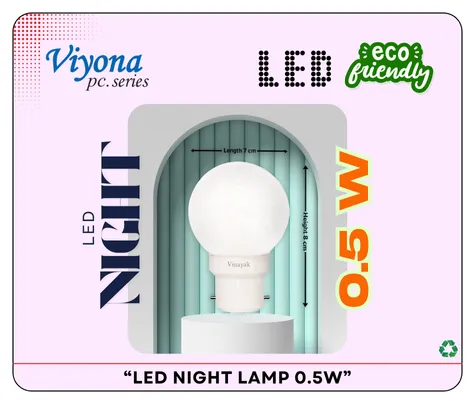
- 0.5W LED night lamp — about 0.15 units a month at 10 hours a night. Ours, code 1061, is ₹40 MRP.
- “Zero watt” bulb — a small filament bulb that typically draws around 10 to 15 watts, many times an LED night lamp.
- Colour — a dim, warm light is commonly preferred for sleep; keep bright cool light out of the bedroom at night.
- Placement — low, below eye level, along the path to the door or bathroom, not facing the bed.
- Board night lamp — our KEMPS K216 2-module night lamp clips into the switch board, ₹280 MRP.
Night lamp: the short answer
A night lamp gives just enough light to move around a dark room, find a child, or reach the bathroom without waking everyone with the main light. Because it runs for eight to ten hours every night, all year, its wattage matters far more than its price.
For years the standard was the “zero watt” bulb, a small coloured filament bulb. It was cheap, but the name was misleading: it drew real power and ran warm. A modern LED night lamp gives a similar soft glow at a small fraction of the power.
This guide works out what a night lamp actually costs to run, explains the zero watt bulb, covers colour and placement for good sleep, and shows the three ways to fit one: in a bulb holder, built into the switch board, or as a foot light low on the wall. We make all three kinds at our works in Marol, Andheri East, Mumbai, and give their MRPs below.
What types of night lamp are there?
Night lamps for Indian homes come in three common forms: a small lamp that fits an ordinary bulb holder, a night lamp module that clips into the modular switch board beside the switches, and a foot light set low in the wall that lights the floor along a passage or staircase; all three can be LED and draw under a watt or so.
Holder type Easiest swap The simplest swap: replace an old zero watt bulb in its existing holder.
Switch board type A module that sits in the board, with its own switch, so no separate point is needed. It lights the area around the board.
Foot light No glare A small fitting low on the wall, usually in a passage or by a stair, that lights the floor without shining into eyes.
Plug-in types that go straight into a socket also exist. We do not make plug-in night lights; if you use one, check it sits firmly and does not block the socket switch.
Choose the type by where you need light: a holder lamp for the room, a board lamp near the bed, a foot light along the path.
| Type | Typical draw | Units a month, 10 h a night | From us |
|---|---|---|---|
| LED night lamp | 0.5W | About 0.15 | 1061, ₹40 |
| Board night lamp module | Low, LED | Very low | KEMPS K216 2M, ₹280 |
| Foot light in the wall | Low, LED | Very low | VIZA V1314 4M, ₹460 |
| Zero watt filament bulb | Around 10 to 15W | 3 to 4.5 | We do not make these |
| Plug-in night light | Varies | Check the label | We do not make these |
How much electricity does a night lamp use?
A night lamp uses watts × hours ÷ 1,000 units, so a 0.5W LED night lamp left on 10 hours a night uses 0.005 units a night, about 0.15 units a month, while a 15W zero watt bulb on the same hours uses about 4.5 units a month, thirty times as much.
Units per month, 10 hours a night for 30 nights
Calculated as watts × 10 × 30 ÷ 1,000. The 0.5W is our 1061; the zero watt figures are typical draws for that kind of bulb, not measurements. Bar length is units with 4.5 as the full bar, rounded to the nearest 5%.
The method is the same for every appliance: watts × hours ÷ 1,000. A 0.5W LED sits at the bottom of any chart; a filament night bulb does not. Our appliance power consumption chart applies it to fans, ACs and fridges, and our guide to how to calculate an electricity bill turns units into rupees on your own tariff.
Our 1061 LED night lamp draws 0.5W and costs ₹40 MRP.
A filament night bulb typically draws around 10 to 15 watts.
Keep it low, warm and out of view of the pillow.
KEMPS K216 2-module night lamp clips in beside the switches.
What is a zero watt bulb, and does it use zero watts?
A zero watt bulb is a small, usually coloured, incandescent bulb sold as a night lamp; it does not use zero watts, but typically draws somewhere around 10 to 15 watts, and got its name because old electricity meters barely registered such a small load, not because it used no power.
Inside is a tiny filament, the same principle as an old normal bulb. That means most of its power becomes heat, which is why it is warm to the touch after a night’s use, and why its holder often turns brown over the years.
The name stuck long after meters became sensitive enough to count it. On a modern meter it is a real, steady load every night, and on a large family home with several in use it adds up.
Our guide to the difference between an LED bulb and a normal bulb explains why a filament wastes so much as heat, for the main lights as well as the night lamp.
If a night lamp is warm to the touch in the morning, it is almost certainly a filament bulb, and swapping it for LED is an easy saving.
0.5W LED night lamp vs zero watt bulb: what does a year cost?
At an example tariff of ₹8 a unit and 10 hours a night, a 0.5W LED night lamp costs about ₹15 a year to run, while a zero watt bulb drawing 10 to 15 watts costs roughly ₹290 to ₹440, so the LED lamp usually pays for itself within the first couple of months.
Running cost per year, 10 hours a night at ₹8 a unit
Our arithmetic: watts × 10 × 365 ÷ 1,000 × ₹8, rounded. ₹8 is an example rate; use your own tariff. Bar length is cost with ₹440 as the full bar, rounded to the nearest 5%.
Our LED night lamp, VIYONA LED 1061, is a 0.5W LED night lamp with an MRP of ₹40. At these figures it covers its own price in under two months against a 10W zero watt bulb. Before ordering, check the cap or fitting of the 1061 against your point with your dealer, since our catalogue lists it by wattage only.
The saving per lamp is small in rupees, but a home often has two or three night lamps on every night, and it is a saving that needs no change in habits.
Which colour night lamp is best for sleeping?
A dim, warm night lamp, warm white, amber or a soft red-orange, is commonly preferred for sleep, because bright light and bluish cool white light at night are widely thought to make it harder to fall asleep; the key is to keep it dim and out of direct view of the bed.
Dim and warm is the usual advice. A night lamp should help you see the floor and the door, not light the room. If you can read comfortably by it, it is probably too bright for a bedroom.
Cool white or blue night lights look crisp but are the colour most often advised against for sleeping rooms. Coloured zero watt bulbs, green, blue or red, were popular mainly because they dimmed the light, not because the colour helped.
For the main bedroom lights, the same thinking applies in the hour before sleep. Our guide to warm white vs cool white explains colour temperature and which suits each room.
This is general lighting practice, not medical advice. Anyone with persistent sleep trouble should speak to a doctor.
Is it safe to leave a night lamp on all night?
Yes, an LED night lamp is designed to be left on all night: at half a watt it runs barely warm and draws very little; the safety points are a sound holder or board, a lamp that sits firmly, nothing flammable touching it, and a registered product rather than an unbranded one.
LED: barely warm A 0.5W lamp produces very little heat. Old filament lamp A zero watt bulb runs warm for hours every night, which is what browns and cracks old holders.
Check the holder If the holder is brown, cracked or loose, replace it when you swap the lamp. Our VIYONA lamp holders include batten and angle types from ₹26 MRP.
Children’s rooms Fit the night lamp out of a child’s reach, and avoid plug-in lamps in sockets a small child can get to.
To change a holder, switch off the MCB for the circuit and test the point dead first. A wall switch alone may not isolate it.
Where should a night lamp be placed?
A night lamp is best placed low, below eye level from the bed, on the route you walk at night, between the bed and the door or bathroom, and pointed at the floor rather than at the bed, so it lights your path without shining into the eyes of anyone sleeping.
Low on the wall along the path. Near the bathroom door for night trips. At the top and bottom of a staircase. Facing the pillow is the one spot to avoid.
Foot lights are made for exactly this: small fittings set low in the wall that wash light across the floor. Our VIZA Black V1314 4-module foot light is ₹460 MRP; the VIZA foot light range and its colours are on our VIZA 4-module LED foot lights page.
In a child’s room, a night lamp near the door helps a parent check without switching on the main light. In a passage, one lamp at each end is usually enough.
Can you fit a night lamp in the switch board?
Yes, a night lamp module can be fitted in a modular switch board beside the switches, taking up module space in the plate and coming with its own switch; it lights the area around the board, which is handy beside a bed or near the bedroom door, and needs no separate point or holder.
Our KEMPS modular range includes the K216 2-module night lamp with 3 LEDs at ₹280 MRP, built to clip into the same frame as the switches.
Plan the module count before choosing the plate. A 2-module night lamp in a bedside board means the plate needs two spare modules. Our guide to 1 module and 2 module switches explains module sizes, and switch board design ideas shows how to lay out a bedroom board.
A board night lamp is wiring work: switch off the MCB, test the board dead, and use a licensed electrician to fit a new module.
Why does my night lamp glow or flicker when switched off?
A night lamp or LED that glows faintly or flickers after being switched off is usually picking up a tiny current, most often because the switch is breaking the neutral instead of the phase, because an illuminated indicator switch leaks a little current, or because of voltage induced in a long cable run beside another live wire.
A faint glow on a 0.5W lamp is more noticeable than on a big bulb, because it takes so little current to light. That is why night lamps are often the first light in a house to show the problem.
The usual suspects, in order: switch in the neutral illuminated indicator switch induced voltage on a long run
The first matters for safety, not just for the glow: the lamp holder stays live even when the switch is off. Have an electrician check it.
Our guide to LED glowing when switched off goes through each cause, and why an LED light flickers covers flicker while the lamp is on. If a switch is warm or a board smells of burning, stop and read switch getting hot or socket sparking.
FAQs
How much electricity does a night lamp use?
Does a zero watt bulb really use zero watts?
What is the price of a 0.5W LED night lamp?
Which colour night lamp is good for sleep?
Is it safe to keep a night lamp on all night?
Why is my night lamp glowing when switched off?
Why buyers choose Vinayak Electricals
- A 0.5W LED night lamp, code 1061, at ₹40 MRP, made at our works in Marol, Andheri East, Mumbai.
- The KEMPS K216 2-module LED night lamp for the switch board at ₹280 MRP, and VIZA 4-module foot lights.
- Lamp holders from ₹26 MRP to replace a heat-browned holder when you retire the zero watt bulb.
- Switches made to IS 3854 under BIS licence CM/L-7567794, for the board the night lamp sits in.
- MRPs published openly; sold through 500+ dealers with delivery across India.
- Manufacturing in Mumbai since 1995; ISO 9001:2015 certified.
A 0.5W LED night lamp for ₹40
See our LED night lamp 1061, then order through a dealer or call us. Board night lamps and foot lights are in the same catalogue.
View LED night lamp