Electricity Saving Devices: Why a Plug-In Box Will Not Cut Bills

Do power saving devices work? For a home, the plug-in power saver that promises to cut the bill by correcting power factor does not reduce the units your meter records, because those units measure the real energy your appliances need. Below we explain what the devices claim, why the claim fails, the risks of cheap units, why a bill may seem to drop after fitting one, and the changes that genuinely save electricity, with our own LED and regulator MRPs.
Key takeaways
- Plug-in power savers — do not cut the kWh a home meter bills; a capacitor in one socket cannot reduce the real power your appliances need.
- Risk — cheap, unrated units left plugged in 24 hours can overheat; check for a maker and an ISI mark.
- Bill fell? — usually the season, billing days or habits. Compare same month, same days, actual readings.
- Real savings — fewer watts × fewer hours: LED lamps, efficient fans, electronic regulators, standby off at the wall.
- Example — 60 W bulb to our 9 W LED lamp (₹70 MRP) saves about 7.65 units a month at 5 hours a day.
Do power saving devices work? The short answer
Do power saving devices work in a home? Plug-in power savers that promise to cut your bill by improving power factor do not reduce the units a home meter records in any meaningful way, because those units measure real power used by your appliances, and a box in one socket cannot make a fan, AC or geyser need less of it.
What does cut a bill is less glamorous: appliances that need fewer watts for the same job, and fewer hours of use. An LED lamp in place of a filament bulb, an efficient fan, an electronic regulator, switching off standby loads, and a sensible thermostat on the AC all reduce the units the meter counts.
We make LED lamps, electronic fan regulators, switches and MCBs at our works in Mumbai, and we do not make or sell power saver plugs. This guide explains what those devices claim, why the claim fails for home meters, the safety risks of cheap units, why a bill may seem to drop after fitting one, and what actually saves electricity, with our own MRPs where we make the part.
What is a power saver plug and what does it claim?
A power saver plug is a small box that plugs into any socket, often with a glowing indicator, sold with the claim that it stabilises voltage, filters the supply or corrects power factor so the whole home draws less electricity and the bill falls, sometimes by a large percentage printed on the box.
The common claims: Corrects power factor Stabilises voltage Filters surges Cuts bill by a big %.
Notice what the box does not do: it is not wired into any appliance and sits on one socket. Every other appliance in the house draws its current through its own circuit, straight from the board.
Their own descriptions usually mention a capacitor, the part that can shift power factor on a circuit. That word carries the whole claim, so the next section looks at what power factor means for a home bill.
A large saving percentage printed on a box is a claim, not a measurement. Ask what it was measured against, on which meter, and by whom.
| Change | Reduces kWh billed? | Why |
|---|---|---|
| Plug-in power saver | No, not measurably | Affects reactive current, not real power |
| Filament bulb to LED lamp | Yes | Fewer watts for the same hours |
| Resistor regulator to electronic | Yes, at low speed | Less power wasted as heat |
| Standby off at the wall | Yes | Removes an all-day load |
| AC thermostat and closed doors | Yes | Compressor runs fewer hours |
| Geyser on a timer or switched off | Yes | Heats only water you use |
Why do electricity saving devices not reduce the bill?
Electricity saving devices do not reduce a home bill because most home meters in India record units in kWh, the real energy appliances turn into heat, light and motion, while a power factor capacitor only affects reactive current, which a kWh meter does not bill, and a fan or AC still needs the same real power to do its work.
In plain words: Units = real energy Capacitor = reactive current Different things.
A motor draws some current that flows back and forth without doing work. A capacitor near that motor can supply it locally, which lightens the load on the wiring upstream. That is real engineering in factories, where tariffs often charge for it. In a home, the meter charges for kWh, so the bill does not move.
And a capacitor in one socket is not near your motors. It cannot correct a fan in the bedroom or an AC compressor on another circuit.
Some tariffs for larger connections bill kVAh instead of kWh. Check the unit on your bill; if it says kWh, a power factor device has nothing to save.
Does not cut the units a home meter records.
Fewer watts for the same hours: a real saving.
Cuts fan power at low speed instead of wasting heat.
A week with, a week without: the units decide.
Can a power saver be dangerous?
A power saver can be dangerous when it is cheaply built: an unrated capacitor, thin internal wiring, no fuse and a plastic case that is not flame retardant can overheat while left plugged in day and night, and units with no ISI mark or traceable maker give no assurance about any of it.
What to watch for in any plug-in device: Warm case Loose pins No maker or address No ISI mark Left in 24 hours a day.
A device that is plugged in round the clock and promises to do something to the supply deserves more scrutiny than a phone charger, not less. Our guide to spot a fake ISI mark shows how to check a licence number.
Plug-in boxes also loosen sockets. A heavy body hanging off a socket for months wears its contacts; our guide to a loose socket covers the signs.
If any plug-in device feels hot, smells of burning or makes the socket warm, switch off the socket and the MCB, unplug it and do not use it again.
Why did my bill go down after fitting a power saver?
A bill often goes down after fitting a power saver for reasons that have nothing to do with the device: the season changed and the AC or geyser ran less, a billing period was shorter, an estimated reading was corrected, or the household simply became more careful about switching things off once they started watching.
Fair ways to compare: Same month, last year Same number of days Actual, not estimated Same appliances.
The honest test costs nothing: read your meter at the same time each day for a week with the device, then a week without it, in the same season, with the same habits. A real saving would show. Our how to calculate electricity bill guide shows how to turn readings into rupees.
Summer and winter bills in many Indian homes differ more than any device could change them, because cooling and water heating dominate. Our appliance power consumption chart shows which appliances use the most units.
Watching the meter is itself a saving. Most households that start reading it switch off more, whatever device is plugged in.
What actually saves electricity at home?
What actually saves electricity at home is using fewer watts for the same result and fewer hours of use: LED lighting in place of filament bulbs, efficient fans and electronic regulators, a sensible AC thermostat and closed doors, a well-sealed fridge, switching off standby loads, and heating only the water you use.
The big levers, in rough order for a typical home: AC habits Geyser timing Fans Lighting Standby.
Each works because it reduces watts × hours, which is exactly what the meter counts. A unit is 1,000 watts for one hour.
Our how to save electricity at home guide sets out each lever with worked numbers; here we pick out the two where our own products sit, lighting and fan regulators, and give the arithmetic.
A star rating label compares appliances of the same type and size. Use the units per year printed on it, not the number of stars alone.
How much does switching to LED save?
Switching a 60 W filament bulb to a 9 W LED lamp saves about 51 watts while it is on, which at 5 hours a day is about 7.65 units a month for one bulb by simple arithmetic; that is a real, measurable saving because the LED lamp draws fewer watts, unlike a plug-in power saver.
Units a month for one lamp at 5 hours a day
Our arithmetic: watts × 5 hours × 30 days ÷ 1,000. General practice, not a test result. Bars to scale with 9 units.
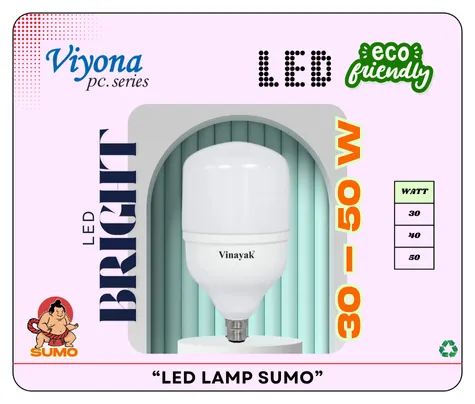
VIYONA 1065 is a 9 W LED lamp at ₹70 MRP. Our LED lamps run from 9 W to 23 W, with the Sumo lamps at 30 W, 40 W and 50 W.
Multiply by the number of lamps in a home, and the saving is a real line on the bill. How LED and filament bulbs differ is covered in our LED vs normal bulb guide.
Replace the lamps that burn longest first: the passage, the kitchen, the outdoor light. Lamps used ten minutes a day save little.
Fans and regulators: where real savings sit
Fans save real electricity in two ways: an efficient fan draws fewer watts at the same speed, and an electronic regulator reduces the power drawn at low speed, while an old resistor-type regulator wastes the difference as heat, so a fan at low speed on an old regulator saves almost nothing.
Typical ceiling fan draw at full speed (W)
Typical figures from our ceiling fan power consumption guide, not a test of any fan. Bars to scale with 75 W.
Our electronic regulators: VIYONA 137 mini 4 step at ₹215 and 138 medium 5 step at ₹225 MRP. Our fan regulator types guide compares step and electronic regulators.
We make regulators and capacitors, not fans. A BLDC fan usually comes with its own remote; do not fit a wall regulator unless the fan maker says so.
A regulator that runs hot at low speed is wasting power as heat. That warmth is the old resistor design at work.
Standby power and night lamps
Standby power is the small draw of devices that are off but plugged in, and because it runs all day it adds up: each watt left on around the clock is about 0.72 units a month, so switching off at the wall, or using a switched socket, saves real units that no plug-in power saver can.
Common standby loads: Set-top box TV on standby Chargers left in Microwave clock.
One switch at the wall turns all of them off. A switched socket makes it one press; our switched socket guide explains where to use one.
Night lamps are the other always-on light. Our VIYONA 1061 LED night lamp is 0.5 W at ₹40 MRP, against the 10 to 15 W a filament ‘zero watt’ bulb typically draws; our night lamp guide works through the numbers.
Walk round the house at night with the lights off. Every glowing indicator you see is a standby load you could switch off at the wall.
How to check a saving claim yourself
To check any saving claim yourself, read the meter: note the kWh reading at the same time each day for a week without the change and a week with it, in the same season and with the same habits, and compare the daily units; a real saving shows in the units, and a claim that cannot survive this test is not a saving.
The method: 1. Note the reading 2. Same time daily 3. One change at a time 4. Compare daily units.
Change one thing at a time. If you fit LED lamps and a new regulator in the same week, you will not know which saved what.
The meter reading is in kWh, the same units as your bill. Our electricity bill guide turns units into rupees using your tariff’s slabs.
Do not open the meter or its seal. Read the display only; the meter belongs to the supply company.
What we make that genuinely saves power
What we make that genuinely saves power is LED lighting, from 0.5 W night lamps to LED lamps, panels and tube fittings, and electronic fan regulators, all with published MRPs; we do not make or sell power saver plugs, because they do not reduce the units a home meter records.
From our catalogue: VIYONA 1065: 9 W LED ₹70 VIYONA 1061: 0.5 W ₹40 VIYONA 138: 5 step ₹225.
Our full LED range is on our LED Lamp Sumo page and the series pages linked from it. We also make the switches, sockets and MCBs that make switching off easy, at our works in Marol, Andheri East, Mumbai, under ISO 9001:2015.
We would rather tell you a device does not work than sell you one. The savings above come from fewer watts and fewer hours, and nothing else.
Start with the cheapest real saving: swap the longest-burning bulbs for LED lamps, and switch standby loads off at the wall.
FAQs
Do electricity saving devices really work?
Can a power saver reduce my bill by half?
Are power saver plugs safe to use?
Does a capacitor reduce the electricity bill at home?
Why does a power saver light up when plugged in?
What is the cheapest real way to save electricity at home?
Why buyers choose Vinayak Electricals
- LED lamps from 9 W at ₹70 MRP, plus 0.5 W LED night lamps, panels and tube fittings.
- Electronic fan regulators that cut fan power at low speed, from ₹215 MRP.
- Switches, switched sockets and MCBs that make switching off easy, made at our works in Marol, Andheri East, Mumbai.
- We say plainly what we do not sell: power saver plugs.
- ISO 9001:2015 certified; making electrical products since 1995.
- Published MRPs; sold through 500+ dealers with delivery across India.
Real savings start with the lamp
See wattages and MRPs for our LED lamps and night lamps, then order through a dealer or call us.
View LED lamps