Which Light Is Best for Study Tables and Rooms? A Practical Guide

Which light is best for study has a fairly settled answer: a steady, flicker-free, neutral to cool white light that falls evenly on the desk without glare, backed by softer general light in the rest of the room so the eyes are not jumping between a bright page and a dark wall. Below we take each part in turn, colour, brightness, glare, flicker and placement, then answer the tube light and table lamp questions and list the LED fittings we make for a study room.
Key takeaways
- Colour — neutral white, around 4000K to 5000K, is the common choice for study; warm white for winding down afterwards.
- Two layers — a ceiling light for the room plus a light over or beside the desk. One bright point in a dark room tires the eyes.
- No glare, no flicker — diffused light, nothing bright in direct view, and a good LED driver.
- Placement — light from in front or from the side opposite your writing hand, never from behind you.
- Our fittings — LED tube fittings from ₹160 and LED panels from ₹300 MRP. We do not make table lamps.
Which light is best for study: the short answer
The best light for study is not a single product. It is a combination: enough light on the page, a colour that keeps you alert without feeling harsh, no glare bouncing off the book or screen, no flicker, and a room that is not much darker than the desk.
In practice that usually means a neutral white ceiling light, such as an LED panel or tube, for the room, and a second light aimed at the desk, either a tube fitting on the wall above it or a table lamp. The desk light does the reading work; the room light stops the contrast that makes eyes tired over a long evening.
The details matter most for children doing homework and for anyone studying for hours: where the light sits relative to the writing hand, whether the bulb is visible from the chair, and whether the light is steady. We make LED tube fittings, panels, down lights and surface lights at our works in Marol, Andheri East, Mumbai, and we list those that suit a study room further down.
What is the best light for eyes while studying?
The best light for the eyes while studying is even, steady and diffused: enough light on the desk to read without straining, no visible bright source in your line of sight, no flicker, and general room light so the eyes are not adjusting between a bright page and a dark surrounding every time you look up.
Four things cause most eye discomfort at a desk: too little light, glare, flicker and high contrast between the desk and the room. Fixing those does more than chasing any particular colour or brand.
Diffused light from a panel or a frosted tube spreads softly and casts gentle shadows. A bare bulb gives hard shadows and a bright point that dazzles when you glance up.
Lighting is one part of eye comfort. Regular breaks from close work, a sensible distance from the page or screen, and an eye test if headaches persist matter just as much. We are lighting makers, not eye doctors, so treat this guide as practical lighting advice.
A simple check: sit at the desk and look up. If any light source is bright in your view, move it or shade it.
| Need | Good choice | Avoid | From our range |
|---|---|---|---|
| Room light | Diffused ceiling panel | Single bare bulb | 10W panel 1021, ₹300 |
| Desk light | Tube above desk or shaded lamp | Light behind the chair | 20W T5 tube 1059, ₹200 |
| Colour | Neutral white, 4000K to 5000K | Mixed colours in one room | Check the carton |
| Steadiness | Good LED driver | Old choke tube, worn starter | Any LED fitting, no choke |
| Position | Front or opposite the writing hand | Straight overhead on glossy pages | Wall-mounted T5 fitting |
Which colour light is best for study: warm, neutral or cool white?
Neutral white, roughly 4000K to 5000K, is the colour most commonly recommended for study because it feels clear and alert without the bluish harshness some people find in 6500K cool daylight; warm white around 2700K to 3000K is relaxing and better kept for the hour before sleep.
Colour temperature of common white LED light (kelvin)
General practice, not a test result. Bar length is kelvin with 6,500K as the full bar, rounded to the nearest 5%. Higher kelvin looks bluer, not brighter.
Kelvin is colour, not brightness. A 6500K lamp and a 4000K lamp of the same lumens light the desk equally; they only look different. Many students like cool white for long sessions; others find 6500K glaring at night. Choose by comfort.
Keep one colour per room: a warm lamp on a desk under a cool ceiling light looks odd and gives two shadow colours. Our guide to warm white vs cool white goes deeper on choosing a colour for each room.
A room light plus a desk light, never one bright spot in the dark.
Around 4000K to 5000K for study; warm white for winding down.
Left side for right-handers, so the hand casts no shadow.
Heavy dark bands on camera mean the light is worth replacing.
How bright should a study light be?
A study desk is commonly lit to around 300 to 500 lux at the work surface, which in a typical home means a dedicated desk light in addition to the ceiling light; the exact fitting depends on the room size, ceiling height and wall colour, and is best checked by sitting at the desk rather than calculated from watts.
Lux is light landing on a surface, lumens are light leaving the fitting, and watts are the power drawn. A ceiling light alone often gives a room enough light to move around but not enough on a desk in a corner. That is why a task light near the desk matters more than a brighter ceiling light.
Watts are not a reliable guide to brightness, because two fittings of the same wattage can give different lumens. Our guide to lumens vs watts explains the difference, and our guide to how many lights in a room has rule-of-thumb lux tables for each room.
Too bright is a problem too. A very bright desk in a dark room causes glare and contrast fatigue. Light the room as well.
Is a tube light good for study?
Yes, an LED tube light is good for study when it is fixed on the wall above or just in front of the desk, because a tube spreads even light along its length with soft shadows, covering a whole desk or bookshelf; it is less suitable behind the chair, where your head and shoulders throw a shadow onto the page.
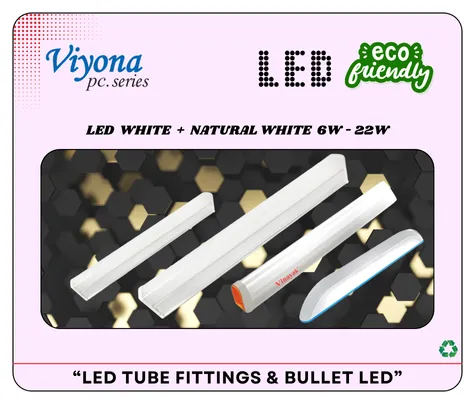
A LED tube fitting is slim enough to sit on the wall above a desk or under a shelf. Our LED tube fittings come in 6W (1051) at ₹160, 12W (1058) at ₹180 and 20W (1059) at ₹200 MRP, the 12W and 20W as PVC T5 fittings. VIYONA LED 1059 is a 20W LED tube fitting with an MRP of ₹200.
An old fluorescent tube with a choke is a poorer choice: it can flicker as the starter wears and hum as the choke ages. Replacing it is covered in our LED bulb vs tube light guide.
Fix the tube parallel to the front edge of the desk, above eye level, so it lights the whole width without shining into your eyes.
Do you need a study table lamp as well as a ceiling light?
Most students benefit from both: a ceiling light that lights the whole room evenly and a study table lamp or wall-mounted desk light that puts concentrated light on the page, because a table lamp alone leaves the room dark and tires the eyes, and a ceiling light alone often leaves the desk too dim or shadowed.
Ceiling light for the room, desk light for the work. A table lamp with an adjustable arm lets you bring light close for reading and push it away for screen work. A shade that hides the bulb from your eyes is the single most important feature.
We do not make table lamps. What we do make is everything around them: the 6A socket the lamp plugs into, the switches, and the ceiling panels and tube fittings for the room.
Plan a socket at desk height when the room is wired, so the lamp cable does not trail across the floor. A switch for the ceiling light within reach of the desk saves a walk to the door.
Pick a table lamp whose bulb you can swap: then you can choose its colour and wattage instead of living with the one inside.
Where should the study light be placed?
A study light should be placed in front of you or on the side opposite your writing hand, on the left for a right-handed person and on the right for a left-handed one, so that your hand does not cast a shadow over the line you are writing, and it should never be directly behind you.
Front or opposite side keeps the page clear of your own shadow. Behind the chair is the worst spot: your head and shoulders block the light exactly where you are looking.
Height matters too. A desk light should sit a little above eye level when seated, angled down onto the work. A ceiling light directly overhead can reflect off glossy pages; slightly in front of the desk is better.
For a desk facing a wall, the wall above it is the natural place for a tube fitting. For a desk facing a window, daylight comes from in front, which is ideal; add the desk light at the side for evenings. Our guide to switch board height from floor helps place the switch and socket for the desk.
How do you avoid glare on books and screens?
To avoid glare while studying, use diffused fittings rather than bare bulbs, keep every light source out of your direct line of sight, position the desk light to the side rather than straight above glossy pages, choose a matte desk surface, and set the screen so no light or window reflects in it.
Diffuser Shaded lamp Matte desk Glossy pages Glass desk top Bare bulb in view
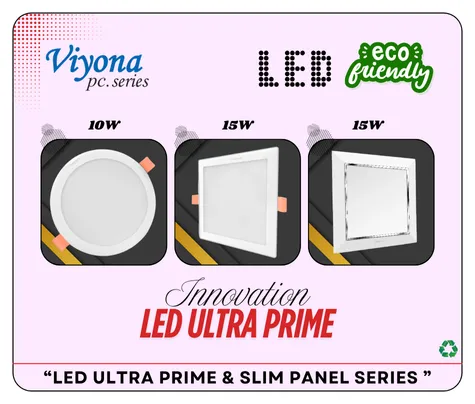
For a ceiling light, a panel with a frosted diffuser spreads light over a wide area and is far gentler than an exposed bulb. Our Ultra Prime and slim panels run from 10W (1021) at ₹300 to 22W (1023) at ₹580 MRP. If you are deciding between a panel and down lights, see panel light vs downlight.
For screens, turn the monitor so the window is to the side, not behind or in front, and keep the room light on so the screen is not the brightest thing in view.
Does LED flicker hurt the eyes while studying?
Visible or near-visible flicker can cause eye strain and headaches over a long study session, and a good LED fitting with a well-made driver gives steady light; you can check a light by pointing a phone camera at it, since rapid flicker often shows up on the screen as moving dark bands.
Flicker usually comes from a poor or failing driver, a dimmer that does not suit the LED, or a loose connection. An old fluorescent tube with a worn starter flickers too.
The phone test is rough but useful. Bands on screen do not prove a light is harmful, and a steady screen does not prove it is perfect, but a light that bands heavily on camera is worth replacing over a desk.
Our guide to why an LED light flickers goes through the causes in order, from a loose holder to a switch in the neutral. If a light glows faintly after switching off, our guide to LED glowing when switched off explains why.
Before opening any fitting to look for a loose wire, switch off the MCB for the circuit and test it dead. A switch alone may not isolate it.
Which of our LED lights suit a study room?
For a study room we make LED tube fittings for the wall above a desk, LED panels and surface lights for the ceiling, and small LED down lights for false ceilings; our catalogue does not print colour temperature for these lines, so check the carton or ask your dealer for neutral or cool white.
Our LED fittings for a study room, by watts (MRP in label)
Watts and MRPs from our current catalogue. Bar length is watts with 22W as the full bar, rounded to the nearest 5%. Watts are power drawn, not light output.
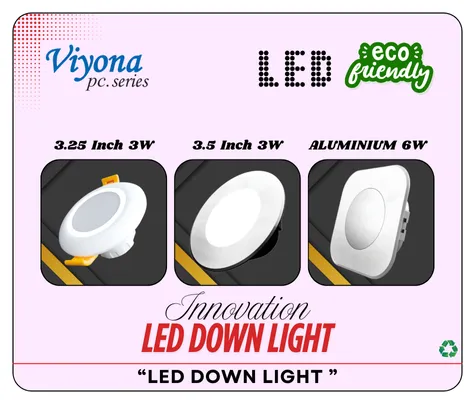
A typical small study might use a 15W panel on the ceiling and a 12W or 20W T5 above the desk. Our LED down lights start at 3W (1010) at ₹100 for a false ceiling.
What about a child’s study corner and night-time study?
For a child’s study corner, use the same rules, neutral white, diffused, no glare, desk light opposite the writing hand, and add a switch the child can reach, a socket placed so cables do not trail, and a separate low night lamp so the main lights are not left on after homework.
Reachable switch A child should be able to switch the desk light on and off without climbing. Socket behind the desk keeps a lamp cable away from feet and chairs. Shutters on sockets in a young child’s room are worth asking for.
For late study, many people switch the room to warmer, dimmer light in the last hour before sleep, keeping the desk light only where it is needed.
After lights out, a 0.5W LED night lamp gives enough light to find the door. Our night lamp guide covers what it costs to leave one on all night.
Plan the study corner before the room is wired: the desk light point, its switch and a socket cost little at that stage and a lot later.
FAQs
Which light is best for study, white or yellow?
Which light is best for eyes while studying?
Is 6500K good for study?
Is a tube light good for study?
Where should a study lamp be placed?
How many watts LED is good for a study table?
Why buyers choose Vinayak Electricals
- LED tube fittings in 6W, 12W, 20W and 40W, from ₹160 MRP, made at our works in Marol, Andheri East, Mumbai.
- LED panels from the 10W Ultra Prime at ₹300 MRP, plus down lights and surface lights for the same ceiling.
- LED down lights and panels registered with BIS to IS 10322 (R-71026476); drivers to IS 15885 (R-71026310).
- Switches and sockets for the desk point, made to IS 3854 under BIS licence CM/L-7567794.
- MRPs published openly; sold through 500+ dealers with delivery across India.
- Manufacturing in Mumbai since 1995; ISO 9001:2015 certified.
LED tube fittings for the desk
See wattages and MRPs for our LED tube fittings, then pair one with a panel for the ceiling. Order through a dealer or call us.
View LED tube fittings