Which Tube Light Is Best for Home, Room by Room
Which tube light is best for home has a short answer: for most Indian rooms, a complete LED tube fitting, usually a slim T5 batten, in the 20W class, with the brightness checked in lumens on the carton. The longer answer depends on the room. Below we compare integrated battens with retrofit tubes, T5 with T8, 20W with 40W, pick a tube for the bedroom, kitchen, bathroom and balcony, and give the MRPs of the LED tube fittings we make in Mumbai.
Key takeaways
- Best for most homes — a complete LED tube fitting (batten), not a loose tube in an old fluorescent holder.
- T5 vs T8 — T5 is about 16 mm thick and slimmer on the wall; T8, about 25 mm, mainly survives as a retrofit size for old battens.
- 20W vs 40W — 20W class for a typical bedroom or kitchen counter; 40W for a large hall, shop or garage.
- Check lumens and colour — watts are power, not brightness; pick warm or neutral white for bedrooms, cooler for work areas.
- Our tube fittings — 6W ₹160, 12W ₹180, 20W ₹200, 40W ₹600 MRP.
Which tube light is best for home: the short answer
For most rooms in an Indian home, the best tube light is a complete LED tube fitting: a slim batten with the LEDs, the driver and the diffuser built in, fixed straight to the wall and wired to the light point. It needs no choke or starter, lights instantly and is the simplest to fit and to replace.
Within that, three choices matter. Wattage, which sets the electricity it uses and roughly how much light it gives. Size, which for most homes means the slim T5 profile. And colour, from warm to cool white, which changes how the room feels but not the bill.
We make LED tube fittings at our works in Marol, Andheri East, Mumbai, in four wattages, all listed in our catalogue as T5. This guide uses them as worked examples. Whether a tube or a bulb suits a room in the first place, and how many units each uses, is answered in our LED bulb vs tube light guide, so here we assume you have decided on a tube.
What is an LED tube light fitting?
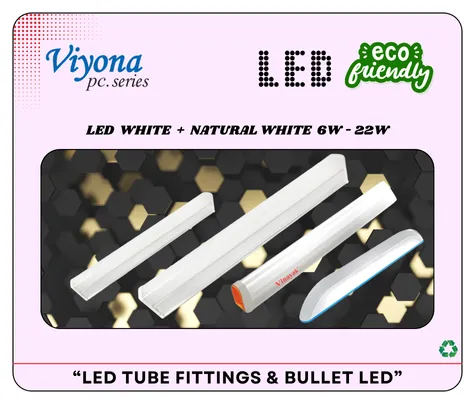
An LED tube light fitting, often called an LED batten, is a complete light in one piece: a long body with LEDs, a driver that converts mains power for them and a diffuser cover, screwed to the wall or ceiling and wired directly to the light point, unlike a retrofit LED tube that slots into an old fluorescent batten.
The two types compared:
Integrated batten One part, factory-wired, nothing to go wrong between tube and holder. The usual choice for a new home or a full replacement. Our LED tube fittings are this type.
Retrofit LED tube A loose tube with pins that fits an old fluorescent batten. Some need the old choke and starter removed or bypassed, as the tube’s maker instructs; it is a job for an electrician, not a quick swap.
Old fluorescent tube Glass tube, choke and starter. Worth replacing; the reasons are in our bulb vs tube guide.
A batten also comes in different bodies. Our catalogue lists the 12W, 20W and 40W fittings as PVC bodies.
If you are replacing an old fluorescent batten anyway, fit a complete LED batten. It costs little more than a retrofit tube and removes the old holder pins.
| Room or use | Starting wattage | Suggested colour | Our fitting | Our MRP |
|---|---|---|---|---|
| Mirror, wardrobe, niche | 6W | Natural white | 1051, 6W T5 | ₹160 |
| Small kitchen, passage, bathroom | 12W | Natural or cool white | 1058, 12W T5 PVC | ₹180 |
| Bedroom | 12W to 20W | Warm or natural white | 1058 or 1059 | ₹180 to ₹200 |
| Kitchen counter, living room wall | 20W | Natural or cool white | 1059, 20W T5 PVC | ₹200 |
| Hall, shop, garage, workshop | 40W | Cool white | 1060, 40W T8 PVC | ₹600 |
Which tube light wattage is right for each room?
As a starting point, a 6W tube suits a mirror, a wardrobe or a small niche, a 12W tube a small kitchen, passage or bathroom, a 20W tube a typical bedroom, living room wall or kitchen counter, and a 40W fitting a large hall, shop, garage or workshop; the lumens printed on the carton are the real test.
Our LED tube fittings by wattage
Wattages from our current catalogue, bars to scale with 40W as the full bar. Watts are power drawn, not light given; our catalogue does not list lumens.
Room size, ceiling height and wall colour all change what you need: a dark wall swallows light, a white one reflects it. Count by job, not by square feet: one general light, plus a task light where you cook, read or dress. Our guide on how many lights in a room goes further.
Brighter is not always better: an over-lit bedroom only adds glare and units.
One complete fitting; no choke, no starter, no loose tube.
About 16 mm thick against about 25 mm for T8.
40W only for halls, shops and garages.
Warm or natural white for bedrooms, cooler for work areas.
T5 vs T8 tube light: what is the difference?
T5 and T8 describe a tube’s diameter in eighths of an inch, so a T5 tube is five-eighths of an inch, about 16 mm, and a T8 is one inch, about 25 mm; for a new LED fitting the difference is mainly looks, as T5 battens sit slimmer, while T8 matters when re-using an old fluorescent batten.
Tube diameter by size name
The number after T is the diameter in eighths of an inch, converted to millimetres; general practice, not a measurement of any product. Bars to scale with 38 mm as the full bar.
T12 is the fat old fluorescent tube, now rare. T8 is the common fluorescent size, so most retrofit LED tubes are T8 to fit those battens. T5 is the slim size, and most integrated LED battens for homes use it.
The T number says nothing about brightness or efficiency on an LED fitting. Compare lumens and watts on the carton instead. All four of our tube fittings are listed as T5.
20W vs 40W tube light: which do you need?
A 20W LED tube fitting is the right size for most single rooms in a home, such as a bedroom, a kitchen counter or a living room wall, while a 40W fitting is for larger spaces like a hall, a shop, a garage or a workshop, where one fitting has to light a wide area or a high ceiling.
The difference in running cost is simple arithmetic: a 20W fitting on for 5 hours a day uses 3 units a month, a 40W fitting 6 units. Our electricity bill calculator guide shows how to turn units into rupees with your own tariff.
Price follows the same pattern in our range: the 20W 1059 is ₹200 MRP and the 40W 1060 is ₹600. Two 20W fittings on opposite walls often light a large room more evenly than one 40W fitting, for less money, because the light comes from two directions.
For a small room, do not over-size. A 40W fitting in a 10 by 10 ft bedroom is harsh. A 12W or 20W fitting, with a warmer colour, suits it better.
Large room, one point? Ask the electrician about adding a second point opposite. Two smaller fittings beat one big one for shadows.
Which tube light is best for a bedroom?
For a bedroom, a 12W or 20W LED tube fitting in warm white or natural white is usually best, fixed on the wall away from the line of sight from the bed, with a separate low-wattage night lamp so the main light is not needed late at night.
Three things decide it: wattage sized to the room, not the biggest on the shelf; warm or natural white rather than a stark cool white; and position, ideally above the wardrobe or on the wall behind your head, not facing the pillow.
The colour choice is explained in our warm white vs cool white guide. A tube on the wall opposite the bed throws glare straight into your eyes every time you look up, so move it if you can.
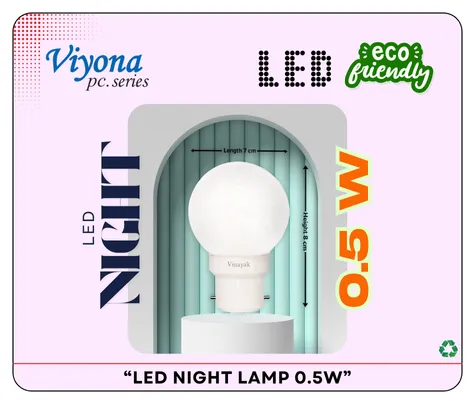
Add a 0.5W night lamp; our LED night lamp 1061 is ₹40 MRP. A ceiling panel instead of a tube is another option in a false ceiling; our panel light vs downlight guide compares them.
Which tube light for a kitchen, bathroom or balcony?
A kitchen is best lit by an LED tube fitted above the counter, not behind you, a bathroom by a small tube or bulb placed clear of the shower and taps, and a balcony by a fitting under the projection or sunshade, with any wet or outdoor point placed and sealed by an electrician.
Kitchen A 20W tube along the counter, under the cabinets or on the wall above, so your own shadow does not fall on the chopping board. A cooler white helps colours read true while cooking. Our guide to kitchen electrical points covers placement.
Bathroom A 12W tube or a bulb above the mirror, away from water. Fittings in a wet area are for the electrician to choose and seal.
Balcony A tube under a sunshade, or a small flood light for a larger terrace. Our catalogue does not list an IP rating for our tube fittings, so do not fit them where rain can reach.
Any light point in a bathroom or open balcony needs proper protection from water. Leave the choice and position to a licensed electrician.
How long is a tube light, and where should it go?
LED tube fittings for homes are commonly made in two lengths, about 2 feet (600 mm) and about 4 feet (1200 mm), with the longer one usual for 18W to 20W fittings; mount the tube above head height and above the task, typically high on the wall or on the ceiling, so it lights the room without dazzling.
Our catalogue does not list lengths for our tube fittings, so measure the wall and ask the dealer for the length of the code before buying. Leave a little clearance at each end for the fixing clips.
Placement rules of thumb from general practice:
Above the work In a kitchen or a shop, the tube goes over the counter, not behind you. Out of the eyeline In a bedroom, not on the wall you face from bed. Along the long wall In a long room, the tube runs parallel to the length. Clear of the fan A tube right above a ceiling fan blade makes the light flicker as the blades pass.
Switch board placement for the light is in our switch board height from floor guide.
What does an LED tube light cost?
Our LED tube fittings cost ₹160 to ₹600 at MRP: the 6W T5 (1051) is ₹160, the 12W T5 PVC (1058) ₹180, the 20W T5 PVC (1059) ₹200 and the 40W T8 PVC (1060) ₹600, which makes the 20W fitting the cheapest per watt at ₹10.
MRP per watt of our LED tube fittings
MRP divided by the wattage in the product name, from our current LED price list. Bars to scale with ₹26.67 as the full bar. Per watt is cost against power, not against light.
The VIYONA 1059 is a 20W LED tube fitting with a PVC body at ₹200 MRP. Per watt is a rough guide only: without lumen figures it does not tell you light per rupee. Compare the lumens on two cartons for that, as our lumens to watts guide explains.
What should you check before buying an LED tube light?
Before buying an LED tube light, check the lumens and watts on the carton, the BIS registration number, the colour temperature in kelvin, the length against the wall, the body material, and the printed MRP, and buy the same model for every tube in a room so the light and colour match.
Lumens The brightness figure; compare it before watts. Watts The bill. BIS R-number LED lighting carries a registration number you can verify in the BIS Care app; our guide to spotting a fake ISI mark shows how. Kelvin About 3000K is warm, 4000K natural, 6500K cool. Length Measure first. MRP Compare a quote with the printed MRP.
Watch for a flicker you can see on a phone camera, or a fitting that hums. A steady driver matters more than a few extra lumens; our guide on why LED lights flicker explains the causes.
Our catalogue lists our tube fittings by wattage and body; it does not give lumens or colour for them, so read the carton.
How is an LED tube light installed?
An LED tube fitting is installed by switching off the MCB, testing the point dead, fixing the clips or base to the wall, connecting the fitting’s phase and neutral leads to the switched phase and neutral at the point in a proper connector, then clipping the fitting in place and testing; anything beyond a like-for-like swap is an electrician’s job.
The connection itself is the same two-wire job as any light: switched phase and neutral, with the switch in the phase. Our bulb holder connection guide explains the rule. Some fittings also have an earth lead; connect it if the point has an earth.
Removing an old fluorescent batten means dealing with its choke and starter. Take the whole old fitting down rather than wiring around it.
Joints go in a connector inside a box or inside the fitting’s terminal cover, never as a taped twist behind the batten.
Switch off the MCB and test the point dead before touching any wire. If the point has no neutral, scorched wiring or aluminium cable, stop and call a licensed electrician.
FAQs
Which tube light is best for home?
Which is better, T5 or T8 tube light?
Is a 20W tube light enough for a room?
How many watts is a tube light for a bedroom?
How many units does a 20W tube light use?
What is the price of your LED tube light?
Why buyers choose Vinayak Electricals
- LED tube fittings made at our works in Marol, Andheri East, Mumbai.
- Four LED tube fittings: 6W, 12W, 20W and 40W, from ₹160 MRP.
- LED lamps, panels, downlights and night lamps in the same catalogue.
- Switches and holders for the same light point, from one supplier.
- MRPs published openly; sold through 500+ dealers with delivery across India.
- Manufacturing in Mumbai since 1995; ISO 9001:2015 certified.
LED tube fittings by wattage
See our LED tube fittings and bullet LEDs with codes and MRPs, then order through a dealer or call us.
View tube fittings