Kitchen Points Plan: Which Socket Goes Where, and Why
Kitchen electrical points decide whether your appliances plug straight into the wall or end up on an extension board beside the gas. Below we go appliance by appliance: the fridge, chimney, gas or induction hob, RO purifier, microwave, OTG and oven, which need 16A and which 6A, where each point usually goes, how many points a kitchen needs, and the MRPs of the sockets and switches we make in Mumbai.
Key takeaways
- Count from appliances — a typical kitchen needs four or more 16A points, two or more 6A, plus chimney, RO, lights and exhaust.
- 16A for heat and motors — microwave, OTG, oven, induction, kettle, dishwasher and commonly the fridge.
- Chimney and RO — light loads on 6A points: the chimney behind its duct cover, the RO beside it, never under the sink.
- Counter sockets — commonly 1,050–1,200 mm from the floor, never behind the hob or over the sink.
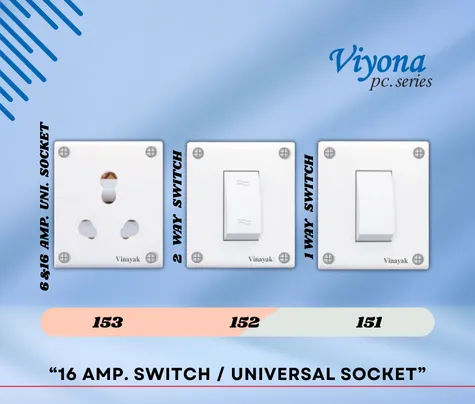
- Our parts — VIYONA 153 universal socket ₹90, VIZA V263 16A ₹160, KEMPS K147 20AX switch ₹120 MRP.
Kitchen electrical points: the short answer
Kitchen electrical points are the sockets, switched points and light points planned around a kitchen’s appliances: a fridge point, a chimney point, a hob or induction point, an RO water purifier point, sockets above the counter for the microwave, mixer and kettle, plus lights and an exhaust fan. Heating and motor loads take 16A points; small appliances can use 6A.
The kitchen is the busiest room in an Indian home for electricity. It holds more heavy appliances than any other room, it has water and a gas flame within a metre of the sockets, and once the modular cabinets and tiles go in, every point is fixed. A point that is missing or in the wrong place usually ends as an extension board on the counter.
So plan the kitchen from the appliance list, not from the number of boards. This guide goes appliance by appliance: which socket each one needs, where it usually goes, and what we make for it at our works in Marol, Andheri East, Mumbai. Any wiring is a job for a licensed electrician, with the MCB switched off and the circuit tested dead first.
How many electrical points does a kitchen need?
A typical Indian kitchen needs around nine to twelve points: four or more 16A sockets for heavy appliances, two or more 6A sockets for small ones, separate points for the chimney and RO, two light points and an exhaust fan point, with the exact count set by your own appliance list and counter length.
Our house electrical layout plan works through a 2BHK and gives its kitchen the figures in the chart below. Treat them as a starting plan, not a rule.
Kitchen points in our worked 2BHK layout
From the worked 2BHK in our house electrical layout guide: a starting plan, not a rule. Chimney and RO points are in addition, and an oven or dishwasher adds more.
Add a point for each appliance you own plus one spare. A built-in oven, dishwasher or instant water heater each adds one more heavy point. Counting now is free; adding later means cutting tile.
| Appliance | Point | Where it usually goes | Note |
|---|---|---|---|
| Fridge | 16A socket, commonly | Beside the fridge, reachable | No extension board |
| Chimney | 6A socket | High, behind the duct cover | Position from the model sheet |
| Gas hob, mains ignition | 6A socket | Cabinet below the counter | Away from gas pipe |
| Induction hob | 16A, often own circuit | Counter or cabinet below | Sized from rating plate |
| RO purifier | 6A socket | Beside the purifier | Not under the sink |
| Microwave or OTG | 16A socket | Above the backsplash | One socket each |
| Built-in oven | 16A or own circuit | Cabinet beside the niche | Follow the manual |
| Mixer, chargers | 6A or universal socket | Counter boards | Spare socket for later |
Which kitchen appliances need a 16A socket?
Kitchen appliances that heat or run a motor under load need a 16A socket: the microwave, OTG, built-in oven, induction hob, electric kettle, dishwasher, an instant water heater and, in many homes, the fridge, while the RO purifier, chimney, mixer at the counter and phone chargers commonly run from 6A points.
The reason is current. A 6A socket at 230 V carries about 1,380 W; a 16A socket about 3,680 W. An induction cooktop typically draws 1,200 to 2,000 W and a microwave 800 to 1,500 W, so both sit at or beyond what a 6A point is built for.
What a socket carries vs what kitchen appliances draw
Socket figures are rating × 230 V. Appliance figures are the top of the typical ranges in our appliance power consumption chart, not tests; your rating plate is the real figure.
Our 6A vs 16A socket guide covers the rule for every room, and our appliance power consumption chart lists typical watts. A universal 6 & 16A socket takes both plug sizes, which suits a counter where appliances move.
Never run a microwave, induction hob or kettle from a 6A socket through an adaptor or a multi plug. The plug and socket overheat even when nothing trips.
List every appliance first, then add one spare point.
Microwave, oven, induction and kettle need 16A points.
No socket under the sink or below the RO outlets.
No socket or cord behind or over the hob.
What is the right kitchen socket height?
Kitchen counter sockets are commonly fixed 1,050 to 1,200 mm from the finished floor, just above the backsplash of a counter that is usually 850 to 900 mm high, so plugs sit clear of the counter top, spills and the tile line, with fridge and appliance-specific points placed to suit each appliance.
The full set of heights, for the fridge, washing machine, geyser and every other room, is in our switch board height from floor guide; we do not repeat it here. Three kitchen-specific rules matter more than the exact millimetre:
Above the backsplash line Not behind the hob Not over or under the sink
Plan the height with your kitchen designer, because tall units, wall cabinets and the chimney hood all decide where a box can go. A box set in the wall before the cabinet drawing is final is the most common kitchen mistake we hear about.
Mark each counter socket on the cabinet drawing with its rating, 6A or 16A, and the appliance it serves. The electrician and carpenter then work from the same sheet.
Where should the chimney point go?
The chimney point is commonly placed high on the wall above the hood, where the chimney’s duct cover hides it, close enough for the chimney’s own cord to reach without a joint, with its exact position taken from the chimney’s installation sheet before the wall is tiled and the cabinets are fixed.
A chimney’s motor and lamps are a light load, so a 6A socket is common practice, though a universal socket also works. Plan for:
Hidden behind the duct cover Within cord reach Not directly over the flame
Most chimneys are switched from their own buttons, so the wall point can stay on. Some homeowners add a switch at the counter board; ask your electrician. If the chimney is not bought yet, ask the dealer for the model’s installation height first, because hood height changes with the hob and the cook’s height.
Our switch board design ideas show kitchen boards in photographs, with the chimney switch near the counter board.
A chimney point placed before the model is chosen often ends up visible above the hood or out of the cord’s reach. Fix the model first, then the point.
Which point does a hob need: gas or induction?
A gas hob with mains auto-ignition needs a 6A socket, usually inside the cabinet below the counter, while a battery-ignition gas hob needs no point at all, and an induction or electric hob needs a 16A point, commonly on its own circuit, sized by your electrician from the rating plate.
Gas hob, mains ignition Small load; a 6A socket in the cabinet below, away from the gas pipe and regulator, reachable by opening the shutter.
Gas hob, battery ignition No point needed.
Induction hob, plug-in A 16A socket on the counter or below it, never through a multi plug.
Built-in induction or electric hob Many are wired to a fixed connection rather than a plug; follow the manual and have an electrician fix the circuit and MCB rating.
Check what you are buying before the electrician lays conduit. A kitchen planned for a gas hob that later gets a two-zone induction hob needs a new circuit, which means chasing the wall. Our guide to wire size for AC and geyser covers how heavy circuits are sized.
Keep sockets and wiring away from the gas pipe, regulator and cylinder. Never run an electrical cord across a burner.
Where should the RO water purifier point go?
The RO point is commonly a 6A socket placed beside or just above where the purifier hangs on the wall, to one side of the sink rather than directly over or under it, so that a leak or overflow from the purifier or the tap cannot run onto the plug or into the socket.
An RO purifier is a light load, so a 6A socket is enough. Placement is about water:
Beside the purifier Not under the sink Not below the RO’s outlets Shutter on low sockets
If the purifier sits under the counter, put the socket high in that cabinet and clear of the drain and inlet pipes. A switched socket lets you turn the purifier off for filter changes without pulling the plug.
Our VIYONA 6A 3 pin socket (119) is ₹40 MRP; for a modular board, KEMPS K192 is a 6AX 3 pin socket with shutter at ₹110. Our guide to socket shutters explains why a low socket benefits from one.
If the RO or tap leaks onto a socket, switch off at the MCB before touching anything, and have an electrician check the point before it is used again.
Microwave, OTG and built-in oven: which point?
A countertop microwave or OTG needs a 16A socket at counter height, ideally one for each, and a built-in oven or microwave in a tall unit needs a 16A point placed in the cabinet beside or below its niche, where the plug can be reached after installation, with an oven’s circuit sized from its manual.
Countertop microwave A 16A socket above the backsplash, close to where it will sit.
OTG Another 16A point; ovens and microwaves are often used together.
Built-in oven Follow the manual; many need a dedicated circuit.
A built-in appliance plugged in behind its own niche cannot be switched off without pulling the unit out. A switch beside the socket, in a reachable cabinet, solves it; KEMPS K147 is a 20AX 1 way switch at ₹120 MRP.
Do not plan two heavy appliances on one socket through a twin adaptor. Our guide on whether you can use an extension board for a fridge explains why heavy appliances need fixed sockets.
Ask the carpenter for the oven and microwave niche sizes before the electrician fixes the box. A box hidden behind the appliance is the hardest point to reach later.
Where should the fridge socket go?
The fridge socket is commonly a 16A point fixed beside the fridge at about the height of the room’s switch board, not hidden behind it, so the plug can be reached without pulling the fridge out, with the fridge on a fixed wall socket rather than an extension board.
Three things to plan: beside, not behind, 16A commonly and space for a stabilizer if you use one. Whether a modern fridge needs a stabilizer is covered in our voltage stabilizer for AC and fridge guide.
A fridge runs day and night, so its plug and socket carry current for longer than anything else in the kitchen. A loose fit there warms over months. A firm-gripping socket is worth more than a decorative one.
We make 16A sockets in every range: VIZA V263 with a porcelain base at ₹160, the VIYONA 153 universal socket with shutter at ₹90, and KEMPS K193 at ₹205 MRP, all on our VIYONA 16 amp range and series pages.
A fridge plug that is brown, soft or warm means the socket contact is loose. Switch off at the MCB and have the socket replaced.
How many circuits and MCBs does a kitchen need?
A kitchen commonly has its own socket circuit or two, separate from the lights, with each very heavy appliance such as a built-in oven or a large induction hob on a circuit and MCB of its own, so a fault or overload on one does not take out the fridge, and the electrician sizes each MCB to its cable.
The pattern most electricians follow: lights on a lighting circuit, counter sockets on a kitchen circuit, oven or induction on its own, and an RCCB upstream for earth leakage.
The MCB rating follows the cable, not the appliance’s hopes. Our which MCB for home guide sets out ratings circuit by circuit. VIYONA 401 is a single pole 10 kA MCB from 6A to 32A at ₹145 MRP. We do not make RCCBs.
If the main MCB trips when the kettle and microwave run together, the circuit is overloaded. Our guide to an MCB tripping again and again sorts trips by pattern.
Ask for one spare way in the DB for the kitchen. A future dishwasher or oven then needs only a new cable and MCB, not a new board.
Which sockets and switches suit a kitchen board?
A kitchen board suits 16A or universal 6 and 16A sockets for heavy appliances, shuttered 6A sockets for small ones, and 20A switches beside heavy sockets so each appliance can be switched off at the wall, in a plate finish that wipes clean easily near the counter.
MRP of kitchen sockets and switches we make
MRPs from our current catalogue, bars to scale with ₹245 as the full bar. The 153, K193 and K594 are universal sockets with shutters.
For conventional boards, the VIYONA 5 in 1 switch socket combined (161) is ₹250 MRP. For finishes, our modular plate finishes guide notes that a deep texture beside the hob holds grease, and glossy faces show every fingerprint.
Our universal socket guide compares the 3 in 1 and 5 in 1 units. Every one of these parts is made at our Mumbai works.
Kitchen electrical mistakes to avoid
The most common kitchen electrical mistakes are too few 16A points, sockets placed behind the fridge or appliances, sockets over the hob or under the sink, a chimney point fixed before the model is chosen, heavy appliances on extension boards, and no spare way left in the DB for the next appliance.
Each is cheap to avoid on paper and costly to fix in tile:
Socket behind the hob Socket under the sink Extension board on the counter Fridge plug unreachable No spare 16A point Chimney point visible
If you are taking possession of a new flat, our electrical checklist for a new flat turns these into a walk-through. For bathrooms, the other wet room, see our guide to bathroom electrical points.
Plates and switches near the stove collect grease. Clean them with the power off; our how to clean switch plates guide covers each finish.
If a kitchen socket sparks, smells of burning or a plug turns brown, stop using it, switch off at the MCB and call a licensed electrician.
FAQs
How many electrical points are needed in a kitchen?
What is the standard kitchen socket height?
Does a chimney need a 16A socket?
Which socket is used for a microwave?
Where should the RO socket be placed?
Does a gas hob need an electrical point?
Why buyers choose Vinayak Electricals
- 16A, universal and shuttered sockets made at our own works in Marol, Andheri East, Mumbai.
- Switches to IS 3854 under licence CM/L-7567794, including 20AX and 32A DP switches.
- Universal sockets from ₹90 (VIYONA 153) to ₹245 (KEMPS K594) MRP.
- 10 kA VIYONA MCBs to IS/IEC 60898-1 for each kitchen circuit, from ₹145.
- MRPs published openly; 500+ dealers and delivery across India.
- Manufacturing since 1995; ISO 9001:2015 certified.
16A and universal sockets for every counter
See our VIYONA 16A switches and universal sockets with codes and MRPs, then order through a dealer or call us.
View 16A sockets