Shop Electrical Points: Wiring a Shop or Showroom, Zone by Zone
Shop electrical points have to handle long hours, a busy counter and a clean switch-off at night. Below we plan a retail shop or showroom point by point: the point count, shop wiring layout, MCB box, showroom switch board, billing counter, lights, signboard, heavy loads and night isolation, with MRPs of the parts we make in Mumbai.
Key takeaways
- Point count — about fifteen to twenty points for a 10 by 20 ft shop; more for a showroom.
- Layout — zones for front, display, counter and storeroom, each on its own switches and circuits.
- Board — a 6 to 8 way SPN MCB box (VIYONA 372, ₹480) with spare ways; TPN for three phase.
- Heavy loads — AC, chiller and cooler on 16A points and their own MCBs.
- Night — one isolator turns the shop off; CCTV, router and fridge stay on their own circuits.
Shop electrical points: the short answer
Shop electrical points are the lights, sockets, appliance points and boards that a shop or showroom needs: display and general lights switched by zone, sockets at the billing counter, 16A points for an AC, display fridge or water cooler, a signboard point, data and CCTV points, and a distribution board with an MCB for each circuit.
A shop is wired differently from a home because of how it is used. Everything comes on when the shutter goes up and almost everything goes off when it comes down. The lights run ten or twelve hours a day. The counter holds a billing machine, a printer, a router and a row of chargers. A chiller or a CCTV recorder must stay on overnight while the rest is off.
This guide plans a typical retail shop or small showroom point by point: how many points, the wiring layout, the MCB box, the showroom switch board, counter, lighting, signage, heavy loads and night shutdown, with the MRPs of the parts we make at our works in Marol, Andheri East, Mumbai. Shop wiring is a job for a licensed electrician, with the MCB switched off and the circuit tested dead first.
How many electrical points does a shop need?
A small shop of around 10 by 20 feet commonly needs fifteen to twenty points: six to eight light points, four to six 6A sockets, two 16A points, an AC point, a signboard point, and data and CCTV points at the counter, with a larger showroom scaling the lights and sockets with its display area.
A starting point list for a 10 by 20 ft shop
General practice for a small retail shop, not a rule or a test result. Bars show the upper figure; the trade and the fit-out decide the real count.
The trade changes the list. A garment shop needs more display lights and a trial room point; a mobile shop needs many more sockets at the counter; a food or dairy shop needs 16A points for chillers. Our electrical load calculation guide adds up the load once the list is ready.
| Point | Where | Usual type | Our example (MRP) |
|---|---|---|---|
| Distribution board | Beside or behind the counter | SPN box, 6 to 8 way | VIYONA 372, ₹480 |
| Showroom switch board | At the counter | Switches by zone, 12M plate | VIZA V398 plate, ₹299 |
| Counter sockets | Under or behind the counter | 6A with shutter | KEMPS K192, ₹110 |
| Data point | Billing counter | RJ45 jack | VIZA V1256, ₹189 |
| Heavy load point | Chiller, cooler, AC | 16A socket, own MCB | VIZA V263, ₹160 |
| Night isolation | At the board | Double pole isolator | VIYONA 442, ₹230 |
| Shelf lighting | Along display shelves | T5 LED tube fitting | VIYONA 1059 20W, ₹200 |
What is a good shop wiring layout?
A good shop wiring layout divides the shop into zones, the front and signboard, the display area, the billing counter and the back or storeroom, gives each zone its own circuits from one distribution board near the counter, and keeps the overnight loads such as the fridge and CCTV on circuits separate from the lights.
The usual zones: front and signage, display, counter and storeroom. Lights in each zone go on separate switches so the storeroom light is not on all day. The distribution board sits where the owner can reach it, usually behind or beside the counter, never behind stock.
Check the supply first: most small shops are single phase, but a showroom with several ACs may need three phase. Our single phase vs three phase guide explains the choice. Conduit runs should be straight and noted on a drawing, because display fixtures are drilled and changed often.
Ask the shopfitter for the display and counter drawing before wiring. Points placed before the fixtures are fixed usually end up behind a shelf.
Front, display, counter and storeroom switched apart.
Enough fixed sockets that no spike guard is chained.
Heavy and overnight loads on their own circuits.
One move turns off the shop; CCTV and fridge stay on.
Which MCB box does a shop need?
A small single phase shop commonly needs an SPN MCB box with six to eight ways: a double pole incomer, separate MCBs for lights, sockets, the AC, the fridge or chiller, the signboard and the counter, and one or two spare ways, while a three phase showroom needs a TPN board sized by the electrician.
MRP of VIYONA MCB boxes for shops
MRPs from our current VIYONA price list, bars to scale with ₹2,620 as the full bar.
VIYONA 411 is a double pole 10 kA MCB, 6A to 32A, at ₹350 MRP, and the single pole 401 ₹145. An RCCB is common practice for a shop; we do not make RCCBs. Box sizes are in our MCB box size list and the SPN or TPN choice in SPN vs TPN distribution board.
What should a showroom switch board carry?
A showroom switch board commonly carries one switch per lighting zone, a switch for the signboard, an indicator for any point that must be seen to be on, and one socket, fixed near the counter where the owner stands, so the whole shop can be lit or darkened from one place at opening and closing time.
Group the switches by zone and label them: front, display left, display right, counter, signboard, storeroom. A 12M plate usually fits; VIZA ROYAL V398 is a 12M plate at ₹299 MRP, a plain finish that suits a busy shop wall.
Light switches are 10AX as at home. Where a display chiller or water heater is switched at the board, use a 20A switch with indicator such as VIZA V1248 (₹160) so staff can see it is live. Switch ratings are explained in our switch and socket ratings guide.
Which points does a billing counter need?
A billing counter commonly needs four to six 6A sockets for the billing machine, receipt printer, router, CCTV recorder and phone chargers, a USB charger for staff phones, an RJ45 data point for a wired billing system, and enough spare sockets that no spike guard is chained under the counter.
Count the plugs: billing PC or POS, receipt printer, card machine charger, router, CCTV recorder. KEMPS K192, a 6A 3 pin socket with shutter, is ₹110 MRP; the VIZA V305 USB charger, 2 A, is ₹650; VIZA V1256, an RJ45 one line jack, ₹189.
Put the counter sockets on a socket circuit of their own, and the router and CCTV on a circuit that stays on overnight. Our USB socket for switch board guide covers the neutral a USB module needs.
A chain of spike guards under the counter is a common fire risk in shops. Fit enough fixed sockets, and never plug one spike guard into another.
Which lights suit a shop?
Shops are commonly lit with LED panels or surface lights for general light across the floor, T5 tube fittings or panels along shelves, and focused lights on key displays, all switched by zone, with the wattage and colour chosen for the goods on show rather than for the room’s size alone.
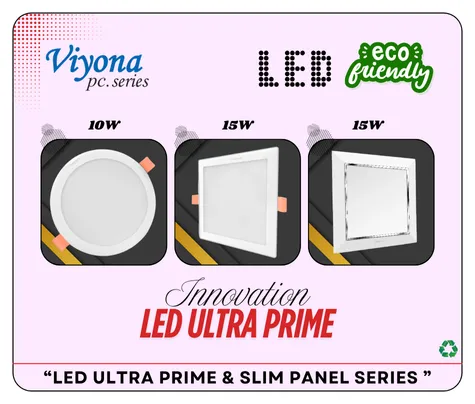
From our range: the Ultra Prime 22W panel (1023) is ₹580 MRP and the 15W (1022) ₹400; the 20W T5 LED tube fitting (1059) is ₹200; the 20W surface LED light (1008) is ₹600. See the Ultra Prime and slim panel range.
Which fitting, wattage and colour suits each kind of shop is the subject of our LED lights for shop guide, so we do not repeat it here. For the wiring, the key point is zones on separate switches and LED, not old tubes: a shop’s lights run all day, so running cost adds up fast.
Where does the signboard point go?
The signboard point goes on the wall or soffit just behind where the sign will be fixed, fed by its own circuit or a clearly labelled switch inside the shop with an indicator, so the sign can be switched on at dusk and off at closing, and with every outside joint in a weatherproof junction box.
A sign is outdoors, often on a high fascia exposed to rain. Feed it from a switch inside with an indicator: KEMPS K217, a 6A red indicator module, is ₹95 MRP. Our catalogue lists no timers or photocells; if you want the sign on a timer, buy it from a brand that makes one.
An outside shutter light or a small flood light over the entrance works the same way. Our Ultra Prime 10W flood light (1080) is ₹490 MRP; aiming and fixing are covered in how to install LED flood light.
Signboard wiring is high, outdoors and often on a ladder. Switch off at the MCB, prove dead, and leave it to a licensed electrician.
Which shop loads need a 16A point or their own MCB?
Shop loads that heat or run a motor need a 16A point and, for the larger ones, their own MCB: the AC, a display fridge or chiller, a water cooler, a deep freezer, a tea kettle or an induction plate in the back, and any heavy machine the trade uses, such as a sewing or packing machine.
Give each heavy load a 16A socket with a switch beside it. VIZA V263, a 16A socket on a porcelain base, is ₹160 MRP; KEMPS K193, a 6A and 16AX universal socket with shutter, is ₹205. The AC and chiller go on circuits of their own.
Where a separate MCB is wanted at the point itself, a modular breaker fits the switch board: KEMPS K225, a Tiny Trip single pole MCB from 10A to 32A, is ₹295 MRP and VIZA V1301, 6A to 32A, ₹281. Our MCB in switch board guide explains when that makes sense, and MCB for AC the AC circuit.
How should a shop be switched off at night?
A shop is best wired so that one main switch or a few clearly labelled MCBs turn off the lights, sockets and AC at closing time, while the fridge, chiller, CCTV and router stay on their own circuits, so the owner can shut the shop safely without unplugging anything or leaving everything live.
Plan two groups at the board: off at night for lights, display and counter sockets, the AC and signage, and on at night for the chiller, CCTV, router and any alarm. A double pole isolator on the night-off group cuts it in one move; VIYONA 442, a 40A double pole isolator, is ₹230 MRP.
An isolator only switches; the MCBs below it still protect each circuit. Our isolator vs MCB guide explains the difference. Label both groups in the board so a new staff member can close the shop correctly.
Shop electrical mistakes to avoid
The most common shop electrical mistakes are all lights on one switch, the distribution board behind stock, too few sockets at the counter, spike guards chained under it, a chiller or AC on the socket circuit, a signboard switched from outside, and no way to switch the shop off at night while the CCTV stays on.
Each costs money every day the shop is open: one switch for all lights DB behind stock chained spike guards chiller on socket circuit sign switched outside no night circuit.
Opening a shop that sells electrical goods yourself? Our electrical shop business guide covers stock and costs. For a clinic, office or rented unit, our modular switches for office guide covers buzzers, call bells and surface gang boxes.
If a socket, MCB or board in the shop gets hot, smells of burning or trips repeatedly, switch off and call a licensed electrician before reopening.
FAQs
How many electrical points are needed in a small shop?
Which MCB box is best for a small shop?
Should the shop signboard be on a separate switch?
How do I switch off my shop at night but keep CCTV on?
Does a display fridge need a separate socket?
Can I put an MCB in the shop switch board?
Why buyers choose Vinayak Electricals
- MCB boxes, MCBs, isolators, switches, sockets and LED fittings for a whole shop, from one Mumbai maker.
- VIYONA SPN MCB boxes from ₹380 MRP and 10 kA MCBs from ₹145.
- KEMPS and VIZA Tiny Trip modular MCBs for the switch board, from ₹281 MRP.
- LED panels, T5 tube fittings and surface lights for display and general light.
- Codes and MRPs published openly; sold through 500+ dealers with delivery across India.
- Manufacturing at Marol, Andheri East, Mumbai since 1995; ISO 9001:2015 certified.
Wire your shop with one supplier
See VIYONA MCBs, isolators and MCB boxes with codes and MRPs, then order through a dealer or call us.
View MCBs and MCB boxes