Restaurant Electrical Points: Circuits, Sockets and Lighting by Zone
Restaurant electrical points start from the equipment list: every oven, fryer, dishwasher and cold room gets its own circuit and MCB, heavy machines usually need three-phase, and the kitchen, wash area, billing counter and dining room are wired as separate zones. Below we work through a café and restaurant electrical layout with real kilowatt figures from makers’ spec sheets, the wire and MCB sizes they need, socket placement on the line, lighting by zone, the board, and the emergency lights.
Key takeaways
- Load first — list every machine’s kW; a 6-tray combi oven can be 11.8 kW and a 10-litre fryer 9 kW.
- Three-phase — a 9 kW fryer draws 39 A on single-phase but about 12.5 A per phase on three-phase.
- Own circuit — ovens, fryers, hobs, dishwasher and cold room each on a dedicated MCB sized to its wire.
- Zones — RCCB on every kitchen circuit, 30 mA for prep and wash; UPS for billing; separate lighting for kitchen and dining.
- ⚠ Exits — emergency lights at every exit and over the DB; requirements come from your fire NOC.
Restaurant electrical points: the short answer
Restaurant electrical points are planned from the equipment list, not from the floor plan. Every heavy cooking machine, the dishwasher and each cold room gets its own circuit and MCB, big fryers and ovens usually need three-phase, and kitchen, wash area, billing counter and dining room are wired as separate zones.
The rest of this page shows the numbers behind that paragraph.
To be clear about our part: we do not make ovens, fryers, dishwashers, RCCBs or emergency lights. We make the MCBs, distribution boards, DP switches, sockets and LED fittings that carry the power to them, at our works in Marol, Andheri East, Mumbai. If you are wiring a home kitchen instead, our kitchen electrical points guide is the one you want; a retail counter is covered in shop electrical points.
Start with the equipment list, not the socket count
Before anyone marks a point on a wall, list every machine the menu needs with its rated power from the spec sheet. A few machines carry most of the load and decide the supply, board and wire sizes.
Rated power of example commercial kitchen machines
Maximum ratings from makers’ published spec sheets (Electrolux SkyLine 6GN1/1, a GGM 10-litre countertop fryer, Washtech UD-R and XU); sources listed with this page. Your own machines’ rating plates are the figures that count. Bars to scale against 11.8 kW.
Look at the top two. A six-tray electric combi oven from one major maker is rated 11.8 kW maximum on a 380–415 V three-phase supply. A 10-litre countertop fryer is 9 kW, also three-phase. The two undercounter dishwashers we looked at are rated 3.37 kW and 5.37 kW on single-phase (one model also comes in 2.87 kW), depending on the booster heater.
Turn kilowatts into amps and the problem is obvious. On single-phase, 9,000 W ÷ 230 V = 39 A for the fryer alone, more than a 32 A MCB can carry. On three-phase the same fryer draws about 12.5–13 A per phase (9,000 ÷ (1.732 × 415–400 V)).
Ask the equipment supplier for the spec sheet before the electrician quotes. A quote written without the kW list is a guess.
| Zone | Points | Circuit | Protection |
|---|---|---|---|
| Cooking line | Combi oven, fryer, electric tandoor (if three-phase) | Dedicated, three-phase | 3 or 4-pole MCB sized to the machine, isolator at machine, + RCCB |
| Cooking line | Induction hob | Dedicated, single-phase | MCB sized to wire, DP switch, + RCCB |
| Prep counter | 16 A sockets for mixers and grinders | Shared socket circuit | MCB on 2.5 sq mm, 30 mA RCCB |
| Wash area | Dishwasher, hot water | Dedicated each | MCB to maker’s rating, 30 mA RCCB |
| Cold store | Cold room, freezers | Dedicated each | Own MCB, kept off the wash RCCB |
| Exhaust | Hood fan | Dedicated | MCB, switch outside the hood |
| Billing counter | POS, printer, router, card machine | Own circuit via UPS | MCB |
| Dining | Lights, fans or AC, a few sockets | Lighting zones plus sockets | MCB per circuit |
| Exits | Emergency lights, exit signs | Own circuit | MCB, as the fire NOC requires |
Does a café need three-phase supply?
A café with an espresso machine, a microwave and a few fridges can often run on single-phase. Once a combi oven, electric fryer or pizza oven rated in double-digit kilowatts arrives, three-phase is the normal answer: those machines are built for it.
In Mumbai the supply comes from BEST, Adani Electricity, Tata Power or, in Mulund and Bhandup, MSEDCL. Your utility sets when a connection has to be three-phase and what sanctioned load you can draw. Apply for the load your equipment list adds up to, with margin for the next oven. Our single-phase vs three-phase guide explains the connection itself.
Café floor plan with its circuits
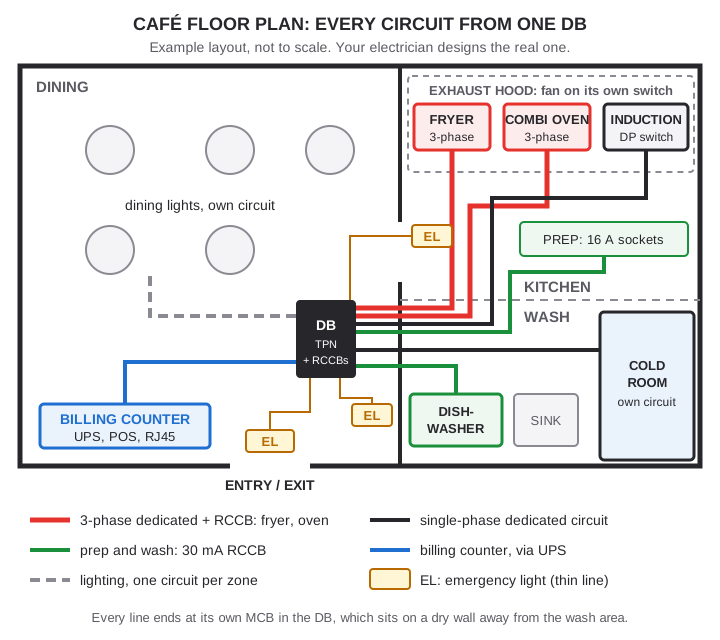
Drawn by us, simplified and not to scale. Neutral and earth conductors, kitchen lighting and the exhaust fan circuit are left out for clarity. The board sits on a dry wall, away from the wash area. A licensed electrician designs the real layout.
On three-phase, share the single-phase circuits across the three phases so that no one phase carries most of the load; your electrician balances them on the board.
A three-phase machine must never be “converted” to run off one phase by a shop-floor jugaad. Use the connection the maker specifies.
Copy every machine’s rating from its spec sheet before planning a point.
Double-digit-kW ovens and fryers are built for it and draw less per phase.
A fault trips only that machine; the cold room keeps running.
Bright, even kitchen light; warm, dimmable dining light; emergency lights at exits.
Which restaurant equipment needs its own circuit?
Every machine that heats, washes or keeps food cold gets a dedicated circuit with its own MCB: combi oven, fryer, each hob, dishwasher, cold room, large freezers, bain-marie and water heater.
A fault then trips only that machine, and each cable is sized for one load.
The MCB protects the wire, so the MCB rating must not exceed what the wire can carry. Under IS/IEC 60898-1 an MCB carries its rated current continuously; it trips on a sustained overload above that rating (the thermal part) or on a short circuit (the magnetic part). A three-phase machine needs a 3-pole (or 4-pole) MCB sized to the machine’s rating and matched to its cable; your electrician picks it from the spec sheet. Our VIYONA 422 40 A three-pole MCB (MRP ₹655) and 432 40 A four-pole (MRP ₹855) are for the incomer or kitchen sub-main on cable rated for 40 A, never for a single machine circuit. 3-pole vs 4-pole MCB explains the difference.
The cooking line needs earth-leakage protection too: a 4-pole RCCB on the three-phase group or at the incomer, rated in mA as your electrician advises (heating elements leak a little, so it may be 30 mA per machine or 100 mA for the group). Every kitchen circuit should sit behind an RCCB.
Compressors and ovens can have a high switch-on current; our B curve vs C curve guide shows which trip curve suits them.
Wire size and MCB rating for each kitchen circuit
Once each machine has a current figure, the cable is chosen to carry it and the MCB is chosen so it never lets through more than that cable can take.
Common Indian practice: copper wire size and the MCB it pairs with
Common Indian practice for copper wire; bars to scale against 25 A. Long runs and hot, bunched cables change the answer, so your electrician sizes each run.
The smaller dishwasher above, at 3.37 kW, draws about 14.7 A at 230 V; its maker specifies a 15 A circuit (in India, a 16 A MCB on 2.5 sq mm wire; the heater runs near that limit, so keep this machine alone on its circuit). The larger one at 5.37 kW draws about 23 A and its maker lists a 25 A circuit: a heavier cable, not a 16 A socket. Never put a 16 A socket on a 20 A MCB with 1.5 sq mm wire: the wire overheats long before the MCB trips.
A commercial kitchen ceiling is hot and greasy, so ask for FR or FRLS wire in conduit, never bare single-core wire clipped to the wall. Our MCB size calculation page has the formula with more examples.
We do not make wire. The VIYONA copper FR PVC wire we sell under IS 694 is made for us by a partner.
Sockets on the kitchen line and prep counter
Above the prep counter you need sockets for mixers, grinders, a toaster and the order phone. Use 16 A sockets here: commercial mixers and grinders draw more than domestic ones, and a 6 A socket loaded with a heater overheats. Our 6A vs 16A socket guide explains the difference.
From our catalogue: the VIZA V263 16 A socket with porcelain base is MRP ₹160, the VIZA V264 16 A PC socket MRP ₹150, and the conventional VIYONA 153 6 and 16 A universal socket with shutter MRP ₹90.
Place them above the worktop, well clear of the sink, the dishwasher spray and the fryer splash zone. Put the prep sockets and the wash area on a 30 mA RCCB group, because wet hands, steel tables and water are a shock risk. We do not make RCCBs; any BIS-marked RCCB of the right rating does the job.
Fixed heavy machines are better hard-wired through a DP switch or isolator than plugged in. One dishwasher maker asks for the isolating switch within 1 m of the machine and not directly behind it.
Isolating each machine: DP switches and isolators
Every hard-wired machine needs a local switch for cleaning or service that cuts phase and neutral. For single-phase machines a 32 A DP switch does this: our VIYONA 176 concealed DP switch is MRP ₹205, and on a modular board the KEMPS K116 32AX DP switch with indicator is MRP ₹360 in white.
For three-phase machines use a three- or four-pole isolator near the machine. Our VIYONA 452 40 A three-pole isolator is MRP ₹370 and the 461 40 A four-pole MRP ₹480.
An isolator is a switch with no overload or short-circuit trip, so it never replaces the MCB. Our isolator vs MCB and DP switch pages go into the detail.
Mount isolators where the cook can reach them without leaning over a hot surface or a fryer.
Exhaust, cold room and refrigeration
The exhaust hood fan runs for every hour the kitchen cooks, often in grease, heat and steam. Give it its own circuit and a switch at the kitchen entrance or on the wall beside the line, so it can be switched on before the burners and off after the last pan. Keep switches and sockets out of the hood itself.
The cold room, each large freezer and the under-counter chillers run day and night. A trip at 2 a.m. can mean a morning of thrown-away stock, so put each on its own MCB and keep them off the RCCB group that serves the wash area, so a dishwasher fault does not switch off the cold room as well. Refrigeration still needs to be earthed and protected; your electrician decides how.
Never run a fridge, freezer or chiller on an extension board; our page on extension boards for fridges explains why. For low voltage, see voltage stabilisers.
Label the cold room MCB clearly on the board. A night cleaner who switches off “the one that looks spare” can cost more than the whole board did.
Lighting a restaurant by zone
The kitchen wants bright, even light that shows food in its true colour; the hotels and restaurants table of the European indoor lighting standard EN 12464-1 (2011 edition) lists 500 lux for kitchens with a colour rendering index of Ra 80. The dining room wants lower, warmer, dimmable light that sets a mood. That is why each zone gets its own lighting circuit.
From our VIYONA LED range, for the kitchen: the 1059 T5 LED tube fitting 20 W is MRP ₹200, and the 1023 Ultra Prime panel 22 W is MRP ₹580. For the back store and wash corridor, the 1046 12 W PVC LED bulkhead is MRP ₹330. In the dining room, the 1011 3.5″ 5 W downlight is MRP ₹135. Before putting a dimmer on any circuit, check that the fitting and its driver are rated dimmable; ordinary LED drivers flicker or fail on a dimmer, so ask us or the dealer which fittings suit.
For steamy or wet spots, ask for the fitting’s IP rating before you buy; our IP rating guide explains the numbers. Panel vs downlight helps with the dining ceiling.
Put the kitchen lights on two circuits. If one MCB trips mid-service, half the lights stay on and nobody walks into a hot pan in the dark.
The billing counter: POS, UPS and network
The billing counter needs the POS terminal, a receipt printer, the card machine, the router and a phone charger, all on a UPS so that a power dip does not lose an order mid-bill.
Give the counter its own circuit from the board, feed the UPS from it, and run the counter sockets from the UPS output. Add a data point for the router or the POS cable: the VIYONA 128 RJ45 computer jack is MRP ₹130, and on a KEMPS modular board the K207 USB charger socket is MRP ₹750. Our RJ45 socket guide covers the data side.
Keep the counter away from the kitchen pass, where water and steam travel.
Never plug the UPS output back into a wall socket or join it to mains wiring. It can make supposedly dead wiring live.
Emergency lighting, exits and the fire NOC
When the power goes out during dinner, people need to see the way out. Put emergency lights at each exit, at the door out of the kitchen, and over the DB so the electrician can see what tripped. Lit exit signs belong on their own circuit.
Mumbai takes this seriously. After the City Kinara fire in Kurla in October 2015, which killed eight people, the civic body checked about 200 hotels and restaurants in a week, sealed 50, and required every restaurant to display its fire brigade NOC at the entrance. The exact emergency lighting and signage your premises needs depends on its size, seating and building, so get it from your fire consultant and the fire NOC conditions, not from a generic list.
We do not make emergency lights or exit signs; we supply the board and MCBs that feed them.
Test emergency lights every month by switching off their supply MCB. A battery that died last monsoon will not help on the night it is needed.
The distribution board: size, labels and spare ways
A restaurant board fills up fast: incoming main, RCCB groups, three-phase machines, a row of dedicated single-phase circuits, lighting zones and the counter. Count the ways and leave spare ways for the next machine you buy. Our SPN vs TPN board guide explains the two layouts.
From our catalogue: the VIYONA 389 8-way TPN double-door board is MRP ₹3,350 and the 388 6-way TPN MRP ₹3,050. For a single-phase café, the 384 10-way double-door board is MRP ₹1,090. The 401 single-pole 10 kA MCB is MRP ₹145 and the 411 double-pole MRP ₹350, both made under licence CM/L-2544151.
Label every way in plain words: “Fryer”, “Cold room”, “Dining lights 1”. Fix the board somewhere dry, clear of the wash area and reachable without walking through the kitchen line. Our full VIYONA MCB range and MCB boxes are listed on their pages, and every code with its MRP is in our e-catalogue. We sell in full boxes through dealers, never single pieces, and share test reports on request before an order.
Keep a printed circuit list inside the board door. It saves the electrician an hour at 11 p.m. and saves you that hour’s bill.
Earthing and handover checks before opening day
Steel tables, sinks, ovens and fryers are metal a cook touches with wet hands; each must be earthed, and the earth tested. Our types of earthing and how to check earthing pages explain what the electrician does.
Before you open, ask the electrician to walk you through: each MCB matched to its label, RCCB test button pressed and tripping, three-phase loads balanced, earth tested at the machines, and emergency lights working on battery. If the RCCB keeps tripping later, our RCCB tripping guide lists the usual causes.
All fixed wiring work belongs with a licensed electrician, with the main switch or MCB off before anyone opens a board.
Spend the money on the board and the circuits now. Rewiring a kitchen that is already serving 200 covers a day means closing it.
FAQs
How many electrical points does a restaurant kitchen need?
Does a restaurant need a three-phase connection?
Which MCB is used for a commercial kitchen oven?
Can I use 6A sockets in a restaurant kitchen?
Do restaurant kitchens need an RCCB?
What lighting level does a restaurant kitchen need?
Why buyers choose Vinayak Electricals
- VIYONA 10 kA MCBs in single, double, three and four pole, made under BIS licence CM/L-2544151.
- TPN double-door distribution boards from ₹2,620 MRP (387, 4-way) to ₹3,350 (389, 8-way).
- 32 A DP switches, three and four pole isolators and 16 A sockets for the kitchen line.
- LED panels, T5 tubes, bulkheads and downlights, with LED down lights and panels under IS 10322 R-71026476.
- Making electrical accessories since 1995, today at our works in Mumbai; ISO 9001:2015 certified; test reports on request.
- All-India delivery through 500+ dealers and distributors, in full boxes.
Boards, MCBs and lights for your restaurant
Send us your circuit list and we will put you in touch with a dealer near you, or call us at our Marol works.
Vinayak Electricals is a manufacturer of switches, MCBs and LED lights in Mumbai, supplying dealers, electricians and contractors across India by the box. Ask us for prices and stock.
Contact us WhatsApp for prices Download catalogue