RJ45 Socket for a Switch Board, Plus TV and Phone Jacks
The right RJ45 socket for a switch board is a data jack in the same range as your switches, 1M or 2M wide, wired with the same colour code as the router end. Beside it, a TV antenna socket takes the coaxial lead for cable TV or DTH, and an RJ11 telephone socket takes a landline. Below: which socket does which job, the module widths and MRPs of the ones we make in KEMPS, VIZA and VIYONA, how each one connects, the T568A and T568B colour code, and where to put them on the board.
Key takeaways
- RJ45 = data (8 pins, internet and network); RJ11 = telephone (narrower, 2 or 4 wires used); TV socket = coaxial antenna or cable TV lead.
- Module widths we print: VIZA V1256 and V190 RJ45 one line jacks are 1M; KEMPS K205 and VIZA V1257 and V191 are 2M.
- MRPs: RJ45 jacks from ₹130 (VIYONA 128) to ₹284 (KEMPS K205); TV sockets from ₹44 (VIYONA 124) to ₹102 (KEMPS K201) in white.
- Colour code: T568A or T568B both work; match the router end and keep both ends the same.
- ⚠ Switch off the MCB and confirm dead with a tester before opening any board, and run data and TV cable in its own conduit.
RJ45 socket for a switch board: what it is and where it goes
An RJ45 socket for a switch board is a data jack that clips into the same plate as your switches and power sockets, so the network cable from the router ends in a neat wall point instead of trailing across the floor. It sits beside two other low-voltage points that share the board: the telephone jack (RJ11) and the TV antenna socket.
None of the three carries mains power. Each ends a signal cable in the wall and takes its own plug: an RJ45 patch cord for a computer, router or smart TV, an RJ11 cord for a landline, and a coaxial lead for a cable TV or DTH set-top box.
We make all three in KEMPS and VIZA modular form and in our conventional VIYONA range, at our works in Marol, Andheri East, Mumbai. Below: which socket does which job, widths and MRPs from our catalogue, connection, the colour code and placement. Why a home needs these points at all is in our electrical accessories list for a new house.
What is the difference between RJ45 and RJ11?
RJ45 is the wider eight-pin jack used for computer network (Ethernet) cable between a router, a computer and a smart TV, while RJ11 is the narrower telephone jack with six positions, of which usually two or four are wired, used for landline phones and the phone line into some broadband modems.
Contact positions in each jack
General jack geometry, bars to scale with 8 positions as the full bar. An RJ11 jack usually has only 2 or 4 of its 6 positions wired; an RJ45 data jack uses all 8.
The plugs differ in width, so an RJ45 plug will not go into an RJ11 jack. A small RJ11 plug can be pushed into an RJ45 jack, but it will not work as a data connection and can bend the jack’s outer contacts, so label the points. For data, think RJ45 = internet; for a landline handset, think RJ11 = phone.
Our catalogue follows the same split. VIZA names its jacks by type, such as RJ11 FOUR LINE TEL. JACK and RJ45 ONE LINE TEL. JACK - 1M, while KEMPS lists a 2M RJ45 MODEM JACK and VIYONA an RJ 45 COMPUTER JACK.
“Computer jack”, “modem jack”, “LAN socket” and “data socket” usually all mean an RJ45 jack. “Telephone socket” usually means RJ11. Check the code, not the nickname.
| Socket | KEMPS | VIZA | VIYONA |
|---|---|---|---|
| RJ45 data jack (network cable) | K205, 2M, with shutter: ₹284 | V1256 1M ₹189, V1257 2M ₹215; V190 1M ₹185, V191 2M ₹197 | 128 computer jack: ₹130 |
| Telephone jack, 2 line (RJ11) | K203, with shutter: ₹122 | V1255 ₹109, V183 ₹98, both with shutter | 126 mini 2 line: ₹46 |
| Telephone jack, 4 line | K204 double jack: ₹158 | V1254 ₹142, V182 ₹134 | 127 medium 4 line double: ₹80 |
| TV antenna socket (coaxial) | K201: ₹102 | V1252 ₹90, V184 ₹83 | 124 mini ₹44, 125 medium ₹48 |
| HDMI socket | K206: ₹1,150 | Not listed | Not listed |
Which RJ45 socket fits a modular switch board?
On a modular switch board, an RJ45 socket is a clip-in module of a fixed width, so it fits any plate of the same range with a free slot: in our catalogue the VIZA one-line RJ45 jack is 1M, and the KEMPS RJ45 modem jack and the VIZA two-line RJ45 jack are 2M.
KEMPS K205 2M RJ45 modem jack with shutter, ₹284 in white (K605 in G.Grey, ₹302). VIZA V1256 RJ45 one line jack, 1M, ₹189; VIZA V1257 RJ45 two line jack, 2M, ₹215. These two are listed in our matt black and S.grey VIZA range. In the other VIZA block, V190 (1M, ₹185) and V191 (2M, ₹197) are the same pair.
KEMPS K205 is a 2M RJ45 modem jack, with shutter, at an MRP of ₹284. VIZA V1256 is a 1M RJ45 one line jack with an MRP of ₹189.
An RJ45 module needs an RJ45 socket box deep enough for the cable to bend gently behind it. Count the modules before choosing the plate: our modular plate sizes guide shows how 1M and 2M modules add up on a plate.
A 1M jack such as VIZA V1256 leaves more room on a small plate; a 2M jack such as V1257 or KEMPS K205 takes two module positions, so count it as two when planning the plate.
Eight pins for the network cable from the router to a TV, desk or second router.
The narrower telephone jack for a landline or a phone-line modem.
Takes the round coaxial lead from cable TV, a DTH dish or an antenna.
Pick T568A or T568B to match the router end and use it at every jack.
What is the RJ45 socket price?
In our current catalogue, an RJ45 socket costs from ₹130 MRP for the conventional VIYONA 128 computer jack, ₹185 to ₹215 for VIZA modular jacks, and ₹284 for the KEMPS K205 2M modem jack with shutter in white, before the plate, box and cable that complete the point.
MRP of the RJ45 data jacks we make
MRPs from our current catalogue, bars to scale with ₹284 as the full bar, rounded to 5% steps. KEMPS K605, the G.Grey version of K205, is ₹302.
VIYONA 128 is an RJ45 computer jack with an MRP of ₹130, for conventional (non-modular) boards. The lowest MRP is VIYONA; the shuttered KEMPS K205 matches a KEMPS board. In VIZA, a two line jack costs little more than a one line jack.
We sell in full boxes through dealers, never single pieces: K205 and V1257 come 10 to a box, V1256 20. Ask your dealer for the box price.
How is an RJ45 socket connected?
An RJ45 socket is connected by stripping the outer sheath of the network cable, untwisting each of the four pairs only as far as needed, and pressing each of the eight wires into its matching slot on the back of the jack with a punch-down tool, following one colour scheme, before the module clips into the plate.
The order of work for an RJ45 socket connection:
Switch off the MCB for the board and confirm dead with a tester. The data cable is low voltage, but it shares the box with mains wiring. Then: 1. Strip the sheath 2. Keep pairs twisted 3. Punch down by colour 4. Trim the ends 5. Test the link.
Many jacks print the A and B colour sequences beside the slots; check yours, as layouts differ. A cable tester across both ends confirms all eight wires before the plate goes on.
The power side of the same board follows our switch board wiring diagram. The data jack has no phase, neutral or earth terminal and is never connected to them.
If the board is live or you are unsure which MCB feeds it, stop and call a licensed electrician. A data point is not a reason to work inside a live box.
What is the RJ45 socket colour code?
The RJ45 socket colour code comes in two standard wire orders, T568A and T568B, which differ only in swapping the orange and green pairs on pins 1, 2, 3 and 6, and either works, provided the jack at the wall uses the same order as the far end, usually the router or patch panel.
T568A and T568B pin order for an RJ45 jack
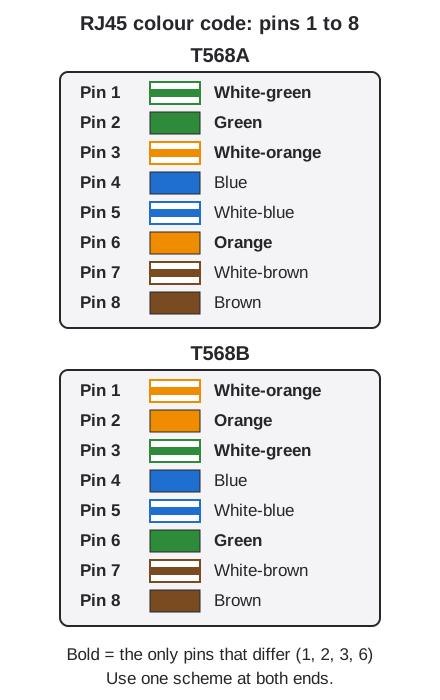
Drawn by us from the two published wire orders. Pins 4, 5, 7 and 8 are the same in both; only the orange and green pairs swap. Tap the diagram to open it full size.
T568A: white-green, green, white-orange, blue, white-blue, orange, white-brown, brown. T568B: white-orange, orange, white-green, blue, white-blue, green, white-brown, brown.
Neither order is faster or safer. What matters is that both ends match: follow the router end or whatever scheme the rest of the building already uses. A cable punched A at one end and B at the other can fail on some equipment.
Write the scheme (A or B) on the inside of the board or in the house wiring notes.
Which telephone socket (RJ11) do I need?
For a landline phone or a broadband modem fed by a phone line, you need an RJ11 telephone socket, either a two-line jack for a single line or a four-line jack where two lines or an extension share the point, chosen in the same range as the rest of the board.
MRP of the telephone jacks we make
MRPs from our current catalogue, bars to scale with ₹158 as the full bar. KEMPS prints these as TEL. jacks without the RJ11 label; the G.Grey K603 is ₹137 and K604 ₹174.
A telephone socket connection is simpler than data: the incoming phone pair goes to the two centre terminals, and on a four-line jack the second pair goes to the next two. Shuttered versions such as K203, V183 and V1255 keep dust out of a point that may sit unused for months.
If you are unsure whether you still need a landline point, fit a blank or a data jack now and keep a spare conduit to the board; a jack is a module swap later.
What are the types of TV antenna socket?
The common types of TV antenna socket are the coaxial TV socket in modular form, which clips into a switch board plate, and the mini or medium TV socket for conventional boards, both of which take the round coaxial lead from a cable TV line, DTH dish or antenna to the TV or set-top box.
MRP of the TV sockets we make
MRPs from our current catalogue, bars to scale with ₹118 as the full bar, rounded to 5% steps.
VIYONA 124 is a mini TV socket with an MRP of ₹44, the lowest-priced of these. On a modular board, KEMPS K201 at ₹102 and VIZA V1252 at ₹90 are the TV antenna socket outlets. KEMPS also lists a K206 T.V. HDMI socket at ₹1,150, for an HDMI cable rather than an antenna lead.
Our catalogue prints no coax impedance or frequency range for these sockets; if your installer specifies one, ask your dealer for that code’s spec. The VIYONA range is on our TV antenna sockets page.
A TV socket carries the antenna or cable signal, not HDMI and not internet. A smart TV that streams needs a data point or Wi-Fi as well.
Is a TV antenna socket male or female?
A TV antenna socket can be either: a male socket has a centre pin sticking out and takes a lead with a female plug, while a female socket has a hole for the pin and takes a male plug, so look at the face of the wall socket before buying the lead to the TV or set-top box.
The quick check: pin visible = male, hole in the centre = female. The lead needs the opposite end to the socket. Check both ends of the lead: the set-top box end often differs.
For a TV antenna socket connection, the coaxial cable from the cable TV line or dish has a centre copper conductor and an outer braid. The centre goes to the socket’s centre terminal and the braid is clamped under its screen clamp, with no stray braid strands touching the centre. A short there weakens or kills the picture.
Where a DTH cable would otherwise run straight to the set-top box, a wall TV socket keeps the visible lead short.
Switch off the board’s MCB before opening it to fit a TV socket, even though the coax itself carries no mains. Confirm dead with a tester first.
Do I still need a computer jack if I have Wi-Fi?
Yes, a wired RJ45 computer jack is still worth fitting in a home with Wi-Fi, behind the TV unit, at the study desk and at the router position, because a cable gives a steadier connection than Wi-Fi through walls and costs little to add at the wiring stage.
Three points cover most flats: router point where the fibre or cable enters, TV wall for the smart TV or streaming box, and study desk for a desktop or work laptop.
The router itself needs a 6A socket beside its data point, and a desk often wants a USB charger too: our USB socket for switch board guide covers that module. Offices need more per desk; our modular switches for office guide counts out workstation by workstation.
Our catalogue does not state a Cat5e or Cat6 rating, a speed or shielding for these jacks. If you are running Cat6 cable for a faster connection, ask your dealer for the specification of the exact code before you order.
Even if you never plug in, a data jack with cable already pulled to the router is far cheaper than chasing a wall later.
Where should data and TV sockets go on a switch board?
Put data and TV sockets on the same board as the power sockets they serve, at the TV unit and the study desk, so every plug for one device sits together, and run their cables in a separate conduit from the power cables, which is common practice to keep electrical noise off the signal.
Heights follow the furniture. Our switch board height from floor guide gives the common practice figures: a TV board either low at about 305 mm (1 ft) behind the unit or about 100–150 mm above its top, and a study desk board at 900–1,000 mm.
A typical TV wall board holds 6A sockets for the TV, set-top box and router, a TV socket and an RJ45 jack. On KEMPS that might be a K201 and a K205 on one plate; on VIZA a V1252 and a V1256. Our house electrical layout guide puts the same points on its living-room list.
Never pull a data or TV cable through the same conduit as the mains wiring. Keep it in its own pipe from the router or dish to the board.
RJ45, TV and telephone sockets: checks before you order
Order by code and module width, not nickname. Same range: take the modules from the plate’s own range, since modules clip into their own frames. Width: confirm 1M or 2M against the free slots on the plate.
Spec: for a cable category, coax rating or shielding, ask the dealer for that code’s spec; our catalogue lists name and MRP only. Shutter: on low points that children can reach, the shuttered K205, K203, V1255 and V183 keep dust and small objects out.
Full boxes: we supply through 500+ dealers across India in full boxes, never single pieces, with all-India delivery and 15-day returns in the same condition. There is no online ordering: browse the e-catalogue, then call or visit. The full module ranges are on our KEMPS accessories and VIZA accessories pages, and VIYONA’s conventional jacks on the telephone and computer jack page.
One plate, one range, one finish: order the data, TV and phone modules with the switches so the colour matches across the board.
FAQs
Which RJ45 socket is used for a modular switch board?
What is the difference between an RJ45 and an RJ11 socket?
What is the RJ45 colour code for a wall socket?
What is the price of an RJ45 socket?
Is a TV antenna socket male or female?
Do I need an RJ45 socket if I use Wi-Fi?
Why buyers choose Vinayak Electricals
- RJ45, telephone and TV sockets in KEMPS and VIZA modular form and in conventional VIYONA, made at our works in Marol, Andheri East, Mumbai.
- Module widths printed in the catalogue: 1M and 2M RJ45 jacks, so you can plan the plate before you order.
- Shuttered options for low points: KEMPS K205 and K203, VIZA V1255 and V183.
- MRPs published openly in our catalogue; sold through 500+ dealers across India with all-India delivery.
- Power sockets made under BIS licence to IS 1293, and switches to IS 3854 (ISI CM/L-7567794).
- Manufacturing in Mumbai since 1995; ISO 9001:2015 certified.
Data, TV and phone points for every board
See the KEMPS modules, including the K205 RJ45 jack and K201 TV socket, with codes and MRPs.
View KEMPS accessories