IP65 vs IP66 vs IP67: What the IP Rating on a Light Means
IP65 vs IP66 is the question most people meet on an outdoor light’s carton: both are dust-tight, but IP65 is tested against low-pressure water jets and IP66 against powerful jets, so IP66 suits fully exposed, storm-lashed spots. Below we decode both IP digits, compare IP65, IP66 and IP67, say which rating suits a flood light, a balcony or a garden, and explain why a good rating still depends on how the light is installed.
Key takeaways
- IP65 — dust-tight, and protected against water jets from a 6.3 mm nozzle. The common choice for a wall-mounted outdoor light.
- IP66 — dust-tight, and protected against powerful jets from a 12.5 mm nozzle. For open rooftops, coastal walls and wash-down areas.
- IP67 — survives temporary immersion up to 1 m. A higher second digit does not automatically include the jet tests below it.
- “Waterproof” — not a rating. Ask for the two IP digits against the exact product code.
- Our outdoor lights — our catalogue does not print an IP rating for them, so we do not claim one; ask us for the code you are buying.
IP65 vs IP66: the short answer
An IP rating tells you how well a light’s enclosure keeps out solid objects, dust and water. IP65 and IP66 share the first digit, 6, which means dust-tight. They differ in the second digit: a 5 means the enclosure withstood low-pressure water jets in a test, and a 6 means it withstood powerful jets with roughly eight times the flow.
For most homes the practical difference is small. A gate light under a canopy or a flood light on a sheltered wall is usually well served by IP65. A light on an open terrace that takes the full force of a monsoon storm, a building near the sea, or a yard that is hosed down every day are the places where IP66 earns its extra cost.
What matters as much as the number is that it applies to the exact product you are buying and that the light is fitted the way its maker says, with the cable entry sealed. This guide explains the digits, then turns them into choices for a flood light, a balcony, a bathroom and a garden. We make outdoor LED fittings at our works in Marol, Andheri East, Mumbai, and we are plain below about what our own catalogue does and does not state.
What does IP rating mean on a light?
IP stands for Ingress Protection, and an IP rating on a light is a two-digit code from the international standard IEC 60529 in which the first digit grades protection against solid objects and dust, from 0 to 6, and the second grades protection against water, from 0 upwards, so a higher digit means a tougher test passed.
The code is always read as two separate numbers, not as one figure. IP65 is “six-five”, not sixty-five, and it is not “better by one” than IP64 in any simple sense. Each digit points to a defined test.
First digit: solids runs from hands and fingers down to fine dust. Second digit: water runs from dripping water through spray, splashing and jets to immersion. Where a product has not been tested for one of the two, the digit is replaced with an X, so IPX4 means splash-tested for water with no dust claim at all.
Typical indoor fittings such as ceiling panels and down lights are often IP20: they keep out fingers and have no water protection, which is fine in a dry room. For how indoor fittings differ by shape, see our panel light vs downlight guide.
An IP code is a claim about a tested enclosure. If a carton says “IP65”, ask which product code the test covered.
| Rating | Solids | Water | Typical use |
|---|---|---|---|
| IP20 | Fingers kept out | No protection | Dry indoor rooms |
| IP44 | Objects over 1 mm | Splashing from any direction | Bathroom away from shower, covered balcony |
| IP54 | Dust-protected | Splashing from any direction | Covered outdoor areas |
| IP65 | Dust-tight | Water jets, 6.3 mm nozzle | Wall-mounted outdoor lights, gate lights |
| IP66 | Dust-tight | Powerful jets, 12.5 mm nozzle | Open roofs, coastal walls, wash-down yards |
| IP67 | Dust-tight | Immersion up to 1 m, 30 min | Ground lights, areas that flood |
| IP68 | Dust-tight | Continuous immersion beyond 1 m | Pond and fountain lights |
What do the two digits in IP65 stand for?
In IP65 the 6 means the light is dust-tight, with no dust getting inside under test conditions, and the 5 means it is protected against water jets projected from a 6.3 mm nozzle from any direction, which is why IP65 is the usual baseline for a light fixed outdoors on a wall.
First digit: the smallest solid object kept out (IEC 60529)
From the IEC 60529 definitions; general, not a test of any product. Bar length is the object size in mm with 50 mm as the full bar, rounded to the nearest 5%. Digits 5 and 6 are about dust, not a size.
The jump that matters outdoors is from 5, dust-protected to 6, dust-tight. A dust-protected light may let a little dust in; a dust-tight one should let none. Insects, fine dust from a road and construction grit all count.
First digit is dust and solids, second is water.
Same dust-tight body; IP66 survives far stronger jets.
For lights that sit in water, not lights that get rained on.
Tight gland, drip loop and a sealed junction box.
IP65 vs IP66: what is the difference?
The difference between IP65 and IP66 is only in the water test: IP65 means the enclosure withstood jets from a 6.3 mm nozzle at about 12.5 litres a minute, while IP66 means it withstood powerful jets from a 12.5 mm nozzle at about 100 litres a minute, both sprayed from roughly 3 metres away.
Water flow in the jet tests (litres per minute)
Test conditions from IEC 60529, general and not a test of our products. Bar length is flow with 100 L/min as the full bar, rounded to the nearest 5%.
In real weather that means IP65 copes with heavy rain blown against a wall, and IP66 with rain driven sideways by strong wind, a hose, or water pouring off a roof edge onto the fitting. On a sheltered porch, IP66 buys you little. On a rooftop signboard in Mumbai’s monsoon, it is worth asking for.
Both are dust-tight, so neither has the edge on dust.
Pick by exposure: under a roof or canopy, IP65 is common practice; fully open to storms, sea air or hosing, look for IP66.
IP66 vs IP67 and IP68: is a higher number always better?
No, a higher IP number is not always better for a light, because IP67 and IP68 test immersion in still water rather than jets, so a light rated IP67 alone has not necessarily passed the IP66 jet test, and a fitting meant for a wall or pole rarely needs to survive being submerged.
IP67 means the enclosure survived temporary immersion to 1 metre for 30 minutes. IP68 means continuous immersion beyond 1 metre, under conditions the maker states. Those suit lights set into the ground, steps that flood, or fittings in a fountain or pond.
Jets and immersion stress a seal differently. That is why some products carry two codes, such as IP66/IP67, meaning both tests were passed. If you see only IP67 on a flood light for a windswept roof, ask whether it was also jet-tested.
A higher rating also usually costs more. For a wall-mounted gate light it is money spent on a test the fitting will never face. Spend it instead on a sealed junction and a proper cable entry, covered in our guide on how to install an LED flood light.
Submersible ratings are about lights that sit in water. For lights that get rained on, the jet tests, 5 and 6, are the relevant ones.
Which IP rating does an outdoor flood light need?
An outdoor flood light fixed on a wall or under a canopy is commonly specified at IP65, and one on an open roof, a tall pole, a coastal building or a wash-down yard at IP66; the deciding factor is how directly rain, wind and hosing will hit it, not the wattage of the light.
Think about where water comes from. A gate or porch light under a slab mostly sees blown rain. A terrace parapet sees rain from every side. A roof edge can sit under a stream of runoff. Choose the rating for the worst of those, then fit the light so water runs off it, not into it.
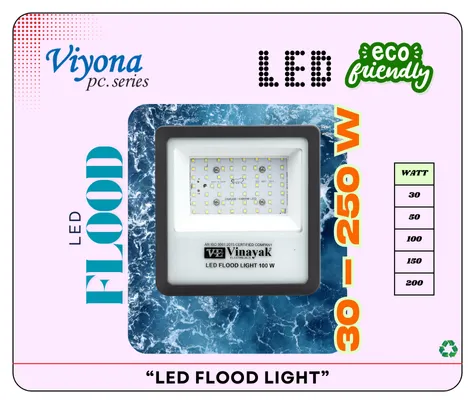
For a home, the usual flood light starting points are small: our LED flood light range starts at 10W and 15W in the Ultra Prime line. Every wattage and MRP is set out in our LED flood light and street light price list, so we will not repeat it here. Gate lights, compound lights and bullet lights for the rest of the house are compared in our guide to outdoor lights for home.
Before you order for an exposed spot, ask the dealer for the IP rating against the exact code, and keep it with the bill.
Is an IP65 light waterproof?
An IP65 light is water-resistant to jets and rain, not waterproof in the everyday sense of surviving being dropped in water; it should not be submerged, and “waterproof” on a carton without an IP code is a sales word with no defined test behind it.
When a shop calls a light a waterproof light for outdoor use, ask for the two digits. A real rating tells you what was tested. “Weatherproof” with no code tells you nothing you can check.
Even a correctly rated light can let water in if it is fitted badly. The rating covers the enclosure as tested, with its gasket seated and its cable entry sealed. Common ways it gets lost:
Cable gland left loose Gasket pinched or missing Fitting mounted upside down Driver housing opened and resealed poorly Joint taped in the open
Water inside an LED fitting usually shows first as condensation on the glass, then as flicker or dead sections. If you see either, switch the circuit off at the MCB before touching the light. Flicker has other causes too, which our guide to why an LED light flickers works through.
What IP rating for a bathroom, balcony or garden light?
As common practice, a bathroom light away from the shower is often IP44, a light near or above a shower IP65, a covered balcony light IP44 to IP65, an exposed balcony or garden wall light IP65, and a light set in the ground or a water feature IP67 or IP68; your electrician sets the final choice.
IP44 keeps out objects over 1 mm and water splashed from any direction, enough for a light that only sees steam and the odd splash. Shower area lights see direct spray and are better at IP65. Bathroom wiring has its own safety rules on distances from water, so the position is your electrician’s call.
A covered balcony in a city flat is often closer to indoors than outdoors, until the monsoon blows in sideways. If the light can be reached by rain from the open side, treat it as outdoor. A garden spike or step light that may sit in a puddle needs immersion protection, which is where IP67 belongs.
Wet areas raise the risk of shock. Lights in bathrooms, balconies and gardens should be on a circuit your electrician has protected for wet locations, and fitted only with the MCB off.
What IP rating do our outdoor LED lights have?
Our printed catalogue does not state an IP rating for our flood lights, street lights or bullet LEDs, so we do not claim one here; if you need a rating for a specific spot, ask us or your dealer for the figure against the exact product code before you fit it somewhere fully exposed.
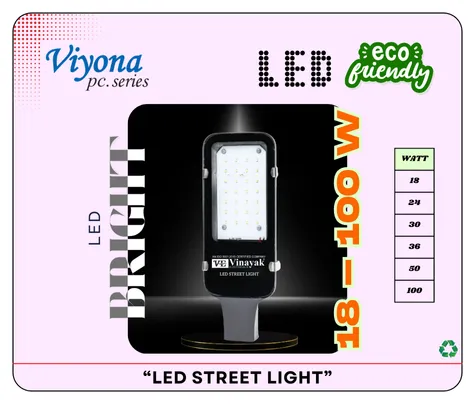
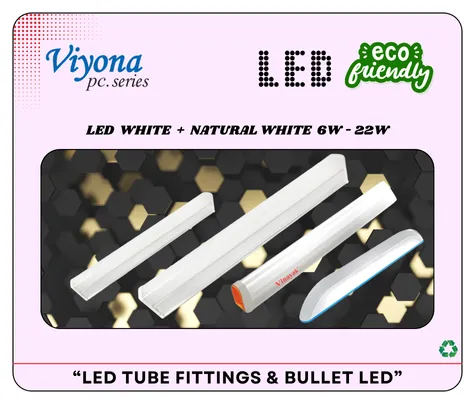
We would rather leave the number out than print one we cannot point to. What our catalogue does state: VIYONA LED 1080 is a 10W Ultra Prime flood light at ₹490 MRP, and VIYONA LED 1086 is a 30W LED flood light at ₹1,100 MRP. Our LED street lights run from 18W to 100W, and our bullet LEDs from 9W to 22W.
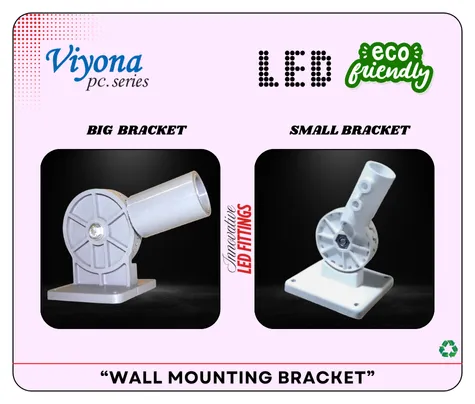
For mounting, our wall mounting brackets are 1082 at ₹90 and 1083 (big) at ₹180. The rest of the range, and the BIS registrations for our LED luminaires, are covered in best LED light brand in India.
No IP figure on the box or the bill means no IP claim. That applies to our lights as much as anyone’s: ask, and get the answer against the code.
How do you keep the IP rating after installation?
You keep a light’s IP rating by mounting it the way its maker shows, sealing the cable entry with the supplied gland, making the supply joint inside a weatherproof junction box rather than with tape, and leaving a downward loop in the cable so water drips off before it reaches the fitting.
Gland tight on the cable The gland only seals on a round cable of the size it was made for. A flat twin cable or a bunch of single wires leaves gaps.
Drip loop Let the cable dip below the entry, so rain running along it falls off at the bottom of the loop.
Junction box, not tape The joint between the house wiring and the light’s lead belongs in a weatherproof box. Insulation tape in the open lets water in within a season.
Orientation Some fittings must be mounted with the cable entry at the bottom. Check the box.
Every one of these is wiring work. Switch off the MCB for that circuit and test that it is dead first, and use a licensed electrician for anything more than replacing a like-for-like fitting. Our electrical safety tips at home cover the basics.
How do you check an IP rating before buying?
To check an IP rating before buying, look for the two-digit code printed on the light or its carton, confirm it matches the product code on your bill, ask the dealer whether both digits were tested or one is an X, and be wary of any outdoor light sold only as “waterproof”.
Code on the product Code on the carton Same model number on the bill An X in either place “Waterproof” with no code
Remember what an IP rating does not cover. It says nothing about corrosion from salty sea air, UV yellowing a plastic cover, or the quality of the driver inside. For a coastal building, ask about the body material as well as the rating.
For indoor lights the question rarely comes up, but for anything outside it should be the first thing you ask after the wattage.
An IP rating is about the enclosure. Electrical safety still depends on the circuit: a correctly rated MCB, earthing and, where your electrician advises, earth-leakage protection.
FAQs
Which is better, IP65 or IP66?
What does IP65 mean?
Can an IP65 flood light be used in rain?
Is IP67 better than IP66 for an outdoor light?
What IP rating is needed for a bathroom light?
What does X mean in an IP rating like IPX4?
Why buyers choose Vinayak Electricals
- Outdoor LED fittings, flood lights from 10W to 200W and street lights from 18W to 100W, made at our works in Marol, Andheri East, Mumbai.
- Plain about what we state: our catalogue does not print an IP rating for these lines, so we give you the figure against a code only when asked, never on a guess.
- Wall mounting brackets at ₹90 and ₹180 MRP from the same catalogue as the lights.
- Published BIS registrations: LED down lights and panels to IS 10322 (R-71026476), LED drivers to IS 15885 (R-71026310).
- MRPs published openly; sold through 500+ dealers with delivery across India.
- Manufacturing in Mumbai since 1995; ISO 9001:2015 certified.
Outdoor LED flood lights
See codes, wattages and MRPs for our VIYONA LED flood lights, then ask your dealer for the details of the code you need.
View LED flood lights