Monsoon electrical safety in Mumbai: what to check before June

Monsoon electrical safety tips for Mumbai start with one fact: from about 11 June to early October, your walls stay wet. Rain soaks outer walls, runs down conduits from terraces and balconies, and damp, salty air near the sea speeds up corrosion of the metal parts inside switches and sockets. This guide shows how water actually reaches a switch box, why RCCBs trip more in July, a pre-monsoon checklist for flats and bungalows, what to do when water enters a board, and which IP rating suits a balcony or terrace light.
Key takeaways
- Before June — electrician checks boards on outer walls, seals conduit ends, tests the RCCB button and the earthing.
- Why it trips — damp leaks current to earth and the 30 mA RCCB cuts it; an MCB trips on a short or a sustained overload.
- Water in a board — hands off, switch off at the DB if you can reach it dry, then dry, test and replace before it goes back on.
- Outdoors — IPX4 at least under cover, IP65 or IP66 in the open; a socket shutter is not a water seal.
- ⚠ Never — bypass a tripping RCCB, touch a wet board, or wade into a flooded room or meter cabin.
Monsoon electrical safety tips: the short answer
The monsoon electrical safety tips that matter most in Mumbai are simple: before June, have an electrician tighten and check every switch board on an outside wall, seal the conduit ends at terraces and balconies, test the RCCB with its test button, and look at the earthing. During the rains, never touch a wet switch board, and if water gets into one, switch off at the MCB and leave it off until it has been dried and checked.
Most monsoon trouble is not dramatic: an RCCB that trips at 2 a.m. in July, a switch that buzzes, a balcony light full of water. Each has a cause you can find.
We make switches, sockets, MCBs, MCB boxes and LED lights at our works in Marol, Andheri East; we have been making electrical accessories since 1995. Below: what happens inside the wall, checklists, and what to do when water gets in.
How wet does Mumbai get, and when?
Mumbai gets about 2,500 mm of rain a year at Santacruz and about 2,200 mm at Colaba, and roughly 95% of it falls between June and September, with July the wettest month. The India Meteorological Department’s normal onset date for the monsoon over Mumbai is 11 June, and its normal withdrawal date is 8 October.
Average monthly rainfall at Santacruz, Mumbai (1991–2020 normals)
IMD 1991–2020 normals for Santacruz, as published on the Climate of Mumbai page; bars to scale against July. The four months add up to about 2,390 mm of the 2,502 mm yearly average.
Put that in a home’s terms. An average July drops 920 mm on Santacruz, nearly a metre, onto the walls and terraces that carry your conduits. Wind drives it sideways into window frames and wall cracks.
Plan around the calendar. The useful window for electrical work is April–May, when walls are dry and electricians are free. By 11 June the rains are normally here, and they normally withdraw only around 8 October. That is close to four months in which a damp wall stays damp.
Book your electrician in April or May. In late June every electrician in your area is already busy with tripping RCCBs and burnt sockets.
| What you notice | Likely cause | What to do |
|---|---|---|
| RCCB trips in heavy rain | Damp circuit leaking current to earth | Switch all MCBs off, reset the RCCB, then switch MCBs on one at a time until it trips; if it trips with all MCBs off, call an electrician |
| MCB trips when it rains | Water bridging terminals, causing a short | Leave it off; electrician opens, dries and insulation-tests the circuit; replace anything that was under water |
| Switch buzzes or sparks | Loose or corroded terminal | Switch off at the MCB; replace the switch |
| Green crust on socket contacts | Damp, salty air corroding the metal | Replace the socket; check the plug top |
| Balcony light full of water | Wrong IP rating or open cable entry | Replace with a sealed fitting; cable in from below |
| Tingle from appliance or tap | Earth fault or broken earth | Stop using it; electrician checks earthing |
What humid, salty air does to switches and sockets
Humid, salty air does slow damage rather than sudden damage: moisture settles on the metal parts inside switches, sockets and MCB boxes, damp and salty air near the sea speeds up corrosion, and a corroded or loose terminal then heats up, sparks or leaks current to earth.
Average evening humidity at Colaba, by month
Average relative humidity at 17:30 IST, 1991–2020 normals, from the Climate of Mumbai page. Bars to scale against 85%. Santacruz reads 81% in July.
Colaba sits at the tip of the island city, and its July evening humidity averages 85%. Sea-facing homes from Colaba to Versova live in this air all year; the monsoon adds driven rain.
What you see in a sea-facing flat: a green or white crust on terminals and socket contacts, screws that will not turn, and a plug that fits loosely. A loose plug heats the contact, which is how sockets brown and melt; our guide on a switch getting hot or a socket sparking covers those signs.
No plate keeps salt air off the terminals, screws and joints behind it.
Never spray water, a household cleaner or oil into a switch or socket to “clean” a crust. Switch off at the MCB and have the part replaced. Our plate cleaning guide covers the plate only.
Walls are dry and electricians are free before the rains arrive around 11 June.
Water often travels down conduits from a terrace or balcony point.
A 30 mA RCCB tripping in rain is doing its job; find the wet circuit.
Switch off at the DB, dry, test and replace before switching back on.
How water reaches a switch box inside the wall
Water usually reaches a concealed switch box by one of two routes: rain soaks through a crack in the outer plaster into the brick and then into the back of the box, or water enters an open conduit end at a terrace light or balcony point and runs down inside the pipe until it pools at the bottom of the box.
How monsoon water reaches a switch box in an outside wall
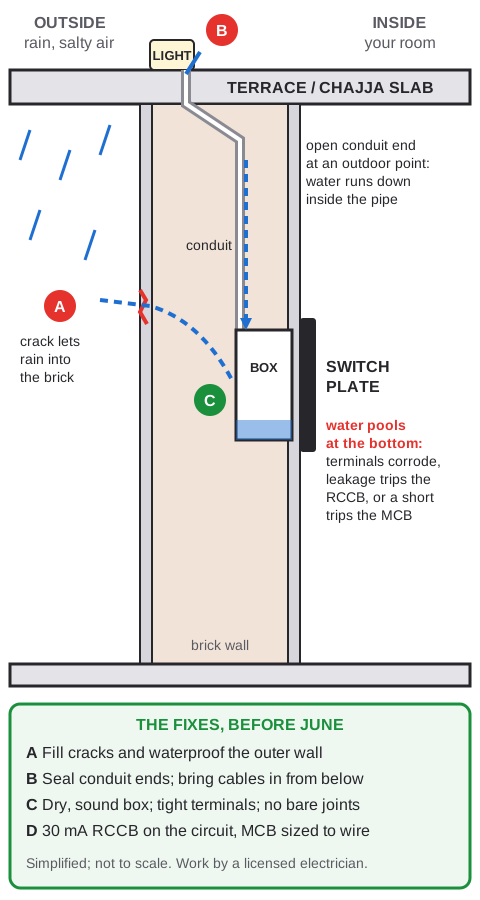
Drawn by us, simplified and not to scale. A and B are the two water paths; C marks the box; the fixes are listed below the wall. Tap the diagram to open it full size.
Path A, the crack. Plaster cracks, window gaps or a leaking chajja let driven rain into the brick, and the box sits in a damp pocket for weeks.
Path B, the conduit. An open conduit end at a terrace light, a gate light or an AC outdoor unit takes in rain and carries it down, sometimes a full floor, to a box that looks dry from outside.
The fixes match the paths: A: seal cracks, B: seal conduit ends, C: tight terminals in a sound box, and D: a 30 mA RCCB.
If the same board trips or buzzes every monsoon, look above it. The cause is often on the terrace or the balcony, not in the board.
Why the MCB or RCCB trips more in the rains
An RCCB trips more in the monsoon because damp wiring, wet boxes and outdoor fittings leak a little current to earth, and when that leakage crosses its rating, typically 30 mA for shock protection, it cuts the supply; an MCB trips when water causes a short circuit or a heavy fault to earth, or on a sustained overload above its rating.
An MCB under IS/IEC 60898-1 carries its rated current indefinitely and trips on a sustained overload above it or on a short circuit. It protects the wire, so its rating must not exceed the wire’s capacity: commonly 1.5 sq mm for lights and fans on 6–10 A, 2.5 sq mm for 16 A sockets. Our which MCB for home guide has the full table.
An RCCB compares the current going out on phase with the current coming back on neutral. Missing current has leaked, through damp plaster or through a person. BIS puts the usual threshold at 30 mA, “well below the limit of danger for humans”, and notes that the CEA’s 2023 safety regulations mandate a residual current device.
So an RCCB that trips in a downpour is usually doing its job. Our RCCB tripping guide shows how to find the wet circuit.
Never bypass, remove or tape down an RCCB because it trips in the rain.
We make MCBs, not RCCBs. Your electrician will fit an RCCB from a maker who does.
Earthing in the monsoon: check it before June
Check your earthing before the monsoon because almost everything around you is damp in July, and a sound earth gives fault current an easy path so the MCB or RCCB can cut the supply quickly; a broken earth wire, a corroded clamp or a buried earth pit leaves metal-bodied appliances able to become live.
Mahavitaran (MSEDCL), which supplies Mulund, Bhandup and much of the MMR, lists periodic inspection of earthing among its own monsoon safety advice, alongside not using wet switch boards and replacing damaged wires without delay.
What a check covers: the earth pit and its cover (not buried under paving or a flooded garden), the clamp on the electrode (no green crust, tight), the earth wire to the DB, and earth continuity at the sockets that matter most: the washing machine, the geyser, the fridge and any outdoor socket.
Our how to check earthing guide lists the safe checks and the tests an electrician runs; types of earthing explains plate, pipe and chemical earth pits. If you get a tingle from a washing machine on a damp day, read washing machine giving shock and stop using it until it is checked.
A tingle from a tap, a metal door or an appliance is a fault, not a monsoon quirk. Switch off at the MCB and call a licensed electrician.
Pre-monsoon checklist for a flat
A pre-monsoon electrical checklist for a Mumbai flat covers boards on outer walls, the balcony, the AC outdoor unit, the DB and its RCCB, and the earthing, done in April or May by a licensed electrician with the supply off at the MCB.
1. Boards on outer walls Damp patches or brown marks round the plate? Open these first and tighten every terminal.
2. Balcony points Check the balcony light and socket for a cracked cover, water marks inside, or an open conduit end. Our balcony and terrace electrical points guide shows where they should sit.
3. AC outdoor unit Its cable should enter from below, with a drip loop.
4. RCCB test button Press it once. The RCCB should trip at once. If it does not, it needs replacing before June.
5. DB labels Label every MCB. At 2 a.m. in July you will want to know which is the balcony.
Our home electrical maintenance checklist is the year-round version; this list is the monsoon cut of it.
An hour with an electrician in May costs less than a burnt board in July.
Pre-monsoon checklist for a bungalow, row house or ground floor
A bungalow, row house or ground-floor flat needs the flat checklist plus the points that sit low or outside: gate lights, the gate bell push, the water pump, low sockets and the meter cabin.
Ground-level sockets In a low-lying flat, a floor-level socket can end up under water. Raise it; our switch board height from floor guide gives typical heights.
Gate bell push A mains bell push at the gate takes rain directly; at least fit a hood and an RCCB. Better still, use a wireless or low-voltage bell push at the gate so no mains wiring runs to it. Also see doorbell not working.
Compound and gate lights Check each fitting’s seal and cable entry. Our outdoor lights for home guide covers placement.
Water pump The pump needs its own correctly sized MCB, a starter where the motor needs one, and an RCCB; see MCB for water pump.
Meter cabin If the meter or the society’s cabin takes water, do not open it or touch it. Call your own supply company’s 24-hour number, printed on your electricity bill: BEST or Tata Power in the island city, Adani Electricity or Tata Power in the western and most eastern suburbs, and MSEDCL in Mulund, Bhandup and beyond.
Never wade into a flooded room or meter cabin while the supply may be on. Wait for the supply company or an electrician to make it dead.
Water entered a switch board: what to do
If water has entered a switch board, do not touch it or anything plugged into it; with dry hands and footwear, switch off that circuit’s MCB or the main at the DB, if you can reach it without standing in water, and leave it off until a licensed electrician has dried and tested it.
1. Hands off Do not press switches or pull plugs from a wet socket.
2. Off at the DB Circuit MCB off, or the main if unsure. If the DB is wet or the floor flooded, stay away and call the supply company.
3. Do not reset and hope A breaker that trips again on reset means the fault is still there.
4. Dry and test The electrician dries the box and tests the circuit’s insulation.
5. Replace, do not reuse Anything that was under water, whether an MCB, RCCB, isolator, MCB box, switch box, switch or socket, is replaced, not dried and reused; salt and silt stay on the contacts and in the trip mechanism. A licensed electrician checks the circuit first.
If someone is getting a shock, switch off at the DB first. If you cannot reach it safely, do not touch them with bare hands; move them off with something dry and non-metal, such as a wooden stick, and call 108. Our electric shock first aid page lists the steps; for smoke, see short circuit and electrical fire at home.
Never dry a live board with a hair dryer, or switch a wet circuit on to “test” it.
Balcony, terrace and outdoor fittings: which IP rating?
For balconies, terraces and outdoor walls, choose fittings by their IP rating under IEC 60529: the second digit is protection against water, where 4 means splashing water from any direction, 5 means water jets, 6 means powerful water jets and 7 means temporary immersion up to 1 metre, and the first digit, 5 or 6, means dust protected or dust-tight.
Match the digit to the spot. A light under a deep balcony roof that only sees splashes needs at least IPX4. A wall or terrace light in the open, taking Mumbai’s sideways rain, is better at IP65 or IP66. Few homes need IPX7 unless a fitting can end up under water.
Our LED range includes the 1046 12 W PVC bulkhead at MRP ₹330, the 1047 20 W at MRP ₹480, and flood lights from the 1080 10 W Ultra Prime at MRP ₹490 to the 1086 30 W at MRP ₹1,100. Our catalogue does not print their IP ratings, so ask us for the test report before ordering for an exposed spot.
Read IP65 vs IP66 and bulkhead light for detail.
A socket shutter is a child-safety feature, not a water seal. An ordinary indoor socket on an open balcony needs a weatherproof enclosure around it, or a better position under cover.
Parts we make for a monsoon-ready board
For a monsoon-ready board you need correctly sized MCBs, a closed MCB box, sound concealed boxes and shuttered sockets; here are ours at catalogue MRP, sold in full boxes through dealers.
MCBs: the VIYONA 401 single pole MCB, 6 to 32 A, at MRP ₹145 and the 411 double pole MCB, 6 to 32 A, at MRP ₹350, both 10 kA and made under IS/IEC 60898-1, CM/L-2544151. See our VIYONA MCB range. The 442 40 A DP isolator at MRP ₹230 switches a circuit off but is not a substitute for an MCB; our isolator vs MCB guide explains why.
MCB boxes: the 371 2–4 way SPN white line box at MRP ₹380 and the 381 4 way double door box at MRP ₹750, which keeps the MCB row behind a door; see double door MCB box.
Boxes and sockets: the V614 4M concealed unbreakable box at MRP ₹88, the VIYONA 153 6 and 16 A universal socket with shutter at MRP ₹90, and the VIZA V262 6 A 2 pin socket with shutter at MRP ₹78. More on shutters in socket with shutter.
Switches are made under ISI licence IS 3854, CM/L-7567794, and MCBs under CM/L-2544151, at our only works, in Andheri East, Mumbai. Test reports are available on request before you order.
FAQs
What are the most important monsoon electrical safety tips?
Why does my RCCB trip when it rains?
What should I do if water enters a switch board?
Barish mein switch board se current aaye to kya karein?
Which IP rating do I need for a balcony or terrace light?
Does Vinayak Electricals make RCCBs or waterproof sockets?
Why buyers choose Vinayak Electricals
- VIYONA 10 kA single and double pole MCBs from MRP ₹145 (401), made under BIS licence CM/L-2544151.
- Switches made under ISI licence IS 3854, CM/L-7567794; sockets with shutters in VIYONA, VIZA and KEMPS ranges.
- SPN and double door MCB boxes, and concealed unbreakable boxes from MRP ₹50 (V611).
- PVC LED bulkhead and flood lights for balconies, gates and compounds, with test reports on request.
- Making electrical accessories since 1995, today at our works in Andheri East, Mumbai; ISO 9001:2015 certified.
- All-India delivery through 500+ dealers and distributors, in full boxes, with MRPs published in our catalogue.
Get your board ready before the next monsoon
See our VIYONA MCBs and MCB boxes, then order through a dealer or call our Marol works.
Vinayak Electricals is a manufacturer of switches, MCBs and LED lights in Mumbai, supplying dealers, electricians and contractors across India by the box. Ask us for prices and stock.
View VIYONA MCBs WhatsApp for prices Download catalogue