Diwali Lights Safety Tips: Without the Burnt Socket
Diwali lights safety tips come down to watts, water and where you plug in. Read the watts on every string and kandil, keep each socket well under its limit, use one extension board per wall socket, and keep plugs and joints dry, behind an MCB and a 30 mA RCCB. Below we show the socket arithmetic, the balcony set-up done right and wrong, and the warning signs to act on, from a Mumbai maker of sockets, MCBs and LED lamps.
Key takeaways
- Load — a 6 A socket carries about 1,380 W at 230 V; LED strings use little, the iron on the same board is the risk.
- Boards — one extension board straight into one wall socket; never a board into a board.
- Balcony — plugs, boards and joints indoors and off the floor; lead out through a gap nothing closes on, clipped, with a drip loop.
- Protection — MCB for overload and short circuit, 30 mA RCCB for shock; test the RCCB button before Diwali.
- ⚠ Never — a diya under a paper kandil, a taped joint outside, or water on a live fitting.
Diwali lights safety tips: the short answer
Diwali lights safety comes down to four habits: read the watts on every string and kandil, keep each socket well under what it can carry, plug one extension board straight into a wall socket instead of chaining boards together, and keep plugs, boards and joints dry and indoors, behind a working MCB and, for balcony and outdoor lights, a 30 mA RCCB.
Diwali 2026 falls on Sunday, 8 November. In Mumbai that means serial lights on grilles, an akash kandil on the balcony and diyas on the ledge. Most of it is harmless. The trouble starts when the lead gets crushed in a sliding door, a cheap board sits in a puddle from the morning’s floor wash, or a paper kandil hangs over a flame.
We make switches, sockets, MCBs, spike guards, lamp holders and LED lamps at our works in Marol, Andheri East, so this is the part of Diwali we think about most: what happens at the socket.
How many watts can one socket take?
A socket’s limit in watts is its current rating multiplied by the supply voltage. At a nominal 230 V, a 6 A socket can carry about 1,380 W and a 16 A socket about 3,680 W, and that limit is for everything plugged into it at once, including whatever is on the extension board.
The sum is simple: 6 A × 230 V = 1,380 W and 16 A × 230 V = 3,680 W. Most of the risk comes from what shares the socket with them: an iron, a kettle, a mixer for the faral, a hair dryer before the puja.
What one socket can carry, against typical Diwali loads
Limits are current × 230 V. Iron, flood light and lamp are catalogue ratings; 8 W per string is an example, so read your label. To scale against 3,680 W; the three small loads are drawn at the 5% minimum.
So a balcony of LED lights barely moves the needle on a 6 A socket. Put the 1,000 W iron on the same board as the balcony lights and you are at about 1,040 W, already three-quarters of 1,380 W. Add a kettle or a mixer and you are past it. Our 6A vs 16A socket guide shows which appliance needs which.
A 6 A socket with a 16 A appliance forced into it through an adaptor is not a 16 A point. The socket’s own 6 A rating, the wire behind it and the MCB protecting it decide what it can carry.
| Decoration | What to check | Where to plug it |
|---|---|---|
| LED serial string | Voltage and wattage printed, BIS registration, insulation whole | One board, one wall socket, kept indoors |
| Akash kandil | LED lamp inside, no diya under it, paper clear of the lamp | Holder or string on a socket circuit |
| LED flood light for rangoli | Wattage on the label, fitted with a plug top by an electrician | Indoors, on a socket that is not already loaded |
| Extension board or spike guard | Rating printed on it, lead uncoiled, no burn marks | Straight into a wall socket, never into another board |
| Dry iron or kettle | About 1,000 W or more on its rating plate | Not on the same board as the lights |
| Balcony or outdoor circuit | 30 mA RCCB fitted and tested | Ask an electrician for a fixed point if needed every year |
Add up your Diwali lighting load before you plug in
Add the watts printed on each string, kandil lamp and fitting, then add anything else that will run from the same socket at the same time; if the total is well under the socket’s limit, you are fine on load, and if it gets near, move the heavy appliance to another socket on a different circuit.
Take a 2BHK in Andheri. On the balcony: four LED strings, each labelled 8 W in our example, and an akash kandil with our 9 W LED lamp, code 1065, MRP ₹70. That is about 41 W. In the living room, a 30 W LED flood light, code 1086, MRP ₹1,100, washing the rangoli by the door, fitted with a plug top by an electrician or wired to a fixed point. Still only 71 W.
Now the trap. The same extension board also feeds the iron and the phone chargers. The lights are not the problem; the board is.
Strings sold under India’s compulsory registration must print their rated voltage and wattage. No wattage printed, no sale. For the bulbs in older kandils, our page on the 9 watt LED bulb has the light output and running cost.
Write the total on a scrap of paper and stick it to the board. Anyone who later plugs in “just the iron” will see it.
A 6 A socket carries about 1,380 W at 230 V. Add up everything on it.
Never plug one extension board into another.
Boards, plugs and joints indoors and off the floor, with a 30 mA RCCB.
LED lamps in kandils; diyas well clear of strings and curtains.
Extension boards and spike guards: one board, one socket
Plug one extension board straight into a wall socket and never plug a second board into the first; a chain of boards puts every load on the first board’s plug and on that one wall socket, and the connections in between are where the heat builds up.
Daisy-chaining is a common festival mistake. A board into a board into a multi plug looks tidy enough, but each joint is one more pin that can sit loose and run warm. Fully uncoil the lead as well; a coiled lead cannot shed its heat.
What we make for this job: VIYONA flex boxes such as the V2 2×4 m, code 271, MRP ₹285, and Classic ABS spike guards from the 1×4, 1.5 m, code 291, MRP ₹370 to the 1×6, 5 m, code 299, MRP ₹670. The Royal ABS spike guards are marked 6 A in our catalogue, so on those, keep the total under 1,380 W. Whatever board you buy, the rating printed on it is the limit, not the number of holes.
We cover warning signs in extension board burning and the choice between a multi plug and a board in multi plug vs extension board. For what a spike guard does and does not protect against, see our spike guard guide.
If you need more sockets than one board gives you, the answer is a second wall socket on a different circuit, not a second board.
Balcony and outdoor lights: keep water away from the plug
For balcony lights, keep the plug, the extension board and every joint indoors and off the floor, bring the lead out with a drip loop so water runs off before it reaches the wall, fix the string with plastic ties rather than metal wire, and have the circuit protected by a 30 mA RCCB.
Balcony Diwali lighting: done right vs done wrong
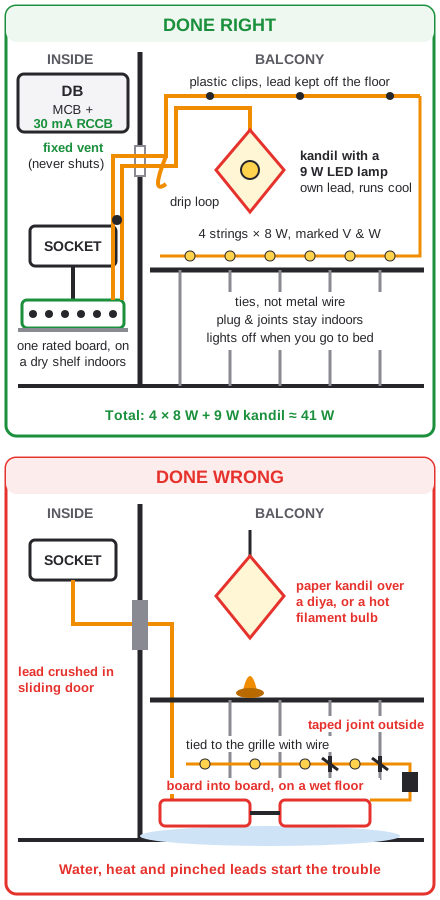
Drawn by us, simplified and not to scale. The 41 W total is four example 8 W strings plus the 9 W kandil lamp. Tap the diagram to open it full size.
The board sits on a dry shelf indoors. The lead goes out through a fixed vent that nothing closes on, clipped along the wall in plastic clips, with a drip loop at the low point outside so water drips off before it reaches the wall. The kandil has its own lead back to the board and a cool LED lamp. If there is no such gap, keep the door open, or better, have an electrician fit a balcony point.
The bottom half shows the common mistakes. The lead is shut in a sliding door. Boards are chained on a wet floor, a taped joint hangs outside, and the string is tied to the grille with wire, which can cut the insulation.
By November the monsoon is over, but balconies still get washed and plants watered. For points that stay up all year, see balcony electrical points, and for fittings, IP ratings for outdoor lights.
Never run a lead through a window or door that closes on it. If you need power on the balcony every year, ask a licensed electrician to fit a proper point there.
Kandils and serial lights: what to buy and what to skip
Buy serial lights that carry a BIS registration and print their voltage and wattage, light paper or cloth kandils with an LED lamp instead of a diya or a filament bulb, and throw away any string with cracked insulation, bare wire or a loose controller box.
Decorative strings are a regulated product. BIS covers them as lighting chains under IS 10322 (Part 5/Sec 7), and MeitY’s Compulsory Registration Order, 2021 requires them to be registered with BIS. The standard calls for marked voltage and wattage, a controller enclosed in non-flammable insulating material and fixed to the cable, and protection against shock as Class II or Class III. It also says a chain must not electrify tinsel or metallic decorations used with it.
A kandil is paper, cloth or thin plastic around a lamp. A diya inside or under it is an open flame next to fuel. An old filament bulb turns most of its power into heat. A 9 W LED lamp gives plenty of light and runs far cooler. A hanging kandil needs a pendant holder on a proper flexible lead, such as our VIYONA 227 skirt pendant holder, MRP ₹27, not a bare lamp twisted onto wires; see B22 vs E27 holders to match the lamp cap to the holder.
Check last year’s strings in daylight before you hang them. Bend the lead gently near each bulb: if the insulation cracks or the copper shows, the string is finished.
What actually protects you: MCB and RCCB
An MCB protects the wiring from overload and short circuit, and an RCCB protects people from electric shock by tripping when current leaks to earth, so a Diwali setup on a balcony or outside the door needs both, with a 30 mA RCCB on the circuit that feeds it.
An MCB does not trip the moment the load reaches its rating. Under IS/IEC 60898-1 it carries its rated current indefinitely. It trips on a sustained overload above that rating, slowly through its thermal element, and on a short circuit almost at once through its magnetic element. It is sized to protect the wire: commonly 6–10 A on 1.5 sq mm lighting circuits and 16 A on 2.5 sq mm socket circuits.
An MCB will not notice the tens of milliamps that can flow through a person touching a wet, damaged string: far too small to trip it, but enough to be dangerous. That is the RCCB’s job: a 30 mA RCCB trips when leakage to earth reaches 30 mA or less, typically somewhere between about 15 and 30 mA, fast enough to prevent most fatal shocks. We make VIYONA MCBs, the 6–32 A single pole, code 401, MRP ₹145 and 6–32 A double pole, code 411, MRP ₹350, made under BIS licence CM/L-2544151. We do not make RCCBs; your electrician will fit one from another maker.
If the RCCB trips the moment the lights go on, do not reset it again and again. Read RCCB tripping first; for main and circuit breaker sizes, see which MCB for home.
Never bypass a tripping MCB or RCCB with a wire, a coin or a higher rating to “get through the festival”. It is telling you something is wrong.
Warning signs during the festival week
Switch off and unplug at once if a plug top or board feels hot to the touch, you smell hot plastic, a socket crackles or sparks, lights flicker when something else switches on, or the MCB or RCCB keeps tripping; then find the cause before you plug back in.
A warm plug top is not normal. Heat at the pins usually means a loose socket, a worn plug or a load that is too heavy for that point. A brown mark around a socket hole is old heat damage, and that socket needs replacing, not just cleaning.
Do a hand check on the first evening: an hour after you switch on, touch each plug top and board. Cool is fine. Warm means take something off. Hot means unplug it now.
Our guide to a switch getting hot or socket sparking explains what each sign means, and loose socket fix covers plugs that fall out.
Lights that flicker when the iron starts point to a poor connection on that circuit. Call an electrician after the festival.
Fire safety: crackers, diyas and wiring
Keep diyas and candles well away from curtains, kandils and light strings, never burst crackers on a balcony full of wiring, keep the way to your main switch clear, and if an electrical fire starts, cut the power at the MCB before anything else and never throw water on a live fitting.
Fire calls in Mumbai over three days of Diwali 2022
Mumbai Fire Brigade figures reported by PTI: 85 fires in three days, 37 of them caused by firecrackers and no casualties. The report did not break down the other 48 by cause. Bars to scale against 41.
That year, crackers caused 37 of 85 fires, about 44%. The report gave no cause for the rest. After Diwali 2021, the Delhi Fire Service said fire calls rise partly because people do not check for loose wires when putting up lights and because overloaded extension boards cause short circuits.
In an emergency in Mumbai, call the Fire Brigade on 101 or the BMC disaster control room on 1916. For what to do before help arrives, read short circuit and electrical fire at home, and keep electric shock first aid handy if there are children around the lights.
On an electrical fire, switch off at the MCB or main switch first. Water on a live board can carry current to the person holding the bucket.
A 10-minute check before you hang the lights
Before you hang anything, switch off at the MCB and look at the sockets you plan to use, check every string and board in daylight, count the watts per socket, and press the RCCB’s test button to make sure it trips.
- Test the RCCB: press its T button. It should trip at once. If not, call an electrician.
- Look at each socket: no brown marks, no cracks, plugs hold firmly.
- Check each string: wattage printed, insulation whole, controller box closed.
- One board per socket: rating printed on it, lead fully unwound.
- Plan the route: a gap nothing closes on, clips, a drip loop.
- Keep flames apart: diyas on a tray away from kandils, curtains and strings.
Our home electrical maintenance checklist covers the rest of the house, and every code and MRP here is in our e-catalogue.
Do this check the week before Diwali, while there is still time to call an electrician or replace a socket.
After Diwali: switch off, take down and store
Switch the lights off when you go to bed or leave home, take outdoor strings down once the festival is over rather than leaving them up for months, and store them loosely coiled in a dry box so the insulation is not kinked or chewed before next year.
UV and heat make cheap insulation brittle, and rats chew leads in storage. A plug-in timer or simply a habit of switching off at night also cuts the hours the strings run unattended.
When you take them down, unplug first, then untie. Wind it loosely, box it dry and label it with its wattage, so next year’s sum takes a minute.
If a socket or plug top was damaged this Diwali, replace it now, with the power off at the MCB. Next year’s lights will go into the same socket.
FAQs
What are the main Diwali lights safety tips?
How many Diwali lights can I put on one socket?
Is it safe to connect one extension board to another?
Can I leave Diwali lights on all night?
Do I need an RCCB for balcony Diwali lights?
Are LED lamps safer than bulbs inside a paper kandil?
Why buyers choose Vinayak Electricals
- VIYONA 6 and 16 A sockets, plug tops, flex boxes and spike guards for festival lighting, with MRPs printed in our catalogue.
- VIYONA 10 kA MCBs made under BIS licence CM/L-2544151, from ₹145 MRP for a single pole (401).
- LED lamps from 0.5 W to 50 W under BIS IS 16102, R-71026514, including the 9 W lamp (1065) for kandils.
- Making electrical accessories since 1995, today at our works in Marol, Andheri East, Mumbai; ISO 9001:2015 certified.
- 500+ dealers and distributors and all-India delivery, in full boxes.
- Test reports on request before an order.
Sockets, spike guards and LED lamps for Diwali
See the VIYONA spike guard range, then buy through a dealer or call us for one near you.
Vinayak Electricals is an LED light manufacturer in Mumbai, supplying dealers, electricians and contractors across India by the box. Ask us for prices and stock.
View VIYONA spike guards WhatsApp for prices Download catalogue