Socket with Shutter: How the Child Safety Shutter Works
Key takeaways
- Shuttered socket — a spring-loaded plastic cover keeps the contacts blocked until a proper plug opens it.
- Child safety — stops a hairpin, key or finger reaching metal through one opening. It is not an RCCB.
- Where — skirting-level, TV-wall and bedside sockets first; high counter and AC sockets matter less.
- Cost — ₹9 to ₹16 more than the plain version in our ranges, e.g. KEMPS K191 ₹95 vs K192 ₹110.
- Ours — KEMPS K192 and K193, VIZA V262 and V266, VIZA Black V1268 and V1269, VIYONA 153.
Socket with shutter: the short answer
A socket with shutter is a power socket with a spring-loaded plastic cover behind its openings that keeps the live contacts blocked until a proper plug pushes it aside. It is the simplest built-in child safety feature a socket can have, because a hairpin, key or small finger poked into one opening meets plastic instead of metal.
Shutters cost little. In our ranges the shuttered version of a socket is ₹9 to ₹16 more than the plain one. They are not a substitute for an RCCB, sensible socket heights or supervision, but they close the most common way a child gets a shock from a socket.
We make shuttered sockets in KEMPS, VIZA and VIYONA at our works in Marol, Andheri East, Mumbai. This guide explains what a shuttered socket means, how the shutter works, where it matters most, how much it adds, and which of ours have one.
What does a shuttered socket mean?
A shuttered socket means a socket whose live and neutral openings are covered from the inside by a movable shutter, which stays closed when nothing is plugged in and opens only when a plug’s pins push on it correctly, so the metal contacts cannot be reached through an empty socket.
From the front, a shuttered socket looks like any other, but look into the openings and you see plastic rather than brass. In our catalogue these are listed with shutter, such as the KEMPS K192 6AX 3 pin socket with shutter.
Shutters appear on 2 pin, 3 pin, universal and 16A sockets, and on data and phone jacks, where they keep out dust. Our best socket brand in India guide lists the shutter among the things to check before buying any socket.
If you are buying sockets for a home with small children, ask for the shuttered version of every socket within reach. The difference is a few rupees per point.
| Plain socket | Socket with shutter | Plain socket + plug-in cover | |
|---|---|---|---|
| Blocks one object in one hole | No | Yes | Only while the cover is in |
| Closes by itself after unplugging | No | Yes | No, must be refitted |
| Can a child remove it | Nothing to remove | No | Sometimes |
| Replaces an RCCB | No | No | No |
| Our 6A example | KEMPS K191, ₹95 | KEMPS K192, ₹110 | Not made by us |
| Best for | High points | Any point within reach | Rented homes, stopgap |
How does a safety shutter in a socket work?
A safety shutter in a socket works by placing a spring-loaded plastic plate behind the openings that only slides away when it is pushed in the intended way by a plug, typically by two pins entering together or by the longer earth pin entering first, so a single object pushed into one hole leaves the shutter closed.
Designs vary by maker. In some, the earth pin of a 3 pin plug opens the shutter for the live and neutral. In others, both current-carrying pins must press at the same time. Either way, the aim is the same: one object in one hole should not reach metal.
When you remove the plug, the spring closes the shutter again on its own. Nothing needs to be remembered or put back, which is the main advantage over plug-in covers. For how a 2 pin plug differs from a 3 pin one, see our 2 pin vs 3 pin plug guide.
What happens when something is pushed into a socket
General practice, not a test result. Bars are equal because these are outcomes, not quantities. Shutter designs vary by maker.
The shutter closes itself every time a plug comes out.
Skirting, TV wall and bedside sockets.
₹9 to ₹16 more per socket in our ranges.
Shutters prevent; an RCCB protects the circuit.
Is a socket with shutter a child safety socket?
Yes, a socket with shutter is what most people mean by a child safety socket, because the shutter is the feature that stops a child pushing a hairpin, key or finger onto a live contact, but full child safety around sockets also needs an RCCB in the board, sensible heights and no loose cords.
The shutter deals with objects in empty sockets. It does not protect against a damaged cord, a pulled-out plug with exposed pins, or a faulty appliance. Those are where an RCCB and good habits come in.
We cover the wider picture, from RCCBs to cord safety, in our electrical safety tips at home guide, and what to do if the worst happens in our electric shock first aid guide.
How much more does a socket with shutter cost?
A socket with shutter costs only about ₹9 to ₹16 more than the same socket without one in our range: the KEMPS K191 6A 3 pin socket is ₹95 and the K192 with shutter ₹110, and the VIZA V261 2 pin socket is ₹63 against ₹78 for the V262 with shutter.
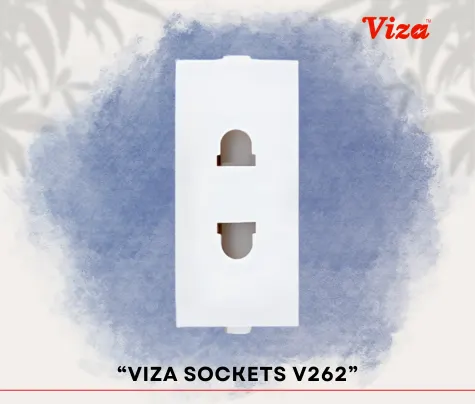
VIZA V262 is a 6A 2 pin socket with shutter at ₹78 MRP, ₹15 more than the V261 without one.
Plain socket vs the shuttered version, same range, at our MRP
MRPs from our current catalogue; bars to scale with ₹110 as the full bar.
On a 2BHK with a dozen low sockets, choosing shutters throughout adds roughly ₹110 to ₹190 in total at these differences.
Which sockets need a shutter most?
The sockets that need a shutter most are the ones a small child can reach: skirting-level points, sockets on the TV wall, bedroom sockets near the floor or the bed, and any socket in or near a play area, while high kitchen counter and AC sockets matter less.
Low points: a crawling child is at skirting height for months. TV and study walls: often low, and often hidden behind furniture where you do not see a child exploring. Bedrooms: sockets beside the bed at mattress height.
High points: kitchen counters, AC sockets and geyser points are out of reach, so a shutter is a nice-to-have there. Our switch board height from floor guide gives the usual height of each point, which tells you which are within reach.
Moving a socket higher is the strongest fix of all, but it means rewiring. Shutters are the quick fix for sockets already in the wall.
Which of our sockets have a shutter?
We make shuttered sockets in all three of our ranges: KEMPS has the K192 6AX 3 pin and the K193 6AX and 16AX universal socket, VIZA has the V262 6A 2 pin, the V266 2 in 1 five pin and Black V1262, V1268 and V1269, and VIYONA has the 153 6 and 16A universal socket.
Pick by plug size first. A 6A socket serves chargers, lamps and TVs; a 16A or universal socket serves heavy appliances. Our 6A vs 16A socket guide covers which appliance needs which, and our universal socket guide covers the combined 6A and 16A types.
MRP of our sockets listed with a shutter
MRPs from our current catalogue, white or standard finish; bars to scale with ₹245 as the full bar.
See the KEMPS K192 and VIZA V262 pages for the full specifications.
Socket shutter vs plastic socket covers: which is better?
A built-in socket shutter is generally better than plug-in plastic socket covers, because the shutter closes by itself every time a plug comes out and cannot be lost or pulled out by a child, while a cover only protects while someone remembers to put it back.
Plug-in covers have their uses: they are a cheap stopgap for a rented flat where you cannot change the sockets. But they can be pried out by a determined toddler, and a cover left on the floor is a choking risk in itself.
A shutter is part of the socket, so it works with no effort. If you own the home, replacing low sockets with shuttered ones is a one-time job that pays off for years.
Does a socket shutter replace an RCCB?
No, a socket shutter does not replace an RCCB, because the shutter only stops objects reaching the contacts of an empty socket, while an RCCB in the board trips when current leaks to earth anywhere on the circuit, including through a person touching a faulty appliance or a damaged cord.
They work on different risks. The shutter is prevention at the socket; the RCCB is protection on the circuit. A home with small children benefits from both, with a 30 mA RCCB being common practice for protecting people.
We do not make RCCBs. We make the MCBs and isolators that sit beside one; our isolator vs MCB guide explains what each device in the board does. Ask a licensed electrician whether your board has an RCCB.
A shuttered socket on a circuit with no RCCB still leaves the shock risk from faulty appliances and damaged cords. Have the board checked.
Why is my shuttered socket hard to plug into?
A shuttered socket can feel stiff because the plug has to push the shutter aside, which works best when the pins go in straight and together; if a plug enters at an angle, or one pin touches first on a design that needs both, the shutter stays shut and the plug seems blocked.
Push the plug in straight and firmly, without wiggling. On a 3 pin socket, line up the earth pin first if the design uses it to open the shutter.
Never force it with a screwdriver or another tool, and never pull the shutter out to make plugging easier; that removes the protection. If a shutter is broken or jammed, replace the socket.
Can you fit a shutter to an existing socket?
You usually cannot add a shutter to an existing socket, but you can replace the socket module with a shuttered one of the same size and rating, which on a modular board is a straightforward like-for-like swap that keeps the same plate and wiring.
On a modular board, a 1 module 6A socket swaps for a shuttered 6A socket in the same range, and a 2 module 16A for a shuttered 16A or universal one. Match the range so the module clips into your plate.
The safe order is: MCB off, test dead, note the phase, neutral and earth wires, fit the new socket, tighten every screw firmly, close up, MCB on. Our replace a switch safely guide covers the same steps for any module. Any rewiring is a job for a licensed electrician.
Shutters also come on data points: the KEMPS K205 RJ45 jack with shutter is ₹284, covered in our RJ45 socket guide.
FAQs
What is a shuttered socket?
Are sockets with shutters safe for children?
How does a socket shutter open?
Do I need shutters on all sockets?
Is a socket with shutter more expensive?
Can I add a shutter to my existing socket?
Why buyers choose Vinayak Electricals
- Shuttered sockets in KEMPS, VIZA and VIYONA, made at our works in Marol, Andheri East, Mumbai.
- Shuttered 2 pin, 3 pin and universal sockets from ₹75 MRP, and shuttered data jacks.
- Plain and shuttered versions of the same socket, so a board can be upgraded module by module.
- Switches made to IS 3854 under ISI licence CM/L-7567794, and 10 kA MCBs for the board.
- MRPs published openly; sold through 500+ dealers with delivery across India.
- Manufacturing in Mumbai since 1995; ISO 9001:2015 certified.
Sockets with shutters, by code
See the KEMPS K192 3 pin socket with shutter and the rest of our shuttered range, then order through a dealer or call us.
View KEMPS K192