Lumens to Watts Explained: How Bright Is a 9W LED Bulb?
Lumens to watts is not a fixed conversion, because lumens measure the light a lamp gives and watts measure the power it draws, and how many lumens each watt buys depends on the lamp: an old filament bulb gives roughly 10 to 15 lumens per watt, a typical household LED lamp several times that. Below we give the formula, work out how bright a 9W LED is, compare old bulbs with LEDs, estimate the lumens a room needs and show how to read a carton, with the wattages and MRPs of the LED lamps we make in Mumbai.
Key takeaways
- Lumens = light out. Watts = power in. Brightness is lumens; the bill is watts.
- Formula — watts = lumens ÷ lumens per watt; lumens = watts × lumens per watt. The lm/W figure comes from the carton.
- A 9W LED lamp — commonly around 800 to 900 lumens, roughly what an old 60W filament bulb gave. Read the carton for the real figure.
- Same watts, different light — two 9W lamps can differ in lumens; compare lumens, not watts.
- Our LED lamps — 9W to 50W, ₹70 to ₹720 MRP; our catalogue lists watts, not lumens, so check the carton.
Lumens to watts: the short answer
There is no single number that turns lumens into watts. Lumens are the amount of visible light a lamp gives out. Watts are the electrical power it draws from the supply. The link between them is the lamp’s efficiency, called efficacy and written as lumens per watt (lm/W), and that changes from one type of lamp to another and from one model to the next.
So the useful form of the question is: how many lumens do I need, and how few watts can give them? Lumens decide whether a room looks bright enough. Watts decide what you pay. A good LED lamp gives the lumens you need for far fewer watts than the bulbs it replaced.
We make LED lamps, tube fittings, panels and downlights at our works in Marol, Andheri East, Mumbai. Our catalogue lists their watts and MRPs but no lumen figures, so in this guide every lumen number is general practice, and our products appear only with the figures we publish.
What is the difference between lumens and watts?
Lumens measure how much visible light a lamp gives out in total, while watts measure how much electrical power it draws from the supply, so lumens tell you how bright a lamp is and watts tell you what it costs to run; a lamp that gives more lumens for the same watts is more efficient.
Think of it as output and input. Lumens are what you get; watts are what you pay for. Before LEDs, almost every household lamp was a filament bulb, so watts and brightness moved together and people learned to ask for “a 60 watt bulb”. That habit no longer works.
Today two lamps of the same wattage can give clearly different light, and a 9W LED can match the light of an old 60W filament bulb. The carton is where the lumens are printed; our LED vs normal bulb guide covers the rest of that switch.
At the shop, read the lumens first and the watts second. A lamp that does not print its lumens gives you no way to compare its brightness.
| Old filament bulb | Typical light output | Typical CFL | Typical LED lamp |
|---|---|---|---|
| 40W | About 450 lm | About 9W to 11W | About 5W to 6W |
| 60W | About 800 lm | About 13W to 15W | About 8W to 10W |
| 75W | About 1,100 lm | About 18W to 20W | About 11W to 13W |
| 100W | About 1,600 lm | About 23W to 26W | About 15W to 18W |
| Efficacy | About 10 to 15 lm/W | About 50 to 70 lm/W | About 80 to 110+ lm/W |
How do you convert lumens to watts?
To convert lumens to watts, divide the lumens by the lamp’s efficacy in lumens per watt, so a lamp rated 900 lumens at 100 lumens per watt draws 9 watts; to go the other way, multiply the watts by the lumens per watt, so a 9W lamp at 100 lumens per watt gives about 900 lumens.
The two formulas:
Watts = lumens ÷ lm/W Lumens = watts × lm/W
The catch is the lm/W figure. It is printed on many LED cartons, or you can work it out by dividing the carton’s lumens by its watts. Without it, any conversion is a guess.
Worked examples, all hypothetical lamps: 800 lm at 100 lm/W = 8W. 1,500 lm at 100 lm/W = 15W. The same 800 lm from a filament bulb at about 13 lm/W needs about 60W.
Watts then turn into units on your bill: watts × hours ÷ 1,000. Our how to calculate electricity bill guide takes it from there.
The brightness figure on the carton. Compare this first.
What the lamp draws, and what you pay for.
Higher lumens per watt means more light per unit.
How much light lands on the table or floor.
How many lumens is a 9W LED bulb?
A typical 9W LED bulb for Indian homes gives somewhere around 800 to 900 lumens, which is roughly the light of an old 60W filament bulb, but the real figure varies by model and colour, so the lumens printed on the carton are the only number to trust for a particular lamp.
The arithmetic behind that range: at about 90 to 100 lm/W, a common efficacy for household LED lamps, 9W × 90 is 810 lumens and 9W × 100 is 900. A more efficient model gives more; a cheaper or warmer model may give less.
Two 9W lamps on the same shelf can differ by a noticeable amount, which is why the carton matters more than the wattage.
Our LED lamps start at 9W (code 1065, ₹70 MRP). Our catalogue does not list lumens for it, so read the carton for the figure. A 9W lamp on for 5 hours a day uses 1.35 units a month.
Replacing a 60W filament bulb? Start with a 9W LED lamp and check its carton says about 800 lumens or more.
What is lumens per watt, and what is good?
Lumens per watt, or efficacy, is the light a lamp gives for each watt it draws, found by dividing its lumens by its watts; filament bulbs typically managed about 10 to 15 lm/W, CFLs about 50 to 70 and household LED lamps commonly 80 to 110 or more, so higher means more light per unit.
Typical efficacy by lamp type, lumens per watt
Typical ranges in general use, not test results for any product; bars drawn at the middle of each range, to scale with 100 as the full bar.
Look for the highest lm/W you can find at the lumens you need. For lamps sold in India, the BEE star label is based on efficacy, so more stars means more lumens per watt. Our saving electricity at home guide puts the savings in units.
What wattage LED replaces an old bulb?
An LED lamp of about 5W to 6W commonly replaces an old 40W filament bulb, about 8W to 10W replaces a 60W, about 11W to 13W replaces a 75W and about 15W to 18W replaces a 100W, because each of those old bulbs gave roughly 450, 800, 1,100 and 1,600 lumens respectively.
Watts drawn for about 800 lumens, by lamp type
Commonly quoted equivalents, general practice, not test results; bars to scale with 60W as the full bar. The lumens on the carton decide the real match.
Use the lumens to match, not the “equivalent” watts printed in large type on some packs. If the old bulb was a 60W filament, look for an LED of about 800 lumens or more.
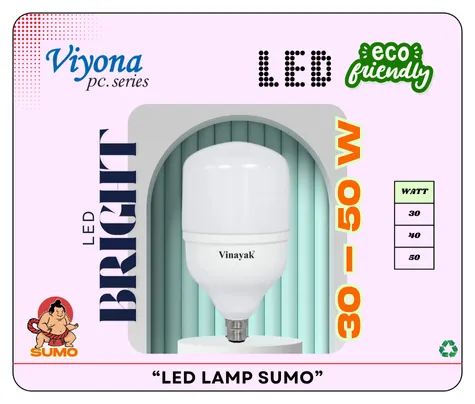
Our LED lamps run 9W, 12W, 15W, 18W and 23W, then the Sumo at 30W, 40W and 50W. Check the cap fits your holder first; our B22 vs E27 guide explains. Life, heat and the other differences are in LED vs normal bulb.
How many lumens do you need for a room?
To estimate the lumens a room needs, multiply the floor area in square metres by the light level you want in lux, then add a margin for light lost to walls and shades, so 150 lux over an 11 square metre bedroom works out to about 1,650 lumens before losses, often split between two or more lights.
The steps, with a worked example:
1. Area A 10 by 12 ft bedroom is about 11 m². 2. Target Choose a light level; living spaces are commonly lit more softly than kitchens or study desks. 3. Multiply 150 lux × 11 m² = 1,650 lm. 4. Allow for losses Dark walls, shades and diffusers absorb light, so real fittings need more.
That is a starting point, not a rule. A room with white walls needs less; one with dark wood needs more. And task areas, a kitchen counter or a study desk, need more light where the work is, not more everywhere.
Our guide on how many lights in a room turns this into fittings.
Does higher wattage always mean a brighter light?
Higher wattage means a brighter light only when you compare two lamps of the same type and efficacy; across different types, or different models of LED, a lower-wattage lamp can easily be brighter, so the only fair comparison of brightness is the lumen figure printed on each carton.
Within one model range More watts does mean more lumens: a 15W lamp gives more light than a 9W lamp from the same series.
Across models A 9W lamp at 110 lm/W gives about 990 lumens; a 10W lamp at 80 lm/W gives about 800. The lower wattage wins.
Across types A 15W LED lamp outshines a 60W filament bulb.
Colour does not change wattage. Cool white can look a little crisper at the same lumens; our warm white vs cool white guide explains why.
Do not buy a higher wattage to fix a dim room until you have compared lumens. A more efficient lamp at the same watts may be all you need.
Lumens, lux and candela: which number means what?
Lumens are the total light a lamp gives out in every direction, lux is how much of that light lands on a surface, one lux being one lumen spread over one square metre, and candela is the intensity in one particular direction, which is the figure that matters for spotlights and torches rather than ordinary room lamps.
Lumens (lm) Printed on lamp cartons. Use it to compare lamps. Lux (lx) Measured with a lux meter at a desk or floor. Use it to judge a room. Candela (cd) Used for focused beams; you will rarely see it on a household lamp.
For room lamps, lumens are the number to read at the shop and lux the number to think about in the room. How a bulb and a tube spread the same lumens differently is shown in our LED bulb vs tube light guide.
Panels and downlights are compared the same way; see panel light vs downlight.
What do our LED lamps cost, and do we list lumens?
Our LED lamps cost ₹70 to ₹720 at MRP, from the 9W 1065 at ₹70 to the 50W Sumo 1070B at ₹720; our catalogue lists their watts, MRPs, IS 16102 (Part 1) and BIS registration, but not their lumens, so the lumen figure for any of our lamps is the one printed on its carton.
MRP of our LED lamps, 9W to 23W
MRPs from our current LED price list, bars to scale with ₹410 as the full bar. The Sumo lamps add 30W (₹480), 40W (₹600) and 50W (₹720).
The VIYONA 1065 is a 9W LED lamp at ₹70 MRP, listed against IS 16102 (Part 1) with BIS registration R-71026514 in our catalogue. Our LED lights page has the full range.
How do you read an LED carton for brightness?
To read an LED carton for brightness, find the lumen figure first, then the wattage, divide one by the other for lumens per watt, check the colour temperature in kelvin, and confirm the BIS registration number and the cap type, so you know how bright the lamp is, what it costs to run and whether it fits.
The checklist, in order:
Lumens (lm) Brightness. Watts (W) Running cost. lm/W Efficiency; work it out if not printed. Kelvin (K) Colour; about 3000K warm, 6500K cool. BIS R-number Verifiable in the BIS Care app; our fake ISI mark guide shows how. Cap B22 or E27, to match your holder. “Equivalent” watts Marketing, not measurement; trust lumens instead.
Write down the lumens of a lamp you like, and buy that figure again next time, whatever the brand or wattage.
Change a lamp only with the switch off, and hold it by the glass or body, not the cap. A cracked or scorched holder should be replaced by an electrician, not ignored.
FAQs
How do you convert lumens to watts?
How many lumens is a 9W LED bulb?
How many watts is 1000 lumens?
Is higher wattage brighter?
What is a good lumens per watt for an LED bulb?
Do your LED bulbs list lumens?
Why buyers choose Vinayak Electricals
- LED lamps from 9W to 50W made at our works in Marol, Andheri East, Mumbai.
- LED lamps listed in our catalogue against IS 16102 (Part 1) : 2012, BIS registration R-71026514.
- The 9W LED lamp (1065) at ₹70 MRP, and the 0.5W night lamp at ₹40.
- Tube fittings, panels, downlights and holders from the same catalogue.
- MRPs published openly; sold through 500+ dealers with delivery across India.
- Manufacturing in Mumbai since 1995; ISO 9001:2015 certified.
LED lamps by wattage
See our LED lamps, tube fittings and panels with wattages and MRPs, then order through a dealer or call us.
View LED lights