Opening a Modular Switch Board: Cover, Base Plate and Colour

How to remove a modular switch plate comes down to two layers: a front frame that clips off and a base plate that unscrews from the box. Below we cover switching off and testing first, unclipping the cover, removing the base plate, taking out a switch, freeing a stuck plate, changing the plate colour, which size to order and refitting, with the MRPs of the KEMPS and VIZA plates we make in Mumbai.
Key takeaways
- MCB off first — switch off and test dead before any tool goes near the plate. Always
- Front frame — clips off at a notch on its edge; twist a thin tool, do not lever.
- Base plate — two screws into the box; remove only if you need the wiring.
- Change colour — a new plate of the same module count; switches stay. No rewiring
- Our MRPs — KEMPS Orchid 4M white ₹160; VIZA Slim 4M ₹155.
How to remove a modular switch plate: the short answer
A modular switch plate comes off in two layers. The decorative front frame, or cover, clips onto a base plate, and the base plate is screwed to the box in the wall, with the switches clipped into it. To change the look, you only unclip the front frame. To reach the wiring, you also unscrew the base plate.
Before either, switch off the MCB for that board and confirm it is dead with a tester. A screwdriver tip near the gaps of a live board is how small jobs turn into shocks.
Then, as general practice: find the notch or slot on the edge of the front frame, ease a small flat screwdriver or a plastic pry tool into it, and lever gently so the frame unclips. Work round the edge rather than forcing one corner. The base plate then shows its two fixing screws.
This guide covers each step, what to do when a plate is stuck, how to change the plate colour without touching the wiring, which size to order, and what our plates cost at MRP. Our KEMPS and VIZA plates are sold as front frames with base plates, and fit all major modular switch systems.
How do you open a modular switch board?
You open a modular switch board by switching off its MCB, unclipping the front frame from the base plate with a small flat tool at its release notch, and then, only if you need the wiring, unscrewing the base plate from the box so the plate and the switches clipped into it come forward together.
The four parts you meet, from the front:
Front frame (cover) Base plate (grid) Modules: switches, sockets Back box in the wall
In our catalogue, our VIZA plates are listed as front frames clipped with base plate, and our KEMPS Orchid plates as front frames cupped with a GSP base plate. The frame is the part you see; the base plate holds the modules at the right spacing.
Our what is a modular switch page explains each part, and the switch board wiring diagram shows what is behind them.
Opening the front frame only changes the look. Unscrewing the base plate exposes the wiring and must only be done with the MCB off.
| Layer | How it is held | Tool | MCB off? |
|---|---|---|---|
| Front frame (cover) | Clips onto the base plate | Small flat screwdriver or pry tool | Yes, as a precaution |
| Base plate | Screws into the back box lugs | Screwdriver | Yes, wiring exposed |
| Switch module | Clips into the base plate | Fingers or small screwdriver | Yes, wiring exposed |
| Back box | Fixed in or on the wall | Electrician | Yes, electrician job |
Before you start: switch off and test dead
Before removing any modular switch plate, switch off the MCB that feeds the board, or the main switch if you are unsure which MCB it is, then confirm the switches and sockets are dead with a tester, because the gaps around a plate sit close to live terminals and a metal tool can bridge them.
What you need:
Small flat screwdriver Plastic pry tool or card Line tester Soft cloth Torch
A VIYONA line tester is ₹36 MRP for the 811. Our guide to using a line tester explains its limits: a tester that does not glow is a good sign, not proof, so also check that the lights on that board have gone off.
If the board has a second supply, such as an inverter feed or a 2 way switch wired from another board, switching off one MCB may not make every terminal dead. In that case, stop and call an electrician.
Switch off the MCB and test dead before you remove anything. If you are unsure, call a licensed electrician; never work on a live board.
Switch off and test dead before any tool goes near the plate.
Release the frame clip at the notch; never lever on a switch.
Changing colour means a new plate; the wiring stays untouched.
Order a plate with the same module count as the old one.
How do you remove the modular switch cover?
To remove the modular switch cover, look for a small notch or slot on its bottom or side edge, insert a thin flat screwdriver or plastic pry tool, twist gently so the clip releases, then work along the edge until the front frame lifts off the base plate, without levering against the switches themselves.
Step by step, as general practice:
1. MCB off, test dead 2. Find the notch 3. Insert the tool flat 4. Twist, do not lever 5. Work round the edge 6. Lift the frame away
Wrap the screwdriver tip in a cloth or use a plastic tool on metallic, wood or glass finishes, which mark easily. If there is no visible notch, the frame often releases from the bottom edge; press lightly in the middle of that edge to find the give.
Not every plate opens the same way, so be gentle on a design you have not handled before. Our plate finishes guide shows which surfaces need most care.
Never lever the frame off with the screwdriver resting on a switch rocker or socket face. That is how modules crack.
How do you remove the base plate from the box?
To remove the base plate, first make sure the MCB is off and the board tests dead, then undo the fixing screws, usually two, that hold the base plate to the lugs of the back box, and ease the plate forward together with the switches clipped into it, keeping the wires attached.
Points to watch:
Screws in the box lugs Support the plate Do not pull on wires Note each wire
Take a photo of the wiring before moving anything. On a full board, the plate can hang on several short wires; support it rather than letting it dangle.
If a box lug is broken or the screws spin, the box is the problem, not the plate. Our concealed box guide covers box sizes and replacements. A plate that rocks once refitted often has a cracked lug behind it.
If you are only changing the colour of the plate, you do not need this step at all.
A board with scorched, brittle or bare wires behind the plate needs a licensed electrician before anything is refitted.
How do you take a switch out of the plate?
To take a switch module out of the base plate, with the MCB off and the board dead, press or ease the module’s retaining clips from the back or sides of the plate and push it forward out of its slot, leaving the wires connected until you are ready to move them one at a time to the new module.
Modules clip into the base plate in 1 module or 2 module slots. A switch is usually 1M; a socket, regulator or 32A DP switch 2M. Our 1 module and 2 module switches guide lists the sizes.
Moving the wires to a new switch is covered step by step in our guide to replacing a switch, so we do not repeat it here. The key points:
One wire at a time Same terminals Tighten firmly Test before refitting
A module that will not release is often held by paint or dust in the clips. Ease it gently; forcing it cracks the base plate.
Mixing modules from different brands in one base plate may not fit or latch well. Seat one module before you buy a full set.
Plate stuck or will not come off: what to do?
If a modular switch plate will not come off, the usual causes are paint over the joint, a hidden release notch on another edge, a clip that is tight from age, or a plate that is actually screw-fixed, so check every edge for a notch or screw cover before applying more force, and never prise against the wall.
Work through these in order:
Check all four edges Look for screw caps Score paint with a blade Gentle twist, not force
Painted-over plates are common after a renovation. Run a sharp blade along the joint between the plate and the wall, and between the front frame and the base plate, before trying again. Some older or non-modular boards have visible screws under small caps; those are not clip-on plates at all.
If the board is a conventional one, our modular vs normal switch guide explains how it differs.
If a plate cracks while you remove it, keep the MCB off until a new plate is fitted. A broken plate can leave terminals exposed.
How do you change the switch plate colour?
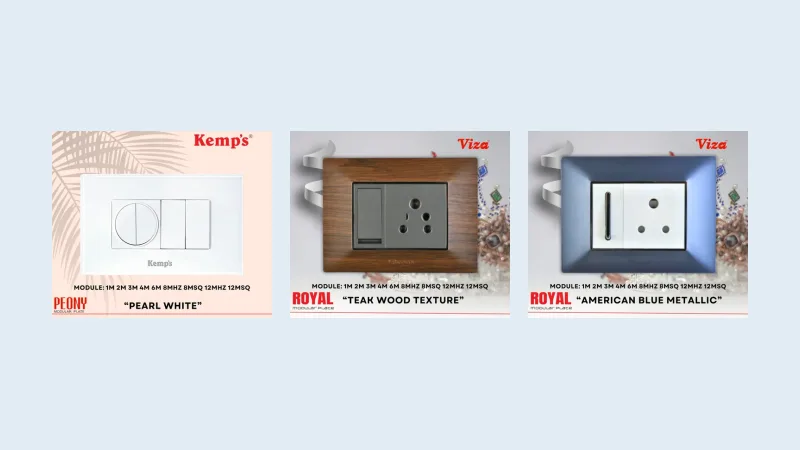
To change the switch plate colour, buy a new plate of the same module size from a range that fits your modules, switch off the MCB, unclip the old front frame, and fit the new frame, or the new frame and base plate together if the old base does not match, leaving the switches and wiring untouched.
MRP of a 4M plate by finish in our range
MRPs from our current catalogue, bars to scale with ₹535 as the full bar.
Our plates fit all major modular systems, are UV-protected and carry a 5-year warranty. Colours by room are in our switch board colour guide.
Which plate size do you need to order?
The plate size you need is the module count of your existing board, written on the back of most base plates or counted from the switches, where a switch is one module and a socket, regulator or DP switch two, and the new plate must match that count and the back box behind it.
KEMPS Orchid plate MRP by size (white)
MRPs from our current catalogue, bars to scale with ₹520 as the full bar.
Count blanks too: an empty slot still needs a blank plate. Sizes are in modular plate sizes explained.
How do you refit the plate?
To refit a modular plate, seat every module firmly in the base plate, screw the base plate back to the box lugs without over-tightening, check it sits flat against the wall, then line up the front frame over the base and press it on evenly until every clip engages, before switching the MCB back on.
Final checks before power returns:
Plate flat to the wall All clips engaged No wire trapped Rockers move freely
A trapped wire behind the base plate is the most common refitting fault. If the plate will not sit flat, take it off and fold the wires back into the box rather than forcing it. Over-tightened screws can crack the base plate or pull the box lugs.
Once the MCB is on, test every switch and socket on the board. For a deeper clean before you refit, our switch plate cleaning guide covers each finish.
If any switch sparks, buzzes or does not work after refitting, switch the MCB off again and check the connections, or call an electrician.
Mistakes that break switch plates
The mistakes that most often break switch plates are levering against a switch or socket, forcing one corner instead of working round the edge, over-tightening base plate screws, pulling on the wiring, working on a painted-over joint without cutting the paint, and buying a plate of the wrong size or system.
Quick list:
Lever on a rocker Force one corner Overtight screws Wrong size Uncut paint
None of these needs special skill to avoid, only patience. A spare plate costs less than a cracked module and an electrician’s visit: our VIZA Slim 1M plate is ₹106 MRP and the KEMPS Orchid 1M white ₹102.
Browse every design on our modular plates range page.
If you are not sure the board is dead, or the wiring looks damaged, stop. A licensed electrician can do the whole job in minutes.
FAQs
How do I remove a modular switch board cover?
Do I need to switch off power to remove a switch plate?
Can I change only the switch plate and keep the switches?
Why will my switch plate not come off?
What tool do I need to remove a modular switch plate?
How much does a new modular switch plate cost?
Why buyers choose Vinayak Electricals
- KEMPS and VIZA plates sold as front frames with base plates, 1M to 18M.
- Plates that fit all major modular switch systems, so a colour change keeps your switches.
- UV-protected plates that do not turn yellow, with a 5-year warranty.
- Finishes from white and grey to metallic, texture and glass-style, from ₹102 MRP.
- Made at our works in Marol, Andheri East, Mumbai, since 1995; ISO 9001:2015 certified.
- Sold through 500+ dealers with delivery across India.
A new plate, same switches
See every KEMPS and VIZA plate design with sizes and MRPs, then order through a dealer or call us.
View modular plates