Blank Module for a Switch Board: Why Every Empty Slot Needs One
A blank plate in a modular switch board is a plain 1 module insert that fills an unused slot, so the board is closed and nothing behind it can be reached. Below we cover what a blank module or filler plate is, why an empty slot is unsafe, what size blanks come in, how to fit one, how to use a blank to reserve a future point, how to match the colour, and the MRPs of the blanks we make in Mumbai.
Key takeaways
- Blank plate — a plain module with no switch or socket; also called a blank module or filler plate.
- Not optional — every empty slot must be closed. Open slot = exposed
- 1M each — two blanks fill a 2M gap; count the empty modules.
- Room to grow — a blank with a wire behind it becomes a USB or night lamp point later.
- Our MRPs — VIZA V284 ₹20, VIZA V1260 ₹22, KEMPS K218 ₹24. From ₹20
Blank plate in a modular switch board: the short answer
A blank plate in a modular switch board is a plain module with no switch or socket in it. It clips into an unused slot in the base plate, just like a switch, and closes the gap so the front of the board is finished and no wiring or terminals behind it can be reached.
Boards need blanks because plates come in fixed sizes, 1M, 2M, 3M, 4M, 6M, 8M and up, while the number of switches and sockets in one spot rarely matches exactly. Five modules of switches in a 6M plate leaves one slot to fill. A blank also keeps a slot ready for a point you plan to add later, such as a USB charger.
Blanks are among the cheapest parts on a board. We make the VIZA V284 1M single blank plate at ₹20 MRP, the VIZA V1260 for our grey and matt black line at ₹22, and the KEMPS K218 blank plate at ₹24. This guide covers what a blank is, why it is not optional, how it fits, how to plan with it, and how to match the colour.
What is a blank module?
A blank module is a 1 module wide insert with a plain face and no electrical parts, made to the same size and clip pattern as a switch so it fits any empty slot of the base plate, and it is also called a blank plate, a filler plate, a blanking module or a dummy module depending on who you ask.
The names, all meaning the same part:
Blank plate Blank module Filler plate Dummy module Blanking plate
A blank is not a cover plate. The cover plate, or front frame, is the decorative surround of the whole board. The blank sits inside it, in one of the module slots, beside the switches.
Because it carries no current, a blank has no rating and needs no certification mark; what matters is that it matches the size, clip and finish of the modules around it. Our what is a modular switch page shows how blanks, modules and plates fit together.
Ask for a blank by brand and range, not just “blank”. Clip details and finishes differ between ranges.
| Code | Range and line | Size | Pack | MRP |
|---|---|---|---|---|
| V284 | VIZA, white line | 1M single | 60 | ₹20 |
| V1260 | VIZA, grey and matt black | 1M single | 50 | ₹22 |
| K218 | KEMPS, white line | 1M | 30 | ₹24 |
| K618 | KEMPS, grey line | 1M | 30 | ₹32 |
Why do you need a blank plate?
You need a blank plate because modular plates come in fixed module sizes while your switches and sockets rarely fill one exactly, and every empty slot must be closed so that fingers, tools, dust and insects cannot reach the terminals and wiring behind the board, which is a safety need, not a finish detail.
The three jobs a blank does:
Closes an open slot Fills the plate to size Reserves a future point
A typical case: a bedroom board needs two switches, a fan regulator and a 6A socket, which is 1 + 1 + 2 + 2 = 6 modules, an exact 6M plate. Add one 2 way switch later and you need 7 modules, which rounds up to an 8M plate with one blank.
Our plate size calculator does the count, and modular plate sizes explained lists every size we make.
An open slot in a live board is an exposed hazard. Fit a blank before the board is switched on.
A blank fills an empty module slot so no live part can be reached.
Two blanks fill a 2M gap left by a socket or regulator.
A blank with a wire behind it is a future USB or night lamp point.
Buy the blank in the same brand and colour as the modules.
Is it safe to leave an empty slot in a switch board?
It is not safe to leave an empty slot in a switch board, because the gap gives a direct path to the terminals and wires inside the box, where a child’s finger, a screwdriver, a pin or water can touch a live part, and dust and insects can get in and cause tracking or a short over time.
What an open slot lets in:
Fingers and small hands Tools and pins Water and steam Dust and insects
We still see boards left with a missing module after a switch was removed, sometimes for years. The fix costs ₹20 to ₹24 in our range and takes a minute once the board is off.
Treat it with the same urgency as a socket without a shutter in a home with children. Our electrical safety tips at home cover the other common gaps.
Until a blank is fitted, keep the MCB for that board off or cover the gap securely with the board dead. Never tape over a live opening.
What size are blank plates?
Blank plates are made 1 module wide, the width of a single switch, so one blank fills a 1M gap, two blanks side by side fill a 2M gap left by a removed socket or regulator, and any larger gap is filled with as many 1M blanks as there are empty modules.
How to count:
1M gap: 1 blank 2M gap: 2 blanks 3M gap: 3 blanks
Our blanks are listed as single 1M pieces: the VIZA V284 and V1260 are each a 1M single blank plate, and the KEMPS K218 is our KEMPS blank. A 2M socket slot takes two of them.
Check that the gap really is empty modules and not a missing 2M part of a different design. If the gap held a 2M module, two 1M blanks fill the same width. Our 1 module and 2 module switches guide shows which parts take one or two.
If a large part of the plate is blank, a smaller plate may look better. The back box decides whether that is possible.
Which blank plates do we make, and what do they cost?
We make three blank plates for our modular ranges: the VIZA V284 1M single blank plate at ₹20 MRP for the white line, the VIZA V1260 1M single blank plate at ₹22 for the grey and matt black line, and the KEMPS K218 blank plate at ₹24, with the KEMPS K618 at ₹32 for the grey line.
MRP of our blank plates
MRPs from our current catalogue and price lists, bars to scale with ₹32 as the full bar.
A blank is the cheapest module on any board: the VIZA V284 costs roughly a third of a VIZA V101 10A switch at ₹56. Pack sizes in our catalogue are 60 for V284, 50 for V1260 and 30 for K218. Ranges are on our VIZA modular page.
How do you fit a blank plate?
To fit a blank plate, switch off the MCB for the board, take off the front frame, push the blank into the empty slot of the base plate from the front or back until its clips engage in the same way as a switch, check it sits flush with the modules beside it, then refit the front frame and switch the MCB on.
The steps:
1. MCB off, test dead 2. Front frame off 3. Clip blank in 4. Check it is flush 5. Frame back on
On most boards the front frame must come off first, because the module slot sits behind it. Our guide to removing a modular switch plate covers that step, including what to do if the plate is stuck.
If wires are hanging loose in the slot where a switch used to be, stop. Loose ends behind a blank must be properly terminated or removed by an electrician before the slot is closed.
Never close a blank over loose or taped wire ends. Have them terminated in a connector or removed first.
Blank module for future points: what can go in later?
A blank module is the cheapest way to leave room for a future point, such as a USB charger, a night lamp, a TV or data socket, an indicator or a smart switch, because the slot is already in the plate and only the blank has to come out when the new module goes in, as long as a wire has been left behind it.
What a spare slot could take later: MRPs in our range
MRPs from our current catalogue (grey line for V1252, K617, K616 and V1303), bars to scale with ₹690 as the full bar.
Leave a wire behind the blank, or the slot is only cosmetic. See our USB socket for switch board guide.
Removed a switch: blank plate or a new plate?
When you remove a switch or socket you no longer need, a blank plate is the quickest and cheapest way to close the gap, while a new, smaller plate is the neater option only if the back box can take it, which on a concealed box usually means the box stays the same size and the blank is the answer.
Choose by the box:
Same box: fit a blank Surface box: smaller plate Concealed box: blank
The plate size is fixed by the box in the wall, not by the switches. Changing a concealed 6M box to a 4M one means chasing the wall. A blank costs ₹20.
Whatever you choose, the wires that fed the removed switch must be dealt with. If they are no longer needed, an electrician should disconnect them at the source or terminate them safely. Our concealed box guide explains box sizes, and our guide to replacing a switch covers the wiring.
A redundant wire left live behind a blank is a hazard for whoever opens the board next. Make it safe, and label it.
How do you match the blank to your board’s colour?
To match a blank to your board, buy it from the same brand and colour line as the switches beside it, because blanks are made in the same white or grey finish as their range’s modules, and a white blank in a grey board, or a blank from another range, stands out and may not clip properly.
In our ranges:
VIZA white: V284 VIZA grey, matt black: V1260 KEMPS white: K218 KEMPS grey: K618
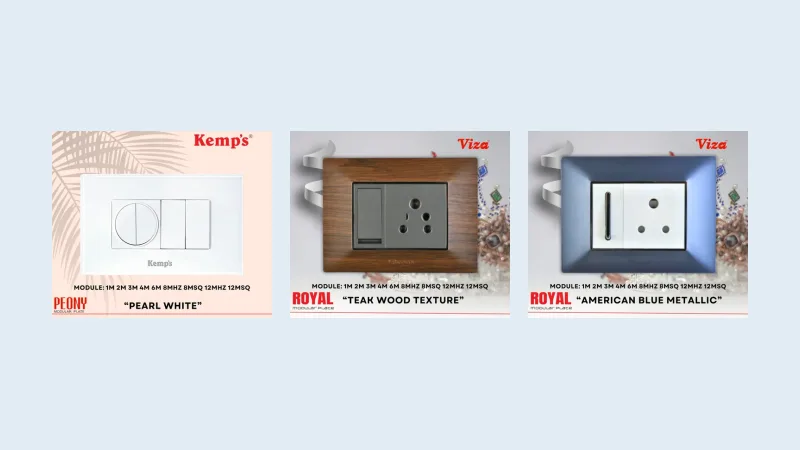
The front frame can be any finish, from white to metallic or wood texture; the blank matches the modules, not the frame. On a dark plate with grey modules, use a grey-line blank.
Our switch board colour guide shows how module and plate colours combine, and the KEMPS accessories page lists the support modules, including the blank.
Bring a photo of the board, or the code of a switch on it, to the dealer. It is the quickest way to match the line and colour.
Ordering blank plates: how many to keep?
When ordering blank plates for a new home, count the empty modules on every board from the electrical layout, add one or two spares for slots that open up during fitting, and buy them in the same line as the switches, since blanks are sold in boxes and cost little enough that a spare saves a second trip.
A simple rule:
Count gaps per board Add 1 or 2 spares Same brand and line
Contractors buying by the box will find blanks packed 30 to 60 per box in our catalogue. A dealer usually keeps them loose for single sales too.
If you are planning the layout now, leave one spare module on busy boards, as our house electrical layout plan suggests, and fill it with a blank until you need it.
Blanks get lost during fitting. One spare per home costs ₹20 and saves an open slot.
FAQs
What is a blank plate in a switch board?
What is the price of a 1M blank plate?
Can I leave an empty slot in a modular switch board?
How many blank plates do I need for a 2M gap?
Is a filler plate the same as a blank plate?
Can I put a USB socket in place of a blank later?
Why buyers choose Vinayak Electricals
- Blank plates for both our modular ranges, from ₹20 MRP.
- Blanks in the same white and grey lines as our KEMPS and VIZA switches.
- Plates from 1M to 18M, so a board can be sized and filled neatly.
- Plates that fit all major modular switch systems, UV-protected, with a 5-year warranty.
- Made at our works in Marol, Andheri East, Mumbai, since 1995; ISO 9001:2015 certified.
- Sold through 500+ dealers with delivery across India.
Blanks to finish every board
See our KEMPS and VIZA support modules, including blank plates, with codes and MRPs, then order through a dealer or call us.
View KEMPS accessories